> For the complete documentation index, see [llms.txt](https://www.opal-rt.com/docs/llms.txt). Markdown versions of documentation pages are available by appending `.md` to page URLs; this page is available as [Markdown](https://www.opal-rt.com/docs/op4815-io/op4815-io-overview/specifications-and-architecture.md).

# Specifications & Architecture

<figure><img src="https://381766541-files.gitbook.io/~/files/v0/b/gitbook-x-prod.appspot.com/o/spaces%2FuNbQwgFm3KJ8huN25Ymr%2Fuploads%2FF2hKB4lkteOO1lSlSn0P%2FOP4815-IO.jpg?alt=media&amp;token=2ee524e0-4b6f-4d3e-8021-5d39ac3868f4" alt="OP4810-IO chassis"><figcaption></figcaption></figure>

## Description

The **OP4815-IO** is a compact I/O expansion unit designed to **extend the capabilities of OPAL-RT simulators**. Equipped with the **AMD Versal™ Prime Adaptive SoC** (FPGA), the OP4810-IO is designed to enhance OPAL-RT simulators by providing advanced FPGA computing resources and a large number of high-speed I/O channels, enabling efficient execution of Hardware-in-the-Loop (HIL) and Rapid Control Prototyping (RCP) applications. It is fully compatible with **RT-LAB** **(2024.2 and higher)** and **HYPERSIM (2024.2 and higher)**: <https://www.opal-rt.com/download-center/>.

The unit can be used as a **desktop, shelf-top, or mounted in a standard 19″ rack**, providing flexible installation options for diverse testing environments.

<table data-search="false"><thead><tr><th width="261">Category</th><th>Specification</th></tr></thead><tbody><tr><td><strong>Form Factor</strong></td><td>2U rackmount (mounting brackets included)</td></tr><tr><td><strong>Dimensions (W × D × H)</strong></td><td>43.18 × 40.6 × 8.8 cm (17” × 16” × 3.45”) without feet and pull handle</td></tr><tr><td><strong>Weight</strong></td><td>Approx. 6.6 kg (14.5 lbs)</td></tr><tr><td><strong>Power supply</strong></td><td>115 VAC ±15 V / 220 VAC ±20 V, Power : 250 W<br>50–60 Hz</td></tr><tr><td><strong>Operating Temperatures</strong></td><td>10–40°C (50–104°F)</td></tr><tr><td><strong>Storage Temperatures</strong></td><td>-20 to 70º C (-4 to 158º F)</td></tr><tr><td><strong>Relative Humidity</strong></td><td>10 to 90% non-condensing</td></tr><tr><td><strong>Max Altitude</strong></td><td>2000 m (6,562 ft.)</td></tr><tr><td><strong>Pollution</strong></td><td>Degree 2</td></tr><tr><td><strong>Ventilation Requirements</strong></td><td>Do not block vents on the unit<br>Allow 15 cm (6") of clearance when not rack-mounted</td></tr><tr><td><strong>Intended Use</strong></td><td>Indoor use only</td></tr></tbody></table>

## Expansion unit architecture <a href="#op4610xgsystemdescription-simulatorarchitecture" id="op4610xgsystemdescription-simulatorarchitecture"></a>

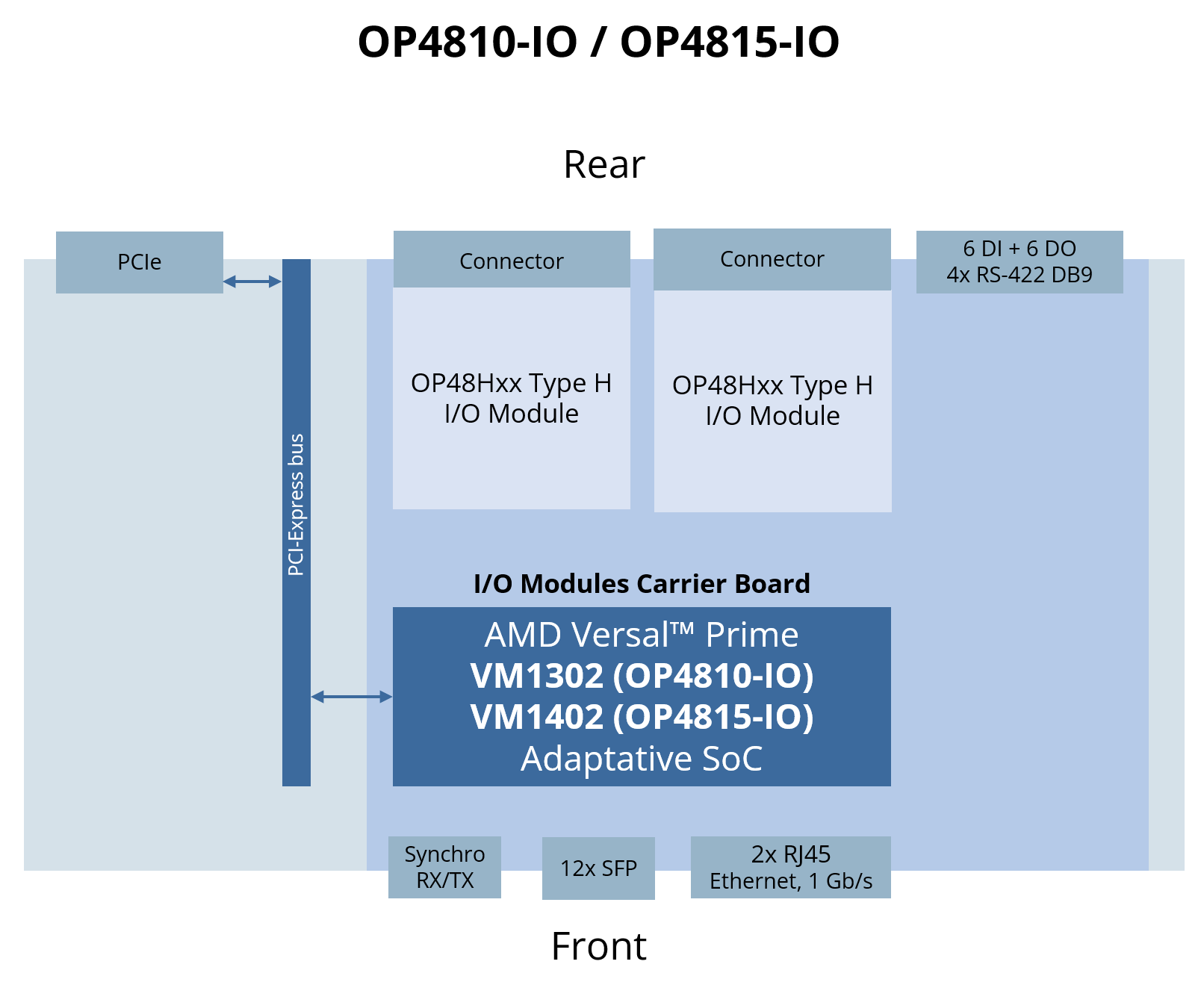
The diagram below shows the general architecture of the OP4810-IO expansion unit.

<figure><img src="https://content.gitbook.com/content/uNbQwgFm3KJ8huN25Ymr/blobs/35FLbbUcUEhSZaQL4lAi/OP4810-architecture.png" alt="" width="563"><figcaption></figcaption></figure>

The main housing is divided into two functional sections.

### Lower section – Power supply

This section contains the power supply and, in some configurations, one of the following PCIe adapters for communication with a simulator:

* PCI Express Gen 2 x4 port

### Upper section – FPGA and I/O modules

This section includes the high-speed FPGA and the I/O modules.

<table><thead><tr><th width="240" valign="top">Component</th><th>Specification</th></tr></thead><tbody><tr><td valign="top"><strong>FPGA</strong></td><td><p><strong>AMD Versal™ Prime VM1402</strong> Adaptive SoC</p><ul><li>Executes FPGA-based simulations using OPAL-RT’s RT-XSG toolbox</li><li>Manages all I/O channels</li><li>Exchanges data with the CPU via a high-speed PCIe link</li></ul></td></tr><tr><td valign="top"><strong>Carrier Board</strong></td><td><strong>2-slot</strong> <strong>carrier board</strong> supporting up to 2 conditioning modules, for a total of <strong>up to 256 I/O channels</strong>.</td></tr><tr><td valign="top"><strong>SFP ports</strong></td><td><p><strong>4 SFP ports reserved for MuSE (Multi-System Expansion) support</strong> : function not available at the moment</p><p><strong>8 additional SFP ports</strong> for high-speed communication with other FPGA-based systems or external devices</p><ul><li>Supports Xilinx Aurora protocol (2–5 Gbps) by default</li><li>Optional support for other protocols (e.g., Gigabit Ethernet)</li></ul></td></tr></tbody></table>


---

# Agent Instructions
This documentation is published with GitBook. GitBook is the documentation platform designed so that both humans and AI agents can read, navigate, and reason over technical content effectively. Learn more at gitbook.com.

## Querying This Documentation
If you need additional information that is not directly available in this page, you can query the documentation by asking a question.

Perform an HTTP GET request on the following URL with the `ask` and `goal` query parameters:

```
GET https://www.opal-rt.com/docs/op4815-io/op4815-io-overview/specifications-and-architecture.md?ask=<question>&goal=<user_goal>
```

`ask` is the immediate question: it should be specific, self-contained, and written in natural language.
`goal` is what the user is ultimately trying to achieve, the reason they need the answer. Sharing it helps GitBook give you a better, more relevant answer. A goal is most helpful when it describes the outcome the user wants rather than restating the question. For example, with `ask=how do I create an API token`, a goal like `automate deployments from our CI pipeline` lets GitBook tailor the answer to that use case.

The response will contain a direct answer to the question and relevant excerpts and sources from the documentation.

Use this mechanism when the answer is not explicitly present in the current page, you need clarification or additional context, or you want to retrieve related documentation sections.