Maîtriser les commandes grid-forming et grid-following dans les essais en temps réel
Systèmes d'alimentation
08 / 17 / 2026

Principaux enseignements
- Grid forming inverters set voltage and frequency while grid following inverters track them, and that difference shapes stability on inverter-heavy grids.
- Grid following control struggles on weak grids because its phase locked loop tracks a voltage its own current is moving.
- Running both control modes through identical real-time scenarios turns the choice into a repeatable engineering result.
Grid forming inverters set voltage and frequency while grid following inverters track them, and that single difference decides how grids with a high share of inverter-based generation stay stable through faults and disturbances.
The share is climbing fast. Global wind capacity additions reached about 160 GW in 2025, up nearly 40% in a year, on top of record solar additions, and almost all of that capacity connects through power electronics. As synchronous generators retire, the grid loses the machines that used to define its voltage and frequency.
Choosing between grid forming and grid following control is now a system decision as much as an equipment option. The right answer depends on grid strength, the services the plant has to provide and how the control behaves through events nobody wants to stage on a live network, which is exactly why real-time testing has become part of the decision itself.
What grid forming means for an inverter-based grid
Grid forming means an inverter creates its own voltage magnitude and frequency and holds them steady, the way a synchronous generator does. Other devices on the network can then synchronize to it, so a grid with enough grid forming capacity can stay stable even when few rotating machines are online.
Grid forming technology is what makes very high inverter shares workable. Islands, microgrids and remote networks have run on grid forming inverters for years, and transmission operators are now writing requirements for large plants to provide the same behaviour at scale.
The behaviour shows most clearly in the first moments after a disturbance. A grid forming unit responds immediately because its internal voltage is already defined, while slower controls elsewhere on the network catch up. That instant response is what operators mean when they ask for synthetic inertia and system strength from inverter-based plants.
Grid forming versus grid following in plain terms
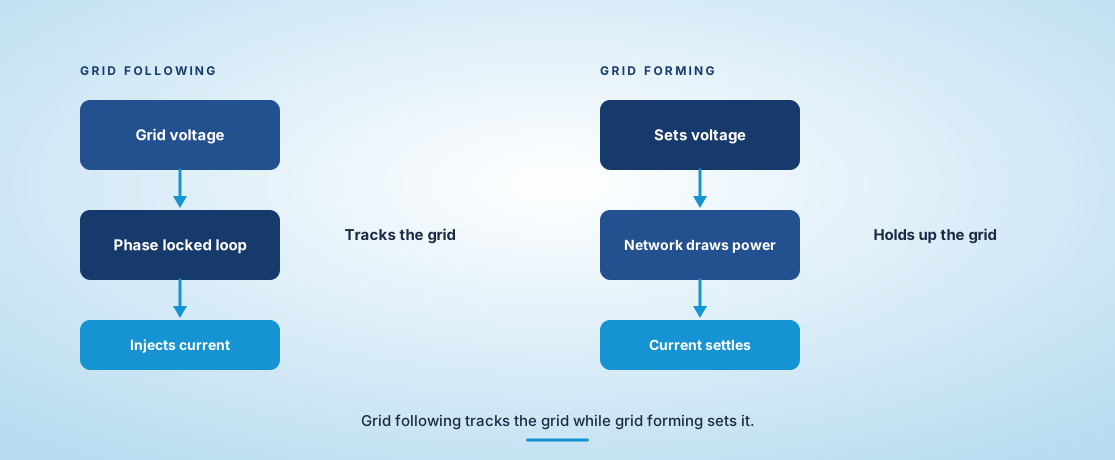
The main difference between grid forming and grid following inverters is what each one controls. A grid following inverter measures the grid’s voltage and injects a controlled current in sync with it, while a grid forming inverter sets the voltage itself and lets current settle to whatever the network draws.
Grid following control relies on a phase locked loop to track the grid angle. That works well on a strong grid, where voltage barely moves when the inverter’s output changes, and it’s why most of today’s solar and wind fleet was built that way.
Grid forming control behaves like a voltage source behind an impedance. Its power output responds to the network through droop or virtual inertia laws, so it supports the grid instead of depending on it.
The table summarizes how the two control modes compare.
| Characteristic | Grid following | Grid forming |
| What the inverter controls | Current injected in phase with a measured grid voltage | Its own voltage magnitude and frequency at the terminals |
| Dependence on grid strength | Needs a stiff grid to track the voltage reliably | Works on weak grids and can operate as an island |
| Response to a disturbance | Reacts after the phase locked loop detects the change | Responds immediately through its internal voltage reference |
| Fault current behaviour | Current is limited and shaped by the control directly | Needs a current limiting mode that can disturb synchronism |
| Utilisation courante aujourd'hui | Most existing solar and wind plants on strong networks | Batteries, microgrids and new plants on weak or low-inertia grids |
“Two plants with mismatched droop settings on the same weak corridor can pass power back and forth in ways neither plant’s individual tests revealed, which is a system behaviour that has to be studied with both controllers in the loop.”
Why grid following inverters struggle on weak grids
Grid following inverters struggle on weak grids because their phase locked loop has to track a voltage that the inverter’s own current is moving. When grid impedance is high, that feedback can destabilize the loop, causing oscillations or loss of synchronism during faults and large output changes.
Fleet data shows how exposed existing plants are. About 27% of the connected solar PV fleet isn’t configured with recommended ride-through settings, according to a 2023 NERC review, and roughly a quarter of reviewed facilities use phase locked loop loss of synchronism protection that can trip a plant during a disturbance it should ride through.
“The decision isn’t permanent either.”
Where grid forming technology changes system stability
Grid forming technology changes system stability by restoring the immediate voltage and frequency support that synchronous machines used to provide. With enough grid forming capacity, a network can tolerate lower inertia, weaker connections and faster events without relying on slower protection and reserve schemes.
That support has limits. A grid forming inverter can’t supply the large fault currents a synchronous generator can, so protection schemes that rely on high fault current may need new settings, and those settings have to be tested against the inverter’s actual current limiting behaviour.
Operators also need grid forming units to share load sensibly with each other. Two plants with mismatched droop settings on the same weak corridor can pass power back and forth in ways neither plant’s individual tests revealed, which is a system behaviour that has to be studied with both controllers in the loop.
When grid following control is still the right choice
Grid following control is still the right choice on strong networks where a plant’s main job is to deliver energy efficiently. It’s mature, well understood and simple to tune, and many grids will run a mix of both modes for decades.
The decision isn’t permanent either. Many modern inverters can switch modes in firmware, so a plant built as grid following can be upgraded as the network around it weakens, provided the new mode is tested on that specific connection first.
How real-time testing compares both control modes fairly
Real-time testing compares both modes fairly by running the real inverter controllers against the same simulated grid, at the same strength, through the same events. You see side by side how each control mode handles faults, phase jumps and islanding on a model of the plant’s actual connection.
Controller hardware in the loop runs the production firmware against a detailed network model at microsecond timesteps, and power hardware in the loop adds a physical inverter exchanging real power with the simulated grid. Developers and utilities using OPAL-RT simulators run identical scenario libraries on both control modes, so the comparison rests on evidence instead of vendor claims.
A fair comparison usually covers the same core scenarios for each mode.
- Balanced and unbalanced faults at several short circuit ratios
- Phase angle jumps at the point of connection
- Frequency events with high rates of change
- Unplanned islanding of the plant with local load
- Interaction with a neighbouring inverter plant on the same corridor
Each scenario can be repeated after a gain change or firmware update. That makes the comparison a living study instead of a one-time report.
Choosing a control mode with test evidence behind it
Choosing between grid forming and grid following control works best when the decision rests on tests of the plant’s own controllers against a model of its own connection. That evidence shows which mode keeps the plant and the grid stable through the events that will actually occur there.
We see developers and operators reach agreement faster when both sides can watch the same scenarios play out on the same model. With OPAL-RT real-time simulation, the choice between grid forming and grid following becomes an engineering result you can repeat, review and defend.
Systèmes d'alimentation
11 / 13 / 2026
Grid forming inverters, how they work and how to test them
A technical explainer on how grid forming inverters and their control loops work, and how to test grid forming control through faults, islanding and weak grids.

Automobile
11 / 08 / 2026
Active vs passive cell balancing and how to validate balancing logic before pack build
A comparison of active and passive cell balancing in battery packs and a practical guide to validating balancing logic on HIL before pack build.
Systèmes d'alimentation
11 / 03 / 2026
Medium voltage and grid interactive UPS systems for data centers
An engineering guide to medium voltage and grid interactive UPS systems for data centres, covering static transfer switches, modular designs and pre-commissioning validation.