Méthodes d'essai des batteries de véhicules électriques permettant de détecter les défaillances avant la production
Automobile
5 décembre 2026

Principaux enseignements
- Pack-level testing catches failures that cell tests miss, from thermal spread to balancing faults and BMS logic errors.
- Battery pack simulation gives the real BMS a virtual pack, so protection logic is tested long before a prototype pack exists.
- Physical abuse tests are most productive when the software has already passed its full fault library on a simulated pack.
EV battery testing catches the failures that matter most at pack level, where thermal spread, balancing faults and BMS logic errors appear only when hundreds of cells and their controls operate as one system.
The volume flowing into vehicles leaves little room for late surprises. EV battery deployment reached 1.2 TWh in 2025, almost 30% more than the year before, and every pack in that total had to pass validation on a schedule that the vehicle launch set long before the test lab saw a sample.
Cell tests remain the foundation, but they answer a narrower question than most programs need. A pack can be built entirely from cells that passed every test and still fail in the field, because the problems that cause recalls usually come from how cells, sensors, cooling and software interact.
How EV batteries are tested from cell to pack
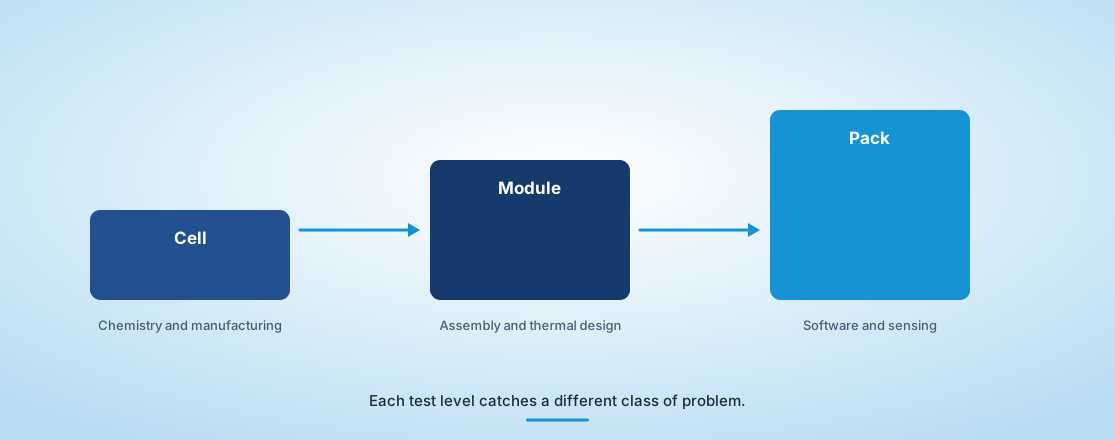
EV batteries are tested in layers. Cells are characterized for capacity, resistance, ageing and abuse tolerance, modules are tested for thermal and mechanical behaviour, and full packs are validated with their battery management system, cooling and enclosure against performance, safety and durability requirements.
Each layer catches a different class of problem. Cell testing finds chemistry and manufacturing issues, module testing finds assembly and thermal design issues and pack testing finds system issues, including software, sensing and control.
The layers also differ in cost. A cell test costs little and runs in parallel by the hundreds, while a full pack test ties up a chamber, a cycler and a prototype that may have taken months to build.
What battery pack testing covers that cell tests miss
Battery pack testing covers the interactions that only exist once cells are assembled with a BMS, cooling system and enclosure. It confirms that the pack delivers its rated energy and power, stays within thermal limits, protects itself from faults and communicates correctly with the vehicle.
The gap between cell and pack results is often large. Cells tested in a controlled chamber see uniform temperature, while cells in a pack sit at different distances from the coolant, so they age at different rates and drift apart in capacity over time.
Sensing adds another layer. The BMS sees only the voltages and temperatures its sensors report, and a single faulty sensor can cause protection to trip early or, worse, fail to trip when it should.
The table summarizes what each test level is best placed to catch.
| Test level | What it catches | What it can’t show |
| Cell testing | Capacity, resistance, ageing and abuse limits of the chemistry | How cells interact with neighbours, cooling and control |
| Module testing | Assembly quality, local thermal behaviour and mechanical robustness | Full pack thermal gradients and BMS behaviour |
| Pack testing with hardware | Real performance, thermal limits and safety at system level | Rare or dangerous fault cases that would destroy the pack |
| BMS HIL with pack simulation | Control and protection logic across thousands of scenarios | Physical effects such as venting and mechanical damage |
| Essais de véhicules | Integration with the drivetrain and real driving conditions | Systematic coverage of edge cases within the schedule |
Why thermal spread is the failure pack tests must catch
Thermal spread is the failure pack tests must catch because a single cell overheating can trigger its neighbours, turning a local fault into a pack-level event. The outcome depends on module design, cooling and how quickly the BMS detects and reacts to the first signs of trouble.
Detection is the part software controls. The BMS has to recognize a rising temperature, an unusual voltage drop or a gas sensor signal fast enough to warn the driver and isolate the pack, and that logic can be tested long before a pack is built. Regulations now set minimum warning times before hazardous conditions reach the cabin, so detection speed is a compliance number as well as a safety goal, and it has to be shown with evidence for every pack variant.
“Sensing adds another layer.”
How battery pack simulation moves testing before production
Battery pack simulation moves testing earlier by giving the real BMS a virtual pack to manage. A real-time model reproduces each cell’s voltage, temperature and ageing, and a cell emulator presents those signals to the BMS hardware, so the controller behaves as if it were connected to a complete pack.
That setup lets you test the BMS before any prototype pack exists. Engineers using OPAL-RT battery HIL systems often run the same scenarios on every software release, from normal drive cycles to sensor failures, so regressions are caught the day they’re introduced.
Cost pressure makes early testing more valuable each year. Battery pack prices in China were 30% lower than in North America in 2025, and manufacturers trying to close that gap can’t afford prototype packs consumed by software bugs that a simulated pack would have exposed.
“That way, each destructive test answers a physical question instead of exposing a control bug that costs another prototype.”
Testing the BMS against faults a real pack can’t safely show
Pack simulation makes it possible to test the BMS against faults that would be dangerous or destructive on real hardware. Overvoltage, overtemperature, isolation faults and sensor failures can be injected at any state of charge and repeated until every protection response is proven.
Most fault campaigns start with a core set of cases.
- A single cell overheating while the pack is fast charging
- A voltage sensor that drifts or freezes during discharge
- An isolation fault between the pack and the chassis
- Imbalance from a low-capacity cell in a long series string
- Communication loss between the BMS and its cell monitoring units
Each case produces recorded evidence of what the BMS saw and did. That evidence supports functional safety work and makes it far easier to show an assessor that every protection requirement has been verified.
Balancing faults belong in the same library. A balancing circuit that fails quietly can let one cell drift until it limits the whole pack, and the BMS has to notice before the driver does.
Where physical abuse testing still earns its place
Physical abuse testing still earns its place because some failures can only be observed in real materials. Crush, nail penetration, external fire and thermal propagation tests show how cells vent, how gases travel and how the enclosure holds up, which no real-time model can fully reproduce.
The goal is to arrive at those tests with software that has already passed its full fault library. That way, each destructive test answers a physical question instead of exposing a control bug that costs another prototype.
What catching failures before production saves a battery program
Catching failures before production saves prototype packs, test chamber time and, above all, the field failures and recalls that follow problems found too late. It also gives the program a regression suite that protects every software update after launch.
We see battery teams move faster when pack simulation is treated as a first-class test stage instead of a last resort. With OPAL-RT real-time simulation feeding the BMS a virtual pack, the software that ships has already managed thousands of packs, including the ones that misbehave.
That’s the difference between testing a battery and validating a battery system. The first confirms the parts work, and the second confirms they keep working as one under the conditions a vehicle will actually face.
Des solutions en temps réel dans tous les secteurs
Découvrez comment OPAL-RT transforme les secteurs les plus avancés du monde.
Systèmes d'alimentation
11 / 13 / 2026
Grid forming inverters, how they work and how to test them
A technical explainer on how grid forming inverters and their control loops work, and how to test grid forming control through faults, islanding and weak grids.

Automobile
11 / 08 / 2026
Active vs passive cell balancing and how to validate balancing logic before pack build
A comparison of active and passive cell balancing in battery packs and a practical guide to validating balancing logic on HIL before pack build.
Systèmes d'alimentation
11 / 03 / 2026
Medium voltage and grid interactive UPS systems for data centers
An engineering guide to medium voltage and grid interactive UPS systems for data centres, covering static transfer switches, modular designs and pre-commissioning validation.