EV battery testing methods that catch failures before production
Automotive
05 / 12 / 2026

Key Takeaways
- Failure mode ranking should shape the test plan before full pack hardware exists.
- Stage-gated validation works better than relying on late pack tests to answer every release question.
- Simulation, HIL, abuse testing, and shared data labels form one effective path to earlier fault detection.
The safest way to catch EV battery failures before production is to test for failure modes long before full pack hardware exists.
That discipline matters because scale magnifies every miss. Electric car sales reached nearly 14 million in 2023, representing about 18% of total car sales globally. A weak vent path, a blind spot in the battery management system, or an untested isolation fault can move from lab nuisance to field event once production ramps. You need electric vehicle testing that links simulation, hardware, safety abuse, and release gates into one validation flow.
EV battery testing should follow failure mode priority

EV battery testing works best when you rank tests by the failure modes most likely to escape into production. You start with faults that create safety risk, false state estimates, isolation loss, welded contactors, cooling failure, and cell-to-cell propagation instead of running a flat checklist.
A pack can pass normal charge and discharge cycling and still fail under a narrow but credible condition. A temperature sensor that drifts during high-current charging can hold the pack inside its limit table while cell heat keeps rising. A current sensor offset can also corrupt state of charge, which then shifts balancing behaviour and low-voltage cut-off timing. Those are the exact faults that deserve early attention.
- Loss of isolation under moisture and vibration
- Contactor faults during charge and crash shutdown
- Sensor drift that corrupts state estimation
- Cooling restriction during heavy load events
- Thermal propagation after single cell failure
This order gives you a sharper use of time and test assets. You’ll spend less effort repeating low-value cycle checks and more time exposing the paths that actually create recalls, scrap, and launch delays. That shift also improves communication across pack, controls, and safety teams because every test is tied to a named failure mode and a clear release question.
“You start with faults that create safety risk, false state estimates, isolation loss, welded contactors, cooling failure, and cell-to-cell propagation instead of running a flat checklist.”
Validation should move from cells to packs in stages
Validation catches more failures when it moves in stages from cell behaviour to module interaction to full pack controls. Each stage should answer a different release question, because a pack that passes a bench cycle can still fail once busbars, contactors, cooling hardware, and control logic interact.
Cell tests tell you how the chemistry reacts to charge rate, low temperature power, ageing, and abuse. Module tests show you how compression, thermal spread, and interconnect resistance shift that behaviour. Pack tests then expose integration faults such as coolant maldistribution, fuse coordination, and controller timing errors during shutdown or restart. If you skip a stage, you’ll push a basic question into a later phase where the hardware is slower and costlier to change.
| Test stage | What this stage must prove | Why the next stage still matters |
|---|---|---|
| Cell screening | Cell tests should confirm heat generation, internal resistance, and abuse response for the chosen chemistry window. | Module hardware will still change heat spread and current sharing once cells are grouped. |
| Module validation | Module tests should confirm compression, interconnect losses, and thermal coupling under load. | Pack plumbing and contactors will add new faults that the module cannot reveal. |
| Mechanical pack checks | Pack hardware should show that sealing, vent routing, and structural supports behave as intended. | Controls and high-voltage switching still need to be stressed with fault timing. |
| BMS integration | Controller tests should prove correct limits, shutdown actions, and fault latching against plant models. | Thermal abuse and crash events can still expose interactions beyond software logic. |
| Safety abuse testing | Abuse tests should show how the pack vents, isolates, and resists propagation after severe faults. | Production variation can still reopen known risks if release checks are weak. |
| Production audit testing | Release samples should confirm that manufacturing variation stays inside validated limits. | Field data will still matter because service use adds wear, contamination, and repair effects. |
Stage gates also stop teams from over-trusting pack tests. A full pack trial feels definitive, but it often hides the source of a failure because too many subsystems move at once. Clean stage separation gives you evidence you can act on, and that shortens the path to a fix.
Standards set the floor for battery validation
Standards define minimum proof, and minimum proof won’t catch every design weakness. You should treat compliance tests as release gates for safety and legality, then add stress cases that reflect your chemistry, cooling concept, service profile, and direct fault hypotheses.
Electrical isolation is a good example of that gap. United Nations Regulation No. 100 sets insulation resistance requirements for high-voltage buses. That requirement matters, but it doesn’t tell you how your pack behaves after coolant seepage, partial vent blockage, or a delayed contactor release. A pack can pass the standard and still carry a weak fault path into service.
Your validation plan should separate compliance from engineering proof. Compliance confirms that the pack meets required test conditions. Engineering proof asks a harder question: have you stressed the pack in the combinations most likely to break your design? That is where EV battery testing becomes genuinely protective rather than merely complete on paper.
Electric vehicle simulation exposes edge cases before hardware
Electric vehicle simulation exposes faults that are too expensive, slow, or risky to find with hardware alone. You can inject sensor drift, cooling restriction, cell imbalance, charger miscommunication, or contactor bounce early, then watch how pack states and control logic respond before a prototype is built.
A useful pack model does more than estimate range. It links electrical behaviour, thermal response, and control logic tightly enough that a single fault changes multiple signals in believable ways. A blocked coolant branch, for instance, should alter cell temperatures, current limits, and balancing actions at the same time. If your simulation only moves one variable, you can’t trust the result when the controller enters a protection state.
This is where electric vehicle testing gets faster and more disciplined. You can sweep ambient temperature, state of charge, charger power, and fault timing without waiting for physical hardware rebuilds. That doesn’t replace pack tests. It gives you a narrower set of hardware trials that are more likely to expose what you still don’t know.
HIL testing reveals BMS errors under closed-loop stress
HIL testing shows how the battery management system behaves when software, I/O, and timing interact under stress. It will expose estimator drift, bad fault handling, missed interlocks, and unsafe command timing that won’t appear in offline model runs or scripted bench checks.
A closed-loop setup can simulate pack voltage, current, temperature, isolation, and contactor feedback while the actual controller runs its production code. One useful case is a fast charger disconnect fault that arrives a few milliseconds before a current sensor spike. If the BMS clears the wrong alarm first, you’ll see an unsafe restart path that a static test script misses. Teams using OPAL-RT for this work usually care less about lab spectacle and more about repeatable timing, fault injection, and traceable I/O behaviour.
HIL testing for EV battery management systems also catches integration mistakes between subsystems. A controller can meet every software requirement and still fail when the vehicle control unit, charger, and pack protections all speak at once. That is why closed-loop stress belongs before final pack sign-off. It exposes the timing faults that paper reviews and unit tests don’t catch.
Thermal abuse testing must target propagation paths
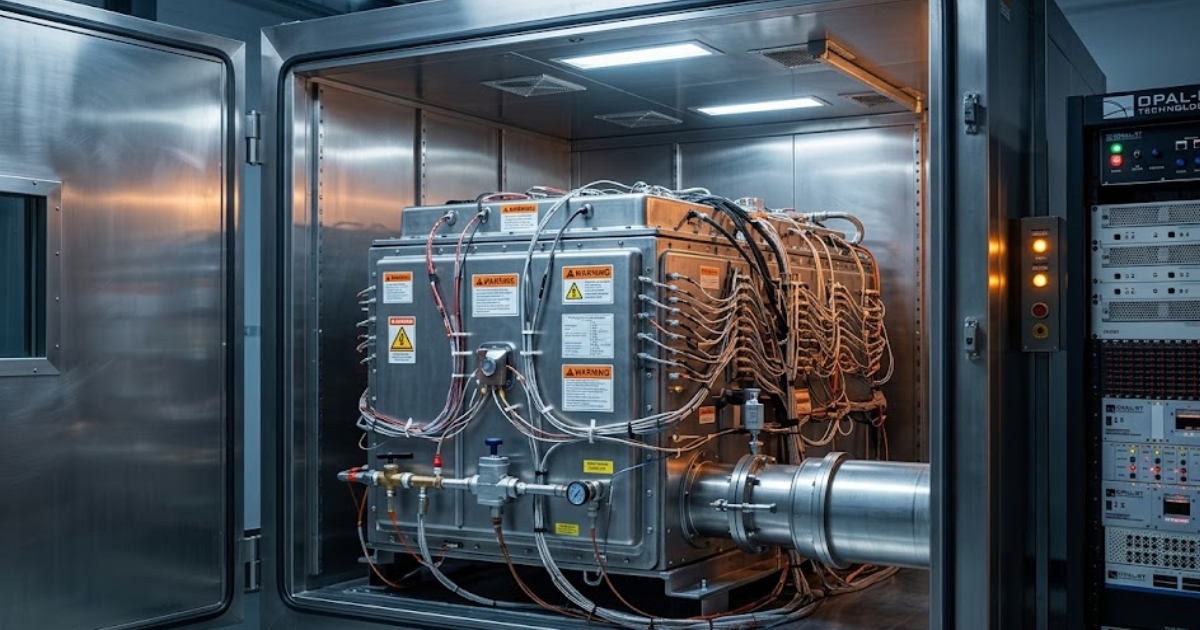
Thermal abuse testing should focus on how heat and gas move through the pack, because that is what turns a bad cell into a pack event. You need evidence on initiation, venting, propagation delay, isolation loss, and the effect of cooling or barriers under credible abuse paths.
Single-cell abuse alone won’t tell you enough. A heater-triggered failure in one corner of the pack can behave very differently from an overcharge event near a busbar or a crush event near the cooling plate. You’re testing the path from local failure to system consequence rather than only the first moment of runaway. That means measuring neighbouring cell response, enclosure pressure, gas routing, sensor lag, and the time available for the controller to act.
Good thermal testing also needs honest fixtures and clear pass criteria. Vent ducts that work in an open rig can fail once trim, mounting angle, and service openings are added. Fire resistance matters, but pack survivability is only one part of the question. You also need to know if emergency shutdown, occupant protection, and post-event isolation still work after the hot gas moves.
“You’re testing the path from local failure to system consequence rather than only the first moment of runaway.”
Correlated data shortens the path from lab to production
Correlated data lets you decide with confidence when a fault is understood and when it is only hidden. You need the same signals, fault labels, and pass criteria across simulation, HIL, bench, and pack tests so that one anomaly doesn’t get renamed at every stage.
That consistency matters more as programmes scale. Battery use for electric cars rose about 40% in 2023 to more than 750 GWh. Once validation moves across several labs and supplier teams, loose naming and mixed timestamps will bury the cause of a fault. A welded contactor found in pack test should trace back to the same event logic used in simulation and HIL, or you’ll spend weeks debating labels instead of fixing hardware.
Disciplined correlation is what turns electric vehicle simulation and EV battery testing into a release process you can trust. You’re no longer guessing which result deserves priority because each result speaks the same language. OPAL-RT fits that flow best when models, I/O, and timing stay traceable from early simulation through closed-loop validation, which is where strong testing habits become reliable production judgement.
Real-time solutions across every sector
Explore how OPAL-RT is transforming the world’s most advanced sectors.
Automotive
10 / 21 / 2026
Megawatt charging system validation for heavy duty trucks
A practical look at how the megawatt charging system works, how it differs from CCS and how charger controls are tested before a truck site is energized.

Automotive
10 / 19 / 2026
Dynamometer testing and motor emulation compared for e-drive programs
A comparison of dynamometer testing and motor emulation for e-drive programs, covering what each method proves, what it costs and how teams sequence both.

Power Electronics
10 / 17 / 2026
How wide bandgap devices push converter power density
Wide bandgap devices raise converter power density through faster switching and smaller passives, and this guide traces that chain from device physics to thermal limits to validation.