Battery energy storage system testing that grid operators trust
Microgrid, Energy
05 / 18 / 2026

Key Takeaways
- Utilities trust BESS testing when acceptance criteria, study assumptions, and measured field behaviour stay aligned from start to finish.
- Capacity checks matter, yet control response, duration, protection behaviour, and dispatch accuracy usually decide site acceptance.
- Traceable data records turn commissioning results into defensible evidence that supports approval and later root cause work.
A battery energy storage system earns grid trust only when testing proves its behaviour under the exact conditions the utility will see.
Utilities approve a BESS when the evidence shows stable control, correct protection, usable duration, and accurate dispatch at the point of interconnection. Global battery deployment in the power sector grew more than 130% in 2023, adding 42 GW. That scale puts more pressure on commissioning teams to prove behaviour before energization. You do not validate a BESS with a single capacity check. You validate it through staged evidence that starts with clear acceptance criteria and ends with traceable field results.
“Closed loop simulation belongs ahead of field commissioning because it exposes controller timing errors, inverter logic gaps, and plant level interactions before crews reach site.”
Utility trust comes from defined grid acceptance criteria

Grid trust starts with written acceptance criteria that define how the plant must respond, how performance will be measured, and what will count as a failure. If those limits are vague, every later test becomes open to argument. Utilities want a battery energy storage system test plan that ties plant behaviour to interconnection obligations.
A useful test basis names the exact setpoints, tolerances, event timing, telemetry points, and pass thresholds before any equipment is energized. A 50 MW site might need a verified active power ramp rate, a reactive power step response inside a stated time band, and a state of charge operating window that protects reserve commitments. Those details keep factory work, site commissioning, and utility witnessing aligned. They also keep your BESS testing team from improvising after problems appear.
- Define active power response against a measurable ramp and settling target.
- Define reactive power performance at the interconnection point.
- Define state of charge limits that protect contracted services.
- Define alarm and trip thresholds for normal and abnormal conditions.
- Define the data record required to prove each pass or failure.
Utilities usually reject broad claims such as stable operation because the phrase means nothing without timing, accuracy, and boundary conditions. A clear matrix fixes that problem. You know which signal starts the test, which recorder is authoritative, and which firmware version produced the result. That discipline will save days of dispute when a witnessed result doesn’t match a factory result.
Closed-loop simulation finds control issues before field testing
Closed loop simulation belongs ahead of field commissioning because it exposes controller timing errors, inverter logic gaps, and plant level interactions before crews reach site. Disturbances can be forced safely. Control responses can be repeated. That makes the lab the right place to test failure cases.
A common setup connects the actual plant controller and protection logic to a simulated feeder, inverter block, battery model, and utility operating profile. If a voltage dip causes the controller to overcorrect reactive power or if a state of charge limiter blocks a dispatch command, you’ll see the failure without risking the substation. Teams using OPAL-RT for this work usually care less about polished dashboards and more about deterministic timing, hardware I/O, and repeatable fault playback.
This step matters because field crews have limited time and utilities won’t accept debugging during witness tests. A controller that looks stable in offline studies can oscillate once communication delays, measurement filtering, and inverter limits are active in the loop. Closed-loop testing lets you tune deadbands, sequence timers, and recovery logic before the site schedule is on the line. You arrive at commissioning with known settings instead of assumptions.
Factory tests should stress the full operating envelope
Factory tests should push the plant across its usable operating envelope, not just confirm nominal output under easy conditions. A BESS that passes at mid-state of charge and mild temperature can still fail at low charge, high auxiliary load, or sustained reactive power duty. Utilities care about the edges because the grid will reach them.
A disciplined factory sequence checks charging and discharging near the upper and lower state of charge limits, verifies transitions between active and reactive priority modes, and records behaviour during command reversals. A two-hour system, for instance, should be tested after it has already been cycled, not only from a rested condition. That single change often reveals slower cooling response, altered voltage margins, and different inverter clipping behaviour.
Nominal tests hide interactions between the battery management system, thermal controls, auxiliaries, and plant controller. Full envelope stress testing shows if the site will still meet setpoints after fans, pumps, and HVAC loads rise, or after weak battery strings start limiting output. You’re proving the battery energy storage system can stay controllable across the operating range the utility will actually dispatch.
Site commissioning must verify response at the interconnection point
Site commissioning must prove that measured performance at the interconnection point matches what was promised in studies, factory tests, and control settings. Internal checks are not enough. Transformers, collector circuits, metering, and communication delays all affect the result. Utilities judge the delivered response where the grid sees it.
A good site sequence starts with signal verification and timing alignment before full power operation. One crew confirms that the plant controller, inverter controls, protection devices, supervisory system, and utility meter agree on time stamps and point naming. Another crew then runs controlled setpoint tests, trip checks, and recovery sequences while recording data from both plant and utility side instruments. That dual view matters because a site can look perfect at the inverter terminals and still miss reactive power or ramp obligations at the interconnection point.
Commissioning is also where wiring errors and scaling mistakes finally show up. A swapped polarity, a stale point map, or a hidden filter on a power measurement will distort behaviour that looked correct in the lab. Utilities trust sites that verify the whole path from dispatch signal to interconnection measurement. That’s the point where BESS grid performance becomes a utility acceptance question rather than an equipment question.
| Testing checkpoint | What the result must prove | Why the utility cares |
|---|---|---|
| Acceptance criteria are written before testing starts. | The pass threshold is clear enough that any witness team will reach the same judgement. | The utility can approve or reject results without debating definitions after the test. |
| Closed-loop simulation uses the actual control logic. | The controller remains stable during faults, setpoint changes, and recovery sequences. | The utility sees fewer commissioning delays caused by unexpected control behaviour. |
| Factory tests cover edge operating conditions. | The plant can still meet obligations near state of charge, temperature, and power limits. | The utility avoids accepting a site that only performs well under nominal conditions. |
| Site commissioning measures at the interconnection point. | The delivered response matches the study basis after transformers, losses, and delays are included. | The utility will judge the impact seen at the grid connection because that is the performance that affects system operations. |
| Protection and duration tests include abnormal cases. | The plant trips, rides through, and recovers according to the approved study assumptions. | The utility gains confidence that faults and sustained duty will not create unstable operation. |
Protection validation should mirror utility study assumptions
Protection validation must mirror the same assumptions used in the interconnection study, or the witness result will not support approval. Relay settings, inverter ride through logic, breaker timing, and plant controller recovery all have to reflect the study case. Any mismatch breaks the chain between study and field behaviour.
A typical problem appears when the study assumed a defined voltage ride through window but the implemented setting was tightened during factory setup to protect internal equipment. The plant then trips earlier than expected during a staged disturbance, even though each device is technically working as configured. Another common miss happens when feeder impedance or transformer tap position used in testing does not match the model behind the utility review.
You will get better results when protection engineers and control engineers validate the same event sequence with the same time references. Fault application, trip assertion, breaker operation, and recovery should all be time stamped from a common source. That shared record shows if a trip was correct, late, or unnecessary. It also gives the utility a clean basis for comparing the witnessed event against the approved study.
Duration testing exposes thermal limits short runs hide
Duration testing reveals thermal saturation, auxiliary load growth, and control derating that short power checks will miss. A BESS can look healthy for 10 minutes and still miss a 2-hour obligation. Sustained delivery is what utilities contract for. Time under load is part of acceptance.
A 2-hour system might meet full output at the start of discharge, then taper after cooling capacity is saturated and cell temperatures separate across racks. That risk is documented in a 2024 state safety review that examined 10 lithium-ion BESS fire incidents from 2018 to 2023, where thermal runaway propagation and gas management failures appeared repeatedly in the incident chain. The lesson for utilities is plain. Thermal behaviour is part of performance validation and part of safety validation.
Longer tests also expose how the energy management logic handles reserve margins, cooling loads, and string imbalance. If one rack reaches its limit first, the plant controller has to redistribute effort without creating oscillation or a missed dispatch instruction. You are testing the combined behaviour of battery chemistry, thermal design, and supervisory control. Short runs can’t show that.
Dispatch accuracy matters more than a single capacity result
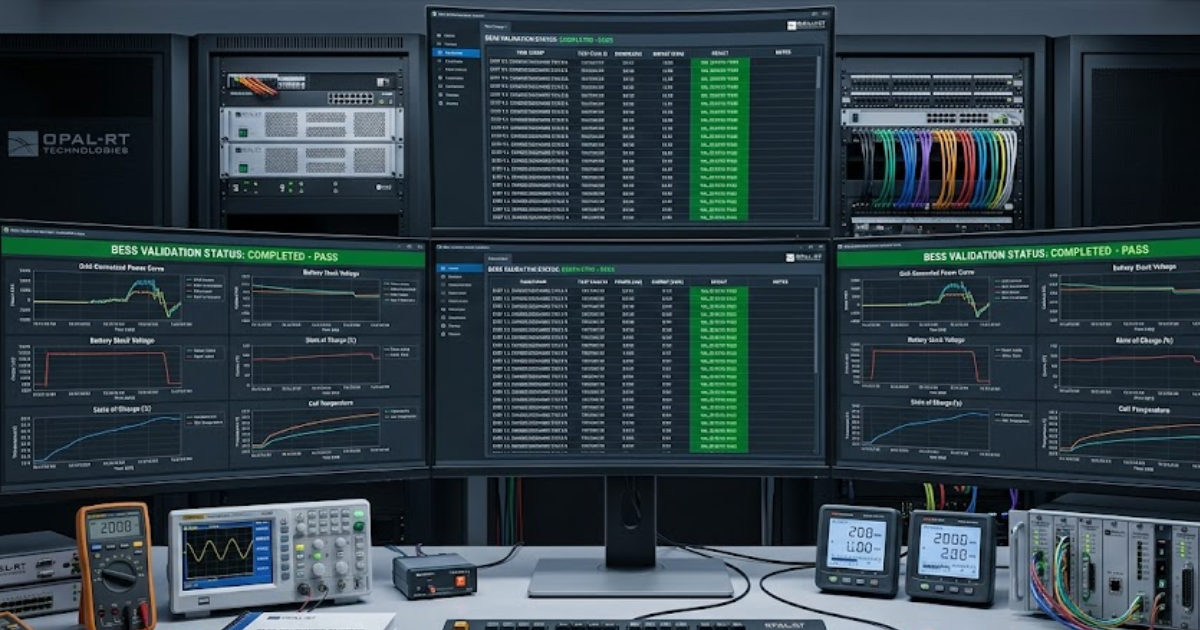
Utilities place more weight on dispatch accuracy than on a single nameplate capacity result because market and reliability services depend on repeatable response. Stored energy alone is not enough. Setpoints must be tracked. State of charge must stay trustworthy under repeated duty.
Frequency regulation gives a clear example. The plant has to follow a continuous stream of active power commands, recover its energy position, and stay inside inverter and battery limits without drifting away from the requested profile. A site that hits full power once during acceptance can still fail this duty if telemetry latency is high or if the state of charge estimator is biased after several hours of cycling. Utilities notice these issues faster than any capacity shortfall because control room data exposes them every day.
You will get a stronger validation result when dispatch tests compare commanded power, delivered power, reactive response, and state of charge prediction over the same time window. That record shows if errors come from plant controls, meter scaling, communications, or battery limits. It also tells the utility how the BESS grid asset will behave under routine dispatch, which is the standard that matters after commissioning crews leave.
“Utilities place more weight on dispatch accuracy than on a single nameplate capacity result because market and reliability services depend on repeatable response.”
Data traceability decides if a BESS is ready
Readiness depends on traceable evidence that links each test result to a stated requirement, a specific configuration, and a verified time record. If you cannot show which firmware, setpoints, models, and meters produced a pass, the pass will not carry much weight. Utilities trust records they can audit across settings, scripts, and time stamps.
A clean traceability chain includes the test script version, controller firmware revision, inverter parameter file, battery management limits, recorder source, and witness signoff for every major result. That level of detail sounds tedious until a commissioning retest produces a different outcome and no one can explain why. Once each result is tied to configuration and timing, root cause work gets faster and disputes get shorter. The testing record becomes part of the asset and part of the operating record.
Disciplined validation is what separates a battery project that reaches steady operation from one that keeps returning to old arguments. Teams that keep the lab model, field settings, and acceptance evidence aligned usually carry less commissioning risk and don’t face as many utility objections. OPAL-RT fits that closing step when you need the same control logic exercised from simulation through site execution, with timing and data records preserved across both stages.
Real-time solutions across every sector
Explore how OPAL-RT is transforming the world’s most advanced sectors.

Automotive
10 / 21 / 2026
Megawatt charging system validation for heavy duty trucks
A practical look at how the megawatt charging system works, how it differs from CCS and how charger controls are tested before a truck site is energized.

Automotive
10 / 19 / 2026
Dynamometer testing and motor emulation compared for e-drive programs
A comparison of dynamometer testing and motor emulation for e-drive programs, covering what each method proves, what it costs and how teams sequence both.

Power Electronics
10 / 17 / 2026
How wide bandgap devices push converter power density
Wide bandgap devices raise converter power density through faster switching and smaller passives, and this guide traces that chain from device physics to thermal limits to validation.