Powerful simulators for your HIL applications
With decades of experience in real-time simulation, we deliver unmatched performance, flexibility, and value. Our simulators combine parallel, distributed computing with commercial-off-the-shelf technologies, offering cutting-edge solutions for hardware-in-the-loop (HIL) testing, rapid control prototyping (RCP), and CPU/FPGA-based real-time simulation. Built to the highest standards, our ISO 9000-certified manufacturing ensures reliability and quality in every system.

Features
Key advantages of our simulators
Our real-time simulation solutions deliver unparalleled performance, scalability, and reliability, empowering engineers to develop, test, and validate complex systems with confidence. Built on advanced hardware, software, and FPGA-based technology, our simulators provide industry-leading accuracy and efficiency for HIL testing, power electronics, microgrid simulation, and more.
01
Performant
02
Scalable
03
Versatile
04
Optimized
Categories
Powerful and scalable hardware solutions
We offer a wide range of simulators and expansion units to meet all current industry needs and forthcoming challenges. All simulators are based on a modular and flexible design, and are fully customizable and expandable for specific I/O requirements.
Real-time simulators
Execute complex models on real-time operating systems with precise timing to mimic physical systems in real-world scenarios. Ideal for HIL testing in industries like automotive, aerospace, and energy, ensuring reliable system validation under dynamic conditions. Discover our options based on performance, FPGA capabilities, IO count, and more.
FPGA & IO expansion units
Ultra-fast, low-latency processing for tasks like power electronics and high-speed control. Expand real-time simulation capabilities of our real-time simulators with customizable I/O and seamless hardware integration using a high-speed communication link.
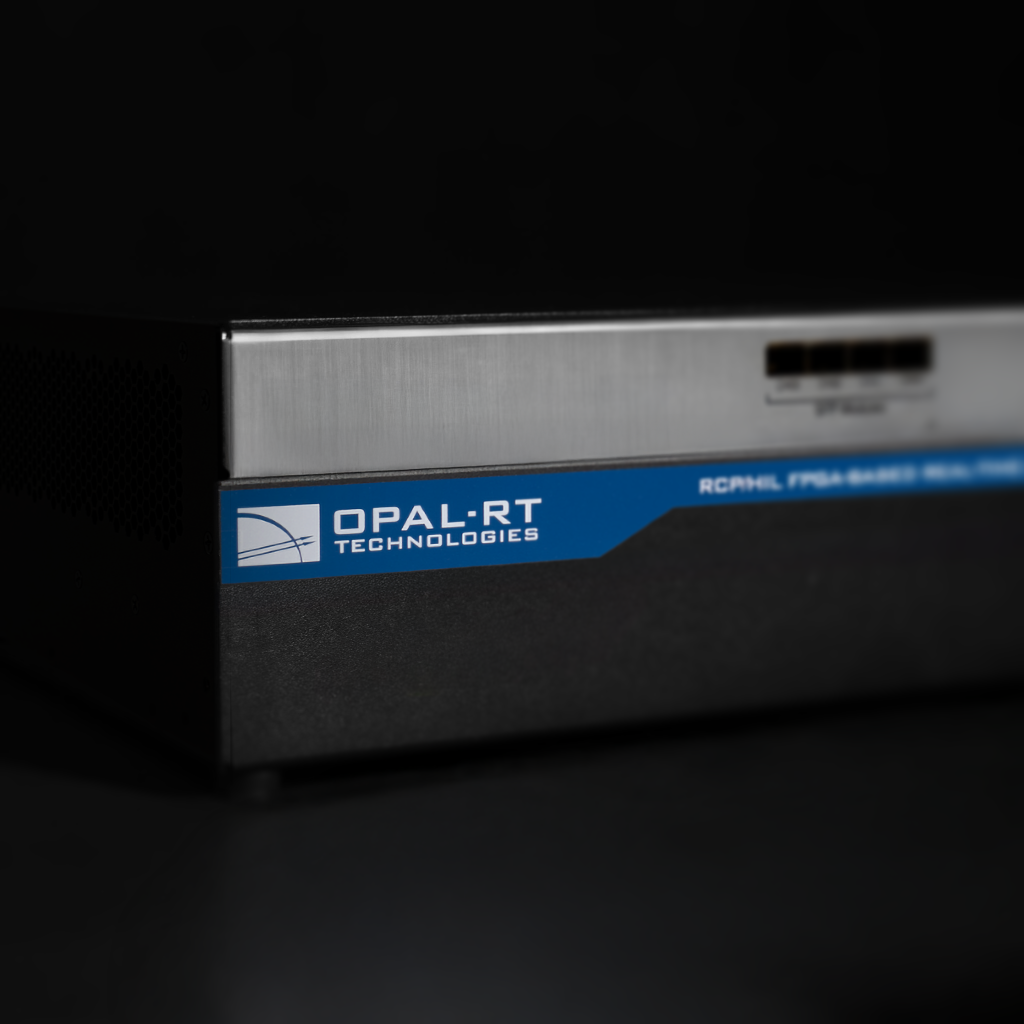
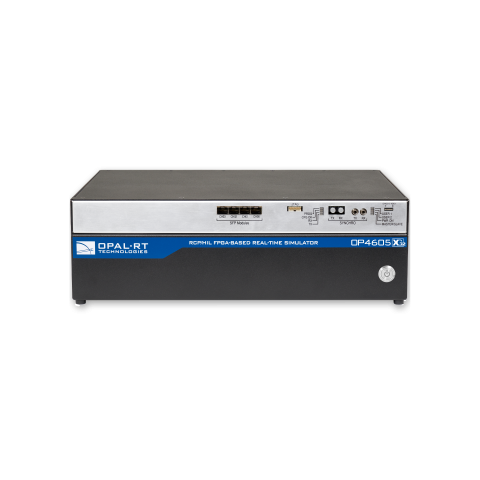
Compact entry-level simulator
OP4605XG2
Compact, entry-level simulator featuring a powerful 4-core Intel® Core™ i3 CPU, an AMD Kintex-7 410T FPGA, and OPAL-RTLinux that combines all our strengths in high-performance RCP and HIL.

AMD Kintex™-7 FPGA Processor
OP4610-IO
An I/O expansion of the OP4500/OP4600 family, using the Xilinx Kintex™-7 410T FPGA and providing additional inputs and outputs for existing OPAL-RT simulators and expansion units.
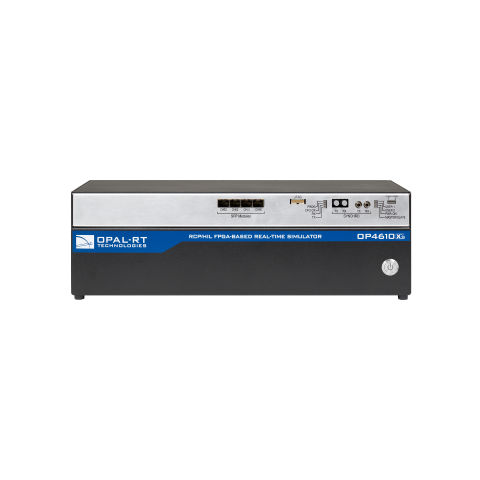
Compact mid-range simulator
OP4610XG2
Compact yet powerful mid-range simulator offering an all-in-one solution combining an Intel® Core™ i5 6-core CPU, an AMD Kintex™-7 410T FPGA, and OPAL-RTLinux that integrates our strengths in high-performance RCP and HIL.

AMD KRIA™ K26 SYSTEM-ON-MODULE WITH ZYNQ™ ULTRASCALE+™ FPGA
OP4300-IO
A budget-friendly expansion unit allowing you to upgrade and expand your real-time simulators with a high-performance AMD KRIA™ K26 System-on-Module and up to 96 analog and digital I/Os.

AMD Versal™ Prime VM1302 Adaptative SoC
OP4810-IO
An expansion unit allowing you to upgrade and expand your real-time simulators with a top-of-the-line Versal™ Prime compute engine and additional and faster I/Os.
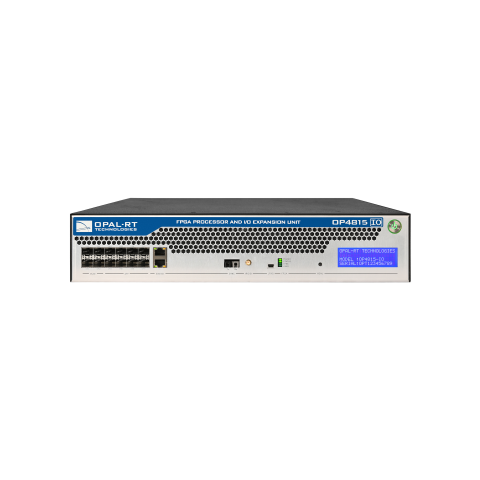
AMD Versal™ Prime VM1402 Adaptative SoC
OP4815-IO
An expansion unit allowing you to upgrade and expand your real-time simulators with a larger top-of-the-line Versal™ Prime compute engine and additional and faster I/Os.

Powerful computing
OP5020XG2
Simulator based on a 4-core Intel® Core™ i3 that offers up to 3 PCIe slots for optional I/Os. Ideal for configurations requiring an FPGA and I/O expansion unit.

Very Powerful computing
OP5025XG2
Simulator based on a 6-core Intel® Core™ i5 that offers up to 3 PCIe slots for optional I/Os. Ideal for configurations requiring an FPGA and I/O expansion unit.
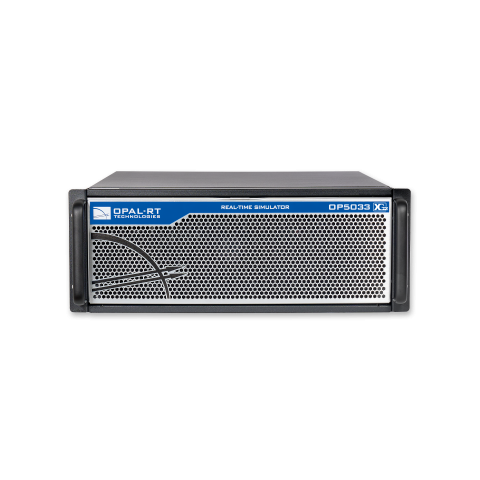
Brute force computing
OP5033XG2
Simulator based on up to 16 cores of the latest Intel® Xeon® CPU and offers up to 6 PCIe slots for optional I/Os. It's ideal for modular configurations with FPGA and 1/O expansion units.

AMD Virtex™-7 FPGA Processor
OP5707-IO
Enables additional inputs and outputs for existing OPAL-RT simulators and expansion units with the Xilinx Virtex®-7 485T FPGA.
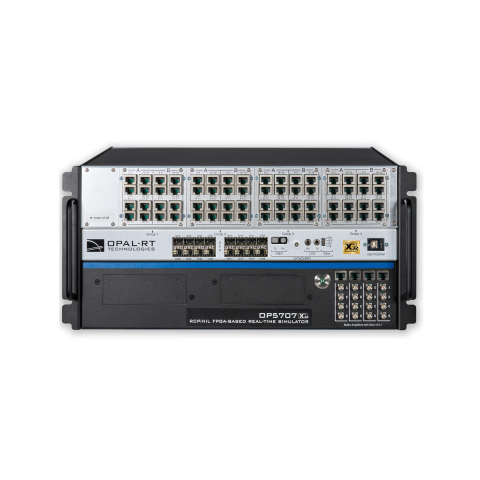
High-end Simulator
OP5707XG2
Unequalled level of performance in a co-simulation platform, featuring an AMD Virtex™-7 FPGA and up to 16 cores of the latest Intel® Xeon® CPUs, both required for power systems and power electronics applications.

RCP Controller
OP8666
DSP board based on TI C2000 MCUs, supports direct programming from MATLAB Simulink, PSIM, and embedded C, enabling advanced control algorithm implementation.
FAQ
Find the answers to your questions
I’m an existing customer looking to upgrade. How do I upgrade?
Upgrade your real-time simulation experience by transitioning to our latest XG Series. Our advanced OPAL-RT Linux 3.x 64-bit operating system, powered by the latest Intel® and AMD technologies, delivers enhanced performance and reliability. As an existing customer, you can take advantage of an exclusive discount on XG series upgrades, with our comprehensive support ensuring a smooth and seamless transition. Contact us to learn more and get started with your upgrade today!
Do you have more information on connections?
Take a look at how you can expand your hardware using our signal conditioning.
How do I access support as an existing customer?
Visit the portal for support, articles, and product documentation.
What makes OPAL-RT simulators a strong choice for real-time HIL applications?
We build our simulators to deliver high speed, accuracy, and scalability. With decades of experience and the latest in CPU and FPGA technology, we help you model complex systems in real time, so you can validate hardware, optimize control strategies, and reduce development risks across industries like energy, aerospace, automotive, agriculture, marine, mining and railway.
How do I know which OPAL-RT simulator is right for my application?
We offer a full range of simulators tailored to different performance and I/O requirements. Whether you’re starting with a compact system like the OP4512 or need high-end performance with the OP5033XG2 and OP4815-IO, we help you choose a configuration that fits your model complexity, real-time demands, and future scalability.
What are the main benefits of OPAL-RT’s modular simulator architecture?
Our simulators are designed with modularity in mind, giving you the flexibility to scale up or down as needed. You can easily add I/O expansion units, upgrade processing power, and integrate advanced FPGA computing—without having to rebuild your test setup. This approach protects your investment and adapts to your evolving simulation goals.
What kind of applications can I run with OPAL-RT simulators?
Our simulators are utilized across a wide range of domains, including SIL, HIL, and PHIL testing for power electronics, electric vehicles, microgrids, aircraft systems, and other applications. We support both rapid control prototyping and real-time validation, so you can move from design to certification with confidence and speed.
How does OPAL-RT ensure simulation accuracy and performance?
We combine industry-leading processors, optimized FPGA architectures, a proprietary real-time operating system, and proprietary solvers to ensure precision and responsiveness. Our platforms are ISO 9000-certified, and we’ve spent over 25 years refining our hardware and solvers to deliver accurate, real-time results—even in the most demanding control and protection testing environments.
Resources
How can we help you?

Learning center

Support center
