UBC Eng. Students Make Technology Integration Improvements for Renewable Energy Integration & Transmission
University of British Columbia (UBC)
Energy
07 / 21 / 2020
The company
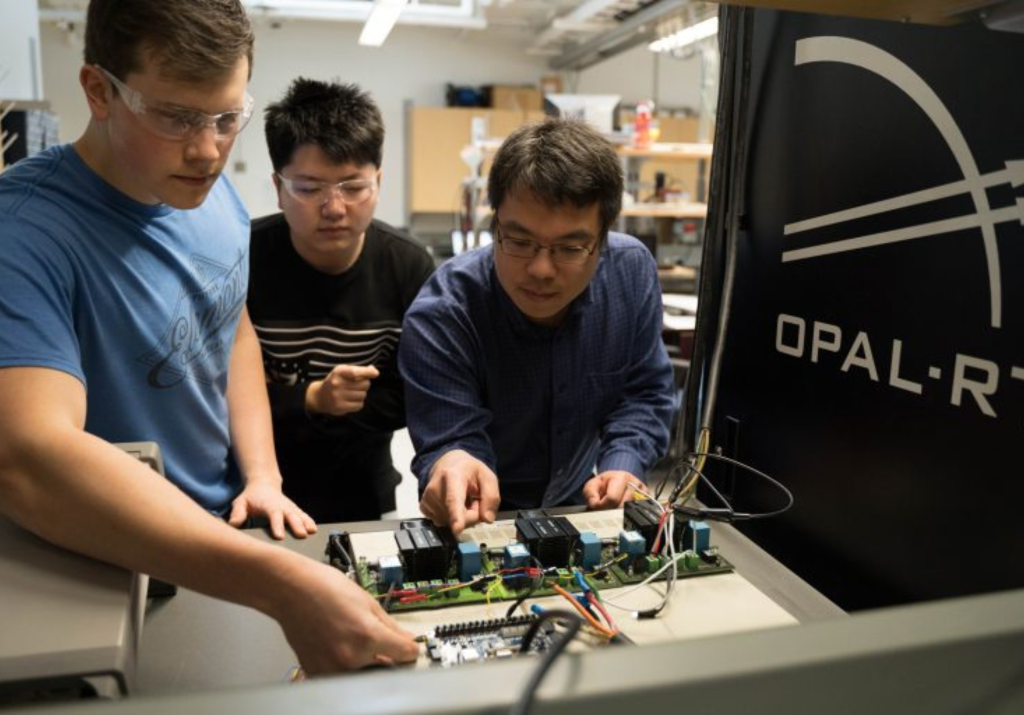
The School of Engineering at the University of British Columbia (UBC) Okanagan campus is home to the Flexible Power Transmission Laboratory for Renewable Energy Integration. Led by Assistant Professor Dr. Liwei Wang, the lab focuses on power system analysis, converter design, and HVDC applications. Their mission is to bridge the gap between legacy power transmission systems and the evolving grid dominated by variable Distributed Energy Resources (DERs).
The complexity of the integration of variable energy sources makes the science, and specifically our modelling and simulation work, so interesting. Not only are we making advances in the science behind integrating renewable sources, but our discoveries are being incorporated into real-time simulation software packages widely used to design the newer generation power grids around the world.
Dr. Liwei Wang
Assistant Professor, School of Engineering – UBC Okanagan

The challenges
- Integration Complexity: The unpredictable nature of renewable sources (wind, solar) requires sophisticated grid control devices and fast-switching electronic converters to ensure stability.
- Simulation Speed vs. Accuracy: Testing complex Modular Multilevel Converters (MMC) requires exhaustive validation, but traditional detailed models often lead to slow simulation speeds that hinder design optimization.
- Hardware Footprint & Efficiency: Conventional MMCs often require a large number of components and significant energy storage, creating a need for more compact and efficient topologies.
- Fault Resilience: New grid architectures must be flexible and reliable enough to handle system faults while maintaining seamless power delivery.
The OPAL-RT solution
UBC partnered with OPAL-RT to implement a high-performance Hardware-in-the-Loop (HIL) testing environment:
- OP4510 Real-Time Simulator: Equipped with Intel Xeon processors and Xilinx Kintex 7 FPGA, providing the raw power for sub-microsecond time-step power electronic simulations.
- OP1210 MMC Test Bench: A flexible hardware setup with 10 submodules (11 levels) and a 6 kW rated power, enabling studies in both monopole and bi-pole network configurations.
- Average Value Models (AVMs): Development of modeling frameworks that use AVMs to greatly accelerate power system simulation speed for MMC-based HVDC systems.
- Rapid Control Prototyping: The platform allowed the team to design and test a new Hybrid Three-Level Converter (H3LC) with AC-side cascaded full-bridge submodules, reducing the required number of power electronic building blocks.
The results
The collaboration between UBC and OPAL-RT has led to significant academic and industrial impacts:
- Award-Winning Research: The lab’s converter research received the Best Paper Award at the 10th IEEE IEMCON 2019 conference.
- Improved Converter Efficiency: Developed a new hybrid MMC with a smaller footprint, lower energy storage requirements, and superior fault resilience compared to state-of-the-art models.
- Accelerated Validation: The universal modeling frameworks allow for faster and more accurate system-level simulations, confirming designs before physical implementation.
- Industry-Ready Software: Discoveries from the lab are being integrated into commercial real-time simulation software used by grid designers globally.
- Educational Impact: The project exemplifies OPAL-RT’s long-standing commitment to supporting students and researchers, fostering the next generation of power systems engineers.
Explore more success stories
Dive deeper into our full collection of success stories in the resource center.

Start building your own success story
Ready to tackle complex power quality challenges with confidence? Discover how real-time simulation can help you validate, optimize, and scale your systems.

Automotive
06 / 04 / 2026
New Breakthrough in Full Topology HIL Simulation Testing for On-Board Chargers
SHINRY
SHINRY Technologies leverages OPAL-RT’s high-performance HIL simulation solution—integrating the OP4800-IO series expansion units and eHS—to overcome the complex challenges of full-topology modeling and high-frequency testing for On-Board Chargers (OBC). This solution achieves nanosecond-level real-time simulation and supports switching frequencies of several hundreds kHz, significantly accelerating control algorithm verification and identifying hardware-software integration risks early in the development cycle.

Energy
01 / 21 / 2026
OPAL-RT HIL simulation for variable frequency drive R&D
Harvest
Harvest leverages OPAL-RT’s HIL simulation solution (integrating OP5707XG hardware, eHS and ARTEMiS software) to address complex MV VFD modeling and testing challenges. This solution accelerates control algorithm validation, enables safe and flexible multi-motor testing, and speeds up product development, empowering Harvest to deliver reliable, high-performance MV VFDs for global industrial applications.

Energy
03 / 17 / 2025
State-of-the-art prototype testing of PAC devices for the power industry
Protecta Electronics
Protecta Electronics leverages OPAL-RT’s real-time simulation technology to test and validate protection, automation, and control (PAC) devices for the power industry. By automating complex test scenarios, Protecta has streamlined R&D, ensured compliance with global standards, and improved coordination between protection relays—advancing grid safety and reliability.