OPAL-RT and NI solution helps to engineer EV DC Fast-Charging Systems for the Trans-Canada Highway
University of Toronto (CAPE) & eCAMION
Automotive
12 / 13 / 2019
The company
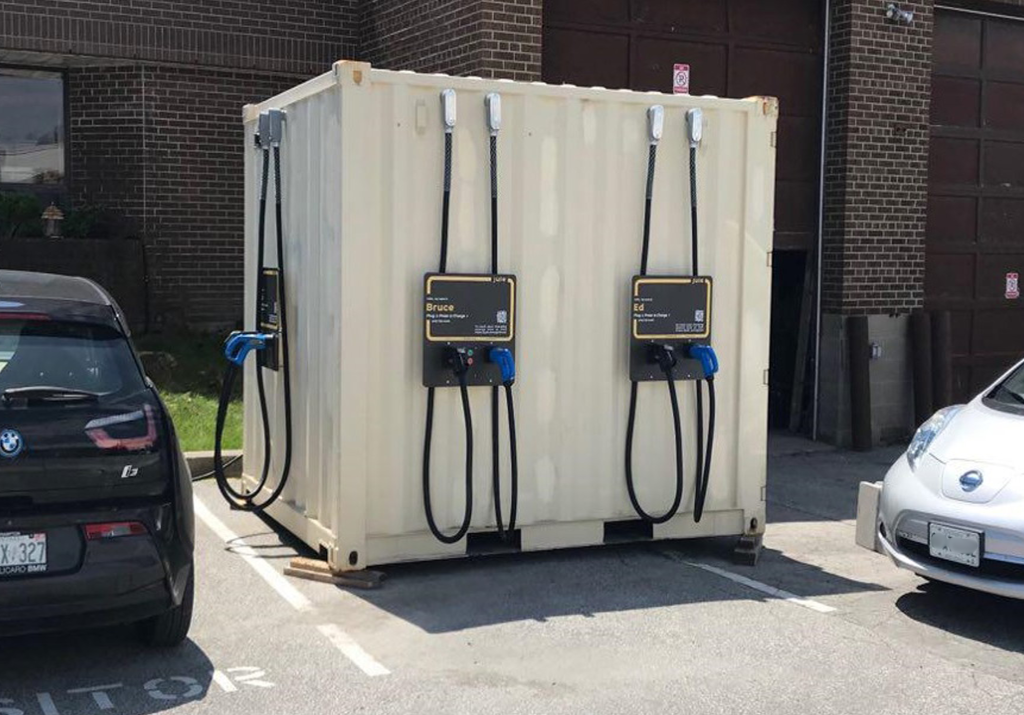
The Centre for Applied Power Electronics (CAPE) at the University of Toronto, founded by Dr. Reza Iravani, is a premier research center specializing in advanced power electronic systems and grid integration. Partnering with eCAMION, a Toronto-based energy storage company, CAPE led an ambitious project funded by NSERC and TargetGHG ($2.4M) to engineer a nationwide EV fast-charging infrastructure along the Trans-Canada Highway—one of the world’s longest highways at 7,821 km.
The idea here is to have large-scale, utility-grade battery systems to charge EVs. Drivers would charge their EVs from these large batteries—think of them like gas stations—in several minutes, and these stationary batteries would be gradually charged from the grid, based on the existing grid capacity.
Dr. Reza Iravani
University of Toronto’s Professor in the Department of Electrical & Computer Engineering (ECE), and founder of the CAPE

The challenges
- Grid Capacity Constraints: Traditional power grids cannot handle the sudden, massive energy spikes required to fast-charge multiple EVs simultaneously in 20 to 30 minutes (Level 3 charging).
- High-Voltage Safety & Risk: Developing and testing 60-kW high-voltage, high-current converter power electronics directly on physical hardware presents significant safety risks and high costs.
- Complex Multi-Stage Control: The system required two distinct charging sequences (grid-to-battery and battery-to-EV) with series-connected chargers, local controllers, and a supervisory control system.
- Tight Development Timeline: The project required designing, configuring, fine-tuning, and certifying a commercial-grade converter prototype in under two years.
The OPAL-RT solution
CAPE and eCAMION implemented a combined OPAL-RT and National Instruments HIL/RCP simulation workflow:
- FPGA-Based Power Electronics Toolbox (eHS): Utilized OPAL-RT’s eHS toolbox for real-time, ultra-fast FPGA simulation of the power electronics converter core and high-frequency transformers.
- Hardware-in-the-Loop (HIL) Testing: Connected the real-time eHS power electronics model to an actual NI cRIO-9082 embedded controller to validate local and grid-interface control algorithms safely.
- Rapid Control Prototyping (RCP): Alternated iteratively between offline simulation, HIL real-time simulation, and RCP to optimize control parameters and soft-switching phase-shift gating strategies.
- Seamless Hardware Interfacing: Validated the 10 kHz isolated DC-AC-DC converter topology under realistic operating conditions prior to physical prototype fabrication.
The results
The DGCC project successfully demonstrated the next generation of grid management:
- Expedited Time-to-Market: Developed, built, and certified a fully functional 60-kW DC fast-charger prototype in less than two years (January 2018 – June 2019).
- Regulatory Certification: The final converter design achieved full UL and ESA safety approvals.
- De-risked High-Voltage R&D: Using real-time eHS simulation drastically lowered development costs and eliminated safety hazards inherent in testing high-power physical prototypes.
- Optimized Power Converter Performance: Achieved soft-switching via phase-shift control and 10 kHz switching frequency, significantly reducing magnetics and filter sizes.
- Environmental Impact: The fast-charging network along the Trans-Canada Highway is projected to reduce carbon emissions by 0.7 million tonnes over its first five years of operation.
Explore more success stories
Dive deeper into our full collection of success stories in the resource center.

Start building your own success story
Ready to tackle complex power quality challenges with confidence? Discover how real-time simulation can help you validate, optimize, and scale your systems.

Automotive
06 / 04 / 2026
New Breakthrough in Full Topology HIL Simulation Testing for On-Board Chargers
SHINRY
SHINRY Technologies leverages OPAL-RT’s high-performance HIL simulation solution—integrating the OP4800-IO series expansion units and eHS—to overcome the complex challenges of full-topology modeling and high-frequency testing for On-Board Chargers (OBC). This solution achieves nanosecond-level real-time simulation and supports switching frequencies of several hundreds kHz, significantly accelerating control algorithm verification and identifying hardware-software integration risks early in the development cycle.

Energy
01 / 21 / 2026
OPAL-RT HIL simulation for variable frequency drive R&D
Harvest
Harvest leverages OPAL-RT’s HIL simulation solution (integrating OP5707XG hardware, eHS and ARTEMiS software) to address complex MV VFD modeling and testing challenges. This solution accelerates control algorithm validation, enables safe and flexible multi-motor testing, and speeds up product development, empowering Harvest to deliver reliable, high-performance MV VFDs for global industrial applications.

Energy
03 / 17 / 2025
State-of-the-art prototype testing of PAC devices for the power industry
Protecta Electronics
Protecta Electronics leverages OPAL-RT’s real-time simulation technology to test and validate protection, automation, and control (PAC) devices for the power industry. By automating complex test scenarios, Protecta has streamlined R&D, ensured compliance with global standards, and improved coordination between protection relays—advancing grid safety and reliability.