Onboard power systems
Over the last decade, onboard power systems have advanced significantly due to the increased adoption of More Electrical Aircraft (MEA), All Electric Ships (AES), and electric high-speed rail. By replacing certain mechanical, hydraulic, and pneumatic functions with electric systems, engineers can now reduce costs, increase architectural flexibility, and improve acoustics. While onboard power systems offer significant benefits, stringent regulations concerning reliability and survivability require more comprehensive control and protection testing. As a result, airplane, ship, train manufacturers, and suppliers must spend more time designing, testing, validating, and certifying this new generation of complex electrical systems.

They trust us


Challenges
Ensuring the reliability and survivability of shipboard power systems
Real-time digital simulation is increasingly critical as the incorporation of new technologies in today’s maritime vessels spreads, including advanced power electronics systems, intelligent control systems, and state-of-the-art energy storage technologies.
Real-time digital simulators provide accurate results at the design stage, enabling more efficient planning for potential issues with equipment failure or ship damage, and ensuring a continuous power supply for electric loads.
Webinar
How HIL is accelerating electric transportation at Virgin Hyperloop
Get insight into the challenges, benefits, and technology trends rapidly transforming the transportation industry at Virgin Hyperloop. Siavash Sadeghi, Propulsion and Levitation Tech Lead, introduces why they use HIL and PHIL in their design cycle to model their onboard power systems and develop their control algorithms.

Research and Innovation
More electric aircraft pushes HIL to new heights
The increased usage of electrical power intensifies the power demands on the electrical system, placing new constraints on dynamic performances and power quality. Today’s new power systems architectures must be designed, extensively analyzed, tested, validated, and certified prior to implementation in actual aircraft.
Real-time simulation of MEA has been used to ensure compliance with a wide variety of avionics test standards. Read more about using real-time simulation on the Bombardier Global Express for avionics standard validation.

Products
The next generation of testing tools
We provide the widest range of proven, state-of-the-art real-time simulation solutions for engineers working on onboard power systems applications. Accelerate projects by testing designs with Hardware-in-the-Loop (HIL), while reducing overall project cost and staff and equipment risks. Benefit from our advanced solvers and libraries that being used across the industry to simulate complex onboard power systems precisely.

Multi-Domain, Simulink®-based HIL
RT-LAB
Fully integrated with MATLAB/Simulink® and best combined with our various toolboxes to bring multi-domain Simscape™ Electrical™ and SimPowerSystems models to real time for fast control development.

Ultra-Fast EMT Simulation and HIL Testing
eHS
Advanced FPGA technology for high-fidelity, low-latency, power systems and power electronics simulation, enabling HIL testing across energy, automotive, aerospace, and industrial applications.
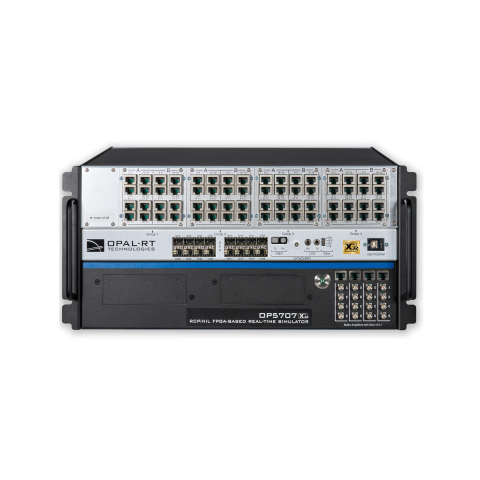
High-end Simulator
OP5707XG2
Unequalled level of performance in a co-simulation platform, featuring an AMD Virtex™-7 FPGA and up to 16 cores of the latest Intel® Xeon® CPUs, both required for power systems and power electronics applications.

EMT Simulation and HIL Testing for Simulink®
ARTEMiS
Designed for Simulink® and SimPowerSystems, ARTEMiS enables accurate, real-time simulation of power systems and power electronics with advanced decoupling, preserving fidelity in complex grid models.
Resources
Discover success stories using our products
Explore how leading institutions and organizations leverage our cutting-edge solutions to achieve remarkable results. From marine power systems to railway simulations and all-electric ships, these success stories showcase the innovative ways our products are transforming industries.
Aalborg University’s marine power systems laboratory
Learn how Aalborg University uses HIL to design, test, and validate the integration of new technologies into various types of marine vessels, such as drilling, transport, and naval.

HIL simulation for rolling stock vehicles
Discover how SNCF Voyageurs’ project, SimHIL, uses HIL simulation systematically to test railway traction chain control electronics, and, in so doing, prevent risks & significantly reduce the costs and delays of this essential testing process.

Optimizing integrated power systems in all-electric ships
Learn how researchers at the University of Michigan use our simulators for analysis & optimization of all-electric ship integrated power systems.

FAQ
Find the answers to your questions
Where can I find more information on your onboard power systems product offering?
Because onboard systems resemble microgrids in terms of challenges and needs, we recommend visiting our microgrid page here.
How does OPAL-RT support the development and validation of onboard power systems?
We provide real-time simulation platforms that allow you to model, test, and validate onboard power systems early in the design cycle. Our HIL and PHIL solutions help you verify control and protection logic under realistic operating conditions, ensuring your systems meet performance, reliability, and regulatory requirements before physical prototypes are built.
What industries can benefit from OPAL-RT’s onboard power system simulation tools?
We work with engineers and researchers across aerospace, marine, and rail industries—anywhere that electrification is transforming onboard systems. Whether you’re developing all-electric aircraft, naval vessels, or high-speed trains, our real-time simulation tools help reduce cost, risk, and development time while supporting stringent compliance and survivability standards.
What are the key advantages of using real-time simulation for shipboard or airborne power systems?
Real-time simulation allows you to test complex power systems under a wide range of operating scenarios, including generators, converters, and loads. You can identify faults, optimize control strategies, and evaluate system responses to component failures or dynamic loads, all without endangering physical hardware or crew safety.
How are organizations using OPAL-RT for real-world projects?
Institutions like Aalborg University and companies such asSNCF use our solutions to simulate and validate complex onboard power systems. Whether it’s marine propulsion or next-gen transport networks, our customers rely on us to deliver high-fidelity testing environments that help them innovate, meet compliance targets, and accelerate their development cycles.
What communication protocols do you support?
Consult our comprehensive list of supported protocols here.

Let’s get to work
Whether you need more details or have a specific question, our experts are here to help. Contact us today for personalized support.
EXata CPS has been specifically designed for real-time performance to allow studies of cyberattacks on power systems through the Communication Network layer of any size and connecting to any number of equipment for HIL and PHIL simulations. This is a discrete event simulation toolkit that considers all the inherent physics-based properties that will affect how the network (either wired or wireless) behaves.