Microgrid and renewable energy
As a pioneering leader in power systems simulation, working with world-leading utilities for over three decades, we have helped deploy cutting-edge microgrid real-time simulation projects globally. Always at the cusp of innovation, our solutions test the systems required for any level of microgrid control, whether through real-time or accelerated simulation.

They trust us


Challenges
From lab to field: a smarter path to microgrids
Microgrids pose unique challenges over traditional power grids: variable topologies, complex control and protection systems, fast power electronics, and the need to interoperate multivendor equipment. These challenges make field testing complex and risky.
The IEEE 2030.8-2018 standard recommends hardware-in-the-loop (HIL) and power hardware-in-the-loop (PHIL) testing for the development, validation, and integration of microgrid control and protection systems. With HIL, you can test and optimize devices prior to release and installation, accelerate R&D and integration, and demonstrate proofs of concept.
Applications
Hardware-in-the loop and power hardware-in-the loop made for microgrids
Using HIL and PHIL for microgrid controller testing. Our HIL and PHIL advanced and entry-level systems allow engineers and researchers to design and validate their models, perform power grid studies, and emulate AC or DC grids to test power devices under different operating conditions.

Advantages
Why choose OPAL-RT?
With decades of collaboration alongside industry leaders and world-renowned research institutions, our expertise in HIL systems continues to drive innovation in microgrid and renewable energy applications.
Test fast DER controllers
Efficient Co-Simulation
Exclusive IEEE 1547-compliant inverter control library
Unmatched speed for tightly coupled models
Success story
HIL for Hawaii’s renewable grid in collaboration with Siemens
To support Hawaii’s goal of 100% renewable energy, Siemens and OPAL-RT deployed a real-time HIL simulation to test and validate advanced grid control systems. Using a digital twin of the island’s power grid, the project ensures stable, resilient operation in high-renewable scenarios—paving the way for smarter, cleaner microgrids.
The development and validation of innovative solutions for such systems is not possible without a high-fidelity digital twin of the real system. For our project, OPAL-RT was of great support to develop this virtual environment for our demonstrator.
Dr. Ulrich Muenz
Principal Key Expert Control Systems at Siemens

Products
The essentials for microgrid testing
Discover the tools that professionals depend on for fast and precise testing. Ensure optimal performance with our products.
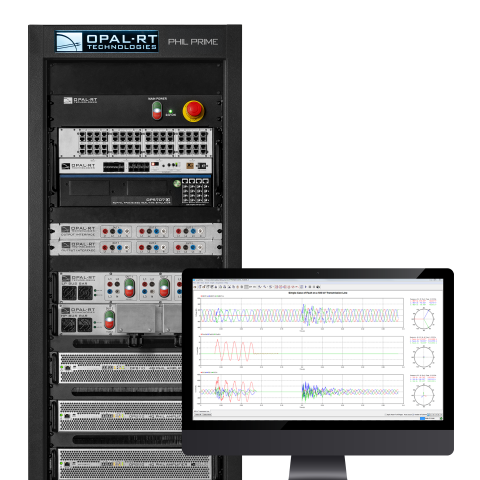
4-Quadrant PHIL Amplifier
OP1400PR
A fully-integrated and modular power hardware-in-the-loop (PHIL) test bench designed to provide seamless, flexible, and high-performance power testing capabilities for researchers and manufacturers.

Ultra-Fast EMT Simulation and HIL Testing
eHS
Advanced FPGA technology for high-fidelity, low-latency, power systems and power electronics simulation, enabling HIL testing across energy, automotive, aerospace, and industrial applications.

EMT Simulation and HIL Testing
HYPERSIM
High-fidelity platform for EMT simulation, SIL and HIL testing, ideal for validating control, protection, grid integration and large-scale stability across all stages of power system development.
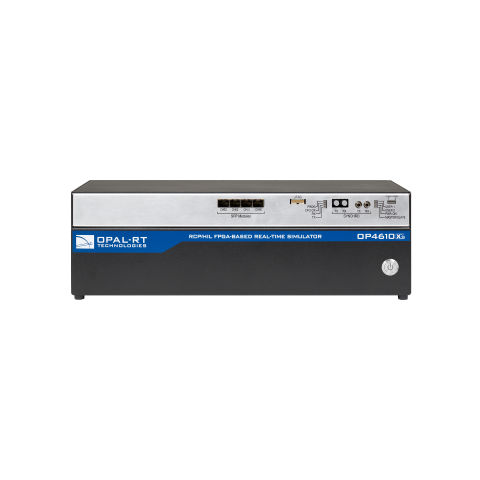
Compact mid-range simulator
OP4610XG2
Compact yet powerful mid-range simulator offering an all-in-one solution combining an Intel® Core™ i5 6-core CPU, an AMD Kintex™-7 410T FPGA, and OPAL-RTLinux that integrates our strengths in high-performance RCP and HIL.
FAQ
Find the answers to your questions
How does OPAL-RT’s HIL and PHIL technology accelerate the development of microgrid control systems?
Our hardware-in-the-loop (HIL) and power hardware-in-the-loop (PHIL) solutions let you simulate complex microgrid environments with high fidelity and in real time, without the risk and cost of field testing. We support controller testing across primary, secondary, and tertiary levels, and align with IEEE 2030.8-2018 standards to help you safely and efficiently validate your microgrid integration strategies.
What makes OPAL-RT’s real-time simulators ideal for testing high-speed DER controllers?
We design our simulators to handle the demands of fast-acting distributed energy resource (DER) controllers. With sub-microsecond EMT simulation, low-latency architecture, and high-speed I/O, our platform gives you the precision needed to validate DER performance under realistic grid conditions. We also support industry-standard protocols like IEC 61850, C37.118, DNP3, and Modbus to ensure seamless communication.
Why is OPAL-RT’s IEEE 1547-compliant inverter library important for smart grid development?
We’re proud to offer the only smart inverter control library built specifically for IEEE 1547 compliance. This library gives you a major advantage when it comes to validating interconnection performance, automating grid support testing, and accelerating certification of both grid-forming and grid-following inverters, especially in renewable-rich distribution scenarios.
How does OPAL-RT enable accurate simulation of tightly coupled power electronic systems?
When your models can’t be parallelized, raw processing power matters. That’s why we optimize our CPU-based solvers to handle tightly coupled systems, achieving sub-50 μs time steps even on complex benchmarks like GHOST from NREL/MIT. For even further performance, our FPGA solver is available to model converters with switching frequencies in the hundreds of kilohertz. This allows you to simulate fast-switching, high-fidelity power electronic systems in real time, without compromise.
What real-world results have been achieved using OPAL-RT for microgrid applications?
We partnered with Siemens to help build a digital twin of Hawaii’s power grid, supporting the state’s 100% renewable energy goal. Using our real-time HIL simulation, the project validated advanced grid control strategies and ensured operational stability under high renewable penetration. This is just one example of how we help turn lab innovation into real-world impact for modern microgrids.
What communication protocols do you support?
Consult our comprehensive list of supported protocols here: Communication Protocols

Let’s get to work
Please contact us for more details or any inquiries. Our local team of experts will be pleased to promptly answer any of your questions.
EXata CPS has been specifically designed for real-time performance to allow studies of cyberattacks on power systems through the Communication Network layer of any size and connecting to any number of equipment for HIL and PHIL simulations. This is a discrete event simulation toolkit that considers all the inherent physics-based properties that will affect how the network (either wired or wireless) behaves.