
Key takeaways
- Real-time and hardware-in-the-loop validation cuts risk by exposing timing, protection, and communications issues before field work.
- A single, version-controlled feeder model supports off-line studies, real-time execution, and operator checks without rebuilds.
- Time synchronization, common I/O, and standard protocols connect planning, testing, and operations for an advanced distribution network.
- DERMS links microgrid design intent to operational limits, improving voltage, frequency, and reserve outcomes.
- Automated reporting creates repeatable evidence that speeds approvals, improves safety, and reduces commissioning effort.
Reliable power systems come from practical tools, not wishful thinking. Across distribution networks and microgrids, teams face tight schedules, complex controls, and hard safety limits. Clear, hands-on tooling shortens the path from concept to commissioning. Engineers rely on advanced toolsets to test ideas early, validate controllers, and cut risk before field work.
Project success often hinges on what can be proven in the lab before a breaker ever closes. Hardware and software must work as one, with timing, protection behaviors, and communications checked under stress. A balanced stack that includes real-time simulation, hardware-in-the-loop testing, and operational platforms lets teams make confident calls. Practical examples connect tool choices to reliability, cost, and schedule outcomes.
Understanding how advanced tools shape distribution networks and microgrids

Modern distribution projects now carry bidirectional power flows, inverter-rich feeders, and protection settings that must hold under fast events. Engineers cannot afford guesswork when protection margins, tap changes, and dispatch targets interact across many devices. A tool-first approach makes challenging studies easier to repeat, review, and improve, which keeps designs consistent as projects scale. Early validation also prevents field retrofits, which protects the schedule and budget.
Field teams benefit when models, controllers, and operator platforms share a single source of truth. The same feeder model can run off-line for planning, step into real time for controller tests, and then supply data to operations. Interfaces that support time sync, network protocols, and hardware I/O allow each phase to reuse assets from the last phase. That continuity lowers rework, improves traceability, and raises confidence during commissioning.
5 advanced tools for distribution networks and microgrid design
Successful projects start with tools that reduce uncertainty, expose edge cases, and provide repeatable evidence. Precision matters when simulating inverter controls, protection pickup, and feeder voltage support during faults. Consistency matters when every model change can be traced, replayed, and audited. Teams that invest in the right stack find it easier to scale from a single feeder to an entire site or campus.
1. Real-time digital simulators for precise testing
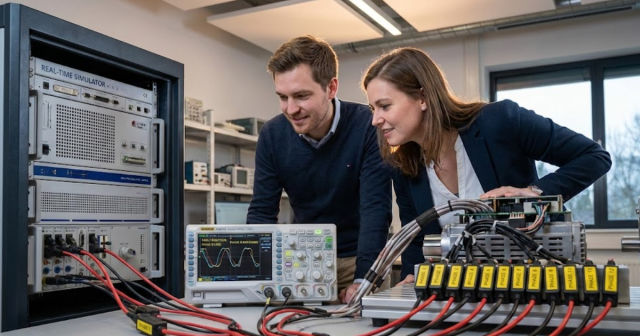
Real-time digital simulators execute electromagnetic transient (EMT) models at fixed time steps, often in the 1 to 50 microsecond range. This timing reveals converter control behavior, sub-cycle harmonics, and fast protection transients that phasor tools smooth out. High-performance hardware combines central processing unit (CPU) and field programmable gate array (FPGA) resources to keep switching events and network calculations stable under heavy loads. Engineers can link analog and digital I/O to external controllers, power amplifiers, and protection relays, which creates a closed loop without waiting for field construction.
Strong time synchronization is essential for accurate replay and correlation. Precision Time Protocol (PTP) and Inter-range instrumentation group time code (IRIG‑B) align simulated events with controller data, feeder measurements, and oscillography. That shared timeline lets teams compare protection pickup and clearing time to target settings with sub-millisecond accuracy. For an advanced distribution network, this level of fidelity reduces nuisance trips, tightens voltage targets, and supports flexible microgrid design choices across storage, solar, and load controls.
2. Hardware-in-the-loop systems for control validation
Hardware-in-the-loop (HIL) places the controller under test in a closed loop with a simulated plant. Controller‑hardware‑in‑the‑loop (C‑HIL) connects I/O signals, communications, and timing so that firmware runs as it will on site. Power‑hardware‑in‑the‑loop (PHIL) adds a power interface to exercise converters, contactors, and sensors at realistic currents and voltages. This setup exposes integration issues such as sensor scaling, filtering delays, and debounce logic well before field work begins.
Real projects rarely use one protocol or one vendor for communications. Interfaces for International Electrotechnical Commission (IEC) 61850, Generic Object Oriented Substation Event (GOOSE), Sampled Values, Modbus, and Distributed Network Protocol 3 (DNP3) allow protection and control devices to talk to the simulation at line rate. Engineers can replay faults, communications dropouts, and voltage sags, then check protections, droop settings, and islanding sequences. That process reduces on‑site commissioning time, and it cuts nuisance alarms that would otherwise frustrate operators during early operation of an advanced distribution network.

3. Power system modeling and simulation software
Planning and protection studies still rely on offline tools, and those tools remain valuable when they connect cleanly to real‑time steps. Phasor‑domain studies guide feeder reconfiguration, capacitor placement, and steady‑state limits with fast run times across many operating points. EMT tools then verify controls, harmonics, and interactions under faults where detail matters. A clear split between the two lets teams choose the right level of detail without overloading compute resources.
A productive modeling flow tracks data sources, device libraries, and assumptions. Functional Mock‑up Unit (FMU) exchanges and scripting in Python keep models portable, testable, and version-controlled. Parameter sweeps and scenario packs make it easy to produce heat maps, staging plans, and acceptance thresholds for protection and control. Strong links between off‑line studies and real‑time execution turn models into a foundation for microgrid design that stands up to audit, review, and field checks.
Successful projects rely on tools that create trustworthy evidence, shorten iteration cycles, and connect lab results to field outcomes.
4. Distributed energy resource management systems
Distributed energy resource management systems (DERMS) coordinate storage, solar, controllable loads, and feeders under both normal and islanded operation. Engineers configure constraints for feeders, transformers, and tie breakers, then set policies for active, reactive, and state‑of‑charge targets. When conditions shift, DERMS applies those policies to keep voltage, frequency, and loading inside limits. Islanding, resynchronization, and safe return to grid supply can be tested thoroughly when DERMS is coupled to real‑time simulation or HIL.
For an advanced distribution network, DERMS becomes the operational layer that turns plans into reliable actions. The platform can issue dispatch commands, run volt‑VAR functions, and coordinate under‑frequency events without manual intervention. Links to measurement and protection systems give the operator timely feedback on constraint margins and reserve status. That feedback loop guides microgrid design refinements such as inverter sizing, storage duration, and protection settings, which lowers cost and increases reliability.
5. Grid automation and monitoring platforms
Supervisory control and data acquisition (SCADA) and distribution management system (DMS) platforms provide operator visibility and control for feeders, devices, and tie points. Advanced distribution management system (ADMS) functions add outage management, state estimation, and fault location to speed up restoration. Phasor measurement units (PMUs) and micro‑PMUs raise temporal resolution for feeders where converters and fast relays interact. Wide area measurement systems (WAMS) combine those signals so engineers can see oscillations and weak‑grid behaviors that slow scans will miss.
Strong event visibility leads to stronger protection and control coordination. With quality time sync, operators can confirm that controls, relays, and breakers respond as intended. Engineers can push recorded events back into HIL or real‑time simulation to test alternative settings and sequences. That closed loop helps both utility and facility teams refine microgrid design choices and maintain a stable, efficient advanced distribution network through its full lifecycle.
Successful projects rely on tools that create trustworthy evidence, shorten iteration cycles, and connect lab results to field outcomes. Engineers gain more value when those tools interoperate through common time sync, I/O, and data formats. Clear ownership of models, data, and test plans keeps multi‑party teams aligned, which removes guesswork during handoffs. A tool‑centric approach delivers safer operations, lower costs, and less rework from early design to long‑term maintenance.
How engineers integrate advanced tools to improve project reliability and efficiency

Integration pays off when each phase builds on the last, so results carry forward without rework. Teams start with a model that matches the one‑line, then connect controllers, relays, and communications in a loop that mirrors the site. Test benches capture timing, limits, and alarms so findings can be repeated and reviewed later. Clear stage gates move projects from modeling to HIL to field procedures with fewer surprises.
- Scope the physics first: Decide where phasor studies are sufficient, and where electromagnetic transient detail is essential. This prevents wasted effort, and it ensures compute budgets land where they add the most value.
- Build a reference feeder model: Create a single source of truth for impedances, loads, and devices, then lock baseline snapshots. This supports change control, and it lets teams compare results across revisions with confidence.
- Close the loop with C‑HIL: Connect the controller to the plant model using the same I/O ranges, filtering, and timing you expect at the site. This catches scaling errors, edge‑trigger glitches, and debounce issues early.
- Stress the controls with scenario packs: Run short‑circuits, voltage sags, flicker sources, and high‑frequency disturbances in a repeatable set. This produces coverage metrics, and it exposes limits before field crews encounter them.
- Validate protection selectivity: Inject faults, change feeder topology, and confirm pickup, coordination margins, and clearing times. This tightens settings and reduces nuisance operations during energization.
- Stage PHIL for converters and relays: Use a power interface to exercise hardware at realistic currents and temperatures. This reveals thermal effects, contact wear, and measurement behavior that signal‑only tests will miss.
- Automate reports and sign‑offs: Script acceptance checks, plots, and pass‑fail criteria so every run generates the same evidence bundle. This speeds reviews, and it creates a clean audit trail for regulators, insurers, and owners.
Reliable power systems come from practical tools, not wishful thinking.
| Integration step | Primary tool | Primary outcome | Typical timeframe | Quality gates |
| Baseline feeder build | Off‑line phasor modeling | Verified power flow, loading, and taps | 1–2 weeks | Matches one‑line, meets voltage limits |
| EMT detail for converters | Real‑time simulator with EMT | Controller stability and waveform fidelity | 1–3 weeks | Time step stability, harmonic limits met |
| Closed‑loop control | C‑HIL with I/O and protocols | Firmware proven under stress | 1–2 weeks | I/O scaling correct, no watchdog trips |
| Protection coordination | HIL with relay models or hardware | Selective, fast clearing under faults | 1–2 weeks | Pickup, coordination, and breaker timing |
| Operational checks | DERMS and SCADA test bench | Dispatch, alarms, and operator workflows | 1 week | Correct limits, accurate state and events |
| Field procedure rehearsal | HIL replay with recorded data | Clear energization and islanding steps | 3–5 days | All steps pass, communications stable |
Projects move faster when the same assets support planning, testing, and operations. Evidence becomes easier to reuse, which shortens meetings and speeds approvals. Teams also develop a shared understanding of risks, limits, and acceptable workarounds. That clarity improves safety, uptime, and cost control for the entire lifecycle.
How OPAL-RT supports engineers in designing advanced distribution networks and microgrids
OPAL-RT helps engineers reduce uncertainty from the first model through final verification. Our real‑time simulation platforms deliver sub‑millisecond steps for EMT studies, which bring converter controls, relays, and grid‑forming modes into clear focus. Open interfaces for I/O, protocols, and time sync link quickly to controllers, protection devices, and operator platforms. That openness preserves past investments in models and test benches, and it supports a modular path as projects scale.
We pair high‑performance simulators with a software stack built for model reuse, automated testing, and smooth handoffs. Teams can combine off‑line studies, HIL tests, and operator checks without rebuilding the setup each time. Support for standards such as IEC 61850, GOOSE, DNP3, PTP, and IRIG‑B makes it straightforward to validate communications at line rate. Engineers who need practical proof under tight schedules count on OPAL-RT for accuracy, repeatability, and knowledgeable assistance.
Common questions
What tools are used in advanced distribution networks and microgrid design?
Projects typically pair off‑line phasor studies with real‑time EMT simulation. Closed‑loop validation then uses hardware‑in‑the‑loop to connect controllers, relays, and, when needed, power interfaces. A distributed energy resource management system coordinates dispatch, reserves, and islanding. Grid automation platforms supply operator control, alarms, and high‑resolution monitoring, which keep the advanced distribution network stable across changing conditions.
How do advanced tools improve distribution networks and microgrid projects?
Real‑time simulators expose timing issues that off‑line runs will hide, so fixes land before field work. HIL tests reveal scaling errors, race conditions, and mis‑wired I/O that would otherwise surface during commissioning. DERMS links plans to operational limits, which prevents stress on feeders, transformers, and inverters. Operator platforms improve visibility and fast response, which shortens outages and keeps the microgrid design within planned limits.
Which technologies support modern distribution networks and microgrids?
High‑fidelity EMT models handle converter controls, harmonic content, and fast protection. Phasor‑domain models provide quick power‑flow checks across many scenarios. Time synchronization using PTP or IRIG‑B aligns simulations, controllers, and measurements for accurate comparison. Communications built on IEC 61850, GOOSE, Modbus, and DNP3 connect the lab setup to field devices without custom one‑off code.
How do engineers choose between electromagnetic transient and phasor‑domain modeling?
Phasor studies are well-suited for steady‑state power flow, voltage profiles, and feeder settings across many cases. EMT models are suited for short‑duration events, converter control loops, and detailed protection timing. A blended approach often works best, with phasor runs guiding siting and sizing, and EMT runs proving fast dynamics. Teams pick the simplest model that answers the specific question, then move to higher detail only when evidence requires it.
What metrics show a microgrid design is ready for field deployment?
Look for coverage of fault types, voltage sags, communications dropouts, and islanding, backed by repeatable HIL runs. Confirm controller stability margins, protection selectivity, and reserve levels for storage and generation. Verify communications latency, time sync accuracy, and alarm fidelity under load. A project earns a green light when those metrics meet agreed thresholds and when procedures for energization, islanding, and resynchronization have been rehearsed successfully.
Clear tooling, strong time sync, and disciplined test planning provide confidence from the first model to field operation. Teams that reuse assets across phases avoid costly rebuilds, and they gain traceable evidence for audits. The approach scales from a single feeder to a campus or utility site without changing how proof is gathered. That consistency keeps costs in check and supports safe, reliable service.
Real-time solutions across every sector
Explore how OPAL-RT is transforming the world’s most advanced sectors.
02 / 28 / 2026
12 phase PMSM validation checklist for mission critical drives
A practical 12 phase PMSM validation checklist covering acceptance criteria, 12 tests, multiphase HIL fault injection, pass fail evidence, test sequencing from SIL to dyno, and common setup errors.

Power Electronics
02 / 27 / 2026
Cloud Simulation for Power Electronics Development
Covers how cloud simulation supports power electronics modeling, faster run cycles, control validation, and the cost and security tradeoffs when selecting a cloud stack.
Simulation
02 / 26 / 2026
CPU versus FPGA simulation for high speed motor drive testing
Compares CPU and FPGA real-time simulation for high speed motor drive HIL testing, focusing on timing limits, solver step size, switching fidelity, I/O latency, and acceptance criteria.
EXata CPS has been specifically designed for real-time performance to allow studies of cyberattacks on power systems through the Communication Network layer of any size and connecting to any number of equipment for HIL and PHIL simulations. This is a discrete event simulation toolkit that considers all the inherent physics-based properties that will affect how the network (either wired or wireless) behaves.