Key Takeaways
- Set clear study questions, fidelity needs, and runtime budgets so faster results stay defensible.
- Use accelerated simulation to widen scenario coverage and validate inverter, protection, and grid-code behavior before commitments lock in.
- Match acceleration methods to each project phase and protect accuracy with model version control, benchmark cases, and repeatable lab workflows.
Accelerated simulation helps you validate grid and plant choices faster with fewer surprises.
Energy projects stall when studies take weeks and answers arrive late. More than 2,000 GW of generation and storage sat in U.S. interconnection queues at the end of 2022. That backlog makes faster, trustworthy analysis a practical requirement. Accelerated simulation shortens the loop between a question and a defensible result.
Accelerated simulation in energy simulation means you run the same study set faster or you run more studies in the same time. The goal is not speed for its own sake; it’s tighter control of risk, cost, and schedule. You still need validated models, clear assumptions, and repeatable workflows. When those pieces are in place, you can act with confidence earlier.
Define grid study scope and speed targets for simulation
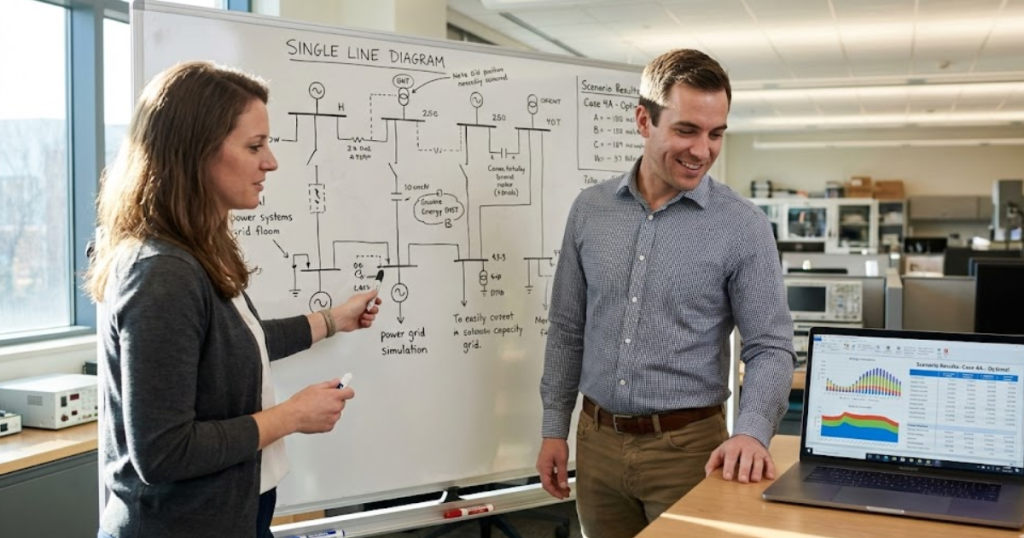
Start by writing down the study question, the time scale, and the acceptable error. Those three choices set the right model type, from steady-state power flow to detailed electromagnetic transients. A speed target is useful only when it is tied to a delivery date and a scenario count. That framing keeps accelerated simulation honest.
Scope also means deciding what needs detail and what can be simplified. Weak-grid behaviour, inverter controls, and protection actions need small time steps and careful solvers. Thermal limits or voltage profiles can use coarser resolution. Lock the scope before chasing runtime improvements.
- The decisions the study will support
- The model fidelity required for those decisions
- The number of scenarios and contingencies to run
- The runtime budget per scenario and total deadline
- The validation checks that guard against bad assumptions
“Speed work starts after inputs are stable.”
Parallel runs, model reduction, and hardware acceleration help, but each has limits. Treat runtime as a budget you spend on fidelity where it matters. You’ll avoid fast answers you can’t defend.
5 ways accelerated simulation strengthens energy project outcomes
Accelerated simulation improves energy projects when it expands the set of risks you can check before commitments lock in. The value shows up in better sizing, stronger control design, fewer late fixes, and tighter test cycles. These five gains map to common project phases. Each one has different setup needs.
1. Run more scenarios per hour for siting and sizing
About 510 GW of renewable capacity was added globally in 2023. That volume forces interconnection, siting, and sizing teams to evaluate many grid conditions, not a single peak hour. Accelerated simulation lets you run long time series, contingency sets, and parameter sweeps within a workday. Consider a 150 MW solar plant paired with a 60 MW 240 MWh battery that must meet a specific export limit at the point of interconnection. A faster scenario pipeline helps you compare control settings and battery sizes across seasonal irradiance and outage cases before procurement locks in. That same throughput also makes sensitivity checks routine, instead of a late add-on. The practical result is fewer redesign loops and a cleaner path through review.
2. Test inverter controls under fast transients and faults
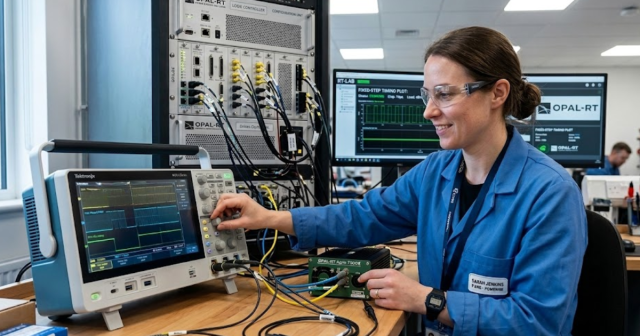
Testing inverter controls under faults often requires electromagnetic transient models with sub-millisecond steps. Those runs get expensive once you add cable models, transformer saturation, and multiple converters at the same bus. Accelerated simulation gives you headroom to test more fault types, weaker grid strengths, and harsher recovery settings without cutting corners. You can check current limiting, phase-locked loop behavior, and voltage ride-through logic against the grid code limits that matter for acceptance. Faster turnaround also improves collaboration between protection and controls teams because both can iterate on the same set of events. The tradeoff is model discipline, since small errors in control blocks can look like stability issues. Plan time to tune numerical settings, or the run speed will come at accuracy cost.
3. Validate protection and grid codes with closed-loop HIL
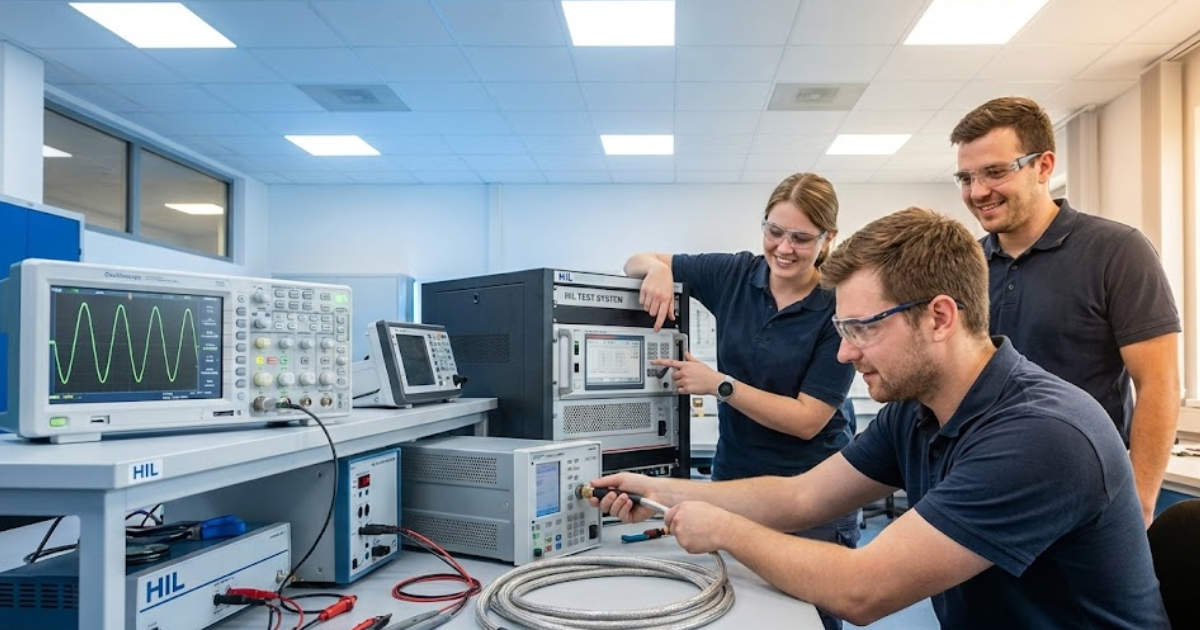
Closed-loop hardware-in-the-loop testing connects a real controller or relay to a simulated grid in real time. That setup reveals timing issues, filtering choices, and saturation effects that software-only tests often miss. Accelerated simulation keeps the loop stable even with detailed network models and fast switching behaviour. Teams often use OPAL-RT real-time digital simulators to interface protection relays, plant controllers, and measurement devices over standard lab signals. You can validate trip logic, breaker failure schemes, and grid code functions while logging signals at the same rates you’ll see in the lab. The key constraint is I/O and time synchronization, since poor time alignment will spoil otherwise good results. Put the acceptance criteria in writing so everyone agrees what a pass really means.
4. Find instability and interoperability issues before field commissioning
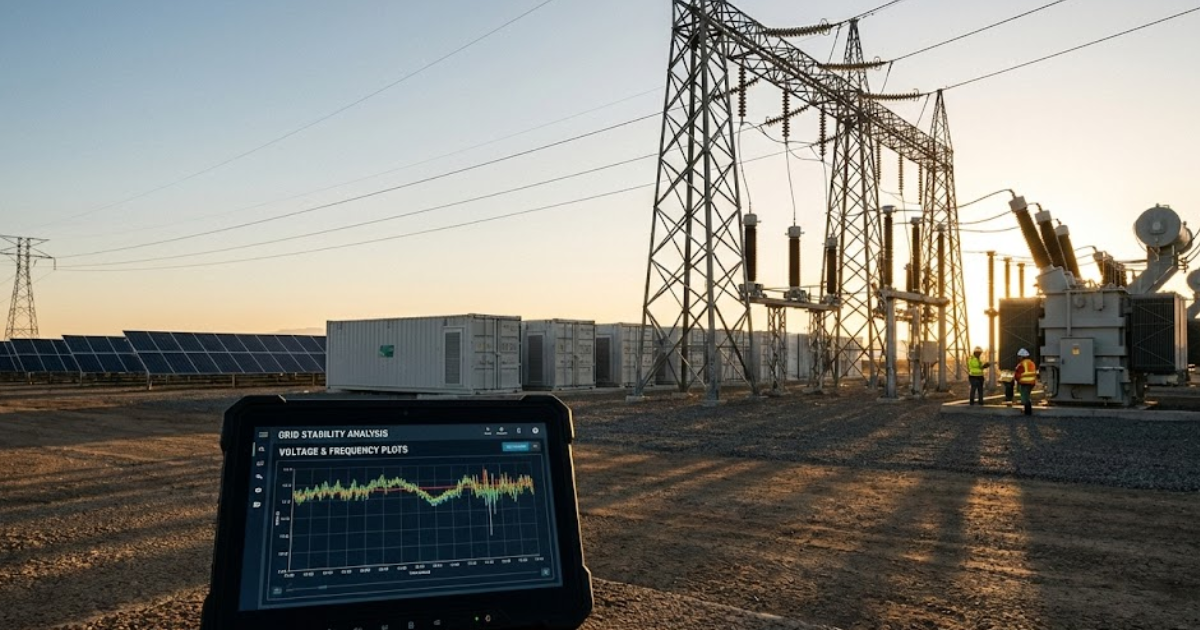
Many late-stage problems come from interactions between devices that were designed in isolation. Oscillations, harmonic amplification, and control fighting can appear only when multiple vendor models run on the same network with the same assumptions. Accelerated simulation supports larger combined models, longer disturbance windows, and more parameter combinations, which makes these issues visible earlier. You can test how plant-level voltage control interacts with feeder regulators, capacitor banks, and neighbouring inverter-based resources. Faster runs also help you separate a true stability limit from a numerical artifact, because you can repeat cases with alternate solvers and step sizes. Good outcomes still depend on model transparency, since black-box blocks hide the root cause. When vendors share only partial detail, insist on test cases that expose key control behaviour.
5. Cut lab and compute costs while keeping fidelity
Compute time and lab time both cost money, and slow studies push expensive work into the last weeks of a schedule. Accelerated simulation reduces the number of overnight runs and shortens the feedback loop between a model change and a verified result. You can keep higher fidelity where it affects risk, then simplify the rest without rewriting the entire model. Hardware acceleration and parallel execution also reduce the need for large shared clusters, which helps smaller teams keep work moving. The caution is that optimization can hide quality problems, so you still need regression tests and version control for models. When that discipline is present, you spend less time waiting and more time verifying. Track compute cost per study so budgets stay predictable.
| Item focus | What you get sooner |
|---|---|
| 1. Run more scenarios per hour for siting and sizing | You lock sizing choices after broader stress testing, not best guesses. |
| 2. Test inverter controls under fast transients and faults | You confirm fault response limits before late tuning becomes schedule risk. |
| 3. Validate protection and grid codes with closed-loop HIL | You verify timing and trip behaviour using the same signals used in labs. |
| 4. Find instability and interoperability issues before field commissioning | You catch device interaction problems early enough to fix them cleanly. |
| 5. Cut lab and compute costs while keeping fidelity | You spend less time waiting on runs while keeping checks that matter. |
Match accelerated simulation approaches to planning, design, and commissioning
The right accelerated simulation method depends on your project phase and the question you must answer. Planning teams gain most from high-throughput scenario runs on simplified network models. Detailed design needs electromagnetic transient studies for converter and protection behaviour. Commissioning benefits from real-time closed-loop tests that match lab signals.
“Speed counts only when those benchmarks stay intact.”
Treat model inputs like engineering requirements with versioning and sign-off. Keep a small set of benchmark cases that must reproduce after every change. Set a runtime budget per study type, then check it after major design updates.
Lab workflows also hinge on I/O planning and time sync, not just compute speed. OPAL-RT is often used when teams need stable real-time execution for repeatable HIL tests. The best results come from a calm, repeatable process. When you can rerun key cases on demand, field issues drop.
Real-time solutions across every sector
Explore how OPAL-RT is transforming the world’s most advanced sectors.
Industry applications, Simulation
03 / 31 / 2026
Managing high-frequency switching in real-time EMT simulation
Precision in testing complex power systems is essential to avoid failures, accelerate innovation, and integrate new technologies safely.

Simulation
03 / 30 / 2026
Understanding timestep requirements for modern power converters
Practical criteria for selecting EMT and real time simulation timesteps for power converters, covering switching resolution, control and PWM timing alignment, multirate approaches, and verification checks.
Industry applications, Simulation, Energy
03 / 29 / 2026
Validating data center energy management systems using real-time HIL
This piece explains how AI workload variability affects data centre power stability and how closed-loop HIL testing helps validate EMS control behaviour under site and grid stress.
EXata CPS has been specifically designed for real-time performance to allow studies of cyberattacks on power systems through the Communication Network layer of any size and connecting to any number of equipment for HIL and PHIL simulations. This is a discrete event simulation toolkit that considers all the inherent physics-based properties that will affect how the network (either wired or wireless) behaves.