Key Takeaways
- Simulation answers a bounded engineering question and ends, while a digital twin stays bound to one deployed asset through live measured data.
- Live data connection, one named unit and ongoing reconciliation separate a twin from even the most detailed offline model.
- Twins earn their cost only when a single asset carries enough consequence to justify permanent data plumbing and model upkeep.
A simulation answers a question you ask once, and a digital twin keeps answering it for as long as the physical asset stays in service.
That one distinction settles most of the confusion between the two terms, and it settles the budget conversation that follows. Simulation is a method. You build a model, run it against a scenario, read the result, and shut it down. A digital twin is a persistent instance of that model, bound to one piece of hardware by a live data link and kept current while the hardware runs. Money follows the confusion, since the simulation digital twin market is projected to reach $379 billion by 2034, up from $35 billion in 2024.
Getting the boundary right matters because the two carry different costs. A simulation study ends when the report is signed. A twin creates a standing commitment to data plumbing, model upkeep and validation against measurements that keep arriving. Teams that treat a twin as a fancier simulation end up with a stale model wearing a live label, and that’s an expensive way to be wrong.
What a simulation actually does inside an engineering workflow
Simulation runs a model of a system through a defined scenario to answer a bounded question, usually before hardware exists or gets put at risk. It has a start, an end, assumptions you control, and a result you compare against a requirement. Nothing stays connected once the run finishes.
Take a traction inverter headed for a first vehicle build. The team runs thousands of closed-loop cases against a plant model, sweeping temperature, battery state of charge and fault timing, until the control software survives conditions no prototype could safely see. Hardware-in-the-loop rigs belong here too, since the controller is real and the plant is modelled.
Value comes from questions you can ask cheaply. You can inject a phase-to-ground fault a hundred times in an afternoon without damaging a stack, then rewind to the millisecond the current regulator lost control. What you don’t get is any claim about a specific unit in the field.
What a digital twin adds beyond a standalone model
A digital twin is a model of one specific physical asset, kept synchronized with that unit through measured data so its state tracks the hardware over time. The modelling underneath is ordinary simulation work. What makes it a twin is the binding to a serial number and the obligation to stay current.
A wind turbine twin shows the shift plainly. Once nacelle vibration, pitch angle and generator current stream in every few seconds, the drivetrain model stops describing turbines in general and starts describing turbine 41 on row 3. Operators use it to estimate gearbox fatigue no sensor reports directly.
Persistence is where the engineering cost lands. Sensors drift, firmware gets updated and components are replaced, so the twin needs a calibration routine pulling the model back toward measurement. Teams at OPAL-RT see this when a real-time model that passed acceptance testing needs re-tuning a year later. A twin that isn’t reconciled is an old simulation with a dashboard on top.
Where digital twin and simulation actually diverge in practice
The main difference between a digital twin and a simulation is the live data connection to one physical asset. A simulation is a bounded experiment on a generic model. A twin is a standing representation of a particular unit, updated from measurements, and judged on how closely it tracks that unit.
| What you are comparing | Simulation | Digital twin |
| Reason it exists | Answers one engineering question before a commitment | Tracks the condition of an asset already in service |
| Where inputs come from | The engineer running the case chooses every input | Sensors on the physical unit feed it continuously |
| How long it lasts | Ends when the test campaign closes | Runs as long as the asset stays in service |
| What it represents | A class of hardware under stated assumptions | One serial number with its own duty history |
| How it gets validated | Checked once against bench data or first principles | Reconciled against fresh measurements on a schedule |
| How it fails quietly | Wrong assumptions produce a confidently wrong answer | Broken data plumbing produces a confident stale answer |
“The main difference between a digital twin and a simulation is the live data connection to one physical asset.”
Boundary cases are where teams argue. A rig fed by recorded field data looks twin-like, and it stays a simulation, because the replay is fixed rather than tied to one live unit. Stream that data continuously from a named asset and you’ve crossed the line. The crossing point isn’t fidelity, since coarse twins run in production every day.
Choosing between a simulation study and a live digital twin
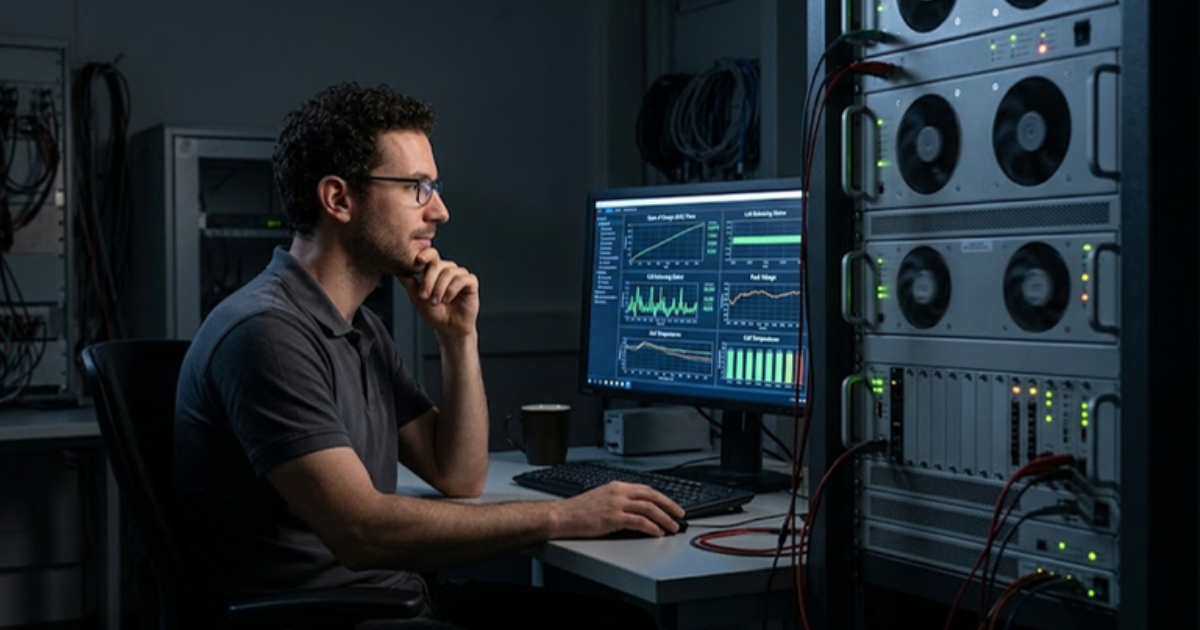
Pick simulation when the question ends. Pick a twin when the asset matters more than the answer. Programs that need a design decision, a certification result or a control tuning campaign get everything they need from simulation. Operations carrying consequence for one unit in the field justify the extra plumbing.
Grid operators show the calculation clearly. United States developers plan to add 86 GW of utility-scale capacity in 2026, with solar and battery storage accounting for 51% and 28% of that total. Power electronics at that share alter how a network responds within milliseconds, so planning studies stay in simulation, while a battery site under a settlement obligation earns a twin.
A twin earns its keep when several of these hold at once.
- One unit carries enough financial or safety consequence to justify constant attention.
- Sensors already exist on it and their readings survive calibration checks.
- The quantity you care about cannot be measured and has to be inferred.
- Someone owns the model after handover and holds budget to maintain it.
- A decision gets revisited often enough that a one-off study goes stale.
Most teams land between the two, starting with simulation models built for design validation and promoting a subset to twins once the asset ships.
Common misconceptions that blur the line between these terms
Three assumptions cause most of the trouble. A twin goes beyond a more detailed model, a 3D visualization on its own is not a twin, and real-time execution alone does not make something a twin. Each mistake sends budget somewhere it won’t pay back.
Visualization trips up the most teams. A rendered plant floor with live tag values is a dashboard sitting on a data historian. Nothing behind it computes what happens next, so ask it about a valve that hasn’t failed yet and it has nothing to say.
Fidelity confusion costs more. Teams assume a twin needs the highest resolution model they own, then find that a model too heavy to run faster than the asset itself can’t answer any forward-looking question. Twins get built at the coarsest fidelity that works, and detailed offline models stay where they belong, in design and validation.
“Twins get built at the coarsest fidelity that works, and detailed offline models stay where they belong, in design and validation.”
Common questions engineering teams ask about twins and simulations
Is a digital twin the same as a simulation?
No. Simulation is the method that computes behaviour, and a twin is one deployment of that method against a named physical asset with a live data feed. Every twin contains a simulation, and very few simulations are twins.
Can you build a digital twin without a physics model?
You can build a data-only twin from historical measurements and machine learning, and plenty of condition monitoring products work that way. It will struggle with operating points the asset has never reached, which is where physics earns its place.
Does real-time execution make a model a digital twin?
Real-time execution is a requirement for twins that keep pace with hardware, and it isn’t sufficient on its own. A hardware-in-the-loop rig runs in real time all day without being tied to a deployed unit, so it stays a simulation.
Which one should a team start with?
Start with simulation. The modelling, validation and parameter work carry straight into a twin later, and you’ll learn what the asset’s behaviour depends on first.
Getting the boundary right before you commit engineering budget
Clarity about the boundary saves more money than any tooling decision that follows it. Simulation earns its place by answering hard questions before hardware exists. A digital twin earns its place by staying honest about one asset that already runs. Confusing the two produces expensive models nobody trusts.
Discipline shows up in unglamorous places. Someone has to own model parameters after the project team disbands, someone has to notice when a sensor starts lying, and someone has to decide what accuracy the twin owes its readers. Teams that skip those answers find a model drifted away from the asset two firmware revisions ago, and nobody caught it.
The simulation layer is where that discipline starts, since a twin will only ever be as trustworthy as the model beneath it. OPAL-RT works at that layer, building real-time models validated against hardware, so the engine feeding a twin is one you can defend when someone asks how it knows. Get the model right and the twin becomes a maintenance question you can answer.

Power Electronics
10 / 17 / 2026
How wide bandgap devices push converter power density
Wide bandgap devices raise converter power density through faster switching and smaller passives, and this guide traces that chain from device physics to thermal limits to validation.
Power Electronics
10 / 15 / 2026
Flying capacitor converter simulation for multilevel designs
How a flying capacitor converter balances its capacitor voltages through switching, where that balance breaks, and what a switching-accurate simulation has to capture.

Industry applications
10 / 12 / 2026
Validating eVTOL electric propulsion before the first flight article
A walk through motor, inverter and battery validation for eVTOL aircraft and the points where real-time simulation carries propulsion evidence ahead of flight test.