
Key takeaways
- Digitalization introduces new communication layers, software components, and data flows that influence how engineers must think about cybersecurity in power systems.
- Distributed resources, digital substations, and enterprise platforms expand the number of devices and interfaces that can influence physical grid behaviour.
- Cybersecurity depends on understanding the combined behaviour of cyber and physical systems, which requires shared models, aligned teams, and detailed testing.
- Real time simulation provides a safe and credible way to observe equipment behaviour under communication stress, abnormal data patterns, and cyber related conditions.
- Cyber physical testbeds give engineering and security teams a practical path to validate controls, assess new architectures, and strengthen response strategies.
Every engineer working on a modern grid now carries cybersecurity responsibilities, even if they never appear in the job title. Digital controls, software based protection, and remote access help you run a more flexible and efficient system, but they also introduce new paths for attackers. A breaker operation, setpoint change, or mis-tagged asset now has both a physical consequence and a digital footprint. Choosing how to model, test, and secure that combined system has become just as important as selecting ratings for lines, transformers, or converters.
Many teams still treat cyber issues as a separate discipline that lives in another building, run by people who rarely touch a one-line diagram. That separation no longer reflects how actual systems behave. Control centres, substations, distributed resources, and field devices now form one continuous cyber-physical system. Engineers who understand digitalization and cybersecurity in power systems can guide requirements, challenge assumptions, and design tests that keep both electrons and packets under control.
“A breaker operation, setpoint change, or mis-tagged asset now has both a physical consequence and a digital footprint.”
Understanding digitalization and cybersecurity in power systems
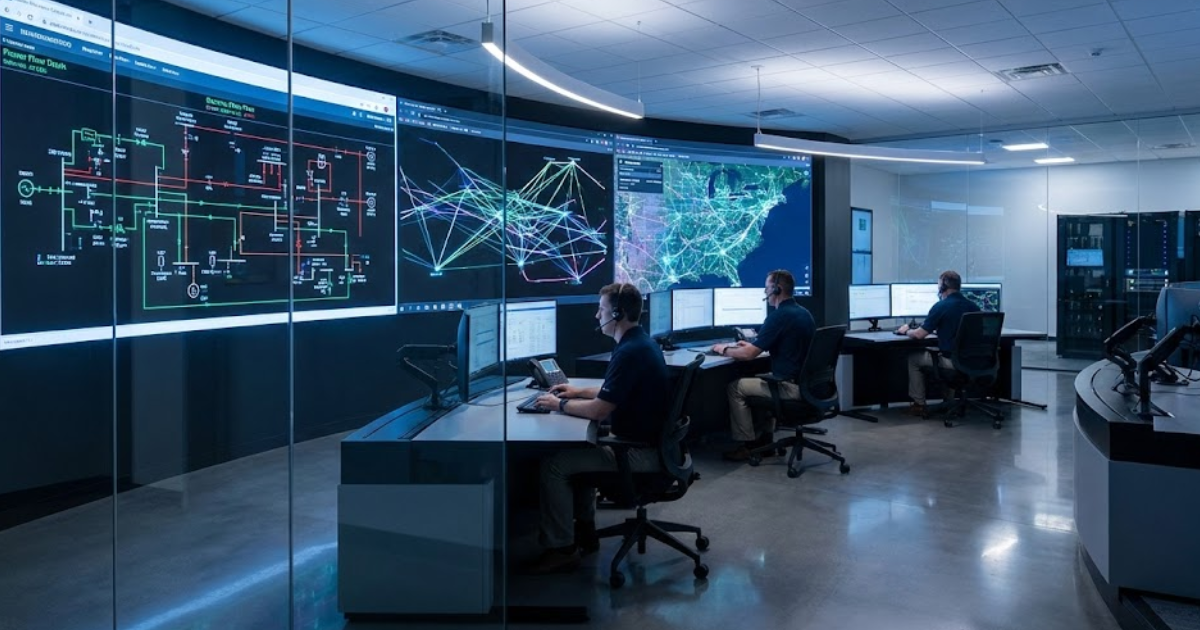
Digitalization in power systems describes the move from analogue, isolated equipment to assets that depend on software, communication networks, and data platforms. Utilities now use automation, sensors, and analytics to manage load, generation, and constraints with more precision. These tools support reliability, improve visibility, and make planning more adaptable to renewable resources. At the same time, dependence on digital systems means a cyber issue can have a direct physical impact.
Cybersecurity in power systems focuses on safeguarding the digital layer and the processes built on top of it. Standards require organisations to identify critical assets, control access, secure communications, and plan incident response. Increased digitalization widens the attack surface and raises the importance of protecting grid control logic, measurement systems, and distributed devices. For engineering teams, the central question is how to embed cybersecurity into modelling, testing, and validation workflows so that risks are understood early.
Digitalization trends shaping today’s power system operations
Modern power system operations reflect significant shifts in how data is collected, processed, and used. Measurements arrive at higher resolution and with greater geographic coverage. Control logic spans multiple layers of software rather than a single device. These changes influence how contingencies unfold and how cyber incidents propagate across networks and equipment.
Regulatory expectations, changing load profiles, and widespread adoption of distributed energy resources push teams to adopt digital tools. More granular monitoring helps manage voltage, frequency, and congestion as systems become more complex. Planning and operations teams benefit when they understand which digital innovations support resilience and which introduce unnecessary complexity.
- High resolution sensing and metering: Phasor monitors, advanced meters, and feeder sensors provide granular data for control and planning. These new endpoints must be authenticated and monitored, as corrupted data can mislead operators or analytics tools.
- Digital substations and process bus architectures: Substations now rely on Ethernet based communication between merging units, relays, and station controllers. This increases flexibility but depends on secure time synchronisation, proper configuration, and careful validation of message integrity.
- Growth of distributed resources and power electronics: Inverters, chargers, and storage controllers rely on firmware, remote access, and cloud functions. Misconfigurations or malicious commands can trigger voltage excursions or coordination issues.
- Convergence of operational and information networks: Control systems increasingly exchange data with enterprise tools for forecasting, asset health, and reporting. Poorly designed interfaces between these networks can introduce new risks.
- Use of data platforms and cloud applications: Utilities integrate cloud tools for analytics and forecasting. These require careful decisions about encryption, authentication, and data quality.
- Expansion of digital twins and real time simulation: Simulation platforms help teams study dynamics, plan upgrades, and test control strategies. These same tools now support cyber-physical experiments by creating safe environments where attacks or communication failures can be examined.
Digitalization affects every department, not only information technology teams. A small configuration oversight in a field device can influence planning models, protection settings, and cyber monitoring. Treating digitalization as a shared engineering responsibility helps teams address problems early and coordinate more effectively.
How digitalization alters cybersecurity priorities across grid assets
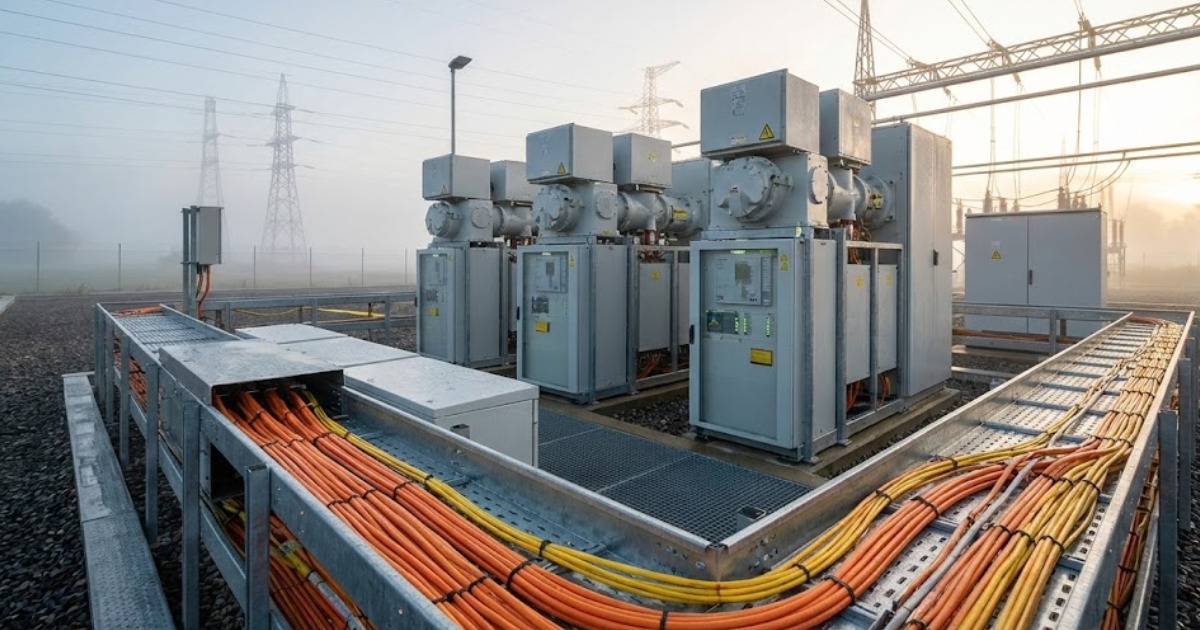
Digitalization changes which assets require the most attention and how cybersecurity priorities are set. Traditional perimeters still matter, but exposure now extends to field devices, gateways, distributed controllers, and cloud applications. An attacker no longer needs to reach core control systems to cause physical effects. Misuse of data, communication delays, or false indications can all affect system stability.
Organisations also need to interpret standards using criteria that reflect both electrical impact and cyber exposure. Engineering models and testbeds that account for these relationships provide teams with clearer evidence of risk and system behaviour.
Control centres and supervisory systems
Control centres host energy management systems, SCADA platforms, and essential databases. Digitalization increases exposure through remote access, market integration, and connections to enterprise platforms. These systems depend on model integrity, data quality, and reliable communication. Corrupted alarms or incorrect topology information can influence operator decisions or automated actions.
Security priorities therefore emphasise data integrity, authentication, and strict change management. Engineering teams that maintain accurate models and validate updates in safe environments help reduce the chance of misoperation caused by compromised inputs.
Digital substations and protection systems
Digital substations now rely on networked relays, merging units, and switching devices. Communication timing, message authentication, and device access control matter as much as coordination curves or pickup settings. Spoofed messages or replay attacks can disrupt time critical processes if protections are not configured with security in mind.
Testing tools and real time simulation help engineers verify protection behaviour under communication faults, outages, and abnormal message patterns. These tests reveal cases where logic fails open, where access control is inconsistent, or where timing margins are tighter than expected.
Field devices, distributed resources, and edge controllers
Distributed resources often sit outside traditional security perimeters. Many rely on cellular networks, vendor portals, or cloud connected dashboards. Incorrect configuration or weak authentication can lead to voltage control issues, reverse flows, or unintended tripping.
Cybersecurity priorities for these devices include secure onboarding, firmware integrity, and controlled configuration access. Engineers can define mandatory settings, validation tests, and monitoring strategies that reduce the risk of unsafe interactions.
Enterprise platforms and operational interfaces
Enterprise systems handle forecasting, asset data, customer information, and reporting. These systems must exchange information with operational platforms. Corruption or misuse of enterprise data can influence planning studies, operator decisions, and maintenance tasks.
Security priorities focus on controlling which signals cross network boundaries, monitoring data access, and ensuring that enterprise systems cannot be used as paths into operational networks. Simulation helps show how corrupted data influences system behaviour and which mitigations are most effective.
Digitalization creates a more interconnected set of responsibilities. Engineers who understand these dependencies and include them in testing provide clearer guidance for the rest of the organisation.
Practical uses of cybersecurity simulation for grid engineering teams
Engineering teams can extend existing simulation models to study the effects of cyber issues on physical grid behaviour. This helps confirm whether systems fail safe, whether they are resilient to delays or corrupted data, and how controls interact with cyber events. Cybersecurity simulation supports realistic experiments that would never be attempted in the field.
These simulations range from simple data alteration scripts to complete hardware-in-the-loop configurations. Teams often begin with modest exercises that reflect real concerns and gradually build more complex scenarios.
- Validating protection and control logic under cyber stress: Engineers can test logic against spoofed measurements, blocked messages, or partial outages to reveal failure modes.
- Testing anomaly detection concepts: Simulation lets teams tune detection rules using realistic benign and malicious behaviour.
- Quantifying the impact of communication failures: Communication latency and outages influence stability and coordination. Simulation helps engineers measure these effects directly.
- Assessing new architectures before deployment: Proposed communication schemes or new devices can be evaluated in a cyber-physical simulation environment.
- Supporting incident reconstruction and training: Past events can be replayed so teams can study the combined cyber and physical behaviour and verify updated mitigation plans.
Small, focused experiments build trust and gradually develop into structured testing practices that support planning, protection, and operations.
“Cybersecurity concerns become a joint exercise in technical detail, governance, and practical engineering judgement.”
Why power grid cybersecurity relies on cyber-physical coordination
Power system functions depend on measurements, communication, software, and physical equipment acting in sync. An incorrect or delayed signal can influence voltage, frequency, and power flows just as much as a physical outage. Treating cyber and physical systems as independent disciplines hides interactions that attackers exploit and defenders must understand.
Engineers encounter these dependencies in distributed control schemes, protective relays, and load-shedding logic. A compromised measurement or a stalled controller can trigger incorrect responses or hide an emerging contingency. Coordinated modelling, testing, and training help teams recognise how cyber events change physical outcomes and how physical contingencies influence cyber systems.
How real time simulation strengthens cybersecurity testing workflows
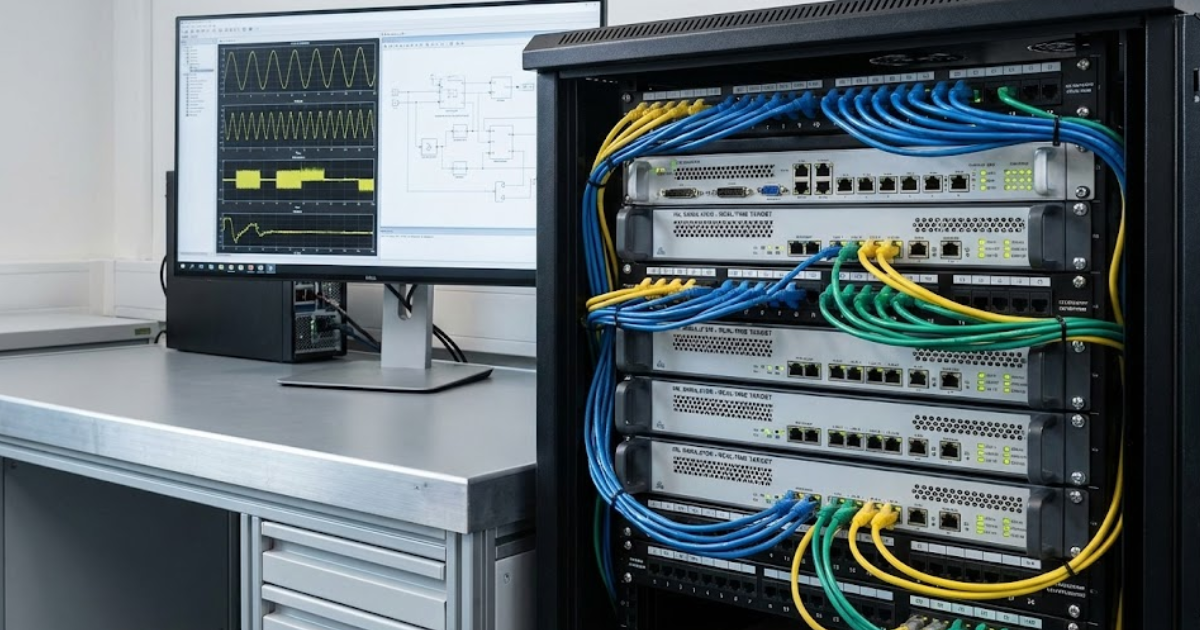
Real-time simulation provides a practical way to safely study cyber-physical interactions. Teams can run high fidelity grid models that interact with real controllers, relays, and communication devices. Scenario-based testing helps engineers understand how devices behave under abnormal traffic or malicious inputs.
Real time simulation also supports collaboration between engineering and cybersecurity teams. Security specialists can introduce realistic threat conditions, and engineers can observe equipment response in detail.
Closing the loop with hardware-in-the-loop testing
Hardware-in-the-loop setups connect actual devices to simulated grids. This lets teams test behaviour under unsafe conditions without endangering real assets. Malicious data patterns, incorrect commands, or communication outages can be introduced while engineers watch how devices respond.
This fits naturally into established protection and control testing workflows. Findings influence settings, architecture choices, and security requirements.
Replaying realistic network traffic and cyber events
Cyber-physical testbeds can replay authentic traffic patterns or replicate abnormal communication conditions. Engineers can study how latency, packet loss, or malformed messages influence grid stability and protection performance.
Device monitoring, detection logic, and failover strategies can be validated using these scenarios. This produces actionable insights grounded in realistic conditions.
Automating regression and compliance oriented checks
Real time simulation supports automated testing routines that verify security controls after firmware updates or configuration changes. Teams can run recurring scenarios to confirm that authentication, failover, and timing requirements remain intact.
Routine automated checks reduce surprises during audits or commissioning and help keep security aligned with operational needs.
Supporting cross functional drills and training
Simulation environments allow operators, engineers, and analysts to practise cyber-physical incidents. Combined physical faults and cyber events can be exercised under controlled conditions. Teams can test communication protocols, response plans, and fallback procedures.
Training based on realistic models helps participants understand timing, sequence, and sensitivity of responses, improving coordination across departments.
| Testing focus | How real time simulation helps | Typical outcomes |
| Device behaviour | Connects hardware to high fidelity models under stress | Clear understanding of failure modes |
| Network traffic | Replays realistic traffic and anomalies | Better tuning of detection and filtering |
| Compliance checks | Automates routine scenarios | Repeatable evidence for audits |
| Training | Provides shared scenarios | Improved cross functional coordination |
Key challenges engineers face securing digitalized power systems
Digitalization introduces new challenges for power system engineers who now share responsibility for cyber-physical resilience. Protection, control, and planning tasks increasingly depend on secure communication, consistent configuration, and strong authentication.
Recognising these challenges helps teams prioritise and request support where it is most needed.
- Limited visibility of assets: Inconsistent tracking of firmware versions, interfaces, and configurations complicates risk assessments and testing.
- Legacy equipment: Older protocols and devices do not support modern security features. Replacements or mitigations require careful planning.
- Balancing security and operational needs: Strict authentication or encryption may introduce latency, affecting the timing of protection.
- Aligning OT and IT practices: Differing goals between teams can lead to disagreements about patch schedules, access rules, and design choices.
- Staff shortages: Many organisations lack personnel with strong skills in both cybersecurity and power systems.
- Keeping pace with standards: Requirements continue to evolve, and translating them into practical engineering tasks can be time-consuming.
Addressing these challenges requires tools and processes that reflect engineering realities while improving security outcomes.
How OPAL-RT supports advanced cybersecurity and digitalization work
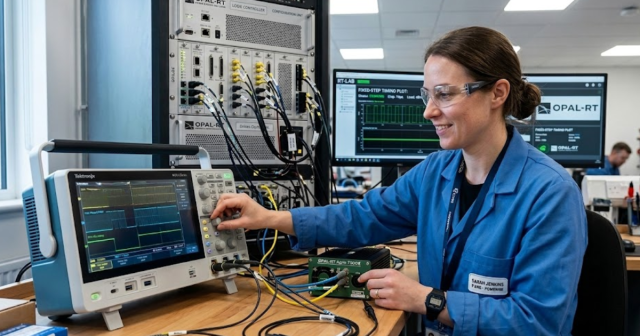
Engineering teams use OPAL-RT platforms to build cyber-physical testbeds where power system models run in real time and interact with physical protection, control, and communication equipment. High fidelity simulation engines represent transmission, distribution, and converter based systems with the detail needed for protection and stability studies. These same models form the electrical foundation for cybersecurity scenarios that explore communication issues, data manipulation, and complex interactions. Hardware-in-the-loop configurations allow field devices to connect through physical communication interfaces to realistic grid simulations, creating controlled conditions for evaluation.
OPAL-RT tools help engineering and security teams share a familiar environment for cyber-physical analysis. Open architectures and broad protocol support make it easier to integrate third party devices, gateways, and monitoring tools. Teams can script repeatable scenarios that reflect security requirements, then capture detailed electrical and digital behaviour for evaluation. These capabilities help organisations anchor digitalization projects to credible evidence and improve coordination across disciplines.
Real-time solutions across every sector
Explore how OPAL-RT is transforming the world’s most advanced sectors.
Industry applications, Simulation
03 / 31 / 2026
Managing high-frequency switching in real-time EMT simulation
Precision in testing complex power systems is essential to avoid failures, accelerate innovation, and integrate new technologies safely.

Simulation
03 / 30 / 2026
Understanding timestep requirements for modern power converters
Practical criteria for selecting EMT and real time simulation timesteps for power converters, covering switching resolution, control and PWM timing alignment, multirate approaches, and verification checks.
Energy, Industry applications, Simulation
03 / 29 / 2026
Validating data center energy management systems using real-time HIL
This piece explains how AI workload variability affects data centre power stability and how closed-loop HIL testing helps validate EMS control behaviour under site and grid stress.
EXata CPS has been specifically designed for real-time performance to allow studies of cyberattacks on power systems through the Communication Network layer of any size and connecting to any number of equipment for HIL and PHIL simulations. This is a discrete event simulation toolkit that considers all the inherent physics-based properties that will affect how the network (either wired or wireless) behaves.