How hyperscale data centers behave as inverter-based loads
Energy, Industry applications, Power Systems, Simulation
03 / 01 / 2026
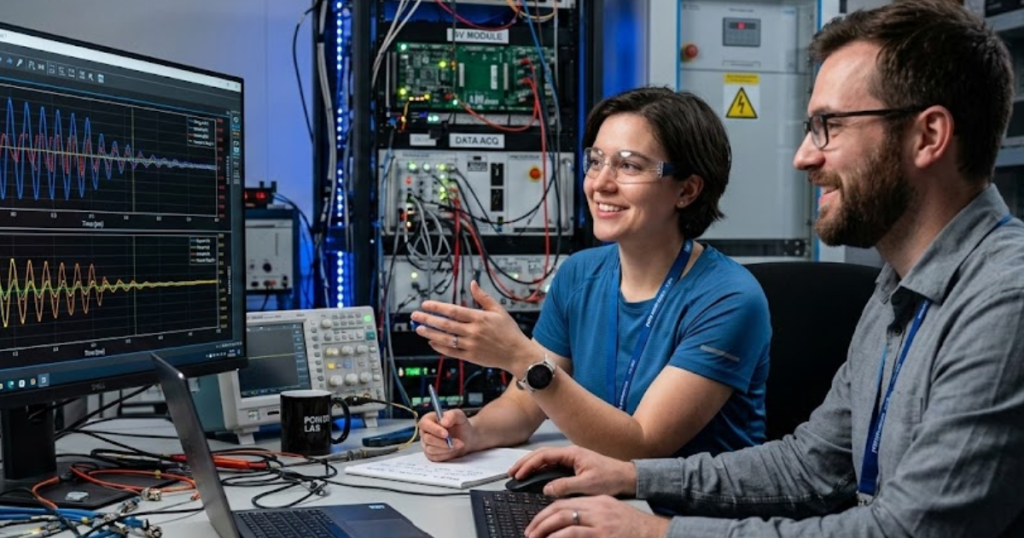
Key Takeaways
- Hyperscale data centers now need load models built around converter controls, protection logic, and ride-through settings rather than aggregate steady-state assumptions.
- EMT studies become necessary when the answer depends on millisecond fault response, harmonic behaviour, or controlled recovery after a disturbance.
- Useful execution starts with architecture-level segmentation of UPS, rack conversion, cooling drives, and battery support so the model reflects how the facility will actually respond.
Hyperscale data centers now need to be studied less like passive demand blocks and more like large collections of fast power electronics with grid-facing controls. That shift matters because the electrical footprint of a modern facility is set by rectifiers, converters, UPS controls, battery interfaces, and motor drives that react to faults, sags, harmonics, and recovery events on millisecond time scales. Global electricity use from data centres could rise from 460 TWh in 2022 to just over 800 TWh in 2026 in the IEA base case, which means grid planners will face this behaviour more often and at larger scale.
You see the problem most clearly when a large campus rides through a disturbance, reduces current, or trips part of its load all at once. A simple steady-state load model will miss those actions. Support for advanced converter topologies, up to 64 converters within a single FPGA, and a 40 ns timestep for detailed converter simulation on one platform.
Hyperscale data centers now behave like inverter-dominated electrical loads
A hyperscale data center behaves like an inverter-dominated load because much of its electrical path now passes through controlled power converters instead of passive equipment. That makes its grid response depend on control logic, protection settings, and converter topology.
The clearest example is the path from the utility connection to the server rack. Grid power enters a medium-voltage system, passes through transformers, large three-phase UPS rectifiers, DC links, batteries, and rack-level power supplies before it reaches information technology equipment. The DOE’s recent EMT model library describes common modern designs with three-phase active rectifiers and notes that future hyperscale designs are trending toward three-phase active front-end arrangements similar to inverter-based resources.
That does not mean a data center behaves exactly like a solar plant or battery site. It is still a load, and its primary goal is service continuity. Yet the grid sees converter controls first. Current limits, DC-link protection, ride-through logic, and recovery ramps shape what the bulk system experiences. Once you accept that, it becomes obvious that model quality depends less on nameplate megawatts and more on how those converters are represented.
Why inverter-based loads change how data centers interact with the grid
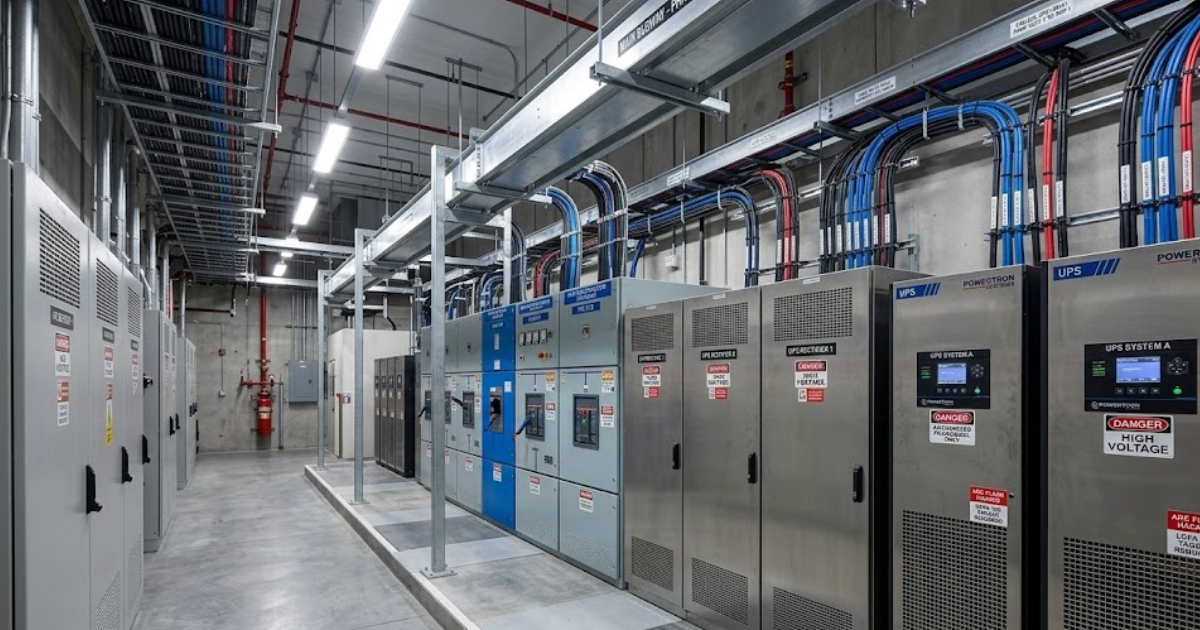
Inverter-based loads change grid interaction because they can alter current, reactive power, and trip behaviour much faster than traditional aggregate load models assume. The system impact comes from response speed and coordination, not only from facility size.
Consider a fault on a nearby transmission path. A conventional static load model might show a smooth voltage dip and recovery. A converter-rich data center can do something very different. Rectifier controls can clamp current, enter momentary cessation, depend on battery support at the DC link, or trip on undervoltage or overvoltage thresholds. The DOE model documentation shows these mechanisms explicitly, including voltage sag thresholds, current freeze functions, and momentary cessation settings that drive current to zero during a sag and ramp it back after recovery.
Those details matter because the grid does not only care about how much power the site consumes in normal operation. It also cares about what happens in the first cycles after a disturbance and in the seconds that follow. NERC warns that large loads can create voltage stability risks when demand changes quickly or when voltage-sensitive equipment trips in response to faults.
Power electronics architectures that define hyperscale data center load behaviour
The electrical behaviour of a hyperscale site is set by its architecture, especially the mix of UPS topology, battery coupling, rack power conversion, and cooling drives. Two facilities with the same megawatt rating can produce very different grid responses.
A centralized UPS design remains common in many operating sites. In that arrangement, large three-phase UPS units protect multiple racks and bridge the gap between grid disturbances and backup generation. Newer layouts push more conversion closer to the rack and rely on active front ends, battery blocks, and DC distribution choices that reduce losses or support higher power density. The DOE library also separates information technology load, cooling load, and site support load, which reflects how each part of the facility responds differently under disturbance.
Cooling deserves more attention than it usually gets. Variable frequency drives on pumps and fans are also converter-based, and the DOE notes that the dynamics of cooling load are often set by the drive front end rather than the motor itself. That matters for facilities serving dense AI racks because higher server density raises cooling sensitivity at the same time that operators are trying to keep every rack online.
“Hyperscale data centers now need to be studied less like passive demand blocks and more like large collections of fast power electronics with grid-facing controls.”
|
What the model must capture |
Why it matters at the grid connection |
| Three-phase UPS rectifier controls | These controls set current limits and reactive behaviour during faults and recovery. |
| Battery and DC-link support logic | DC support can keep the internal load alive while grid-facing current collapses or ramps. |
| Rack power conversion topology | The converter design affects harmonic content, ride-through, and fault current behaviour. |
| Cooling drive front ends | Pump and fan drives can alter dynamic load response even when server demand is steady. |
| Protection thresholds and delays | Small setting changes can decide if the site rides through a sag or drops load abruptly. |
Key electrical characteristics that grid operators must represent in models
Grid studies need electrical characteristics that describe dynamic behaviour, not only peak megawatts. The most important items are voltage sensitivity, reactive power response, harmonic production, current limits, recovery ramps, and trip logic.
A practical screening list will keep you focused on what the grid will actually experience:
- Voltage sag ride-through settings for rectifiers and UPS equipment
- Reactive power response during faults and short recovery periods
- Harmonic behaviour from high concentrations of power electronics
- Ramp rates after disturbance clearing or staged load restoration
- Cooling load dynamics and their interaction with information technology load
NERC’s large-load work shows why these items belong in the model. The organization notes that data centers can become significant sources of harmonics because of extensive power-electronics use, and it links large-load risk to ramp rate, peak demand, voltage sensitivity, and load tripping during disturbances.
This is also where many interconnection studies go off course. Engineers often treat the whole campus as a single balanced load with a power factor assumption and a load-growth forecast. That approach will not show whether the site stays connected, withdraws current, or imposes a difficult voltage recovery profile after a nearby fault.
Why is an EMT simulation required for inverter-based data center load studies?
EMT simulation is required when the study question depends on converter controls, protection action, or sub-second disturbance response. RMS tools remain useful for planning, but they will not resolve the switching-era behaviour that defines inverter-based load response.
A good example is a severe voltage sag at the point of common coupling. The DOE’s EMT work shows that a power-factor-correction converter without energy storage support can draw significant current during the fault and then trip on DC-link overvoltage after fault clearing. With energy storage and low-voltage ride-through logic, the same load can regulate current to near zero during the sag and return smoothly once voltage recovers. That difference is not a small modelling detail. It changes what the grid sees during the most sensitive seconds of the event.
Independent reliability work is pointing the same way. NERC’s 2025 State of Reliability says better models of data center loads are needed for planning and operations, and its large-load white paper points to converter-driven stability, voltage response, and harmonics as material risks.
Modeling approaches used to represent large inverter based data centers
The best modelling approach starts with the study objective and then places detail where converter behaviour shapes the answer. You do not need full switching detail everywhere, but you do need accurate models at the electrical interfaces that govern disturbance response.
A sensible workflow separates the site into grid interface, UPS and rack conversion, cooling drives, and support load. Average-value models work well for broad screening when the goal is fault ride-through, reactive power response, or recovery ramps. Switched models become important when you need harmonic detail, controller interaction, or device-level stress. The MVSC material from OPAL-RT fits that need for execution context because it highlights broad converter-topology coverage, flexible I/O, and a 40 ns timestep for dense converter studies on FPGA hardware.
Model reduction still has a place, but only after you validate the reduction against the behaviour you care about. A campus with dozens of similar UPS blocks can often be represented with grouped equivalents. A mixed facility with different rack feeds, staged battery support, or several cooling plants will need more granularity. Good models are selective, not oversized.
“Hyperscale data centers behave like engineered power-electronic systems attached to the grid, and your models must reflect that discipline.”
Common modelling mistakes that produce inaccurate grid interaction results

The most common modelling mistakes come from assuming data center loads are stable, uniform, and electrically simple. Those assumptions hide the exact behaviour grid operators need to understand before they approve interconnection terms or disturbance limits.
One mistake is treating the whole site as a constant-power block with a single power factor. Another is modelling only the information technology load and ignoring cooling drives, battery interfaces, or protection logic. A third mistake shows up after faults, when studies restore the load instantly instead of using realistic current walk-in or staged restart logic. Ireland’s data centres are projected to reach 32% of the country’s total electricity demand in 2026, which shows how dangerous poor assumptions become once these facilities represent a large share of a local system.
The better judgment is simple. Hyperscale data centers behave like engineered power-electronic systems attached to the grid, and your models must reflect that discipline. You will get more reliable study outcomes when you treat converter controls, ride-through settings, cooling drives, and recovery logic as first-order design inputs. That is also why platforms such as OPAL-RT belong in serious validation work. They fit the job when the question is not how big the load is, but how it will act when the grid stops behaving normally.
Real-time solutions across every sector
Explore how OPAL-RT is transforming the world’s most advanced sectors.
Industry applications, Simulation
03 / 31 / 2026
Managing high-frequency switching in real-time EMT simulation
Precision in testing complex power systems is essential to avoid failures, accelerate innovation, and integrate new technologies safely.

Simulation
03 / 30 / 2026
Understanding timestep requirements for modern power converters
Practical criteria for selecting EMT and real time simulation timesteps for power converters, covering switching resolution, control and PWM timing alignment, multirate approaches, and verification checks.
Energy, Industry applications, Simulation
03 / 29 / 2026
Validating data center energy management systems using real-time HIL
This piece explains how AI workload variability affects data centre power stability and how closed-loop HIL testing helps validate EMS control behaviour under site and grid stress.
EXata CPS has been specifically designed for real-time performance to allow studies of cyberattacks on power systems through the Communication Network layer of any size and connecting to any number of equipment for HIL and PHIL simulations. This is a discrete event simulation toolkit that considers all the inherent physics-based properties that will affect how the network (either wired or wireless) behaves.