Power grids digitalization and cybersecurity
As power grids evolve with advanced automation and increased reliance on digital communication, they are becoming smarter and more efficient—but also potentially exposed to vulnerabilities. To address the challenges of digitalization and cybersecurity, we must account for the growing risks tied to increased connectivity and data exchange. The transition to Ethernet-based protocols and remote monitoring systems increases the risk of communication failures, such as latency issues, data corruption, desynchronization, and equipment misconfigurations. Our real-time platforms support cybersecurity testing and validation by replicating these risks in a safe environment. These challenges highlight the need for robust testing and validation environments to ensure grid stability and security.

They trust us


Challenges
Safeguarding the grid against cyber threats
Beyond accidental failures, power grids are prime targets for cyber-attacks, including denial-of-service (DoS) attacks, man-in-the-middle (MitM) intrusions, ransomware incidents, and data spoofing. As digitalization and cybersecurity become central to power system operations, we enable utilities and researchers to stay ahead of emerging threats through advanced simulation cybersecurity capabilities. We empower power system professionals with cutting-edge real-time simulation platforms that integrate power system and communication network co-simulation.
This integrated approach supports cybersecurity simulation and helps teams carry out accurate cybersecurity testing for critical systems. This enables system operators and researchers to test vulnerabilities, develop resilient control strategies, and enhance grid security in a controlled, risk-free environment, ensuring safe and reliable power system operations in the face of digital threats.
Demo
Coordinated cyber-attacks on an interconnected transmission system and a microgrid with variable renewable generation
Our cybersecurity simulation platform is built to reflect today’s complex grid environments. Discover how our tools enable testing of coordinated cyber-attacks on an interconnected transmission system, including an offshore wind farm with satellite communication and a 5G-connected microgrid with variable renewable generation. By leveraging our cybersecurity simulator, we can identify system weaknesses and improve preparedness.

Advantages
The OPAL-RT edge
OPAL-RT and Keysight Technologies are proud to offer a unique, all-in-one solution for simulating and securing modern power grids. By integrating power system and communication network simulation, we help operators, researchers, and cybersecurity experts streamline workflows, anticipate threats, and build a resilient grid.
Integrated cyber-physical simulation
Seamlessly combine advanced power grid simulation with cutting-edge communication network modeling in a single platform. With built-in support for a wide range of communication protocols—including IEC 61850, DNP3, Modbus, and more—we enable realistic testing of system interactions, optimizing workflows and minimizing latency.
Pre-built cyberattack & defense library
Accelerate your cybersecurity testing with a readily available library of programmable attack and defense models. Simulate real threats like man-in-the-middle, denial-of-service, and spoofing, while testing countermeasures such as firewalls and antivirus solutions—saving months of development time.
Scalable from small setups to large networks
Start with a small system and expand seamlessly. Our solution is built to scale, supporting thousands of electrical and communication nodes for real-world, high-fidelity simulations.
Rapid deployment & auto-configuration
Get started quickly with automated network model creation. Whether scanning an existing network, importing standard network definition files, or parsing our I/O configurations, you can generate your first communication network model in no time.

Webinar
Learning from the Ukraine power grid cyber-attack using network digital twins
Power grids face growing cyber threats, as seen in the 2015 Ukraine attack. This webinar reveals how these attacks impact grid stability and showcases strategies to strengthen resilience against evolving digital threats. It also highlights the value of cybersecurity simulation training using real-time digital twins to build defensive strategies.

Solution
Our solution for cybersecurity applications
Our cyber-physical simulation solution seamlessly integrates power system and communication network simulation on a single hardware platform, optimizing performance and workflow efficiency. By dedicating specific CPU cores to each process, the system ensures real-time execution while enabling direct data exchange through virtual communication links. For Hardware-in-the-Loop (HIL) applications, physical devices can be incorporated effortlessly—data packets are broadcast over physical Ethernet ports, providing a realistic and scalable test environment for power grids and critical infrastructure.

Testing cyber-physical resiliency of a microgrid at the University of Vaasa
Learn how the University of Vaasa’s Smart Grid Laboratory at FREESI strengthened microgrid controllers against cyber threats using HYPERSIM and EXata CPS simulation platforms. By simulating cyberattacks and testing resilience with Hardware-in-the-Loop technology, the team has pioneered enhanced security measures for Smart Grid systems in Northern Europe.
Using HYPERSIM and EXata CPS, we’ve been able to simulate real-world cyberattacks on our microgrid controllers, from denial-of-service to man-in-the-middle attacks. This has allowed us to test resilience strategies in a safe environment, ensuring our microgrid can withstand disruptions and operate reliably under attack scenarios.
Mike Mekkanen
Associate Professor & Senior Researcher at University of Vaasa – School of Technology and Innovations, Information Systems Science

Products
The essentials for cybersecurity testing
Our cyber-physical solution is compatible with any platform outfitted with 6 physical cores or more.

EMT Simulation and HIL Testing
HYPERSIM
High-fidelity platform for EMT simulation, SIL and HIL testing, ideal for validating control, protection, grid integration and large-scale stability across all stages of power system development.

Communication Network Co-simulation
EXata CPS
High-fidelity and scalable communication network emulation for cyber-physical co-simulation, enabling HIL/SIL integration for cybersecurity testing of critical infrastructure.
Brute force computing
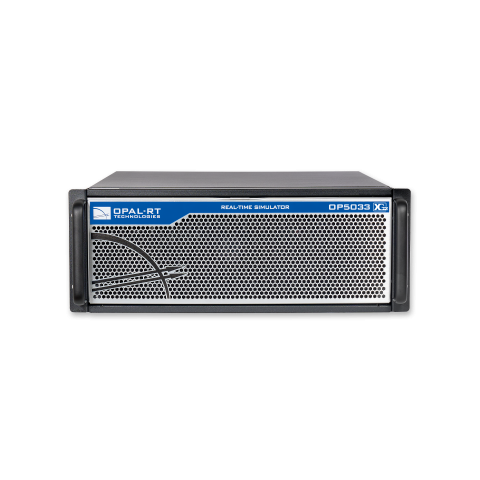
OP5033XG2
Simulator based on up to 16 cores of the latest Intel® Xeon® CPU and offers up to 6 PCIe slots for optional I/Os. It’s ideal for modular configurations with FPGA and 1/O expansion units.

Multi-Domain, Simulink®-based HIL
RT-LAB
Fully integrated with MATLAB/Simulink® and best combined with our various toolboxes to bring multi-domain Simscape™ Electrical™ and SimPowerSystems models to real time for fast control development.
FAQ
Find the answers to your questions
How does OPAL-RT help utilities and researchers simulate and defend against cyber threats to the grid?
We provide an integrated cyber-physical simulation platform that allows you to replicate real-world cyberattack scenarios, like denial-of-service, man-in-the-middle, or spoofing attacks, in a controlled, risk-free environment. By combining power system simulation with communication network co-simulation, we enable you to validate cybersecurity strategies, test system vulnerabilities, and ensure resilient grid operation in the face of digital threats.
What makes OPAL-RT’s solution unique for real-time cybersecurity testing?
Our platform, developed in partnership with Keysight Technologies, offers a seamless combination of real-time power system simulation (with HYPERSIM or RT-LAB) and communication network emulation (with EXata CPS). This all-in-one solution supports synchronized co-simulation on a single hardware platform, giving you rapid deployment, auto-configuration, and scalable performance from microgrids to full-scale transmission networks.
Can OPAL-RT simulate cyberattacks on both microgrids and large transmission systems?
Absolutely. Our cybersecurity solution is designed to handle both localized and system-wide attack scenarios. Whether you’re testing a campus-scale microgrid or a nationwide transmission grid, we enable you to simulate coordinated intrusions, communication failures, equipment misconfigurations, and latency challenges, so you can fully evaluate and improve system resiliency.
How does OPAL-RT’s platform support compliance and protocol testing for grid cybersecurity?
We support a wide range of industry-standard protocols, including IEC 61850, DNP3, C37.118, and Modbus. This allows you to validate device interoperability, assess system latency, and ensure protocol-level fault tolerance, essential for meeting cybersecurity compliance requirements like NERC CIP and advancing digital grid modernization.
What real-world outcomes have been achieved using OPAL-RT for cybersecurity applications?
One great example is our collaboration with the University of Vaasa’s Smart Grid Laboratory. Using HYPERSIM and EXata CPS, they simulated real-world cyberattacks, like denial-of-service and man-in-the-middle scenarios, on microgrid controllers. Our platform helped them validate the defenses of their customer and enhance system resilience, demonstrating how we support the development of secure, reliable power systems in both research and real-world deployments.

Let’s get to work
Please contact us for more details or any inquiries. Our local team of experts will be pleased to promptly answer any of your questions.
EXata CPS has been specifically designed for real-time performance to allow studies of cyberattacks on power systems through the Communication Network layer of any size and connecting to any number of equipment for HIL and PHIL simulations. This is a discrete event simulation toolkit that considers all the inherent physics-based properties that will affect how the network (either wired or wireless) behaves.