Key Takeaways
- Start validation with measurable acceptance criteria tied to specific hazards, so every test produces evidence you can defend under review.
- Run the 12 phases in order to catch wiring, sensing, timing, and control errors early, then prove fault tolerance and thermal limits only after the basics are locked.
- Use multiphase HIL to verify closed-loop timing and fault handling safely, then use dyno and endurance testing to confirm heat, derating, and long-run stability.
You can prove a 12-phase drive is mission-ready only with disciplined, repeatable validation.
Redundancy and fault tolerance are the main reasons teams choose 12-phase permanent magnet synchronous motors for aircraft actuators, critical pumps, and high-availability propulsion.
Those same design choices also create new ways to fail, especially around phase mapping, circulating currents, and fault handling across more devices and sensors. A 12-phase PMSM validation checklist keeps the work concrete and auditable.
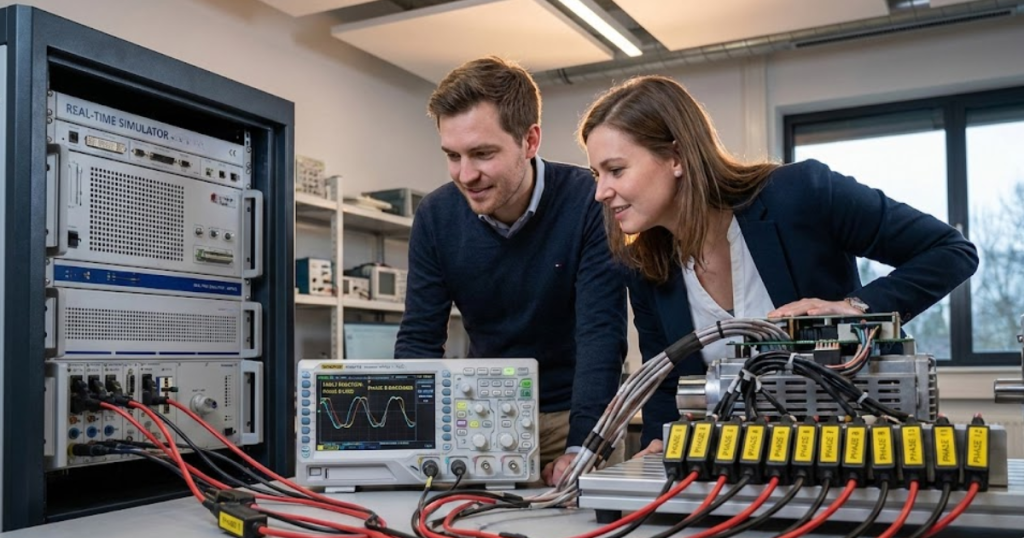
Energy and heat are always in the background, because motor systems consume a large share of electricity and every avoidable loss becomes a thermal problem at high power. Motor-driven systems account for about 45% of global electricity consumption. Multiphase HIL testing helps you find edge cases early, while hardware testing confirms the limits that simulation cannot fully capture.
Define acceptance criteria and hazards for 12-phase drives
Acceptance criteria must state what “safe” and “usable” mean under both normal and faulted conditions. You will write measurable limits for torque error, current ripple, temperature rise, and shutdown behaviour. You will also define which faults are tolerated and which require a stop. These definitions prevent late surprises during integration and certification reviews.
Start with hazards that are specific to multiphase motor drives: a single open phase that shifts phase angles, a sensor drift that biases several phases the same way, or a neutral point that moves under imbalance. Tie each hazard to an observable signal and a required response time. Keep criteria testable with the instruments you already trust, such as power analyzers, current probes, and thermal sensors. When a requirement cannot be measured directly, rewrite it until it can.
Twelve validation phases for 12-phase PMSM mission critical drives
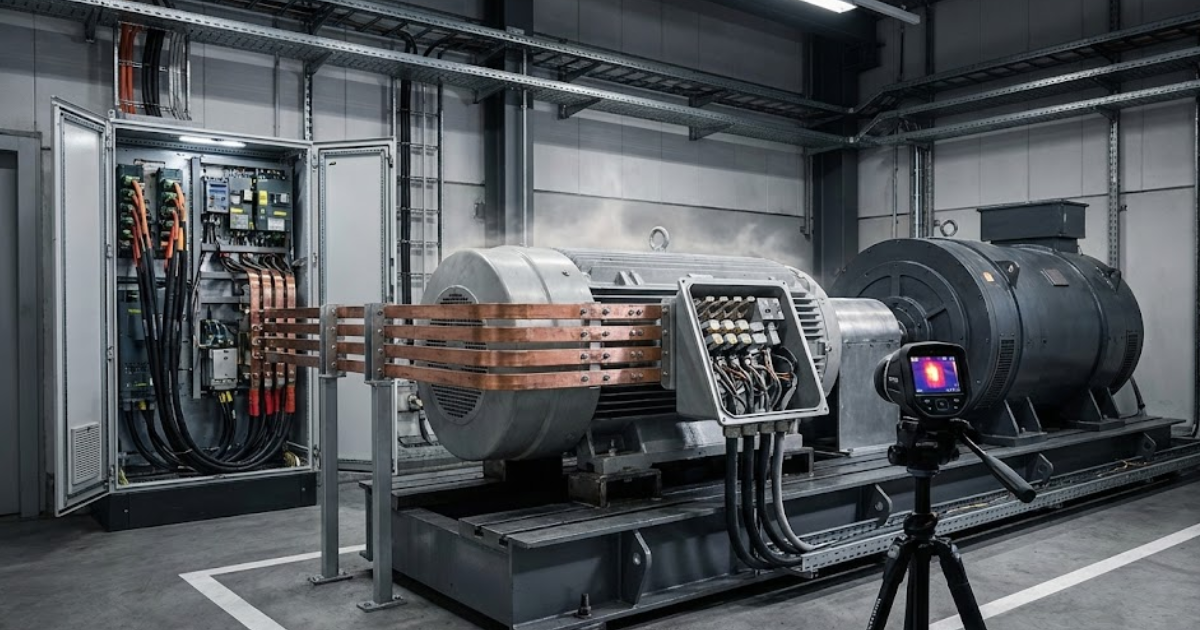
These 12 phases are ordered to catch the cheapest-to-fix errors first, then move toward fault tolerance and long-duration proof. Each step should produce an artifact you can keep, such as plots, logs, and calibrated parameter sets. The list is meant to support tests for multiphase motor drives, not just documentation. Tight traceability between requirements, tests, and evidence will keep the program moving.
1. Confirm winding scheme, phase order, and connection topology
Lock the electrical identity of the machine before tuning control loops. Phase order mistakes will look like poor tuning and waste weeks. Confirm groupings, star or polygon links, and any shared neutral. Validate the mapping end-to-end from motor leads to inverter legs to controller channels.
2. Validate motor and inverter parameter identification across temperatures
Identify resistance, inductance, flux linkage, and inverter deadtime with temperature as a controlled variable. Cold starts and hot-soak operation will not match one parameter set. Record the method, the conditions, and confidence bounds. Feed the results into control limits and observer tuning.
3. Check current sensing, offset, bandwidth, and synchronization errors
Current feedback quality sets the floor for torque quality and fault detection. Measure offset drift, gain error, bandwidth, and sample alignment across all phases. Cross-check with an independent measurement chain to catch wiring polarity issues. Confirm saturation behaviour so clipped signals do not masquerade as faults.
4. Verify PWM modulation strategy and phase interleaving timing
Multiphase PWM timing errors can create unexpected harmonics and circulating currents. Confirm carrier synchronization, deadtime insertion, and interleaving skew across legs. Validate that modulation stays within voltage limits at the worst-case dc bus. Check that protections do not trigger on normal switching edges.
5. Test torque production, efficiency, and harmonic current limits
Measure torque constant and torque ripple across speed and load, then relate results to loss and heat. Efficiency will drop fast if harmonic currents grow with poor phase balance. Motor-driven systems use about 70% of industrial electricity in the United States . Set harmonic limits that align with thermal margins and power quality needs.
6. Measure circulating currents and neutral point behaviour under imbalance
Circulating currents are a multiphase-specific reliability threat, even when torque looks fine. Force controlled imbalance with small phase resistance changes or command offsets. Monitor neutral point voltage, phase group currents, and additional copper loss. Use the results to tune balancing control and protection thresholds.
7. Assess field weakening and voltage margin at max speed
Field weakening must preserve stability while respecting inverter voltage limits. Sweep to maximum electrical speed under realistic dc bus droop. Confirm current vector limits and verify that demagnetization risk stays controlled. Capture voltage margin so overspeed events do not become uncontrolled commutation loss.
8. Validate control stability with latency and jitter budgets
Stability must hold with the full timing stack, not just ideal scheduling. Measure sampling delays, computation time, and actuator update timing. Introduce worst-case jitter and confirm phase margin does not collapse. Verify that filtering does not add unacceptable lag during fast torque transients.
9. Run open phase and short fault response tests
Fault-tolerant value comes from graceful degradation, not perfect operation. Test single and multiple open-phase cases and measure the remaining torque and vibration. Run phase-to-phase and phase-to-dc short response tests with safe limits and containment. Verify that thermal rise stays within the allowed emergency duty cycle.
10. Verify fault detection coverage and safe torque off paths
Detection must be fast, specific, and resistant to nuisance trips. Validate thresholds and timers for overcurrent, desaturation, sensor faults, and loss of commutation. Confirm safe torque off paths through both logic and power stages. Prove that restart rules prevent repeated fault cycling that overheats the system.
11. Execute multiphase HIL closed-loop tests with fault injection
Multiphase HIL closes the loop on corner cases that are risky or expensive on a dyno. A concrete workflow is running the production controller at its target switching frequency, injecting an open-phase event at a known electrical angle, then checking torque drop and shutdown timing against criteria. OPAL-RT platforms are often used here to keep timing deterministic while faults are injected safely. Treat HIL results as a gate, not as a replacement for hardware limits.
12. Complete endurance, thermal cycling, and derating verification
Endurance tests prove that margins exist after hours of heat soak and repeated transients. Run thermal cycling that matches your mission profile and confirm sensors stay calibrated. Validate derating tables against measured winding and semiconductor temperatures. Record drift in parameters so maintenance intervals and diagnostics stay honest.
| Test focus | Main takeaway that must be true |
|---|---|
| 1. Confirm winding scheme, phase order, and connection topology | The controller will command the intended phase set every time. |
| 2. Validate motor and inverter parameter identification across temperatures | Control tuning will stay valid from cold start to hot soak. |
| 3. Check current sensing, offset, bandwidth, and synchronization errors | Measured currents will represent actual phase currents within limits. |
| 4. Verify PWM modulation strategy and phase interleaving timing | Switching will not introduce hidden harmonics or timing-induced loss. |
| 5. Test torque production, efficiency, and harmonic current limits | Torque and heat will match targets without excess harmonic current. |
| 6. Measure circulating currents and neutral point behavior under imbalance | Imbalance will not create uncontrolled neutral shifts or extra heating. |
| 7. Assess field weakening and voltage margin at max speed | High-speed operation will stay stable with known voltage headroom. |
| 8. Validate control stability with latency and jitter budgets | Timing variation will not push the loop into oscillation. |
| 9. Run open phase and short fault response tests | Fault response will preserve safety while meeting emergency torque needs. |
| 10. Verify fault detection coverage and safe torque off paths | Protection will trip for real faults and ignore normal transients. |
| 11. Execute multiphase HIL closed loop tests with fault injection | Corner cases will be exercised safely before dyno and vehicle tests. |
| 12. Complete endurance, thermal cycling, and derating verification | Thermal limits will be respected over time, not just at startup. |
Set pass fail thresholds and evidence for each phase

Pass fail thresholds must be numeric, repeatable, and linked to hazards you already agreed to. Each test will produce evidence that stands on its own, such as calibrated logs, plots with limits, and a clear record of conditions. Tight evidence discipline will also expose gaps, like unmeasured neutral behaviour or missing temperature points. Treat “looks stable” as a failed test until it is quantified.
Sequence tests from model to SIL, HIL, and dyno
Sequencing reduces risk by matching test fidelity to what you are trying to learn. Models and software-in-the-loop will find logic errors and sign mistakes fast, while HIL will validate timing, I/O, and fault logic under closed-loop load. The dyno will confirm thermal, EMI, and mechanical limits that simulation cannot fully capture. Keep entry and exit criteria for each stage so the team does not jump ahead under schedule pressure.
Avoid common multiphase HIL setup errors and false passes
False passes happen when the simulator, I/O, or scaling masks the very fault you are trying to observe. Guard against setup drift with simple checks that run every session, not just at the start of the program. Treat every scaling constant as a safety item. Fixing these issues early will keep your multiphase HIL results credible.
- Mismatch between simulated phase order and physical harness mapping
- Current sensor scaling that clips peaks and hides fault onset
- Timing misalignment between sampled currents and PWM updates
- Fault injection that bypasses the same path as a hardware fault
- Thermal models left at nominal values during long stress runs
Choose lab assets and toolchain coverage for audit-ready results
Lab assets should match the failure modes you must prove, not just the power level you can reach. You will need a dyno path for heat and vibration limits, a repeatable HIL setup for timing and fault logic, and instrumentation that can be calibrated and traced. OPAL-RT can fit as the real-time test backbone for closed-loop fault injection when you need deterministic timing and clean evidence. The most reliable teams treat validation as a product, because evidence quality is what keeps mission-critical drives trustworthy over years of operation.
Real-time solutions across every sector
Explore how OPAL-RT is transforming the world’s most advanced sectors.
Industry applications, Simulation
03 / 31 / 2026
Managing high-frequency switching in real-time EMT simulation
Precision in testing complex power systems is essential to avoid failures, accelerate innovation, and integrate new technologies safely.

Simulation
03 / 30 / 2026
Understanding timestep requirements for modern power converters
Practical criteria for selecting EMT and real time simulation timesteps for power converters, covering switching resolution, control and PWM timing alignment, multirate approaches, and verification checks.

Energy, Industry applications, Simulation
03 / 29 / 2026
Validating data center energy management systems using real-time HIL
This piece explains how AI workload variability affects data centre power stability and how closed-loop HIL testing helps validate EMS control behaviour under site and grid stress.
EXata CPS has been specifically designed for real-time performance to allow studies of cyberattacks on power systems through the Communication Network layer of any size and connecting to any number of equipment for HIL and PHIL simulations. This is a discrete event simulation toolkit that considers all the inherent physics-based properties that will affect how the network (either wired or wireless) behaves.