Top power electronics trends shaping electrified systems
Power Electronics
02 / 14 / 2026

Key Takeaways
- Start electrified system planning with device, topology, packaging, and thermal choices because they lock in loss, EMI, cooling, and cost limits early.
- Treat wide-bandgap adoption as a control and layout problem as much as a semiconductor upgrade since faster edges tighten sensing, protection timing, and parasitic sensitivity.
- Adopt bidirectional power paths and higher bus voltages only with a matched validation plan that covers faults, stability, and compliance across all operating quadrants.
Your inverter and converter choices set efficiency, cost, and thermal headroom in electrified systems.
Power electronics trends matter because they shift what you can hit on range, charging time, and warranty risk with the same battery and motor. Electrification technology is also tightening the link between electrical design and mechanical packaging. That means “good enough” switching and cooling decisions now show up later as noise, rework, or derating. Teams that treat inverter innovation as a system problem stay on schedule more often.
The trends below focus on what changes design constraints, not what looks new on a slide. Each trend points to a concrete engineering pressure, like higher bus voltage, higher switching frequency, or tighter thermal limits. You can use them to sanity-check your roadmap and your test plan before parts and tooling lock. The goal is clarity on where the next integration problem will surface.
“Teams that treat inverter innovation as a system problem stay on schedule more often.”
Power electronics choices that set efficiency and cost targets
Efficiency and cost targets come from a small set of early choices: device material, inverter topology, packaging, thermal path, and control strategy. Those choices set switching loss, conduction loss, EMI risk, and cooling complexity long before calibration work starts. When you pick a device or topology, you also pick test coverage needs and safety constraints. Strong programs keep these choices linked to measurable limits, not preferences.
Start by writing down what must stay true at peak power, at sustained power, and during transients. Then map each constraint to what actually causes it, like loop inductance, junction temperature swing, or common-mode voltage. That mapping prevents late surprises like a heatsink that fits but cannot hold junction temperature under a long grade. It also keeps supplier discussions focused on values you can verify.
7 power electronics trends shaping electrified system roadmaps

1. Silicon carbide adoption grows for traction inverters and fast charging
Silicon carbide shifts the trade space toward higher switching speed and higher voltage with lower switching loss than silicon in many designs. That directly affects how small you can make magnetics, how hard you can push power density, and how much cooling you need at peak torque. The payback shows up when heat limits torque or charge power, not just on a datasheet. You’ll also spend more effort on layout discipline because faster edges punish stray inductance. The practical question becomes how much extra cost buys meaningful thermal margin and simpler cooling hardware.
2. Gallium nitride spreads into onboard chargers and DC-DC converters
Gallium nitride pushes switching frequency higher, which lets you shrink inductors and capacitors in charger and DC-DC stages. That helps packaging teams because passives often dominate volume and weight once you chase higher efficiency. Gate drive, protection, and EMI control become more sensitive, since very fast transitions can raise ringing and common-mode noise. You’ll want a clear plan for dv/dt limits, sensing bandwidth, and fault response time. The main decision is matching GaN’s high-frequency strengths to a layout and control design that stays stable across temperature and tolerance.
3. Integrated power modules reduce parasitics and boost power density
Integrated power modules shorten electrical loops and standardize interconnects, which lowers stray inductance and improves repeatability across builds. That helps efficiency, but it also reduces variation that can hide control issues until late validation. Packaging gains can be real, since busbars, current sensing, and cooling interfaces can move from custom work to a single module footprint. The tradeoff sits in flexibility because the module locks you into a specific internal layout and thermal path. Before committing, you’ll want to confirm serviceability, supply continuity, and how the module handles fault energy during worst-case events.
4. New inverter topologies cut losses at higher DC bus voltages
Higher DC bus voltage pushes inverter innovation toward topologies that reduce switching loss, limit voltage stress, and control EMI without oversized filters. An 800 V traction system, compared with a 400 V system at the same power, cuts phase current roughly in half, which reduces copper loss but raises insulation and safety requirements. That shift changes where heat is generated and how you tune switching edges. Topology choices also shape sensing needs, fault behaviour, and software complexity. You’ll get the best outcome when electrical, safety, and controls teams agree on the acceptable mix of complexity and margin before hardware freeze.
5. Packaging and thermal design shift to double-sided cooling
Double-sided cooling attacks the main limiter for high power density: getting heat out of the semiconductor fast and evenly. Heat spreading improves, junction temperature swing drops, and the same silicon area can deliver more sustained power without derating. Mechanical design gets harder because sealing, pressure uniformity, and coolant routing must be controlled tightly. Reliability work also changes since thermal interfaces become the highest-risk stack-up, not just the device itself. You’ll want thermal validation that treats contact pressure, flow, and contamination as first-class variables, not assumptions.
6. Bidirectional conversion supports regeneration, storage, and vehicle-to-grid
Bidirectional converters turn power stages into flexible energy paths, not one-way chargers or one-way DC-DC links. That supports regen capture, battery-to-load support, and grid-interactive features, but it also expands safety and compliance scope. Isolation strategy, fault detection, and contactor sequencing become central design topics because power can flow in unexpected directions during faults. Control design must handle mode changes cleanly or you’ll see oscillations and nuisance trips. The key tradeoff is operational value versus added validation effort across more operating quadrants and more fault cases.
7. Real-time HIL testing tightens control stability and fault coverage
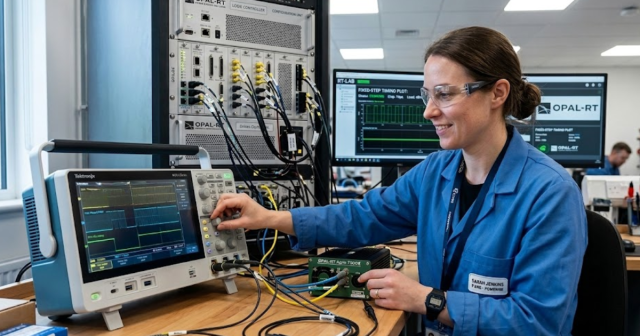
Real-time hardware-in-the-loop testing pulls inverter control validation earlier, when fixes are still software and parameter changes. That matters because wide-bandgap switching and higher bus voltages shrink timing margins for sensing, protection, and PWM updates. You can test stability, protection thresholds, and fault recovery without risking power hardware on every iteration. OPAL-RT real-time simulation is often used to close the loop with actual controllers while the power stage is still being finalized. The value shows up when you catch an interaction between sampling delay, deadtime, and current control bandwidth before it becomes a hardware redesign.
| Trend | What you should take away |
| Silicon carbide adoption grows for traction inverters and fast charging | SiC cuts switching loss and eases thermal limits at high power. |
| Gallium nitride spreads into onboard chargers and DC DC converters | GaN pushes frequency higher for smaller magnetics and filters. |
| Integrated power modules reduce parasitics and boost power density | Integrated modules shrink loop inductance and reduce EMI work. |
| New inverter topologies cut losses at higher DC bus voltages | Topology choices balance switching loss, voltage stress, and control. |
| Packaging and thermal design shift to double sided cooling | Advanced cooling shifts temperature limits and lifetime assumptions. |
| Bidirectional conversion supports regeneration, storage, and vehicle-to-grid | Bidirectional converters add grid services but raise safety needs. |
| Real-time HIL testing tightens control stability and fault coverage | Real-time HIL finds corner cases before hardware damage. |
“The value shows up when you catch an interaction between sampling delay, deadtime, and current control bandwidth before it becomes a hardware redesign.”
Tradeoffs to weigh when adopting new inverter technologies
The main tradeoffs show up as complexity versus margin, and integration speed versus validation scope. Wide-bandgap devices and new topologies can improve efficiency, but they also tighten layout, sensing, and protection requirements. Higher power density can lower mass, yet it raises sensitivity to thermal interface quality and coolant variability. Bidirectional features can add value, but they expand safety, compliance, and test matrices.
Good choices come from matching trends to the limits you actually own, like thermal headroom, EMI budget, or control bandwidth, then testing those limits early and repeatedly. That mindset keeps inverter innovation grounded in what you can verify, not what a component promises. Teams that use OPAL-RT in their validation flow often treat timing, faults, and stability as design inputs, not late checks. You’ll get better outcomes when every new device or topology has a clear pass-fail plan tied to your system targets.
Real-time solutions across every sector
Explore how OPAL-RT is transforming the world’s most advanced sectors.
Industry applications, Simulation
03 / 31 / 2026
Managing high-frequency switching in real-time EMT simulation
Precision in testing complex power systems is essential to avoid failures, accelerate innovation, and integrate new technologies safely.

Simulation
03 / 30 / 2026
Understanding timestep requirements for modern power converters
Practical criteria for selecting EMT and real time simulation timesteps for power converters, covering switching resolution, control and PWM timing alignment, multirate approaches, and verification checks.

Energy, Industry applications, Simulation
03 / 29 / 2026
Validating data center energy management systems using real-time HIL
This piece explains how AI workload variability affects data centre power stability and how closed-loop HIL testing helps validate EMS control behaviour under site and grid stress.
EXata CPS has been specifically designed for real-time performance to allow studies of cyberattacks on power systems through the Communication Network layer of any size and connecting to any number of equipment for HIL and PHIL simulations. This is a discrete event simulation toolkit that considers all the inherent physics-based properties that will affect how the network (either wired or wireless) behaves.