6 Benefits Of Rapid Control Prototyping For Automotive And Energy Projects
Energy
02 / 13 / 2026
Key Takeaways
- Use rapid control prototyping when timing, I/O, and numeric behaviour are the main sources of control risk, since it exposes implementation issues before hardware and requirements lock.
- Prioritize repeatable tests and clean data capture, because RCP value comes from running the same scenario, measuring deltas, and turning tuning into a controlled workflow.
- Select an RCP setup based on step size, latency, channel count, and plant complexity, then scale only after the hardest timing path is stable and predictable.
Late-stage control issues are expensive because they show up after teams have already committed to hardware, wiring, and safety reviews. A long-cited estimate puts the annual cost of software errors to the U.S. economy at $59.5 billion, largely due to rework and downtime. Rapid control prototyping is one practical way to surface timing, I/O, and implementation problems earlier. It also keeps the learning tied to measurable behavior instead of debates.
Automotive and energy projects share a common pain point: controls must behave correctly under tight timing and messy edge conditions. Rapid control prototyping (RCP) lets you run a near-production controller on a deterministic target while you still have freedom to adjust. You’re not trying to prove the final system. You’re trying to prove the control strategy, interfaces, and timing budget before the build becomes hard to change.
“Rapid control prototyping gets your controller on real-time hardware before design details get locked.”
Where rapid control prototyping fits in automotive and energy validation
Rapid control prototyping sits between desktop simulation and full hardware-in-the-loop testing. You execute the control algorithm on a real-time target so scheduling, I/O, and numeric behavior match how the controller will run later. The plant can be simulated, partially physical, or instrumented from a bench setup. That mix gives you speed without pretending every detail is final.
RCP is most useful when implementation details matter as much as the control logic. Sampling rates, interrupt load, sensor scaling, and actuator limits show up fast once code runs under real-time constraints. You also get earlier agreement on what “good control” means in numbers, not opinions. That reduces churn when other teams start wiring, packaging, and safety work.
6 benefits of rapid control prototyping for automotive and energy
1. Cut control tuning time with real-time closed-loop prototyping
RCP shortens tuning because you’re adjusting gains and logic under the same timing and I/O path you’ll face later. That makes loop stability, saturation, and rate limiting show up in the same places they will on a production controller. You also avoid tuning a “perfect” desktop model that hides delays and quantization. Teams end up with fewer retunes when the design moves to a tighter processor and noisier signals. The result is a controller that hits performance targets with less iteration and fewer false starts.
2. Test edge cases safely before committing to production hardware
RCP lets you stress the controller with fault-like inputs while staying away from high-risk hardware states. Sensor dropouts, stuck signals, overcurrent flags, and communication timeouts can be injected in a repeatable way. That helps you verify fallback modes, reset behavior, and alarm latching without putting people or equipment at risk. The same approach works for energy controls that must ride through grid disturbances and protection events. You gain confidence that the controller fails safely and recovers cleanly, not just that it works on a good day.
3. Validate power electronics timing and IO behavior earlier
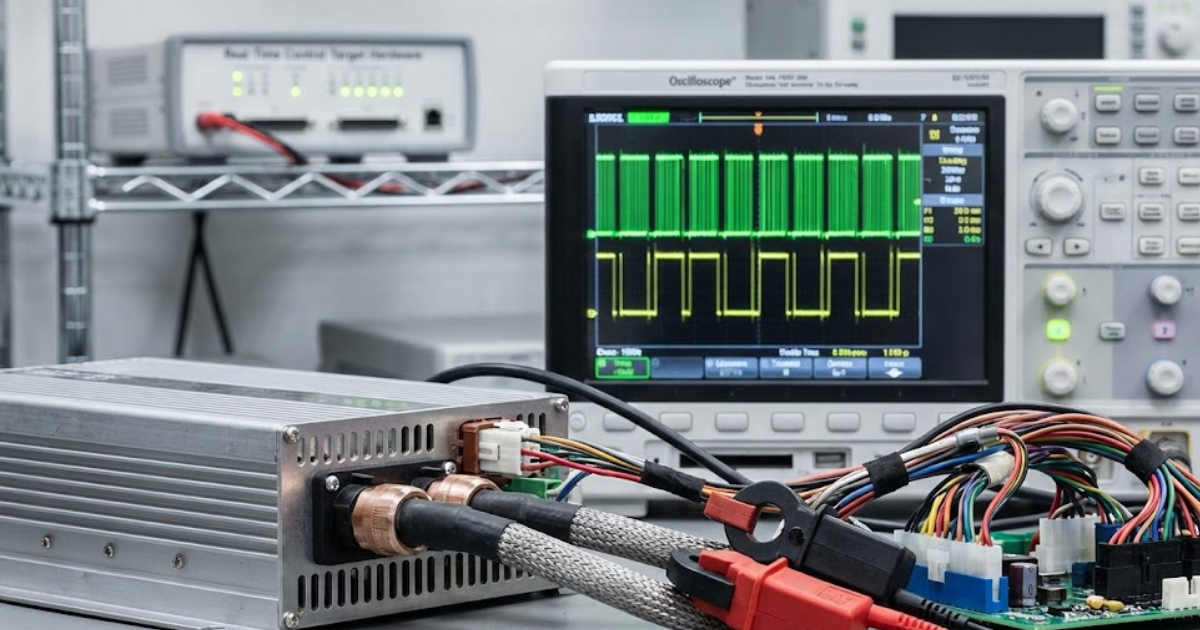
RCP is a strong fit for power electronics controls because timing and I/O latency often decide success. PWM update rates, ADC sampling alignment, and interrupt jitter can break a design that looked stable in offline simulation. A concrete case is validating a traction inverter current loop where the control task must complete inside a fixed sample window, with deadtime and scaling handled correctly. That kind of check is hard to trust on a laptop, even with a detailed model. Catching timing misses here protects your later test phase from long debug cycles and confusing “it worked in simulation” results.
4. Expose plant nonlinearities and constraints under real-time execution
RCP helps you see how nonlinear behavior interacts with your controller once it runs with real time limits. Friction, backlash, thermal limits, magnetic saturation, and actuator clipping can turn a stable design into an oscillatory one. Real-time execution also forces honest treatment of discrete steps, delay chains, and numeric overflow. That matters for automotive driveline control and for energy conversion controls with limiters and protection logic. You get a controller that behaves well across the full operating envelope, not just in the linear region.
5. Improve calibration workflows with repeatable scenarios and data capture
RCP improves calibration because tests become repeatable and tightly logged, with the controller running in its intended execution context. Parameter sweeps, mode transitions, and setpoint profiles can be replayed with the same timing each run. That makes it easier to compare calibration sets and to isolate which change caused a performance shift. It also reduces time lost to “test drift” when different engineers run slightly different procedures. Over time, calibration becomes a disciplined workflow rather than a collection of personal tuning habits.
6. Reduce rework by aligning teams on measurable controller targets

RCP reduces rework because it forces early alignment on interfaces, timing budgets, and acceptance criteria. When software, controls, and test teams agree on signal definitions and pass-fail metrics, late integration surprises drop. That matters in regulated programs where changes trigger reviews and retesting, not just a quick patch. More than 34 million vehicles were affected by U.S. vehicle recalls in 2023, a reminder that late discovery can scale fast. Earlier clarity on “done” helps you avoid churn that eats both schedule and credibility.
| Benefit focus | What you can expect |
|---|---|
| Cut control tuning time with real-time closed-loop prototyping | You tune with realistic timing, so fewer retunes happen later. |
| Test edge cases safely before committing to production hardware | You validate fault handling without risking people or equipment. |
| Validate power electronics timing and IO behavior earlier | You catch jitter and I/O latency issues before integration. |
| Expose plant nonlinearities and constraints under real-time execution | You see limit effects that offline models often hide. |
| Improve calibration workflows with repeatable scenarios and data capture | You compare changes cleanly using consistent tests and logs. |
| Reduce rework by aligning teams on measurable controller targets | You lock interfaces and metrics early, so change requests drop. |
When to use RCP instead of MIL SIL or HIL
The main difference between RCP and MIL or SIL is that RCP runs your controller in real time on target hardware, so timing and I/O behavior are honest. The main difference between RCP and HIL is scope, since RCP focuses on proving the controller while HIL focuses on validating the integrated ECU against a simulated plant. RCP fits when you need implementation confidence but you’re not ready to freeze the ECU. HIL fits when the hardware and interfaces are set and you need system-level evidence.
RCP often becomes the shortest path when the team is arguing about “model vs hardware” behavior. MIL and SIL stay valuable for early logic checks and regression testing. HIL stays valuable for integration, fault injection at the system level, and compliance-oriented workflows. Good programs use all three, but they use them for different questions.
“RCP answers, “Will this controller behave as expected when time is real?””
Data and toolchain needs for a productive RCP setup
A productive RCP setup starts with deterministic timing, clean signal definitions, and a plan for repeatability. You need a real-time target that matches your sample times and I/O types, plus a build path that produces the same code each run. Teams often pick platforms such as OPAL-RT when they want deterministic execution, flexible I/O, and open integration without locking into a single workflow. Clear ownership for model updates and test changes keeps the setup usable past the first demo.
- Fixed-step execution settings that match your control sample times
- Documented I/O scaling, units, and fault-state behavior for each signal
- A plant representation that is stable in real time at your step size
- A repeatable build and deploy path with versioned artifacts
- Data capture rules so runs can be compared without guesswork
Toolchain friction is the silent schedule killer in RCP. Poorly controlled versions create “same test, different result” arguments that waste lab time. Limited logging makes it hard to prove that a change helped instead of just shifting noise around. A tight workflow keeps engineers focused on control quality, not on chasing setup problems. That’s where most RCP advantages become visible.
How to pick an RCP approach for your next project
Pick an RCP approach based on timing reality, I/O complexity, and how soon hardware details will freeze. Sample time targets, interrupt budgets, and the number of sensor and actuator channels should be your first filter. The plant complexity matters next because it sets your real-time step size and compute needs. A small pilot that mirrors the hardest timing path will tell you more than a broad setup that stays abstract.
Procurement choices should follow technical constraints, not the other way around. If your main risk is power electronics timing, focus on deterministic execution and I/O latency first. If your main risk is safety logic, focus on repeatable fault injection and clean data capture. OPAL-RT fits teams that want real-time execution with flexible integration, but the better choice always comes from matching the platform to your timing and test requirements. Disciplined setup turns rapid control prototyping benefits into repeatable results.
Real-time solutions across every sector
Explore how OPAL-RT is transforming the world’s most advanced sectors.
Industry applications, Simulation
03 / 31 / 2026
Managing high-frequency switching in real-time EMT simulation
Precision in testing complex power systems is essential to avoid failures, accelerate innovation, and integrate new technologies safely.

Simulation
03 / 30 / 2026
Understanding timestep requirements for modern power converters
Practical criteria for selecting EMT and real time simulation timesteps for power converters, covering switching resolution, control and PWM timing alignment, multirate approaches, and verification checks.
Energy, Industry applications, Simulation
03 / 29 / 2026
Validating data center energy management systems using real-time HIL
This piece explains how AI workload variability affects data centre power stability and how closed-loop HIL testing helps validate EMS control behaviour under site and grid stress.
EXata CPS has been specifically designed for real-time performance to allow studies of cyberattacks on power systems through the Communication Network layer of any size and connecting to any number of equipment for HIL and PHIL simulations. This is a discrete event simulation toolkit that considers all the inherent physics-based properties that will affect how the network (either wired or wireless) behaves.