8 benefits of distribution network automation for microgrid design
Microgrid
11 / 11 / 2025

Key takeaways
- Distribution network automation raises uptime, curbs outages, and stabilizes power quality across grid-connected and islanded modes.
- Clear data models, time sync, and layered control help microgrid design stay maintainable, auditable, and safe as the scope grows.
- Fault location, isolation, and service restoration accelerate recovery while protection and voltage control limit cascading issues.
- Standards-based integration supports stepwise expansion, reduces vendor friction, and shortens commissioning across projects.
- Hardware-in-the-loop validation with OPAL-RT gives teams credible evidence for timing, selectivity, and interoperability before field rollout.
Automation lifts microgrids from manual firefighting to predictable, high availability power. As distributed energy resources (DERs) grow on campuses, bases, and industrial sites, daily operations become too complex for clipboards and callouts. Rules-based control, event detection, and remote switching cut response time, reduce costs, and improve safety. Teams that automate key distribution functions see fewer outages, better asset health, and faster commissioning.
Engineers want practical steps that improve reliability without replacing every device at once. You will see how control layers, data models, and standards align to reduce risk and shorten test cycles. The focus is on distribution network automation that supports engineering workflows like hardware-in-the-loop (HIL) testing, staged rollout, and regression validation. Every recommendation connects to measurable outcomes such as uptime, power quality, and workforce efficiency.
How automation improves efficiency in microgrid operations
Automation streamlines repetitive tasks that absorb valuable engineering time. Auto-scheduled dispatch aligns storage, controllable loads, and generation with forecasts, then adjusts setpoints as conditions shift. Intelligent switching reduces truck rolls for routine maneuvers and protects crews with interlocks that block unsafe actions. Operators gain consistent outcomes because logic runs the same way on every cycle, at subsecond speed.
Planning and operations also become more connected. State estimation uses metered data to reconstruct flows and voltages, which informs optimal feeder configuration. When conditions fall outside limits, event-driven logic can reconfigure the network and prioritize critical loads. These capabilities give you the headroom to focus on performance improvements, commissioning, and model quality instead of urgent recovery.
8 benefits of distribution network automation for microgrids

Automation across the distribution layer pays off when it is tied to clear objectives and tested against real operating constraints. Distribution network automation raises the ceiling on what a microgrid can safely deliver, because sensors, controls, and analytics act before small issues become incidents. The most important gains show up in availability, cost, and power quality, with measurable reductions in manual interventions. A strong plan couples control logic with simulation and field validation so each update improves stability, not just speed.
1. Improves system reliability and uptime
Automated reconfiguration, sectionalizing, and load transfer keep feeders serving priority loads when faults occur. Microgrids that apply automatic transfer logic can hold voltage and frequency during islanding, then resynchronize when the utility returns. Reliability metrics such as System Average Interruption Duration Index (SAIDI) and System Average Interruption Frequency Index (SAIFI) typically trend lower because outages affect fewer customers and last for shorter periods. Operators also gain consistent start-up and shut-down sequences, which avoid errors during stressful conditions.
These gains rest on clear protection coordination and verified control timing. Fault location, isolation, and service restoration (FLISR) logic needs short detection windows and deterministic communications so switches act in the right order. Event replay helps teams confirm that breaker operations, reclosing policies, and load transfers behaved as designed. Continuous improvement becomes practical because each incident yields structured lessons, not guesswork.
2. Reduces maintenance and operational costs
Condition-based maintenance keeps focus on assets that truly need attention. Sensor data and breaker counters flag unusual cycles or temperature rise, then work orders route to the right crew with component history attached. Remote switching, firmware updates, and parameter changes reduce site visits, travel, and overtime. Spares planning benefits as well, since usage patterns reveal which parts create avoidable downtime.
Automation also limits wear on equipment. Soft-start strategies reduce mechanical stress, and voltage regulation strategies avoid excessive tap changes. Standardized routines catch issues before they grow into failures, which means fewer emergent jobs that disrupt the calendar. Savings arrive steadily, because small efficiencies compound across hundreds of daily operations.
3. Enhances fault detection and faster power restoration
High-quality time synchronization, such as Precision Time Protocol (PTP), lets devices line up events to the millisecond. Sequence-of-events records then reveal fault direction, clearing time, and relay selectivity with clarity. Algorithms detect high-impedance faults or intermittent arcing that older schemes miss, which improves safety for line crews and site staff. Restoration proceeds faster because operators know which sections are healthy and which remain isolated.
Service restoration improves further when logic automates the early steps. FLISR schemes test alternate paths, check capacity, and verify protection settings before closing a switch. Operators maintain oversight, yet the system prepares a safe plan in seconds instead of minutes. Customers feel the difference as outage minutes fall, and sensitive loads see fewer abrupt transitions.
4. Optimizes integration of renewable energy sources
Distributed energy resources (DERs) such as solar, wind, and storage introduce variability that benefits from tight coordination. Distribution network automation smooths ramps, enforces curtailment limits, and dispatches storage to hold frequency and voltage steady. Control profiles such as frequency-watt and Volt-VAR implement grid support while respecting inverter limits and state of charge. Forecast-aware scheduling reduces reserve margins without risking underperformance.
Advanced controllers maintain stability during islanding and reconnection. When generation exceeds local load, logic shapes exports and manages reactive power to avoid voltage rise. During cloudy or gusty periods, rate-limiters and droop settings keep the system within thermal and protection bounds. The result is higher renewable utilization with fewer nuisance trips and fewer manual overrides.
Automation lifts microgrids from manual firefighting to predictable, high availability power.
5. Improves data visibility and real-time control
A modern supervisory control and data acquisition (SCADA) system streams measurements, alarms, and control states to a common view that teams can trust. Role-based access ensures engineers, operators, and analysts see the right signals without crowding screens with rarely used data. Time-series historians capture context for every action, which speeds root-cause analysis and compliance reporting. Dashboards then translate raw signals into KPIs that leadership understands.
Real-time control complements that visibility. Setpoint changes apply consistently, with interlocks that protect against unsafe combinations. When conditions cross thresholds, event-driven logic responds immediately rather than waiting for a human to notice. The combined effect is fewer surprises and quicker, more confident action when the situation is tight.
6. Strengthens grid protection and voltage stability
Protection schemes in a microgrid must work across grid-connected and islanded modes. Adaptive settings let relays and reclosers apply the correct pickup levels when source impedance changes. Volt-VAR optimization (VVO) coordinates capacitor banks, inverters, and tap changers to keep voltage within limits while reducing losses. Frequency support from storage and fast inverters helps ride through transients without tripping.
Verification is as important as design. Closed-loop tests demonstrate that trip times, communication delays, and logic paths meet target values. Hardware-in-the-loop tests place controllers under realistic stress so hidden interactions appear before commissioning. Engineers gain confidence that protection will act quickly, select the right device, and preserve service to as many loads as possible.
7. Supports scalable growth and flexible expansion
Microgrids rarely stay the same size for long. New buildings, process loads, and DER capacity arrive in phases, so control and data models must grow without a full rewrite. Modular logic, consistent naming, and standard protocols such as Distributed Network Protocol (DNP3) and IEC 61850 let teams add feeders, meters, and controllers with predictable effort. Versioned configuration keeps upgrades orderly and reversible.
Planning for change also improves vendor independence. Open APIs and standard file formats reduce integration friction when a new device enters the fleet. Testable interfaces keep commissioning time stable across projects, because the pattern stays the same even as equipment changes. Expansion then becomes a routine activity, not a high-risk event.
8. Simplifies regulatory compliance and performance tracking
Automated audit trails record who changed what, when it changed, and why the change occurred. That traceability supports standards such as IEEE 1547 for inverter interconnection and cyber requirements that align with North American Electric Reliability Corporation Critical Infrastructure Protection (NERC CIP). Reports are generated from the historian instead of manual spreadsheet assembly, which saves time and reduces errors. Leaders see monthly trends for power quality, outage minutes, and asset health without waiting for custom queries.
Performance tracking supports better engineering, not just audits. Clear KPIs reveal which feeders need attention and which strategies return the best value. When targets shift, updated dashboards roll out with the control logic so teams stay in sync. Data moves from siloed systems to a shared source that guides improvement.
Automation tied to measurable outcomes consistently strengthens microgrid operations. Gains in reliability and power quality arrive first, then cost and workforce benefits follow as workflows mature. Scalability increases because standards-based integration lowers friction as the system grows. When automation and testing move forward together, each release raises confidence across the engineering team.
Best practices for applying automation in microgrid design

Careful planning sets up automation to work on day one and stay maintainable for years. Microgrid design benefits from a layered approach that separates fast controls from slower optimization and operator oversight. Clear data governance avoids mismatched tags, stale values, and ambiguous timestamps that erode trust. A small investment in observability and time alignment pays back during every commissioning task and outage investigation.
- Define a layered control architecture: Separate primary device control, secondary coordination, and tertiary scheduling so each loop has a clear time horizon and authority. This structure keeps fast safety functions independent from economic decisions, while still allowing coordination through well-defined interfaces.
- Standardize protocols and data models early: Commit to IEC 61850 for substation messaging, Distributed Network Protocol (DNP3), or Modbus based on use cases, then map names and units consistently. A stable model shortens commissioning, reduces vendor friction, and simplifies staff training.
- Validate with hardware-in-the-loop and staged rollout: Use HIL and power hardware-in-the-loop (PHIL) to test edge controllers, relays, and inverters against realistic scenarios. Roll features in phases so each release carries manageable risk and produces clear lessons.
- Build observability into the plan: Place meters at feeder heads, critical loads, and DER points of interconnection, and time-sync with Precision Time Protocol (PTP). High-fidelity data supports state estimation, fault studies, and accurate asset health scoring.
- Treat cybersecurity as a design input: Segment networks, apply least privilege, and manage certificates centrally to align with NERC CIP practices. Security policies should be testable in simulation and verifiable in the field.
- Prepare for islanding and reconnection: Script automatic sequences for separation, ride-through, and resynchronization under varied operating points. Include clear operator prompts and interlocks to prevent conflicting actions.
- Plan lifecycle management: Version-control every logic block and setting file, document device firmware baselines, and schedule periodic regression tests. These habits make upgrades boring, which is the goal for critical infrastructure.
| Focus area | What to automate | Why it matters | Key metrics | Example tools |
| Forecasting and scheduling | Day-ahead and intraday dispatch of storage and controllable loads | Reduces costs and curtailment while meeting constraints | Curtailment hours, reserve margin, storage throughput | Energy management system (EMS), model predictive control (MPC) |
| Fault management | FLISR logic and sequence-of-events capture | Cuts outage minutes and improves safety | SAIDI, SAIFI, fault clearing time | Advanced distribution management system (ADMS), relay automation |
| Volt-VAR and frequency control | Coordinated setpoints for inverters, caps, and tap changers | Holds power quality during grid and islanded modes | Voltage deviation, power factor, frequency nadir | VVO controller, inverter control profiles |
| Asset health | Condition monitoring and automated work orders | Prevents failures and targets maintenance spend | Health index, thermal margin, breaker operations | Asset management system, historian |
| Cybersecurity | Certificate rotation, user roles, and network segmentation checks | Protects critical functions and simplifies audits | Patch latency, failed logins, policy coverage | Identity management, firewall policies |
| Integration and interoperability | Protocol gateways and data model validation | Lowers commissioning risk and vendor lock-in | Point count validated, interface defects, test coverage | Protocol simulators, conformance test kits |
| Operator training | Scenario-based drills with closed-loop hardware | Shortens response time and improves procedure quality | Mean time to restore, procedure adherence | HIL bench with scripted playbooks |
Thoughtful microgrid design treats automation like any other critical asset, with requirements, tests, and maintenance plans. Teams that standardize models, time sources, and security patterns avoid fragile one-off integrations. Observability and simulation help verify control behavior before field changeover, which protects uptime. A steady cadence of regression tests keeps the system reliable as equipment and policies change.
When automation and testing move forward together, each release raises confidence across the engineering team.
How OPAL-RT helps engineers develop advanced automated distribution networks
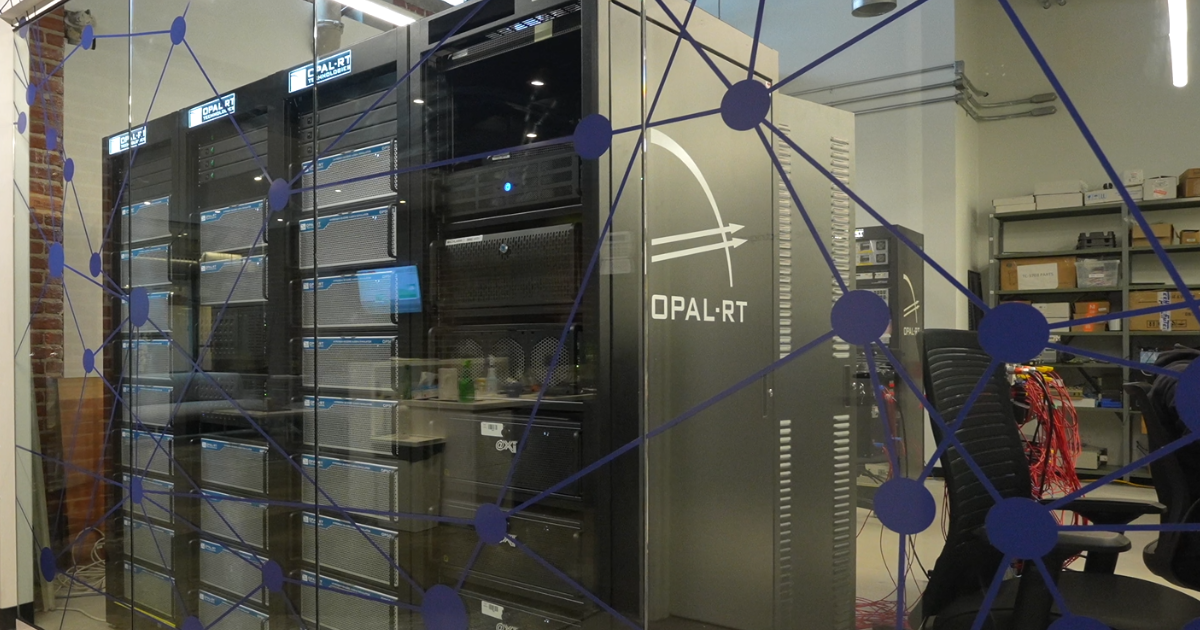
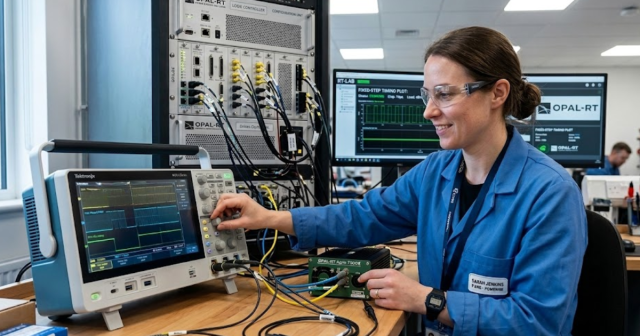
OPAL-RT supports engineers who need to validate control logic, communications, and protection under tight timing constraints. Real-time digital simulators run detailed power system models while controllers, relays, and inverters interact through physical I/O and standard protocols. Engineers script contingencies such as feeder faults, islanding, and reconnection to see how automation behaves before crews touch a breaker. Python integration and open APIs allow custom test orchestration, KPI extraction, and automated reporting that fits your lab workflow.
Teams also use OPAL-RT to de-risk interoperability and compliance. Closed-loop tests exercise Distributed Network Protocol (DNP3), IEC 61850, and Modbus exchanges under heavy traffic, loss, and jitter, then confirm that protection and control remain stable. Hardware-in-the-loop scenarios measure the impact of delays, firmware differences, and edge-case logic without risking service to critical loads. Engineers get a repeatable way to prove performance, shorten commissioning, and document results for stakeholders. Engineers trust OPAL-RT for precision, repeatability, and credible evidence.
Common questions
How does distribution network automation benefit microgrid projects?
Automated switching, protection, and dispatch reduce outage minutes, hold voltage and frequency within limits, and keep critical loads supplied. Operators gain consistent procedures because logic executes the same way every time, which lowers risk during stressful events. Maintenance costs fall as remote actions replace many site visits, and condition monitoring targets the assets that truly need work. The combination delivers measurable improvements that show up in SAIDI, SAIFI, and power quality trends.
What are the advantages of automated distribution networks for microgrids?
Automated distribution networks coordinate DERs, storage, and loads so microgrids can island safely and reconnect cleanly. FLISR restores service quickly, while Volt-VAR strategies minimize losses and keep voltages inside limits. SCADA dashboards unify alarms, status, and KPIs for faster diagnosis and more confident control. Expansion becomes easier because standards-based integration supports new feeders, meters, and controllers without redesign.
Why consider distribution network automation in microgrid design?
A microgrid design that includes automation from the start avoids costly retrofits and fragile workarounds. A layered control approach clarifies timing and authority, which improves both safety and maintainability. Data models, time sync, and security become part of the specification instead of afterthoughts, leading to cleaner commissioning. The result is a system that behaves predictably and grows in a consistent pattern.
What common standards and protocols support automated microgrids?
Distributed Network Protocol (DNP3), IEC 61850, and Modbus cover most device communications in distribution settings. IEC 61850 messaging supports fast events such as trip signals, while DNP3 handles supervisory control and telemetry reliably. Many teams pair those with time synchronization using Precision Time Protocol (PTP) and follow requirements from IEEE 1547 for inverter interconnection. A consistent choice of standards keeps integration predictable and testable across projects.
How should engineers phase automation upgrades in an existing microgrid?
Start with observability, adding metering and time sync so measurements are trustworthy and complete. Next, introduce automation where payback is clear, such as FLISR on the most outage-prone feeders or Volt-VAR control on circuits with chronic voltage issues. Validate each step with HIL or staged field trials, then add scheduling and advanced optimization once the foundation is solid. Version-control every logic change and run regression tests so upgrades remain boring and safe.
Clear thinking, good data, and focused tests make upgrades successful, not just ambitious. Teams that agree on KPIs and standards see faster commissioning and fewer late surprises. Simulation evidence turns opinions into decisions that leadership can support confidently. A steady, disciplined approach delivers the reliability gains that stakeholders expect.
Real-time solutions across every sector
Explore how OPAL-RT is transforming the world’s most advanced sectors.
Industry applications, Simulation
03 / 31 / 2026
Managing high-frequency switching in real-time EMT simulation
Precision in testing complex power systems is essential to avoid failures, accelerate innovation, and integrate new technologies safely.

Simulation
03 / 30 / 2026
Understanding timestep requirements for modern power converters
Practical criteria for selecting EMT and real time simulation timesteps for power converters, covering switching resolution, control and PWM timing alignment, multirate approaches, and verification checks.

Industry applications, Simulation, Energy
03 / 29 / 2026
Validating data center energy management systems using real-time HIL
This piece explains how AI workload variability affects data centre power stability and how closed-loop HIL testing helps validate EMS control behaviour under site and grid stress.
EXata CPS has been specifically designed for real-time performance to allow studies of cyberattacks on power systems through the Communication Network layer of any size and connecting to any number of equipment for HIL and PHIL simulations. This is a discrete event simulation toolkit that considers all the inherent physics-based properties that will affect how the network (either wired or wireless) behaves.