8 Key metrics engineers track in high performance motor drive validation
Automotive
01 / 06 / 2026
Key Takeaways
- Set pass limits around your duty cycle so validation results stay relevant.
- Treat torque, timing, and waveform quality as early warning signals for heat and instability.
- Keep metric definitions and logging consistent so comparisons across benches stay credible.
Motor drive validation will stay on track when your measurements expose control error, loss, and heat early. You need proof the drive will hit the commanded torque and speed without overheating parts or nuisance trips. Consistent metrics will keep fixes from bouncing between teams.
“A stack of plots is not proof unless the same few metrics keep passing across repeats.”
Performance must mean the same thing for controls, power, and test. Peak torque hides slow settling and extra RMS current. Drive efficiency testing will mislead you without duty-cycle weighting. Motor drive performance metrics give you pass limits that match your application.
What engineers mean by performance during motor drive validation
Performance is meeting torque and speed targets with bounded error while staying stable and within thermal limits. Repeatability matters because the same setup should yield the same numbers. Fault behaviour counts because it defines recovery versus shutdown. Clear definitions turn validation into checks.
A dyno run shows why load steps matter. A controller can track 3,000 rpm at light load, then oscillate when a 120 Nm step hits. The trace will reveal saturation or delay as the root cause. That only shows up on a shared timebase.
Tradeoffs must be managed on purpose. Higher switching frequency will smooth torque while raising loss. Tighter gains will reduce error while shrinking stability margin under drift. Shared metrics keep results comparable across benches and HIL.
8 Metrics engineers track in high performance motor drive validation
These eight checks cover output accuracy, loss, timing, fault behaviour, and heat limits. Synchronized logging keeps cause and effect visible on every run. Limits should match your duty cycle, including regen and thermal soak. Consistent definitions keep results comparable across benches.
1. Steady state and transient torque accuracy across operating range
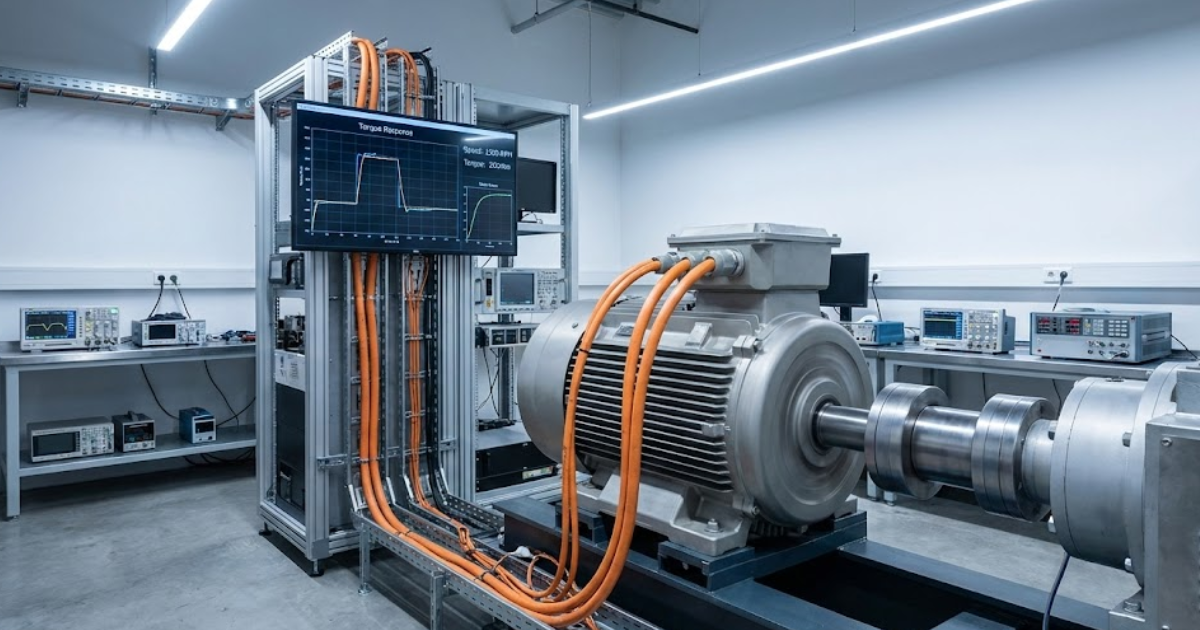
Torque tracking proves the control and sensing chain is aligned. Measure steady error, peak spikes above target, settling time, and any ringing after steps. A common check is a 0 to 150 Nm command at 500 rpm while logging commanded torque, estimated torque, and dyno torque. Repeat the step at several speeds to catch estimator bias or clamp behaviour. Error that grows with temperature often points to parameter drift or current sensing offset.
2. Electrical to mechanical efficiency under load and speed variation
Efficiency tells you how much heat the system will shed in copper, iron, and silicon. Compute it from DC input power at the inverter and shaft power on the dyno over a speed-load map. A useful pattern includes a light cruise point, a peak power point, and a regen point that matches braking. Sudden dips near field weakening often trace back to current angle error or rising switching loss.
3. Current waveform quality and harmonic distortion levels
Current quality predicts extra loss and torque ripple even when the average torque looks fine. Track phase current ripple, harmonic content, and imbalance between phases or legs. A low-speed, high-torque point often reveals PWM ripple that pushes RMS current up without adding torque. An FFT of current at 1,000 rpm and high load will show low-order harmonics and switching sidebands. Better current quality will often lower winding temperature and audible noise in the same pass.
4. Switching losses and semiconductor thermal stress indicators
Power devices fail from stress you will not see in a torque plot. Track switching loss estimates, voltage and current spikes, and junction temperature swing during repeatable transients. A strong stress test steps the torque at high bus voltage, then enters regen and repeats the cycle. Voltage or current spikes are usually tied to stray inductance, gate timing, or layout changes between builds. Loss reduction matters, but a safe margin under worst transients matters more.
“Power devices fail from stress you will not see in a torque plot.”
5. Control loop latency and closed loop stability margins
Latency sets the ceiling on bandwidth and shows up as phase lag under load. Measure the sample-to-update delay from current sensing to PWM action, then relate it to observed oscillation. A simple check adds one filter stage and repeats a speed step under a stiff dyno load. Ringing near a fixed frequency points to a shrinking margin, not random noise. Low latency lets you use gains that stay stable across temperature and bus variation.
6. Fault response timing and torque continuity under phase loss
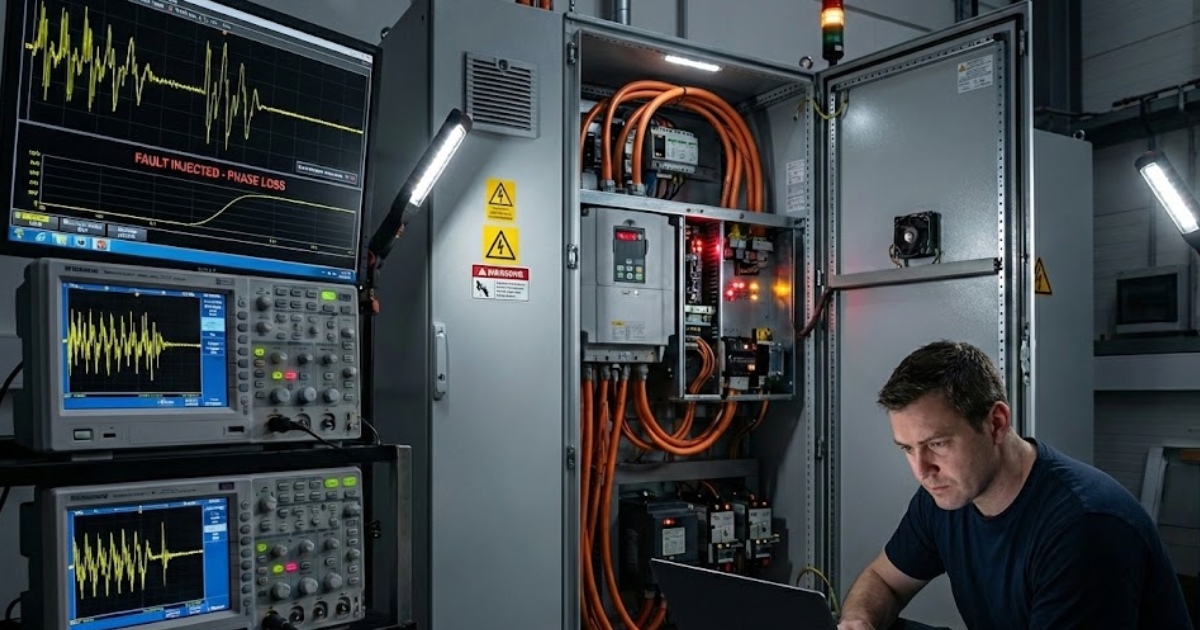
Fault response is about the whole sequence, not just detection speed. Track detection time, isolation time, torque dip, and recovery for events like open phase, short-to-ground, or encoder loss. One practical test opens a phase at 2,000 rpm and 100 Nm and measures the torque drop and recovery time. A 12-phase PMSM drive should hold torque better under phase loss, but only if the control reconfigures cleanly. A real-time HIL setup using OPAL-RT will repeat the same fault timing on every run.
7. Thermal behaviour of windings, magnets, and power devices
Thermal behaviour sets continuous rating and long-run reliability. Log winding temperature, magnet temperature, coolant inlet and outlet, and device temperatures during long holds and repeated overloads. A simple run holds the continuous torque point for 20 minutes, then repeats a short overload cycle and watches the hottest sensor. Magnet heating will shift back-EMF and tighten the voltage margin in field weakening. Validation must confirm the thermal model stays honest once the drive is heat-soaked.
8. Speed and position tracking error during dynamic conditions
Tracking error defines how the system will feel in traction and servo work. Measure steady error, peak spikes above target, jitter, and periodic error tied to sensing or observer behaviour. A clear test runs a rapid reversal, such as +500 rpm to -500 rpm, while logging command, feedback, and phase current. Low-speed motion will expose quantization and friction as hunting and ripple. Stable tracking will keep current under control while meeting motion targets.
| Metric you track | What you confirm from the result |
| 1. Steady state and transient torque accuracy across the operating range | Confirms torque follows commands without peak spikes or ringing. |
| 2. Electrical to mechanical efficiency under load and speed variation | Shows losses stay stable across the duty map. |
| 3. Current waveform quality and harmonic distortion levels | Confirms harmonics stay low enough to limit extra heating. |
| 4. Switching losses and semiconductor thermal stress indicators | Shows device stress stays within limits during worst transients. |
| 5. Control loop latency and closed loop stability margins | Confirms delay stays low enough for stable control. |
| 6. Fault response timing and torque continuity under phase loss | Shows torque dip stays small and recovery stays controlled. |
| 7. Thermal behaviour of windings, magnets, and power devices | Confirms temperatures stay within limits over long holds. |
| 8. Speed and position tracking error during dynamic conditions | Shows motion follows targets without jitter inflation. |
Applying these metrics to prioritize motor drive validation testing
Start with checks that expose unstable behaviour early. Torque tracking and loop latency will surface issues that later show up as heat and trips. Efficiency and current quality will then point to loss that steals thermal headroom. Thermal holds and fault cases land best after control is stable, since data will be cleaner.
Run step tests and sweeps at moderate voltage, then repeat at worst-case bus voltage and temperature. Keep triggers and sampling identical across revisions so traces stay comparable. Treat each metric as a pass gate with a recorded limit. OPAL-RT fits when you need repeatable HIL fault timing that matches bench logs.
Real-time solutions across every sector
Explore how OPAL-RT is transforming the world’s most advanced sectors.
Industry applications, Simulation
03 / 31 / 2026
Managing high-frequency switching in real-time EMT simulation
Precision in testing complex power systems is essential to avoid failures, accelerate innovation, and integrate new technologies safely.

Simulation
03 / 30 / 2026
Understanding timestep requirements for modern power converters
Practical criteria for selecting EMT and real time simulation timesteps for power converters, covering switching resolution, control and PWM timing alignment, multirate approaches, and verification checks.
Energy, Industry applications, Simulation
03 / 29 / 2026
Validating data center energy management systems using real-time HIL
This piece explains how AI workload variability affects data centre power stability and how closed-loop HIL testing helps validate EMS control behaviour under site and grid stress.
EXata CPS has been specifically designed for real-time performance to allow studies of cyberattacks on power systems through the Communication Network layer of any size and connecting to any number of equipment for HIL and PHIL simulations. This is a discrete event simulation toolkit that considers all the inherent physics-based properties that will affect how the network (either wired or wireless) behaves.