Advancing energy generation and storage through real-time simulation
Simulation
11 / 11 / 2025

Key Takeaways
- Energy generation and energy storage now operate as a coordinated toolbox, where synchronous machines, converter-based assets, and storage must share roles across many time scales.
- Accurate, real-time simulation reduces technical risk by exposing timing effects, converter interactions, and protection behaviour long before equipment reaches the field.
- Hardware-in-the-loop workflows help teams validate controllers and battery management systems against detailed models of renewable energy systems and storage, under realistic and stressful operating conditions.
- Power grid integration improves when engineers test grid codes, coordination strategies, and stability margins on a shared simulation platform that represents converters, storage, and networks with high fidelity.
- Teams that invest in real-time simulation gain shorter development cycles, safer test practices, and stronger confidence in renewable and hybrid system performance from concept through commissioning.
You live with the reality that every design choice around power, controls, and protection will eventually face the grid, not just a slide deck. Projects keep adding more renewable energy systems, more storage units, and tighter performance expectations, and you are still expected to keep stability and safety under control. Static studies help frame the problem, but they rarely reveal how firmware, converters, and protection behave under stress. Real-time simulation gives you a way to see those interactions in a safe setting, before hardware and grid constraints lock in your options.
Energy generation and energy storage have expanded far beyond traditional plants that feed predictable load profiles. You now deal with converter-based generation, multi-megawatt battery systems, and complex power grid integration projects that merge legacy assets with new technology. Each of these pieces brings its own time scales, limits, and edge cases, and they all sit on top of control and communication layers that can fail in subtle ways. Real-time simulation turns that complexity into something you can probe, test, and refine with confidence.
Understanding energy generation and storage in modern power systems
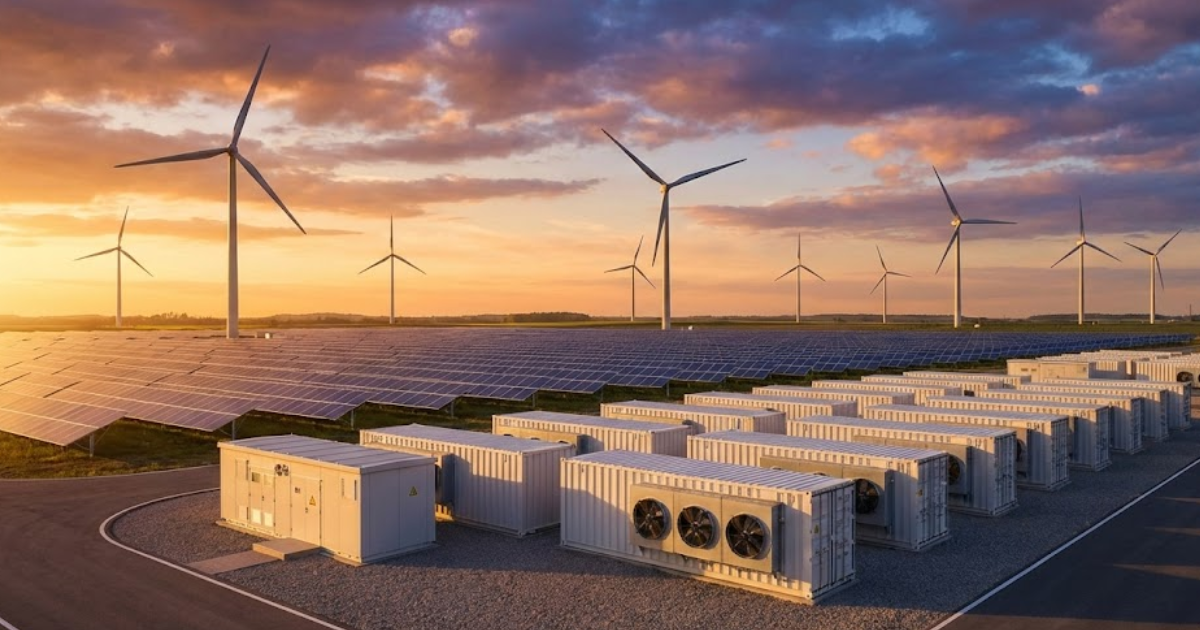
Energy generation refers to the full range of assets that convert primary energy into electrical power, from hydro and gas units to large wind farms and photovoltaic plants. Traditional synchronous generators contribute mechanical inertia and familiar fault behaviour, while converter-based units rely on control algorithms to shape how they react to the grid. Those differences matter during faults, switching events, and frequency excursions, and they change the assumptions used in studies and protection design. Renewable energy systems also vary with weather conditions, which introduces more uncertainty into both short and long time scales.
Energy storage adds a way to shift energy in time and support the grid during variability or contingency. Technologies such as batteries, pumped hydro, and flywheels make it possible to absorb surplus production and release it when generation falls or load climbs. Storage systems also take part in services such as frequency support, voltage control, and black start, which means they sit close to the control and protection decisions that matter most. When you consider energy generation and energy storage together, the focus shifts to how these assets share roles, not just how each one performs in isolation.
The growing need for accurate renewable energy simulation tools
Teams working with renewable energy systems face a mix of stricter requirements, more complex controls, and shorter development cycles. You are asked to prove that plants will behave correctly under rare faults, extreme weather, and new grid codes, often before the final hardware is even available. Offline studies help frame overall performance, yet they miss timing effects, converter interactions, and many non-linear behaviours. Accurate simulation tools step in as a practical way to study those details without exposing equipment or schedules to unnecessary risk.
- Variable resource profiles: Solar and wind outputs shift over seconds, minutes, and seasons, which stresses both plant controls and grid balancing. Simulation tools let you replay realistic profiles and stress-test controls, instead of relying only on a few standard cases.
- High penetration of converter-based assets: Converter interfaces alter short-circuit levels, fault shapes, and dynamic responses. Detailed models show how inverters, filters, and transformers interact, which improves protection and control design.
- Tight grid code expectations: Grid codes now specify fault ride-through, reactive support, and active power behaviour in more detail. Simulation gives you a structured way to validate compliance before formal testing or certification.
- More distributed assets and storage: Smaller generators and storage units appear at many points on the grid, often on distribution feeders. Tools that handle aggregation and coordination help you avoid conflicts between local control and system-level targets.
- Pressure to reduce lab and field risk: Full-scale tests for rare faults or extreme events can put people and hardware at risk. Simulation lets you study those conditions with full visibility and no physical hazards.
- Need for better communication across teams: Protection, controls, and planning groups often use different assumptions and tools. Shared simulation models reduce misunderstandings and give each team a common frame of reference.
Simulation tools that support accurate models and realistic scenarios link renewable projects back to evidence rather than opinion. Design reviews become easier when everyone can point to the same scenarios and plots instead of competing spreadsheets. That shared basis is especially important as plants adopt more advanced controls and interact with storage at multiple scales. In this context, real-time simulation becomes a core part of how projects move from concept to reliable operation.
How real-time simulation enhances renewable energy performance and control
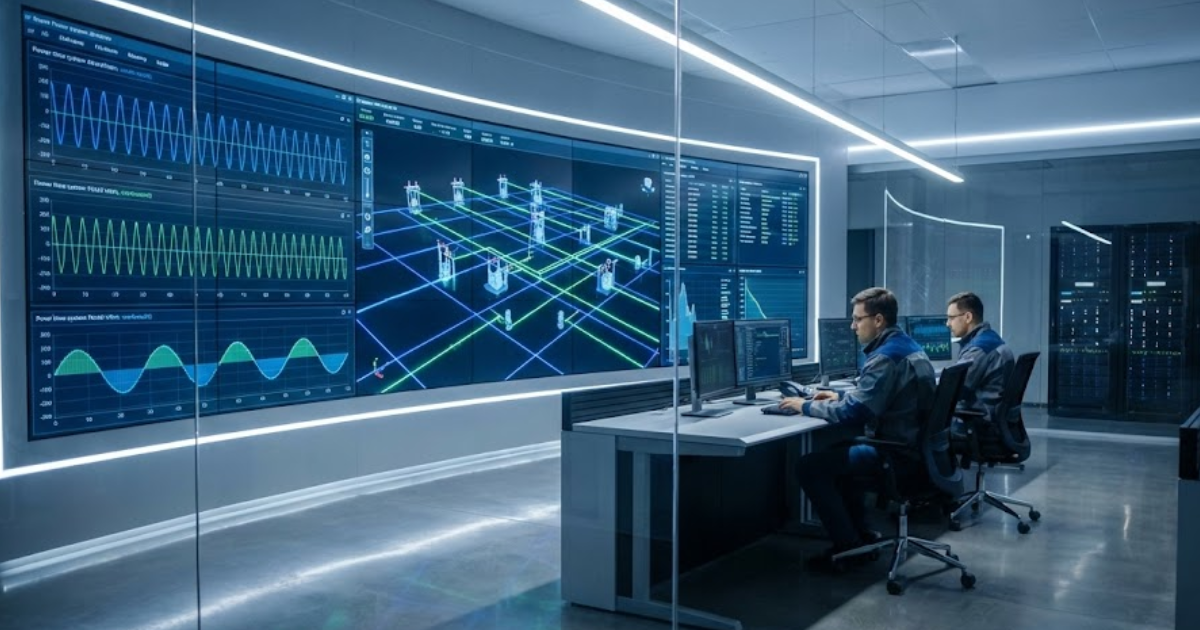
Real-time simulation takes high-fidelity models and runs them fast enough to exchange signals with hardware in closed loop. Controllers, relays, and management systems interact with a digital plant that behaves like the real one, including timing, noise, and non-linear behaviours. This arrangement reveals issues that never appear in static or offline studies, such as interrupt timing mismatches, sampling artefacts, or interaction between control loops. For teams responsible for renewable energy systems, it turns simulation into a functional test bench instead of a separate analytical tool.
Closing the loop between models and controllers
Closed-loop testing connects controller inputs and outputs directly to the simulated plant through analogue and digital interfaces. Control hardware receives currents, voltages, and states from the simulator, and sends back its commands in real time. This setup shows how firmware behaves when faced with realistic sensor dynamics, measurement noise, and communication delays. Engineers can watch control loops as they respond to setpoint changes, ramps, and faults, with visibility into timing that would be difficult to capture on a physical plant.
Using the same models for Software-in-the-loop and Hardware-in-the-loop testing keeps a clear link between early design and final validation. Control developers can debug logic using virtual controllers, then connect the actual hardware once the basic behaviour looks correct. Test plans move across stages with only small adjustments, which reduces rework and keeps progress aligned across teams. As commissioning approaches, much of the controller behaviour has already been explored under a wide range of conditions.
Capturing converter and grid dynamics that matter
Converter-based renewable energy systems include switching, filters, and control loops that respond on very short time scales. Real-time simulation platforms with suitable solvers and time steps replicate these dynamics without overwhelming the hardware. Models can include pulse-width modulation strategies, dead-time, current limits, and non-linear magnetics, all of which affect power quality and protection. This level of detail is important for studies that look at harmonics, resonance, and transient stability.
With these models running in real time, you can evaluate filter designs, switching patterns, and control bandwidths while watching detailed waveforms. This approach provides insight into how changes in parameters affect total harmonic distortion, current ripple, and voltage fluctuations. When specifications call for strict power quality metrics, the simulator becomes a practical way to prove that the design can meet those thresholds. The result is a more confident path from converter design to grid-approved operation.
Testing protection and fault behaviour safely
Faults, voltage dips, and frequency excursions are exactly the conditions that protection and control systems must handle correctly. Real-time simulation lets you recreate those conditions at will without putting physical assets in danger. Relays, controllers, and converters receive realistic fault waveforms, yet the energy behind those faults remains inside the simulator. This safe context makes it practical to test severe scenarios and miscoordination cases.
Protection engineers can try different settings, time delays, and logic paths while watching how the whole plant responds. Data from these tests guide refinements that balance selectivity, speed, and backup coverage. Control teams see how inverters and storage systems behave when faults occur, including ride-through performance and post-fault recovery. Once the configuration performs well across a wide set of cases, it becomes a reference pattern for future projects.
Optimizing plant-level control strategies
Renewable plants often use layered control structures that coordinate multiple inverters, storage units, and support devices. Real-time simulation provides a plant and grid model that reacts in real time to supervisory decisions, local control loops, and external events. You can test grid-following and grid-forming modes, virtual inertia functions, and advanced droop schemes while tracking stability and power quality metrics. These studies help you compare strategies using data instead of assumptions.
Coordination across devices also becomes more transparent when everyone works from a shared simulation setup. Issues such as conflicting voltage regulation, chasing frequency corrections, or poorly damped oscillations show up quickly. Teams can adjust hierarchies, communication rules, and fallback modes to avoid those issues. A tuned plant-level control strategy then supports project targets for energy generation and energy storage while respecting grid limits.
| Focus area | Common concern | Effect of real-time simulation |
| Controller validation | Limited visibility into timing and noise effects | Closed-loop testing with realistic signals and delays |
| Converter and filter design | Difficulty capturing fast switching behaviour | High-fidelity converter models running at suitable time steps |
| Protection and fault behaviour | Risk and cost of severe live tests | Safe reproduction of complex faults for protection studies |
| Plant-level optimization | Complex interaction across multiple assets | Coordinated testing of control strategies under many scenarios |
Real-time simulation adds a practical layer to renewable plant design, where models and controllers interact just as they will on site. You gain insight into timing, non-linearities, and protection actions that are hard to observe in other ways. That insight helps you catch issues earlier and refine designs before hardware is exposed to stress. Over time, this approach improves the performance and reliability of renewable energy systems across projects.
Improving energy storage system design and validation through simulation

Energy storage systems combine electrochemistry, thermal effects, and power electronics, all governed by management and safety logic. Simulation helps you compare chemistries, pack layouts, and converter topologies while keeping application goals in mind. You can evaluate state-of-charge windows, C-rate limits, and thermal margins for use cases such as peak shaving, reserve support, or backup power. These studies contribute to safer and more economical sizing decisions before hardware orders go out.
Validation improves when storage systems are tested with models that represent both electrical and thermal behaviour at suitable time scales. Battery management systems and supervisory controllers can run against digital packs that respond dynamically to current, temperature, and ageing. Real-time simulation with Hardware-in-the-loop brings this behaviour into the lab, connecting models to actual BMS hardware. This setup reveals how estimation, protection, and balancing functions behave under rapid transients, faults, and noisy measurements.
Integrating renewable energy and storage into modern power grids
Power grid integration becomes more complex as renewable energy systems and storage units occupy a larger share of total capacity. Grid operators still expect stable voltage, acceptable frequency, and reliable fault behaviour, regardless of how much converter-based equipment is present. Projects must show that plants will respond correctly to both local issues and system-level events. Real-time simulation helps you test that interaction in a controlled setting before hardware connects to the network.
Working with grid codes and interconnection rules
Grid codes describe expected behaviour for active power, reactive power, voltage limits, and fault ride-through under many conditions. Instead of treating those clauses as theory, you can express them as scenarios and acceptance criteria on a simulator. Plant and storage models then face the same voltage dips, frequency excursions, and setpoint changes that the code describes. Controllers either meet expectations or reveal where tuning and design changes are required.
Repeating these tests across design iterations provides a clear line of evidence for internal reviews and external stakeholders. When operators update their codes, you can reapply the new conditions to existing models and identify upgrades that may be needed. New staff also gain a more concrete understanding of grid codes when they see how specific clauses look in time-domain traces. That shared knowledge makes discussions between plant engineers and grid operators more productive.
Coordinating variable generation and storage
Variable renewable generation raises concerns about ramp rates, congestion, and resource adequacy. Storage systems, flexible loads, and controllable generation are meant to offset those concerns, yet poor coordination can create new problems. Real-time simulation lets you test coordinated control strategies that use both local autonomy and central supervision. You can examine how different dispatch policies affect frequency, voltage, and line loading under changing conditions.
When a coordination scheme works well, each device contributes to stability and performance without causing conflicts. If a scheme creates oscillations or overuse of certain assets, those issues appear in a safe, repeatable setting. Engineers then adjust communication rules, priority settings, or fallback modes and retest. This cycle builds confidence that the chosen strategy will handle both routine operation and rare events.
Maintaining stability with high converter penetration
As converter-based resources displace synchronous machines, system inertia drops and stability margins can shrink. Traditional planning tools make assumptions that may no longer hold under these conditions. Real-time simulation with detailed converter and grid models gives you a way to test stability under line trips, generator outages, and large disturbances. You can study both transient and small-signal behaviour using consistent models.
Mitigation steps such as virtual inertia, enhanced damping controls, and additional reactive support can then be tried and tuned. Parameter sweeps show which settings offer acceptable damping and robustness across scenarios. Results from these studies inform both project-level designs and discussions about future grid code updates. This practice helps maintain stability as the mix of assets shifts toward converter-based equipment.
Planning and validating microgrids
Microgrids combine local generation, storage, and loads that must maintain quality and reliability in both connected and islanded modes. Real-time simulation supports planning by providing a digital replica where you can test black start, resynchronization, and load transfer sequences. Inverters, storage units, and backup generators can be assigned control roles and then observed under many operating patterns. Data from these tests guide choices about architecture, sizing, and operating procedures.
During later stages, the same models support validation and training for operators and engineers. Controllers and protection devices connect to the simulator so that critical sequences can be practised without affecting customers. Observed issues lead to refinements in logic, settings, and procedures before commissioning. Once the microgrid enters service, the simulation platform remains a useful resource for studying upgrades and new operating modes.
Integrating renewable energy and storage into power grids requires attention to codes, coordination, stability, and local operation. Real-time simulation gives you a structured way to examine each of these themes using consistent models and repeatable scenarios. That structure helps teams resolve concerns before they reach the field. Over time, projects benefit from smoother integration and fewer surprises.
Benefits of real-time simulation for renewable and hybrid systems
Teams considering real-time simulation want to see clear links between the platform and daily work on renewable and hybrid systems. The practical advantages include lower risk, better coverage, and more efficient use of lab and field time. Good workflows also support collaboration across specialists in controls, protection, planning, and storage. When everyone works from the same digital plant, conversations move faster and stay grounded in data.
“Real-time simulation turns complex renewable and hybrid projects into something you can inspect, refine, and sign off with better insight.”
- Lower technical risk: Severe faults, rare operating conditions, and miscoordination cases can be tested safely. This reduction in unknowns supports better design signoffs and more confident commissioning.
- Shorter development cycles: Reusing models across stages cuts rebuilding effort and lets teams run Software-in-the-loop and Hardware-in-the-loop testing in parallel with hardware development. Schedules benefit from this overlap.
- Stronger validation of controls and protection: Controllers and relays face realistic signals, noise, and latency, which exposes weaknesses earlier. Adjustments then rely on comprehensive traces rather than limited snapshots.
- Safer test practices: Hazardous tests move from physical assets to the simulator, while lab setups remain flexible for many projects. Safety policies and asset protection benefit from this shift.
- Better assessment of hybrid configurations: Projects that combine solar, wind, storage, and conventional units can be studied under many mixes and setpoints. This insight helps teams choose architectures and strategies with greater confidence.
| Benefit | Impact for engineering teams | Impact for leaders and sponsors |
| Lower technical risk | Fewer surprises during integration and commissioning | Reduced chance of expensive rework or field incidents |
| Shorter development cycles | Parallel progress across modelling and hardware | Faster delivery of new projects and features |
| Stronger validation | Better coverage for controls and protection | Clearer evidence for internal and external approvals |
| Safer test practices | Hazardous conditions kept in the simulator | Improved alignment with safety and asset protection goals |
| Hybrid system assessment | Structured study of complex configurations | Better long-term planning for generation and storage mixes |
Engineers gain tools that align with how they already think about models and controllers. Leaders see clearer evidence behind technical decisions and investment choices. Across multiple projects, these advantages compound into more predictable schedules and more reliable systems.
“Real-time simulation gives you a way to see those interactions in a safe setting, before hardware and grid constraints lock in your options.”
Practical examples of simulation-based improvements in generation and storage
Practical scenarios show how simulation changes the way teams approach energy generation and energy storage projects. Many groups now rely on real-time platforms when refining wind plant controls, validating battery systems, or designing microgrids. These scenarios highlight how issues emerge earlier, where they can be corrected with less cost and stress. They also show how a library of tested cases becomes a long-term asset across programs and teams.
Tuning wind plant controls ahead of commissioning
Wind plants bring many converters, control layers, and protection devices into a single grid connection point. Real-time simulation lets engineers emulate the collection network, point of common coupling, and key turbine behaviour while running actual controllers in closed loop. They can test responses to voltage dips, frequency events, and curtailment requests while watching both electrical and control variables. Settings for active and reactive power control are then chosen based on observed performance.
Teams can also study how operating strategies affect loading across turbines and cables, using realistic wind and setpoint patterns. When grid operators adjust requirements, scenarios can be updated and replayed without visiting the site. These insights guide firmware updates and configuration changes that are ready before field rollout. Commissioning crews benefit from plants that already show predictable behaviour across many tested conditions.
Validating battery management systems with Hardware-in-the-loop
Battery management systems protect storage packs and shape their performance over many years. Hardware-in-the-loop testing connects BMS electronics to detailed real-time models of cells, modules, and converters. Engineers send charge and discharge profiles that include steep ramps, partial states of charge, and abnormal conditions. The BMS responds just as it would in a physical pack but without risking cells or hardware.
This approach reveals how state-of-charge estimation, state-of-health tracking, and protection thresholds behave under stress and noise. Fault injection, such as simulated sensor failures or contactor issues, can be carried out safely. The resulting data help refine thresholds, timing, and diagnostics so that unexpected events are handled gracefully. Once validated, the same models support training for operations teams who must interpret BMS alarms and trends.
De-risking solar-plus-storage microgrids
Solar-plus-storage microgrids use multiple sources and control layers to support local loads, sometimes with backup generators in the mix. Real-time simulation lets teams bring all these elements into a single test setup linked to controllers and relays. They can practise islanding, reconnection, and changes in operating priorities without affecting actual customers. Detailed traces show how voltage, frequency, and state of charge behave during each scenario.
Issues such as conflicting setpoints, poorly damped power sharing, or unintended use of storage show up clearly. Engineers then adjust control logic, communication settings, or operating procedures and repeat tests. Over time, the microgrid strategy becomes more robust while still meeting project objectives for cost and reliability. Once the site is live, the simulator remains a useful tool for exploring new modes and future expansions.
Testing grid-support inverters for critical sites
Critical sites often depend on grid-support inverters to maintain supply during external disturbances or outages. Their behaviour during faults, load changes, and grid resynchronization is complex, especially when several units act at once. Real-time simulation provides a controlled setting where these inverters can run with realistic network and load models. Engineers evaluate stability, power quality, and interaction with protection for many events.
Based on these tests, teams refine droop settings, current limits, and control modes to keep behaviour predictable. They can compare different strategies for islanded operation and grid reconnection, using clear performance criteria. This preparation reduces the chance of unexpected trips or instability when equipment is installed. Critical operations then rest on configurations that have already been stressed and studied in detail.
These practical scenarios show how simulation-based workflows catch problems earlier and turn complex questions into testable cases. Each project adds more models and scenarios that can be reused or adapted later. Over time, this shared library strengthens both technical outcomes and team confidence when dealing with advanced energy generation and energy storage projects.
How OPAL-RT supports innovation in energy generation and storage
OPAL-RT focuses on helping engineers bring real-time simulation into daily work with renewable energy systems and storage. Its platforms combine high-performance digital simulators with flexible Hardware-in-the-loop interfaces so controllers, relays, and management systems can connect directly to detailed models. Teams use familiar modelling tools and open interfaces, which reduces friction when integrating converters, grids, and storage units into one setup. This approach makes it easier to reuse models, standardize test cases, and share knowledge across projects.
For energy projects, OPAL-RT systems support tasks such as tuning inverter controls, qualifying battery management systems, studying microgrids, and evaluating power grid integration strategies. Lab managers appreciate that a single simulator can serve multiple roles, from early Software-in-the-loop checks to final Hardware-in-the-loop campaigns. Technical leaders gain confidence from traceable results that span concept studies through to pre-commissioning tests. This combination of capability and focus helps position OPAL-RT as a trusted partner when teams need to raise the quality and coverage of their simulation work.
Common questions
What is meant by energy generation and storage in modern power systems?
Energy generation covers all assets that produce electrical power, including both traditional synchronous generators and converter-based units such as wind turbines and photovoltaic inverters. Energy storage includes systems that absorb energy and release it later, such as batteries, pumped hydro installations, and flywheels. These resources work together to keep supply and demand balanced across many time scales. When people refer to energy generation and energy storage as a combined topic, they usually focus on how these assets coordinate to support stability, reliability, and performance.
How does energy storage support renewable energy systems during variability?
Energy storage provides a buffer that smooths the natural variability of solar and wind production. Storage units can absorb extra energy when generation exceeds load and deliver energy when generation falls short. They also support grid services such as fast frequency response, ramp-rate control, and voltage support. With suitable control strategies, storage systems help renewable plants appear more predictable and controllable to grid operators without losing the benefits of low-emission generation.
How does real-time simulation improve power grid integration for renewables and storage?
Real-time simulation improves power grid integration by allowing plants and controllers to face realistic network conditions before connection. Models of the grid, converters, and storage units run at a rate that supports closed-loop interaction with control and protection hardware. Engineers can test fault ride-through performance, voltage regulation, and frequency support under many scenarios without risking equipment. Insights from these tests guide design, settings, and operating strategies so that power grid integration becomes smoother and more predictable.
What kinds of models are most useful for renewable and storage studies?
Useful models for renewable energy systems and storage usually combine several levels of detail. Phasor-based models support power flow, voltage profiles, and broad dynamic behaviour for planning and operation studies. Electromagnetic transient models capture converter switching, filter behaviour, and detailed faults, which are important for control and protection work. For energy storage, models that include electrical, thermal, and degradation aspects help you understand both short-term performance and long-term impacts.
How can a team start building a real-time simulation workflow?
A practical approach is to pick one or two high-value use cases, such as BMS validation or grid-code testing for a new plant. The team builds and validates models offline first, then transfers them to a real-time platform for Software-in-the-loop and Hardware-in-the-loop testing. Controllers and protection devices connect to the simulator through well-defined interfaces, and structured test plans drive the scenarios. As experience grows, the workflow extends to more projects, and shared models and test procedures become part of standard engineering practice.
Real-time solutions across every sector
Explore how OPAL-RT is transforming the world’s most advanced sectors.
Industry applications, Simulation
03 / 31 / 2026
Managing high-frequency switching in real-time EMT simulation
Precision in testing complex power systems is essential to avoid failures, accelerate innovation, and integrate new technologies safely.

Simulation
03 / 30 / 2026
Understanding timestep requirements for modern power converters
Practical criteria for selecting EMT and real time simulation timesteps for power converters, covering switching resolution, control and PWM timing alignment, multirate approaches, and verification checks.
Industry applications, Simulation, Energy
03 / 29 / 2026
Validating data center energy management systems using real-time HIL
This piece explains how AI workload variability affects data centre power stability and how closed-loop HIL testing helps validate EMS control behaviour under site and grid stress.
EXata CPS has been specifically designed for real-time performance to allow studies of cyberattacks on power systems through the Communication Network layer of any size and connecting to any number of equipment for HIL and PHIL simulations. This is a discrete event simulation toolkit that considers all the inherent physics-based properties that will affect how the network (either wired or wireless) behaves.