How real‑time simulation creates measurable ROI before deployment
Simulation
10 / 15 / 2025

Delays and late design flaws can quickly drain your project’s budget and schedule, undermining return on investment (ROI) before a system ever goes live. For instance, a large renewable plant can lose over $100,000 per day in revenue when grid integration is held up by unforeseen control issues. Real-time simulation and Hardware-in-the-loop (HIL) testing change this equation by allowing teams to find and fix issues early – long before physical prototypes or grid connections come into play. The real gains come from adopting these tools as a process, not just a purchase. When you treat the real-time simulator as a primary bench and automate rigorous tests well ahead of integration, your team can cut down prototype iterations, shorten commissioning, and avoid costly surprises in the field. Across energy, automotive, and aerospace programs, shifting validation to earlier stages and expanding test coverage with safe, closed-loop scenarios is delivering measurable ROI before deployment.
Shift validation left to cut rework before the first prototype
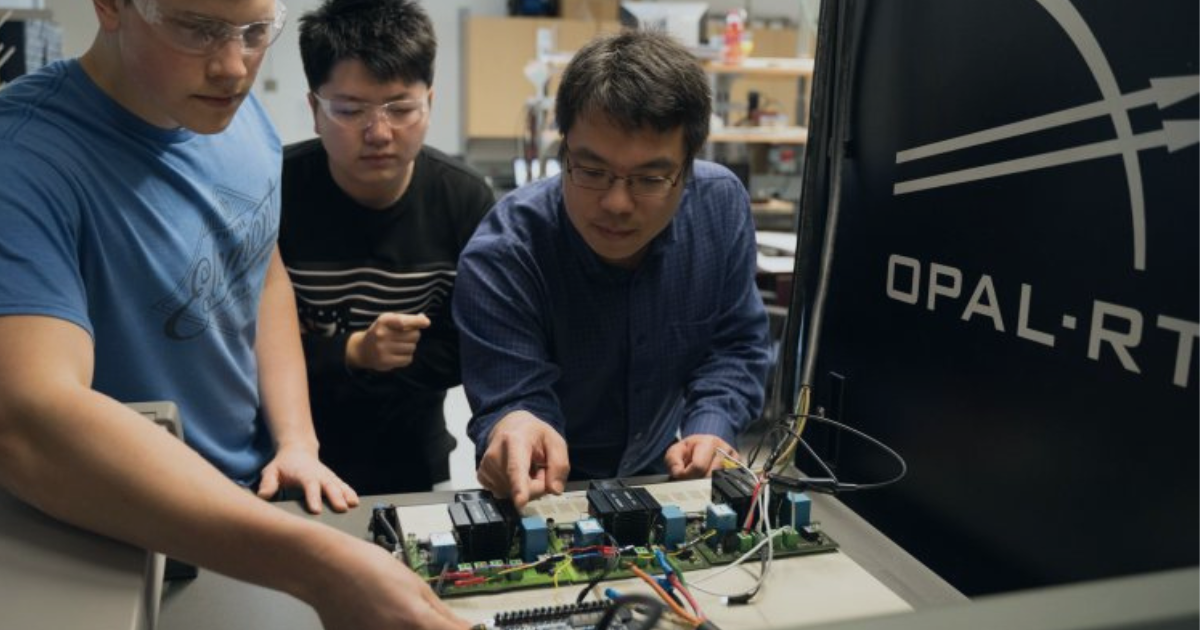
Waiting until a physical prototype is built to test a system invites late surprises and costly rework. Tight development schedules in automotive and aerospace programs no longer allow testing to wait for hardware. For years these industries have used HIL setups to design and test in parallel, continually improving systems against simulated scenarios. In fact, by the time a new engine or vehicle prototype is built, the majority of its controller tests have often already run on HIL systems in parallel with development. By validating control logic against a virtual model of the plant, you can uncover integration problems months earlier than traditional lab tests. Catching a design flaw in simulation early in the design cycle is far cheaper and easier than discovering it after hardware has been fabricated and assembled.
Modern real-time simulation platforms make this shift practical. You can take the same model built in a desktop environment – for example, a high-fidelity power system model in MATLAB/Simulink or an open Functional Mock-up Unit (FMU) – and run it in real time to interface with actual controller hardware. This continuity from Software-in-the-Loop (SIL) to HIL means you aren’t rewriting or approximating the plant model for testing; the controller is exercised on a faithful real-time replica of the system. By reusing models and validating control algorithms earlier, teams avoid the redundant debugging that usually happens when software meets physical hardware for the first time. The result is fewer design iterations and a smoother path to a working prototype.
Close the loop with HIL to reduce integration risk and lab churn
Even after careful design, many problems only surface when software and hardware finally meet. Controllers from different vendors might not handshake correctly, sensor signals may lag, or firmware quirks can throw off system timing. According to industry findings, some common causes of late-stage integration trouble include:
- Design architecture gaps: Components that turn out to be inadequate for their intended purpose, or subsystems that were over-engineered and unnecessary.
- Communication timing mismatches: Delays or incorrect assumptions in communication interfaces (sensor buses, controller cycle times) that lead to overshoots or unstable behavior when systems are integrated.
- Model vs. hardware discrepancies: Simplified models or missing features in the design phase that don’t match the real device’s behavior, causing surprises when the hardware is in the loop.
- Parameter and calibration errors: Human mistakes in transferring gains, units, or calibration data from simulation to physical controllers, resulting in incorrect settings on hardware.
- Multi-vendor integration issues: Incompatibilities when combining components or software from different suppliers, causing unforeseen conflicts during system bring-up.
- Hardware or firmware limitations: Actual controllers underperforming compared to specs, or firmware bugs in devices that only become evident during full system testing.
Using HIL simulation to close the loop on these interactions lets you find and fix such issues before you’re in the lab with a fully built system. Instead of discovering a mis-tuned controller or a protocol bug during on-site commissioning, you catch it on a real-time simulator connected to your controller. In one case, a HIL pre-commissioning testbed for a 50 MW solar farm identified more than 15 integration issues in the control system before grid connection and cut the project’s commissioning time by roughly five months. By resolving integration problems in a virtual environment, teams avoid the endless lab churn of trial-and-error and enter the deployment phase with confidence that the pieces will work together as intended.
Delays and late design flaws can quickly drain your project’s budget and schedule, undermining return on investment before a system ever goes live.
Automate test coverage and fault injection to prove readiness
Realistic system validation goes beyond the “happy path” of normal operation. Achieving true readiness means testing edge cases and failure scenarios – a task often limited by time, safety, and resources if you rely only on physical prototypes. Real-time simulation makes it practical to both automate large volumes of tests and inject extreme faults that would be impractical (or outright dangerous) to recreate on actual hardware. This combination of breadth and depth in testing ensures your design is proven against a wide range of conditions before it ever faces actual operation in the field.
Expand test coverage through automation
Traditional testing might involve a handful of scenarios, but a real-time simulator allows you to run thousands. Engineers commonly script test cases in Python or MATLAB to sweep through operating conditions, parameter variations, and random disturbance events automatically. Because these tests run in a virtual environment, they can execute around the clock – no engineer needs to be present to swap cables or reset equipment. In fact, one automated testing approach was able to execute 10,000+ scenario variations overnight and provide a full report by morning. By comparing outputs against expected results with each run, you can quickly pinpoint any regression or anomaly. This level of coverage gives confidence that even corner cases have been exercised, something manual testing could never achieve within the same timeframe.
Inject faults safely to validate edge cases
Many failure modes are too risky to test on physical equipment – nobody wants to intentionally short-circuit a power converter or push an engine beyond its limits on the stand. HIL simulation offers a way to explore these extremes without damage. For example, grid engineers can simulate a blackout or short-circuit event on a virtual power network to ensure protection devices trip correctly – scenarios too dangerous to try on the real grid. You can verify that protective routines in your controller code kick in as expected (for example, that an overcurrent fault shuts down the inverter safely) all while your real hardware thinks it’s seeing a dangerous event. Testing such failure conditions in a closed-loop virtual setup provides a safe environment to push the system to its limit. It ensures that by the time you move to field trials or certification tests, you’ve already proven the design under worst-case scenarios with minimal risk.
Using HIL simulation to close the loop on these interactions lets you find and fix such issues before you’re in the lab with a fully built system.
Scale models from desktop to PHIL on the same open stack
Implementing real-time simulation should not require reinventing your setup for different project phases. An open, scalable platform lets you use the same modeling and I/O environment from pure software testing on the desktop all the way to power hardware-in-the-loop (PHIL) experiments in the lab. For example, the very Simulink model you validate in Software-in-the-Loop can be brought onto a real-time simulator for HIL, and later expanded to interact with actual power hardware in a PHIL test – without splitting into separate toolchains. This continuity means the assumptions, interfaces, and protocols remain consistent at every stage. Communication protocols (from CAN bus to Modbus to ARINC) and sensor interfaces can be included in the simulator, so the closed-loop tests mirror how the real system will connect in the field. For instance, a team developing a wind farm inverter controller might validate its model in a desktop simulation first, then deploy the same model to a real-time simulator to test the actual controller hardware (HIL), and finally connect the simulator to a physical inverter via power amplifiers for a PHIL trial. All those stages use one platform, keeping the model and I/O consistent throughout.
Modern real-time simulators are powerful enough to handle both high complexity and high fidelity on this unified stack. Specialized FPGA-based solvers can achieve sub-microsecond time steps to accurately represent fast-switching power electronics. In many cases, a HIL simulator is far more affordable than the physical system – for example, a real-time test setup for an entire line of jet engines may cost only about a tenth of a single development engine. This means you can simultaneously test a grid protection relay on a wide-area network model and a high-frequency inverter controller on a detailed converter model – all using one integrated simulation ecosystem. By scaling up without changing environments, engineers avoid translation errors and duplicate effort, and they can gradually incorporate real equipment (loads, converters, controllers) into the loop as needed. From early desktop model checks to full hybrid simulations with real hardware, the same real-time platform carries the project through, ensuring consistency and saving effort.
Common questions about real-time simulation ROI
How does real-time simulation improve return on investment (ROI)?
Real-time simulation improves ROI by uncovering design and integration issues early—long before they can wreak havoc on budgets. Catching bugs in a virtual model or HIL setup is far less expensive than fixing them during physical prototyping or after release, which means fewer costly redesigns and fewer physical prototypes. It also accelerates development cycles, so your product reaches the market sooner and starts delivering value with less risk of late failures.
What are the benefits of real-time simulation before deployment?
Before deployment, real-time simulation lets you thoroughly prove out your design in a risk-free environment. You can vet control software against countless operating scenarios – even extreme faults – without putting real equipment or schedules in danger. By the time you get to actual deployment, you have already discovered and fixed the major bugs and ensured the system behaves as expected. This leads to a smoother commissioning process, with far fewer surprises, delays, or last-minute scrambles in the field.
How can hardware-in-the-loop (HIL) testing save development costs?
HIL testing saves development costs primarily by reducing expensive physical trial-and-error. It allows you to iterate designs in simulation instead of fabricating multiple prototype versions, cutting down on material and assembly expenses. By catching design flaws early with HIL, you avoid the massive labour costs associated with late-stage fixes or engineering change orders. HIL also prevents equipment damage during testing – you won’t risk blowing up real hardware to test fault responses – saving the cost of repairs and downtime.
How do you measure the ROI of real-time simulation?
Measuring ROI for real-time simulation comes down to tracking the before-and-after impacts on your development process. You can quantify how many costly physical prototypes were avoided by using simulation and how much integration or testing time was saved. It’s also useful to log the reduction in late-stage issues or defects escaping to production – a drop in those problems translates directly into cost savings. Some teams also assign a monetary value to time-to-market improvements (if HIL shaved months off the schedule, an earlier launch means more revenue). By assigning dollar or hour values to these factors (prototypes avoided, hours saved, delays prevented), you can clearly see the return relative to the investment in simulation tools.
OPAL-RT’s platform for ROI-driven real-time simulation
As the above best practices show, capturing ROI from real-time simulation requires the right tools and workflow. OPAL-RT’s open real-time simulation ecosystem is designed to support this process change with a scalable architecture and a comprehensive toolchain (from the core RT-LAB software to domain-specific solvers like HYPERSIM for power grids and eHS for power electronics). The platform integrates seamlessly with model-based design environments (such as Simulink and FMI standards) and supports a wide range of I/O and communication protocols on one system. This means engineering teams can adopt the HIL-as-a-bench approach and automated testing – using familiar tools without major integration hurdles.
Crucially, this integrated approach helps teams realize those returns. By using the simulator continuously from desktop model tests to rigorous hardware-in-the-loop and power-in-the-loop sessions, organizations see measurable reductions in late rework and testing overhead. Many teams make the real-time simulator a central part of their development cycle – gating each new controller release on HIL verification – and they report shorter commissioning times and smoother certification as a result. With a unified platform enabling repeatable, high-fidelity tests at every step, teams can quantify improvements in terms of prototypes avoided, test hours saved, and issues prevented.
Real-time solutions across every sector
Explore how OPAL-RT is transforming the world’s most advanced sectors.
Industry applications, Simulation
03 / 31 / 2026
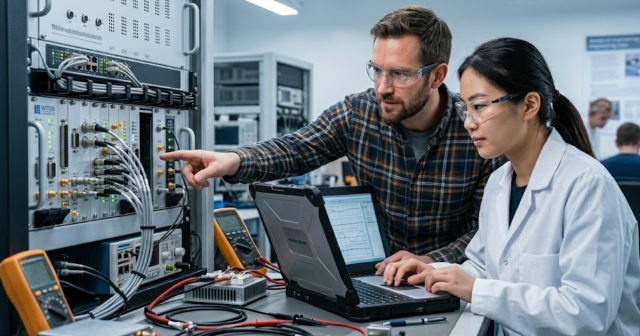
Managing high-frequency switching in real-time EMT simulation
Precision in testing complex power systems is essential to avoid failures, accelerate innovation, and integrate new technologies safely.
Simulation
03 / 30 / 2026
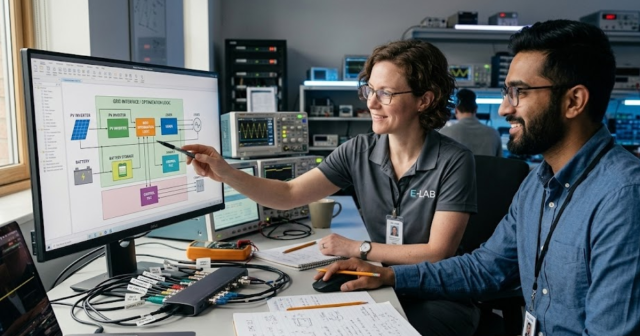
Understanding timestep requirements for modern power converters
Practical criteria for selecting EMT and real time simulation timesteps for power converters, covering switching resolution, control and PWM timing alignment, multirate approaches, and verification checks.
Energy, Industry applications, Simulation
03 / 29 / 2026
Validating data center energy management systems using real-time HIL
This piece explains how AI workload variability affects data centre power stability and how closed-loop HIL testing helps validate EMS control behaviour under site and grid stress.
EXata CPS has been specifically designed for real-time performance to allow studies of cyberattacks on power systems through the Communication Network layer of any size and connecting to any number of equipment for HIL and PHIL simulations. This is a discrete event simulation toolkit that considers all the inherent physics-based properties that will affect how the network (either wired or wireless) behaves.