Testing UPS and battery systems as the backbone of data center reliability
Industry applications
03 / 17 / 2026
Key Takeaways
- UPS and battery systems have to be tested as one electrical system under stressed operating conditions, not as separate devices with isolated pass checks.
- Closed-loop validation with realistic disturbances, timing effects, and converter behaviour gives you evidence that the system will hold up during the events that matter.
- Repeatable real-time testing improves commissioning quality, supports safer firmware and hardware changes, and gives operations teams a stronger basis for sign-off.
A UPS that passes factory checks can still fail under site-specific load steps, rectifier stress, battery ageing, or transfer timing errors. More than half of respondents in Uptime Institute’s 2023 survey said their most recent significant outage cost over $100,000, and 16% said it cost over $1 million. That cost is why validation has to prove behaviour under faulted, noisy, and time-sensitive conditions before commissioning.
You need tests that show how power electronics, controls, battery strings, and facility loads react as one coupled system. Static runtime checks do not answer the questions that matter most during a utility sag, a breaker event, or a sudden load swing from a dense compute cluster. Strong validation starts with electrical stress cases, then moves into closed-loop controller testing, and ends with repeatable scenario coverage that you can trust when the site is live.
“Reliable data centre backup power comes from testing UPS and battery systems as one closed electrical system, not from treating each device as a separate box.”
Data center reliability depends on validated UPS and battery system performance
UPS and battery reliability depends on system validation under the same electrical conditions the site will face in service. A nameplate rating does not prove transfer quality, battery support, or control stability. You need evidence from integrated tests. You also need proof that the system holds voltage and timing when the load becomes difficult.
A common gap appears when a facility tests battery autonomy and UPS alarms, yet never checks how the inverter behaves during a 40% step load at a low battery state of charge. The UPS can remain online and still let bus voltage dip far enough to trip sensitive IT equipment. Another case shows up after maintenance, when a firmware change alters rectifier limits and the battery picks up current sooner than planned. Those failures are not parts failures first. They are validation failures first, because the interaction was never exercised under controlled stress.
Electrical behaviours of backup power systems must reproduce during grid disturbances
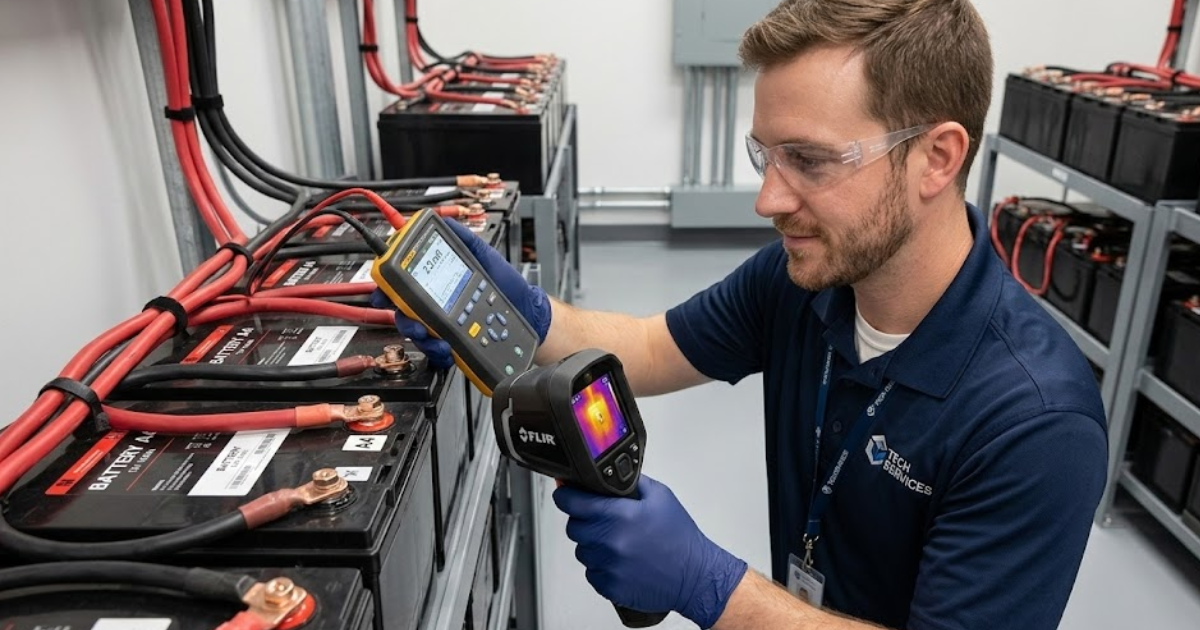
Backup power testing must reproduce the disturbances that force the UPS and battery system to work hard. That includes sags, swells, phase imbalance, frequency deviation, input loss, transfer events, and fault recovery. Each case affects converters, controls, and battery current in a different way. A useful test plan makes those behaviours measurable.
Consider a medium-voltage feed that sags for a few cycles and recovers before the generator sequence starts. The rectifier current limit, DC link support, inverter voltage regulation, and battery discharge response all matter in that short window. Another site might face repeated short interruptions from upstream switching, which can expose weak ride-through settings long before a full outage occurs. You need to verify not only that the load stays energized, but also that current sharing, harmonic response, and recovery timing stay inside limits that protect both IT equipment and the battery system.
How engineers test UPS control response under dynamic load conditions
UPS control response testing checks whether the control loops hold output quality when load demand moves quickly. The test is about timing, stability, and recovery, not just uptime. You need to see voltage regulation, frequency stability, current limits, and transient settling under abrupt change. A passing result means the controller stays predictable under stress.
A practical case is an AI training cluster that shifts from partial utilization to near full draw within seconds as jobs start across multiple racks. That load step can force the inverter and battery path to respond before slower supervisory controls catch up. Another useful case is a downstream power supply fault that creates a short burst of abnormal current and then clears. Tests like these show whether droop settings, current limits, and protective thresholds are coordinated, or if they produce nuisance transfer events. That matters because dense computing loads will expose weak control tuning much faster than legacy steady-state workloads.
Battery system validation methods used for large data center installations
Battery system validation must prove usable support time, current delivery, protection logic, and thermal behaviour under the discharge profiles your site will actually impose. Calendar age and a clean float voltage reading are not enough. Large installations need string-level visibility and pack-level correlation. You need to know which weak element will limit the whole system.
One useful method pairs controlled discharge profiles with temperature and voltage tracking at the string level. That approach exposes imbalance that a short acceptance test can miss, especially after partial replacements or uneven ambient conditions across cabinets. Another method checks how the battery management logic reacts when one string reaches a protection threshold ahead of the others. Four in five respondents in Uptime Institute’s 2023 survey said their most recent serious outage could have been prevented with better management, processes, and configuration. Battery validation belongs in that category because configuration quality often decides which runtime is actually available.
Hardware in the loop testing for closed-loop UPS controller validation
Hardware-in-the-loop testing connects the actual controller to a real-time plant model so you can validate closed-loop behaviour before site energization. That setup shows what the firmware will do when the electrical system misbehaves. It also lets you repeat the same event until the response is understood. Repeatability is what turns troubleshooting into engineering.
A strong HIL setup will inject grid faults, load ramps, transfer commands, sensor noise, and timing delays while the UPS controller runs its production logic. That matters when a controller looks stable in offline simulation but oscillates once I/O timing and measurement filtering are present. OPAL-RT fits this workflow because the controller can be exercised against real-time power system models instead of a simplified scripted test bench. You get faster iteration on protection logic, mode transitions, and control tuning, and you do it without risking a live data hall.
Modelling power electronics and converter behaviour in backup power simulations
Backup power simulations need converter-level models that capture switching behaviour, control timing, and I/O interaction with enough fidelity to expose weak assumptions. Averaged models help early studies, but they will hide issues tied to fast transitions. UPS systems are built around power electronics. Your model has to respect that fact.
A useful example is a double-conversion UPS feeding a dense load through a battery-supported DC link while the upstream source experiences a brief sag. If the model smooths converter behaviour too much, you will miss current spikes, DC bus stress, or unstable recovery. Detailed backup power studies need broad topology coverage, high converter density within a single FPGA, 40 ns timestep resolution, and flexible I/O for closed-loop data centre validation. Those capabilities matter because backup power validation depends on reproducing fast converter interactions rather than only steady operating points.
| Checkpoint for validation | What you should confirm before sign-off |
| Grid disturbance coverage | The test set includes sags, interruptions, recovery events, and frequency deviation that match site risk. |
| Load transient coverage | The UPS has been exercised with abrupt load steps and short fault-like events that stress control limits. |
| Battery visibility | String-level voltage, temperature, and discharge behaviour are recorded so weak sections are easy to find. |
| Control loop realism | I/O delay, filtering, and sensor noise are present so controller response matches hardware conditions. |
| Model fidelity | Converter and inverter behaviour is detailed enough to reveal timing and current-sharing problems. |
| Repeatability | Each severe case can be rerun with the same conditions so tuning changes can be judged cleanly. |
Common UPS and battery validation gaps that appear after deployment
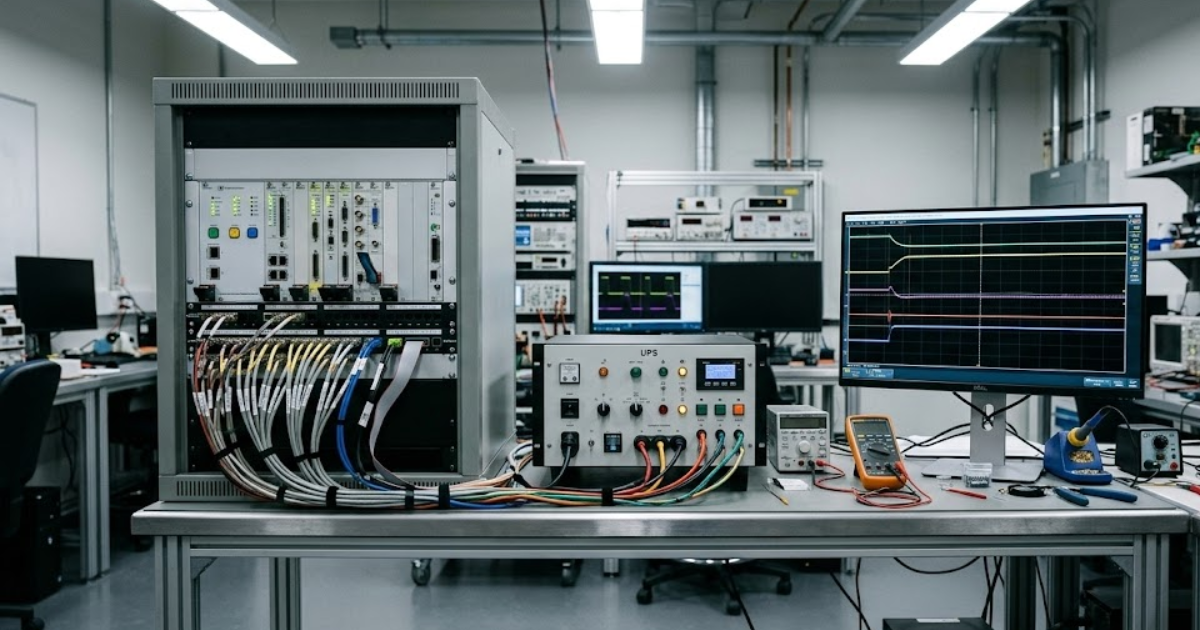
Most post-deployment problems come from missing interactions, incomplete scenarios, or weak acceptance criteria. The issue is rarely a total lack of testing. The issue is testing the wrong things in isolation. You need validation that follows electrical cause and effect across the whole backup path. That is what keeps commissioning results honest.
Several recurring gaps show up across large installations:
- Transfer tests check continuity but do not measure voltage recovery quality at sensitive downstream loads.
- Battery tests confirm runtime but do not stress the strings with site-specific transient current profiles.
- Controller checks use ideal sensor inputs and miss the effect of delay, noise, and scaling errors.
- Protection settings are reviewed on paper but not challenged with repeated abnormal sequences.
- Model assumptions stay too simple and hide converter interactions that appear during commissioning.
A site can pass factory acceptance and still fail during the first live utility event if any one of those gaps remains open. Dense compute loads make the risk larger because they react badly to poor voltage quality, short recovery errors, and uneven current sharing.
“Good validation closes those gaps before the facility team has to diagnose them under pressure.”
Using real time simulation platforms to scale backup power system testing
Real-time simulation platforms make backup power testing useful when they let you run more severe cases, with better fidelity, and with less risk than field-only testing. That is the standard you should apply when choosing a validation approach. The goal is not more test reports. The goal is better judgement before the site depends on the system.
A mature workflow gives you a library of repeatable cases for commissioning, firmware updates, battery changes, and capacity expansion. One team might reuse the same fault and load sequence after a battery cabinet replacement, then compare controller response against the baseline from first acceptance. Another team might test a revised protection setting against a known weak scenario before releasing it to operations. OPAL-RT belongs naturally in that discipline because repeatable real-time studies help you judge UPS and battery readiness from measured behaviour, not from assumptions. Data centre reliability is built through that kind of disciplined execution, case after case, long before the next disturbance arrives.
Real-time solutions across every sector
Explore how OPAL-RT is transforming the world’s most advanced sectors.
Simulation
03 / 25 / 2026
Integration testing between firmware and physical interfaces
Covers how to plan and run firmware integration testing for physical interfaces using staged loops, HIL protocol simulation, tool selection, and trace-based debugging for CAN and similar buses.
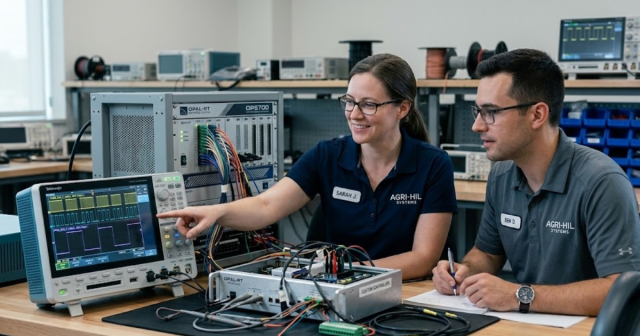
Industry applications, Simulation
03 / 25 / 2026
Real-time simulation of multilevel converters and cascaded topologies
A practical guide to multilevel converter simulation that explains how cascaded H bridge models are partitioned across CPU and FPGA resources for accurate real-time EMT and hardware in the loop testing.
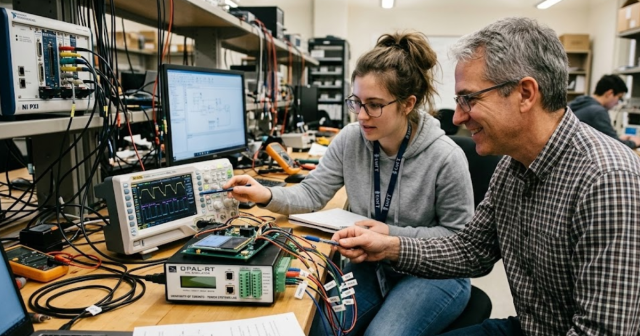
Simulation
03 / 23 / 2026
Scaling from academic HIL setups to industrial validation platforms
Practical guidance for moving an academic HIL system from an entry level FPGA real time simulator to a modular platform that supports scalable real time simulation, repeatable tests, and traceable industrial validation results.
EXata CPS has been specifically designed for real-time performance to allow studies of cyberattacks on power systems through the Communication Network layer of any size and connecting to any number of equipment for HIL and PHIL simulations. This is a discrete event simulation toolkit that considers all the inherent physics-based properties that will affect how the network (either wired or wireless) behaves.