Validating data center energy management systems using real-time HIL
Industry applications, Simulation, Energy
03 / 29 / 2026
Key Takeaways
- AI workload variability becomes a power stability issue when short load swings move through converters, UPS systems, storage, and grid-facing controls.
- Software verification is useful, but only closed-loop HIL testing shows how EMS logic behaves under timing error, weak-grid conditions, and recovery sequences.
- Trustworthy validation comes from repeated testing of realistic electrical scenarios, not from average load models or one-time pass results.
AI workload variability will stress data centre power systems long before annual energy totals tell you what is happening. The main stability problem is not average consumption. It is the speed, size, and coordination of load shifts across servers, power electronics, cooling equipment, and site controls when large training and inference jobs ramp up or move across clusters. Data centres accounted for around 1.5% of global electricity use in 2024, or 415 TWh, and that scale makes local power quality and grid interaction a pressing engineering issue rather than a planning footnote.
You need validation methods that capture electrical behaviour, controller timing, and closed-loop response at the same moment. Static planning models will miss the short transients that matter when AI servers switch states, batteries respond, UPS controls shift, or feeder conditions weaken. That is why real-time hardware-in-the-loop testing belongs at the centre of data centre controller validation for AI-heavy facilities.
Data center energy management systems must be validated under the grid-level electrical behaviour
A data centre EMS must be tested against grid-side electrical conditions, not just internal control logic. AI load variability reaches the utility interface through converters, UPS systems, feeders, and protection devices. Stability depends on the whole chain. Local controller success will still fail the site if voltage, frequency, or ride-through behaviour breaks at the point of connection.
Picture a large training job starting across multiple racks after a scheduler releases reserved compute. Server power draw rises, cooling reacts a few moments later, and the facility bus sees a steep step instead of a smooth curve. That sequence can pull on battery controls, shift reactive power needs, and expose weak coordination between the EMS, UPS, and switchgear before operators have time to intervene.
Grid-level validation matters because the data centre is not an isolated load. It behaves through power electronics, protection thresholds, and communication delays that shape what the upstream network will see. AI-focused sites also cluster geographically, so repeated load ramps can stack on already tight local capacity and make short disturbances more costly to ignore.
Why controller software testing alone cannot verify EMS control performance
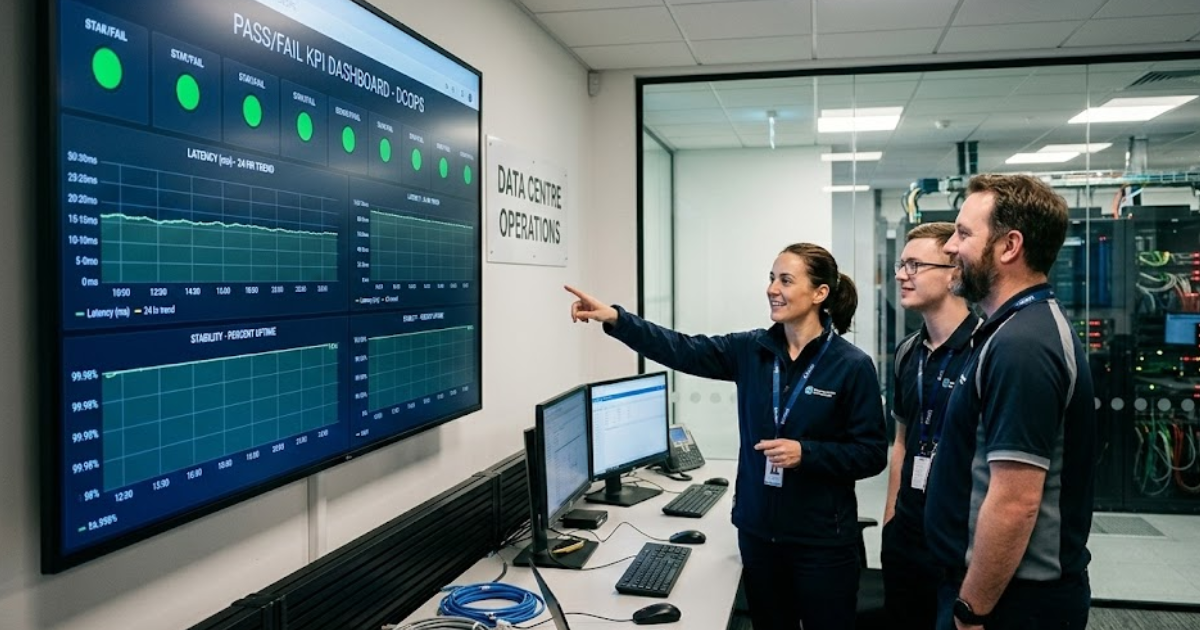
Software-only testing will confirm that control logic follows rules, but it will not prove that the EMS stays stable when electrical conditions shift quickly. Timing error, measurement lag, actuator saturation, and interface mismatches appear only when the controller is tied to a live plant model. AI workloads expose those gaps because they create short, uneven bursts that do not resemble office or enterprise traffic.
A scheduler can tell the EMS to cap feeder import during a utility event, yet the command path still passes through meters, communications, inverter controls, and battery dispatch limits. When each block responds on a different timescale, the final site response can overshoot, oscillate, or arrive too late. Software tests often mark that sequence as successful because the command itself was valid.
You also need to see how compute and facility controls interact. Cooling lag can stretch a short server ramp into a longer site disturbance, while a protective threshold inside a UPS can trip on a transient that looked harmless in a spreadsheet. Those are execution problems, not coding mistakes, and they sit outside pure software verification.
How hardware in the loop simulation validates data center EMS controllers
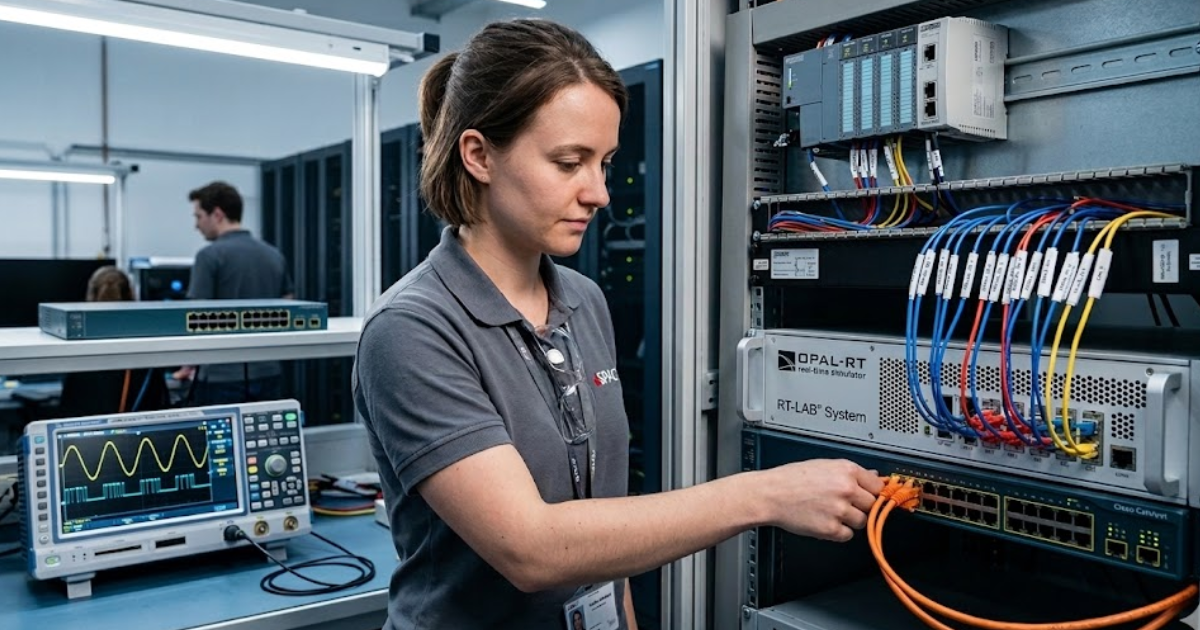
Hardware-in-the-loop validation connects the actual EMS or controller hardware to a real-time simulation of the electrical plant. That setup shows what the controller will do when AI load swings hit the site under credible grid conditions. It turns control logic into measured behaviour.
A useful HIL setup will model the incoming utility source, medium-voltage distribution, UPS paths, batteries, converters, cooling-related auxiliary loads, and representative AI rack profiles. The controller then receives live measurements and sends commands through the same I/O paths used on site. One public test platform modelled a 70 MW grid-interactive data centre in a controller-hardware-in-the-loop framework, which is the kind of scale that makes closed-loop validation meaningful for utility-facing facilities.
This matters because HIL reveals how the controller behaves under electrical stress rather than ideal assumptions. You can test feeder import limits, UPS transfers, battery dispatch, curtailed compute blocks, and recovery sequences without waiting for a risky live event. The result is not a prettier model. It is a more trustworthy control sequence.
Electrical behaviours and operating scenarios EMS validation must reproduce
EMS validation must reproduce the electrical events that create instability risk under AI load variability. The priority is not a long list of rare faults. The priority is the short set of site conditions that decide if the data centre stays stable, compliant, and recoverable.
An AI-heavy campus should test at least these operating cases:
- Sudden step increases in server load after scheduled job release
- Fast load drops after job completion or cluster migration
- Weak-grid voltage dips during high compute utilization
- UPS or battery transfer events during steep feeder loading
- Recovery sequences after curtailed workloads return to service
Each case exposes a different weakness. A steep load rise tests ramp tolerance and battery coordination. A sharp drop tests controller stability when dispatch commands remain active after the electrical need has passed. Weak-grid cases show whether the site absorbs disturbances calmly or reflects them back through converters and controls. Recovery cases matter just as much because many facilities remain stable during the event and then stumble when full compute service returns.
Building a real-time simulation model of data center power infrastructure
A useful real-time model must represent the electrical path from grid connection to compute load with enough fidelity to capture converter response, control timing, and switching effects. Average load blocks are too coarse for AI-related testing. You need component behaviour that matches what the controller will actually see.
That means modelling the utility source, transformers, switchgear, UPS systems, batteries, bus sections, and rack-level or cluster-level load groups with time-varying profiles. Some facilities also need detailed converter representations for solid-state transformer concepts or modular power architectures. OPAL-RT’s FPGA-based modelling can represent advanced converter topologies used in data centre power systems, including solid-state transformers and modular converter architectures. These models support high-density converter simulation, flexible I/O integration, and high-resolution electrical behaviour required for closed-loop testing.
“Static planning models will miss the short transients that matter when AI servers switch states, batteries respond, UPS controls shift, or feeder conditions weaken.”
The table below works as a checkpoint for what the model must capture before you trust the test results.
| Model focus | Why it matters |
| Utility source strength and feeder impedance | This shows how sensitive the site will be to voltage shifts during steep AI load ramps. |
| UPS and battery control response | This reveals if backup assets stabilise the event or add another layer of oscillation. |
| Converter-level behaviour | This captures the fast electrical response that average load models will hide. |
| Load segmentation by cluster or rack group | This reflects how AI jobs start and stop in blocks rather than as one smooth facility curve. |
| Communication and I/O timing | This shows if control delays push a valid strategy into late or unstable execution. |
Controller interface testing with real-time I/O and closed-loop feedback
Controller interface testing proves that measurements, commands, and timing stay coherent under live conditions. A strong control strategy will still misfire if the I/O path adds delay, drops signals, or maps values incorrectly. Closed-loop feedback is where those faults become visible.
A site controller might read feeder power, battery state of charge, and bus voltage, then issue setpoints to UPS or storage assets during an AI load swing. If a measurement is filtered too heavily, the controller reacts to old conditions. If a command scale is wrong, the battery under-responds and the feeder takes the hit instead. Those faults are ordinary integration issues, yet they become serious when load steps are large and frequent.
Closed-loop I/O testing also lets you verify fallback behaviour. If communications drop during a utility disturbance, you need to know which device holds last value, which one enters a safe mode, and how the rest of the system interprets that state. Stable data centres are built on those details.
Common EMS validation gaps that cause control instability after deployment
Most post-commissioning control issues come from omitted interactions, not from exotic failures. Teams often validate steady operation, a few large faults, and nominal dispatch cases, then miss the mixed conditions that AI workloads create every day. That leaves the EMS exposed to ordinary but harsh transitions.
One common gap is treating compute load as a smooth aggregate. Another is validating batteries and UPS assets independently instead of as a coordinated response chain. A third appears when cooling response is left out, even though delayed thermal control can stretch a short server ramp into a longer facility event. Protection settings are also easy to overlook, yet nuisance trips often come from threshold coordination rather than major equipment failure.
Deployment problems grow when recovery is not tested. Teams will check the initial disturbance, confirm the site stayed online, and stop there. The harder question is what happens when curtailed AI jobs return, storage begins to recharge, and the grid is still weak. That sequence decides whether the site settles cleanly or enters a second instability cycle.
Using real-time simulation platforms to scale EMS validation across scenarios
Real-time simulation platforms let you repeat the hard cases until the control sequence is reliable, which is the only standard that matters for AI-heavy data centres.
“Good validation does not depend on a single successful test. It depends on disciplined repetition across credible electrical and operational conditions.”
That discipline gives you a practical way to judge readiness. You can run the same AI load pattern against weak and strong grid conditions, vary battery availability, change feeder limits, and test how the EMS handles interruption, curtailment, and recovery without putting live compute service at risk. The most useful platforms also support detailed converter modelling and flexible I/O, which matters when site architecture is built around power electronics rather than slow mechanical assets.
OPAL-RT fits naturally into that execution context because the value is not a single feature or device. The value is the ability to test closed-loop behaviour with enough speed and electrical detail that control choices become engineering judgments instead of hopeful assumptions. That is how you keep AI workload variability from turning a manageable load problem into a power stability problem.
Real-time solutions across every sector
Explore how OPAL-RT is transforming the world’s most advanced sectors.
Industry applications
03 / 28 / 2026
Control algorithm validation using real-time HIL
A practical look at how real-time HIL testing validates embedded control algorithms through closed-loop simulation, fault reproduction, digital plant models, and disciplined integration.
Simulation
03 / 27 / 2026
Real-time simulation for validating autonomous and ADAS systems
Explains why autonomous and ADAS validation relies on deterministic real-time simulation and hardware-in-the-loop, what scenarios matter, how to assess simulator stacks, and where simulation programs commonly fail.
Simulation
03 / 25 / 2026
Integration testing between firmware and physical interfaces
Covers how to plan and run firmware integration testing for physical interfaces using staged loops, HIL protocol simulation, tool selection, and trace-based debugging for CAN and similar buses.
EXata CPS has been specifically designed for real-time performance to allow studies of cyberattacks on power systems through the Communication Network layer of any size and connecting to any number of equipment for HIL and PHIL simulations. This is a discrete event simulation toolkit that considers all the inherent physics-based properties that will affect how the network (either wired or wireless) behaves.