Why PHIL testing is critical for safe energy innovation
Simulation, Energy
01 / 08 / 2026
Key Takeaways
- PHIL testing validates closed-loop interaction between power hardware and a simulated grid before site work begins.
- Early PHIL work will surface instability and protection conflicts while design fixes are still practical.
- Reliable PHIL results require measured loop delay, calibrated sensing, and repeatable fault injection.
PHIL testing will show you how a power device behaves before it touches the grid. You get proof that control and protection will act safely under faults, weak-grid cases, and transients. That proof cuts down risky commissioning work and rework. Power outages cost U.S. businesses as much as $150 billion per year.
Energy innovation moves from models to metal, and the gap between the two is where safety problems hide. Simulation will not capture timing jitter, sensor quirks, saturation, and interface limits. PHIL testing forces those effects into a controlled test loop, so you can measure them instead of guessing. We make design choices with evidence, not optimism.
PHIL testing closes the safety gap between simulation and hardware
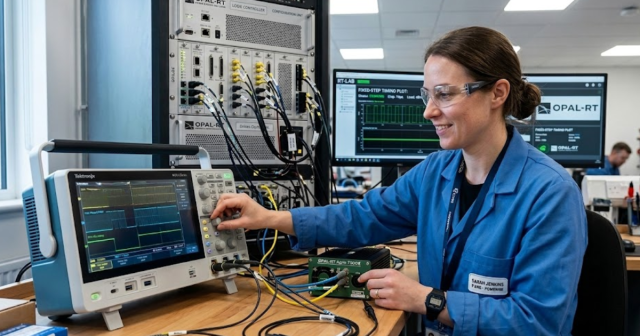
PHIL testing links real power hardware to a real-time simulated grid or plant through a controlled power interface. That closed loop makes the hardware respond to voltage and current that come from the simulation, while the simulation reacts to the hardware. You can rerun the same stress case as needed. Safety improves because failures show up in the lab, not at the first site.
A grid-tied inverter illustrates the difference quickly. A software model assumes ideal sensing and ideal switching, so the controller looks calm across sags and frequency steps. The physical inverter adds measurement noise, dead-time, and current limits that shift stability margins. PHIL lets you run the same sag profile, watch the current clamp engage, and see how protection timers respond.
Better coverage is the main practical gain. Faults, weak-grid impedance, and load steps become scripted inputs, not rare events. Test results are easier to compare across firmware builds because the loop stays consistent. That consistency makes release sign-off easier, because the same evidence can be produced again.
“Risk rises because the schedule sets the guardrail.”
Safety risks rise when power hardware is validated too late
Late validation forces first contact with full power into the most chaotic part of a program. Problems that seem like tuning details in simulation become unsafe transients once hardware, wiring, and protection are present. We then adjust settings under time pressure, with limited fault coverage. Risk rises because the schedule sets the guardrail.
Microgrid commissioning shows this pattern often. A controller that looked stable on a desktop model starts hunting when a genset and an inverter share load, so voltage swings and protections chatter. Each field tweak shifts the operating point, so yesterday’s fix can break today’s start-up. PHIL runs would have recreated the sharing behaviour with a simulated genset while the inverter stayed on the bench.
Late testing also locks in poor choices. Sensor placement, grounding, and thermal paths are hard to change once a prototype is assembled. Compliance work becomes stressful because you discover limits after the design is already fixed. PHIL pulls those limits forward, so fixes happen when they are still clean and controlled.
PHIL testing exposes instability that software-only tests miss
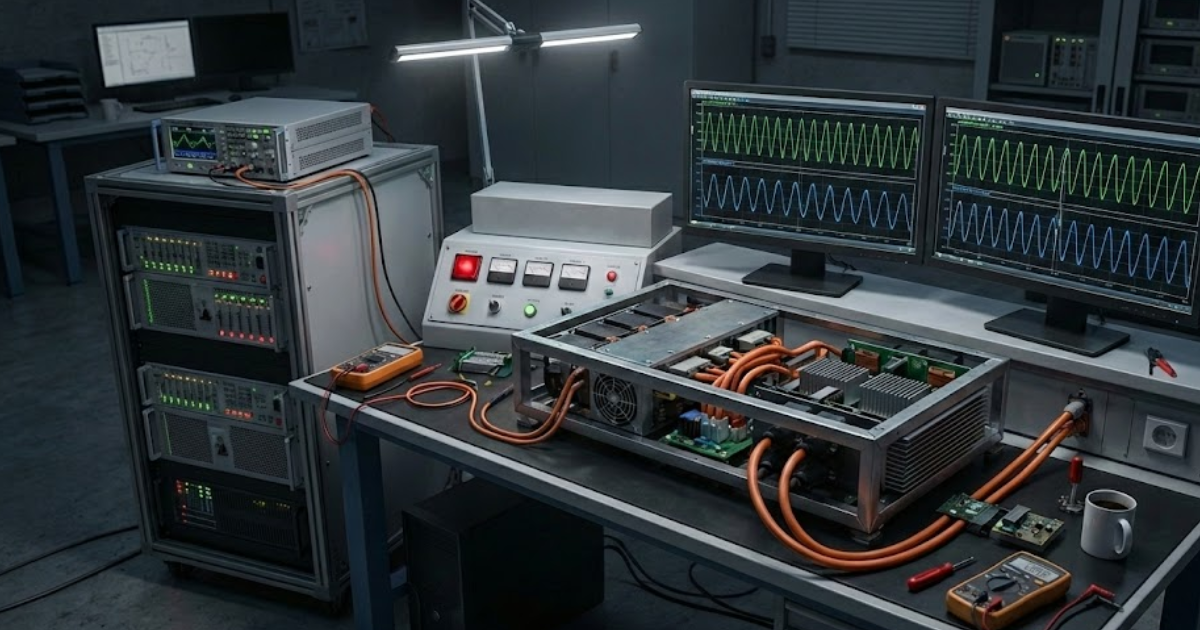
Software-only tests hide several common instability triggers: loop delay, bandwidth limits, sensor dynamics, and power-stage nonlinearities. PHIL testing includes those effects because the loop contains real converters and a power interface with finite response. Oscillations and false trips appear where an ideal model stays stable. That visibility keeps “it looked fine” designs out of commissioning.
A battery inverter operating on a weak grid is a classic trap. The controller is stable in simulation, yet the lab loop adds delay through I/O and power amplification. A resonance builds, current ripple rises, and the inverter hits its clamp, then trips a protection timer. PHIL shows the whole chain, so you can decide if you need damping, a different filter, or a lower control bandwidth.
Misoperation data also points to interaction problems that tests must catch. An overall protection system misoperation rate of 8.0% was reported for 2018, and misoperations can be amplified by unexpected waveforms and timing. PHIL lets you recreate edge cases such as saturation and delay while you watch protection logic respond. You get a safer path to fixes than learning on a live feeder.
Control and protection logic require closed-loop power interaction
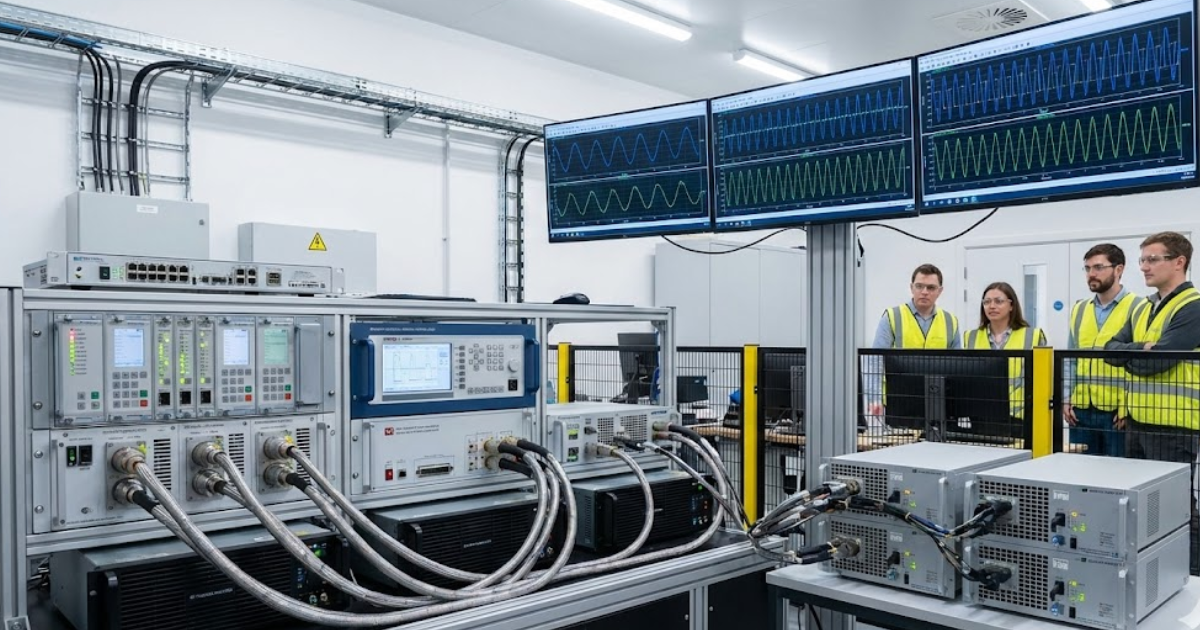
Control goals and protection thresholds will only make sense as a pair once power hardware is present. PHIL testing checks how your controller behaves while protections watch the same voltages and currents. You can inject faults and recovery sequences while keeping the system contained. The key outcome is coordination you can demonstrate, not just settings you can list.
A converter that must ride through a voltage dip while protecting semiconductors highlights the need. Software tests can apply a sag, but they will not show sensor saturation, DC-link voltage spike, or comparator trips caused by switching ripple. PHIL will show those behaviours because the power stage responds physically. That makes it possible to tune ride-through and overcurrent protection based on measured response.
These five checks catch most late-stage surprises without adding weeks of work. Each check links a measured signal to a control or protection response you can rerun. Results become evidence for change control and sign-off. The list stays short so it gets used.
- Trip thresholds stay stable under sensor noise and scaling errors
- Current limiting does not trigger nuisance protection timers
- Fault detection still works when waveforms distort under saturation
- Recovery logic returns to normal control without repeated tripping
- Safe-state behaviour stays predictable during comms dropouts
PHIL testing clarifies limits before field deployment begins
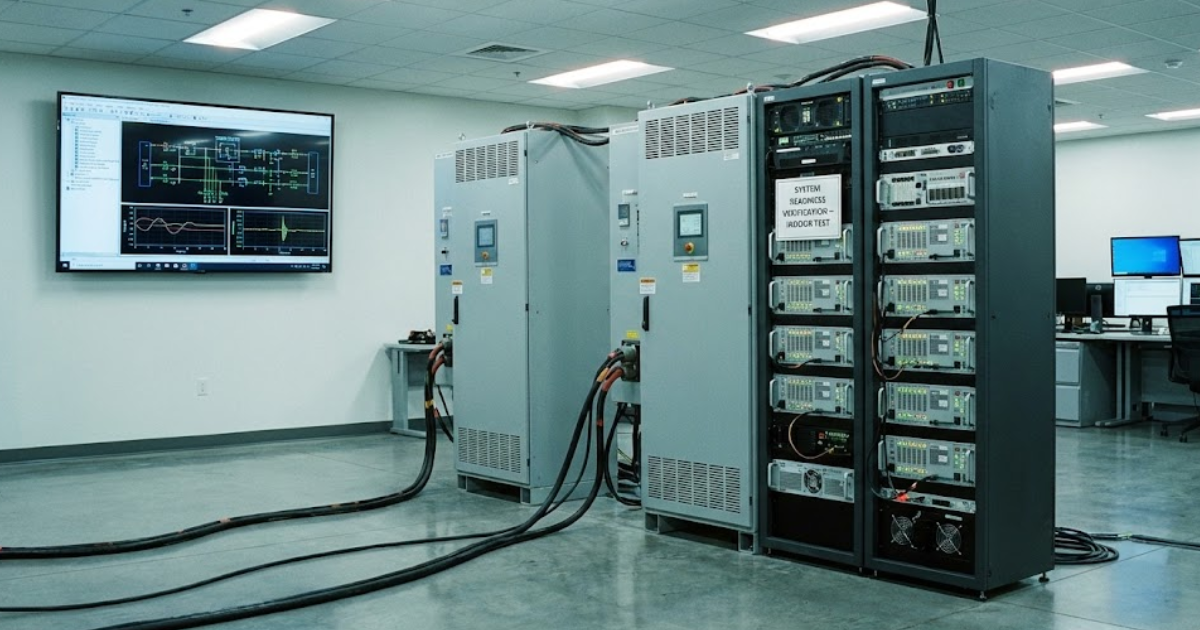
PHIL testing turns assumptions into operating limits you can use during commissioning and operation. You can map where stability holds and protection coordination breaks. Those limits become guardrails for settings, alarms, and mode transitions. The outcome is safer deployment with fewer surprises.
A grid-forming inverter for an islanded microgrid is a practical example. Load steps and fault ride-through can be applied through the simulated network while the inverter hardware runs under controlled power. You can identify where voltage control becomes too aggressive and where current limiting shifts recovery. Those findings translate into commissioning settings and operator rules.
Timing drift shifts phase and gain in the loop. Many teams run PHIL with real-time simulators from OPAL-RT so the plant model and fault injection stay aligned with the hardware under test. Alignment keeps results comparable across test days. The checkpoint table below keeps limits actionable.
| What you need to confirm | What PHIL testing will show | What you should lock in |
| Grid strength tolerance | Stability margin across impedance settings | Connection rules and alarms will be set. |
| Protection coordination | Trip risk during clamps and recovery | Timers and thresholds will be adjusted. |
| Stress during transients | DC-link and thermal stress during sags | De-rating and soft-start logic will be set. |
| Fault response quality | Clearing and control re-entry behaviour | Recovery steps will be staged. |
| Sensor sensitivity | False pickups from noise or saturation | Calibration and filtering steps will be required. |
Common PHIL testing mistakes that undermine safety confidence
A weak PHIL setup creates false passes and false failures, and both outcomes hurt safety. Common causes include unmanaged loop delay, unmodelled interface dynamics, and missing interlocks around the power interface. Results look clean but do not match integration. Confidence drops because we cannot explain what the loop is really doing.
Power amplifier saturation is an easy mistake to miss. A test grid that cannot source the transient current your inverter expects will collapse voltage harder than a stiff source, so the inverter trips early. Someone then relaxes thresholds to “fix” the trip, which raises risk when the inverter meets a stiffer connection. Good PHIL work models interface limits honestly and keeps test intent aligned with physical limits.
Boring checks prevent most pain. Loop delay should be measured and tracked after every wiring or firmware change. Sensor polarity, scaling, and time alignment should be verified before every test campaign. Interlocks should be tested as part of the plan, because safe shutdown is a required behaviour, not a last resort.
“PHIL keeps energy innovation safe because proof comes first.”
When PHIL testing should be prioritized in an energy program
PHIL testing belongs early when new controls, new protection logic, or new power stages create interaction risk you cannot bound on paper. The right moment is before full-power integration, while design changes are still practical. PHIL as a milestone stops field commissioning from becoming the stability test. Safety becomes repeatable work, not late-night heroics.
Complex operating modes raise priority fast. Weak-grid operation, grid-forming control, and mixed inverter fleets will produce interaction that ideal models will miss. Risk also rises when multiple teams edit settings, because each change shifts timing and thresholds. PHIL gives you a shared test setup so updates come with evidence.
Execution discipline is the final separator. Clear pass criteria, calibrated measurement, and controlled fault injection will turn lab results into rules your team follows on site. OPAL-RT fits that discipline when it is used for deterministic simulation and synchronized data capture. PHIL keeps energy innovation safe because proof comes first.
Real-time solutions across every sector
Explore how OPAL-RT is transforming the world’s most advanced sectors.
Industry applications, Simulation
03 / 31 / 2026
Managing high-frequency switching in real-time EMT simulation
Precision in testing complex power systems is essential to avoid failures, accelerate innovation, and integrate new technologies safely.

Simulation
03 / 30 / 2026
Understanding timestep requirements for modern power converters
Practical criteria for selecting EMT and real time simulation timesteps for power converters, covering switching resolution, control and PWM timing alignment, multirate approaches, and verification checks.
Energy, Industry applications, Simulation
03 / 29 / 2026
Validating data center energy management systems using real-time HIL
This piece explains how AI workload variability affects data centre power stability and how closed-loop HIL testing helps validate EMS control behaviour under site and grid stress.
EXata CPS has been specifically designed for real-time performance to allow studies of cyberattacks on power systems through the Communication Network layer of any size and connecting to any number of equipment for HIL and PHIL simulations. This is a discrete event simulation toolkit that considers all the inherent physics-based properties that will affect how the network (either wired or wireless) behaves.