Key Takeaways
- One instrumented bench with short bookable sessions will carry a cohort of 60 to 150 distance learners across a term, so utilization matters more than unit count.
- Session isolation and signed telemetry logs are what make shared hardware trustworthy to run and honest to grade.
- Remote access covers control tuning, fault response and signal interpretation, and it leaves probing, wiring and assembly to a short on-site residency.
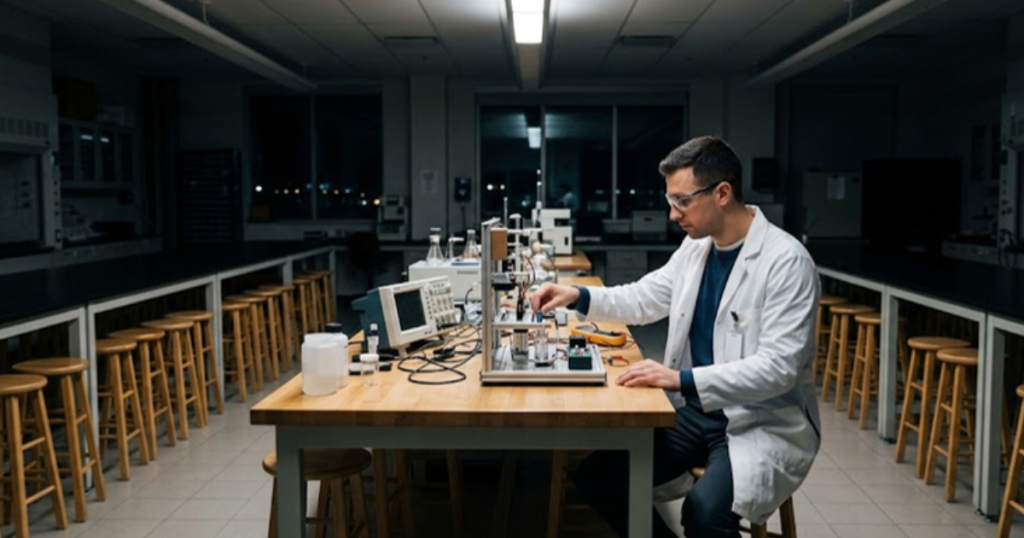
A remotely accessible hardware-in-the-loop bench gives distance learners genuine control authority over real equipment, and one bench can carry an entire cohort.
The teaching problem isn’t the simulation. It’s access. United States postsecondary enrolment in exclusively distance programmes reached 4,982,428 students in fall 2023, and many of them sit in engineering programmes designed around a physical lab room. When the room is unreachable, the control theory survives the move online and the hands-on judgement does not.
Programmes that succeed here treat the remote lab as a scheduling and evidence problem before a hardware problem. One instrumented bench, a booking layer, a clean session reset, and a signed telemetry record per student will carry more teaching value than a shipment of identical low-power kits. The tradeoffs are real, and they’re worth naming precisely.
What distance learners actually lose when the bench disappears
Distance learners lose three things when the lab room closes. They lose a system that pushes back, the habit of reasoning about instrumentation they can watch live, and the accident of a technician spotting a wiring mistake before it becomes a fault. Recorded lectures replace none of that.
A power electronics course that once ran a converter control assignment now hands out a Simulink model and a marking rubric. Students tune gains against a plant that never saturates unexpectedly, never shows a sensor offset, and never trips on a protection limit the model builder forgot. They submit clean step responses and learn that control design is a mathematics exercise with a tidy answer.
That gap surfaces later, when a first hardware bring-up goes badly and nobody can say why. The purpose of a lab isn’t to confirm the model. It’s to teach students that every model is incomplete and to give them a disciplined method for finding where. A remote bench restores that lesson because the hardware in the loop still behaves like hardware.
One shared bench can serve an entire distributed cohort

A single real-time simulator with a controller under test will support 60 to 150 students across a term if sessions are short, bookable, and reset automatically. Utilization is the whole argument. A teaching bench used four hours a week is waste, and the same bench used sixty hours a week is a department asset.
A grid-integration course can split a 90-minute lab into three 30-minute booked sessions per student pair, running Monday morning through Sunday night. Students in three time zones each get bench time at a reasonable hour on hardware the department already owns.
Utilization also changes what you’ll buy. One bench serving everyone means spending on fidelity rather than quantity, so students work against a plant model with sensor noise, converter switching detail, and protection logic that actually trips. Cheap per-seat hardware forces the opposite tradeoff.
“A teaching bench used four hours a week is waste, and the same bench used sixty hours a week is a department asset.”
Session isolation is what makes a shared bench trustworthy
Shared hardware needs a booking layer and a hard session boundary, or one student’s mistake becomes the next student’s mystery. Session isolation means every booking starts from a known state, with the model reloaded, parameters restored, logs cleared, and any latched fault dropped before the next student connects.
A workable booking layer has to guarantee five things.
- Every session starts from a known model state and parameter set, restored automatically rather than by hand.
- A hard time boundary ends the session and releases the bench even when the student leaves the connection open.
- Only one student holds write authority at a time, while teammates and instructors watch read-only.
- Protection limits sit below anything the student can reach, so a badly chosen gain cannot damage the hardware.
- Every session writes a signed log of parameters, commands, and captured signals under that student’s identity.
The last one carries the most weight. A logged session is the record you’ll grade from, the evidence you’ll reach for when a student disputes a mark, and the trace an instructor reads when six students report the same odd result caused by a drifting sensor. Labs that skip session logging end up grading screenshots.
What students can and cannot feel through a remote link
Remote sessions carry timing, causality, and measurement faithfully. They don’t carry heat, vibration, or the physical act of probing a board. A remote HIL lab teaches control behaviour, fault response, and signal interpretation well, and it teaches wiring, layout, and mechanical assembly poorly or not at all.
Being explicit about that split lets you place remote work where it earns its keep.
| What a remote HIL session teaches well | What still needs the student in the room |
| Closed-loop tuning against a plant that saturates and trips realistically | Probe placement and grounding technique on a live board |
| Fault injection and protection response observed at correct timing | Heat and noise cues from a part about to fail |
| Reading captured traces and defending an interpretation | Wiring, connector seating, and mechanical assembly work |
| Repeating an experiment until the result is genuinely understood | Improvising a fixture when the setup doesn’t match the plan |
| Working to a strict session budget with logged evidence | Judging build quality by handling the hardware directly |
Programmes that pretend the second column is empty produce graduates who are confident in simulation and lost at a bench. The honest design keeps a short residency for the physical skills and moves everything in the first column online where it can be repeated. Repetition is the quiet advantage. A study of remote laboratory use in undergraduate mechanical engineering found 84% of students agreed the remote platform helped them grasp the concepts and run experiments unsupervised.
Assessment integrity holds when telemetry becomes the evidence
Remote labs are easier to assess honestly than in-person labs, because the bench records what each student actually did. You grade the session trace instead of a written report about a session nobody watched. Identity binds to the booking, and every command, parameter change, and captured signal carries a timestamp.
A student who claims to have swept the proportional gain across five values either has five logged sweeps or doesn’t. An instructor marking a converter control lab can open the session record, follow the sequence of gains attempted, see where the protection tripped, and mark the reasoning rather than the tidiness of the write-up.
That shifts what you’re able to ask for. You’ll set tasks requiring a specific observable outcome, such as returning the system to tolerance after an injected sensor fault inside the session budget. Copying gets harder when each student’s plant seeds differently and the log records it. Marking gets faster because the evidence arrives structured.
“You grade the session trace instead of a written report about a session nobody watched.”
The cost case against shipping hardware to every student
Shipping hardware to every distance learner costs more than a shared remote bench and teaches less. Per-student kits have to be inexpensive to work at cohort scale, which caps their fidelity, and most of the true cost sits in logistics rather than the purchase order.
Count the full picture on a 120-student cohort. A modest kit at a few hundred dollars each is already a five-figure purchase every term, and then come customs paperwork for international students, replacement units for shipping damage, a support queue for students debugging their own hardware over email, and kits that never come back. None of that buys plant fidelity, and the kit still can’t reproduce a converter switching at 20 kHz or a protection scheme that trips on a genuine fault.
A shared bench inverts the arithmetic. One capable platform, bought once and amortized across every cohort, carries the whole programme, and the recurring cost is scheduling software and technician hours. A packaged teaching platform such as the OPAL-RT HIL Starter Kit exists for this shape of problem, giving a department one instrumented bench that students drive remotely instead of a shelf of kits that arrive scratched.
How disciplined programme design keeps a remote lab credible
A remote laboratory earns its place through the unglamorous parts. Reliable booking, clean session resets, honest scoping of what the link carries, and a marking scheme built on telemetry will do more for distance learners than any amount of interface polish. The hardware is the easier half.
Departments that get this right start narrow. One course, one bench, one well-instrumented plant model, and a full term of running it before anyone raises scaling. They fix scheduling friction first, because a student who can’t get bench time has no lab at all. They write the marking rubric against the session log before the first booking opens, so assessment isn’t retrofitted onto whatever the system recorded.
What you get is a lab distance learners take seriously, and that’s the honest test. Students who book a bench at nine in the evening, break something, reset, and try again are learning the way on-campus students learn, against the same stubborn hardware. OPAL-RT builds its teaching platforms around that premise, and the programmes using them well treat remote access as a teaching commitment rather than a contingency.
Automotive
10 / 21 / 2026
Megawatt charging system validation for heavy duty trucks
A practical look at how the megawatt charging system works, how it differs from CCS and how charger controls are tested before a truck site is energized.
Automotive
10 / 19 / 2026
Dynamometer testing and motor emulation compared for e-drive programs
A comparison of dynamometer testing and motor emulation for e-drive programs, covering what each method proves, what it costs and how teams sequence both.
Power Electronics
10 / 17 / 2026
How wide bandgap devices push converter power density
Wide bandgap devices raise converter power density through faster switching and smaller passives, and this guide traces that chain from device physics to thermal limits to validation.