Key Takeaways
- Automated HIL test cases stay trusted when each has a numeric pass rule tied to safety or timing.
- Prioritize sequencing, protection, sensor integrity, and compute timing before fine performance tuning.
- Automation scales when models, injectors, and logs stay consistent under version control.
Automated HIL test cases will catch electrification faults before hardware is at risk. You can rerun the same checks after every control software update. That keeps safety behaviour consistent and visible. It also keeps late surprises out of your lab schedule.
Electrification testing fails in the gaps between state machines, sensors, and protection logic. HIL exposes those gaps under load, with repeatable timing and signals. A small set of automated tests will do more than a long checklist that no one reruns. You’ll get clearer pass and fail outcomes faster.
What automation-focused HIL test cases cover in electrification programs
Automation-focused HIL test cases prove your controller behaves safely while it closes the loop on a simulated plant. They check sequencing, protection reactions, sensor plausibility, and compute timing under stress. Each test needs a single purpose and a measurable threshold. If the threshold is fuzzy, the test won’t stay trusted.
A practical example is a precharge sequence with a slow DC link rise. The controller must refuse torque, time out cleanly, and log the right fault. Another example is an injected overcurrent that must shut PWM off within milliseconds. Those are simple checks, and they find expensive problems early.
“If a test can’t fail in a meaningful way, it won’t stay in use.”
8 HIL test cases every electrification team should automate
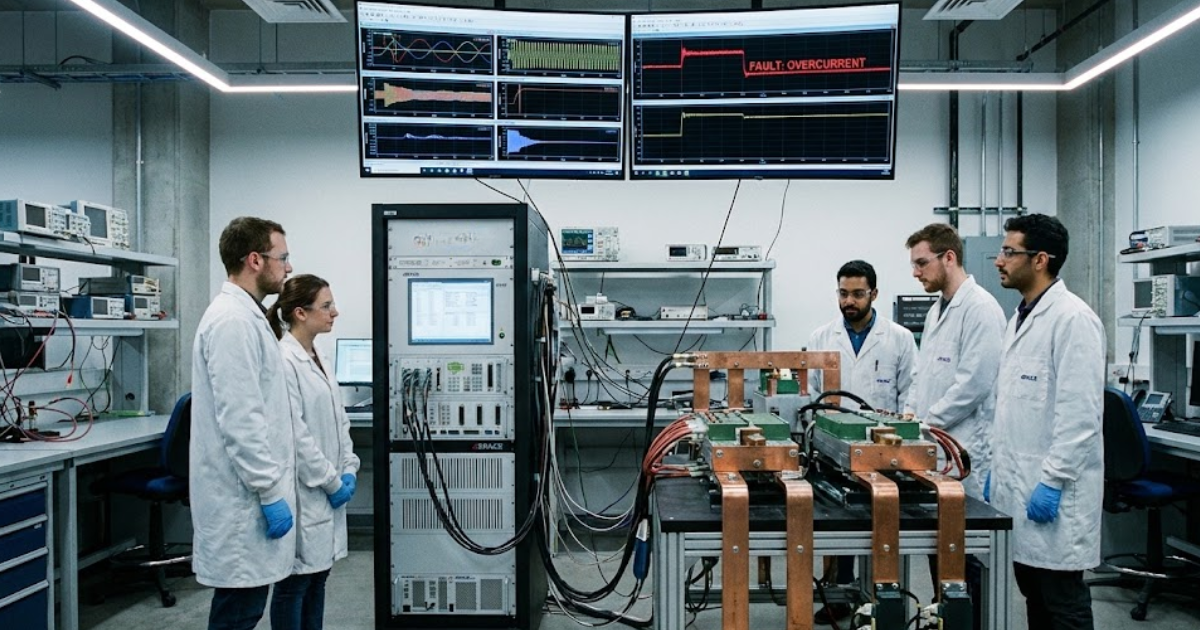
These eight test cases focus on failures that waste the most engineering time. Each one has a clear trigger, a clear expected response, and a clear trace to review. Keep every pass rule numeric, not subjective. When the setup stays consistent, your results will stay comparable.
1. Startup, shutdown, and mode transition sequencing under timing constraints
This test validates mode logic under tight timing windows. You confirm interlocks block unsafe transitions and each state completes in order. A typical run slows DC link rise and checks the controller stays in precharge, then times out into a safe state. The same run forces shutdown at speed and confirms torque ramps down before contactors open.
2. Fault injection and protection response across power and control layers
This test proves that protection shuts power down fast and predictably. You inject faults like overcurrent, overvoltage, and gate command loss and time the path from event to PWM off. A concrete case injects an overcurrent during a torque step and checks latch, diagnostics, and restart rules. Protection gaps show up as delayed shutoff or the wrong safe state.
3. Sensor failure, drift, and latency handling in closed-loop control
This test checks that bad sensor data won’t cause torque jumps. You simulate offset, stuck-at, dropout, and delay on current, voltage, position, and temperature signals. A useful case adds a growing current offset during a load ramp and checks plausibility detection and torque limiting. Delay tests also expose weak stability margins and brittle fallback logic.
4. Inverter switching behaviour and PWM edge cases at high load
This test targets PWM corners that show up near voltage and current limits. You verify deadtime handling, minimum pulse width, and clamping rules under sharp torque changes. A high-stress case runs near max modulation, then applies fast decel to expose pulse dropping and illegal gating requests. Clean results prove gate commands stay valid when the plant pushes back.
5. Multiphase motor operation with phase loss and imbalance conditions
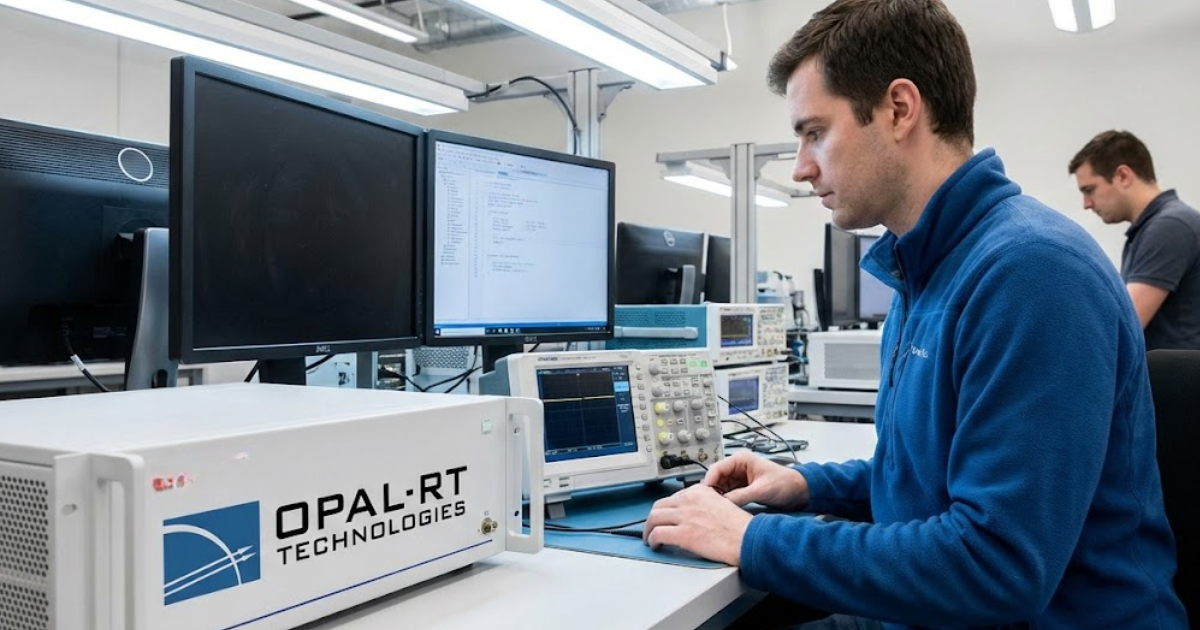
This test validates fault tolerance for multiphase machines like 6-phase and 12-phase PMSMs. You inject open-phase and phase-current imbalance and confirm current limits and torque limits stay inside safe bounds. A practical run drops one phase group at steady torque and checks stable rotation with a derated target. OPAL-RT supports FPGA-based simulation of electromagnetically coupled 12-phase machines, which helps keep these fault tests repeatable at real-time rates.
6. Thermal limits and derating logic under sustained stress profiles
This test checks derating is smooth and free of oscillation. You run repeated load cycles that raise inverter or winding temperature and watch torque limits follow the intended curve. A concrete profile uses back-to-back hard accelerations with short cool-down gaps to trigger limit entry and exit. Stable derating avoids chatter, and it protects both performance and components.
7. Communication bus load, loss, and recovery during active control
This test proves control stays safe when messages are late or missing. You inject load, jitter, dropouts, and stale values while torque control is active. A clear case freezes a torque request at a high value and checks the controller times out, and ramps to a safe fallback. Recovery must require fresh data, not just a link-up flag.
8. Control software regression under real-time execution constraints
This test checks the compute timing under worst-case operating points. You track execution time, jitter, and deadline misses while the plant runs at a fixed step. A common failure comes from added diagnostics that steal time from the control loop and cause control artifacts. Gating releases on this test stops timing regressions before they hit hardware.
| Test case | What automation proves |
| Startup, shutdown, and mode transition sequencing under timing constraints | It confirms state order and timing stay inside safe limits. |
| Fault injection and protection response across power and control layers | It verifies shutdown happens fast and the safe state is correct. |
| Sensor failure, drift, and latency handling in closed-loop control | It shows sensor faults won’t create unstable torque behaviour. |
| Inverter switching behaviour and PWM edge cases at high load | It confirms PWM logic won’t request illegal gate states. |
| Multiphase motor operation with phase loss and imbalance conditions | It proves fault tolerance keeps currents and torque within bounds. |
| Thermal limits and derating logic under sustained stress profiles | It validates derating is smooth and avoids limit chattering. |
| Communication bus load, loss, and recovery during active control | It confirms timeouts and recovery avoid unsafe output steps. |
| Control software regression under real-time execution constraints | It catches overruns and jitter before they reach hardware. |
How to prioritize and scale HIL test case automation across projects
“Each test needs a single purpose and a measurable threshold.”
The main difference between a helpful automation suite and noise is strict control of inputs and pass rules. Start with safety and protection tests, then add timing and regression checks, then add performance cases. Every test needs a stable setup, a single owner, and a clear failure trace. If a test can’t fail in a meaningful way, it won’t stay in use.
- Define numeric pass and fail thresholds early
- Rerun the same suite after every change
- Lock model versions for each milestone
- Log only signals tied to a pass rule
- Retire tests that duplicate coverage
Automation scales when you treat it like code that needs upkeep. Keep models, fault injectors, and signal maps under the same revision control as your controller. Keep logs short and tied to pass rules, not curiosity. OPAL-RT fits best when you need deterministic real-time timing across power electronics and multiphase machine fault cases.
Real-time solutions across every sector
Explore how OPAL-RT is transforming the world’s most advanced sectors.
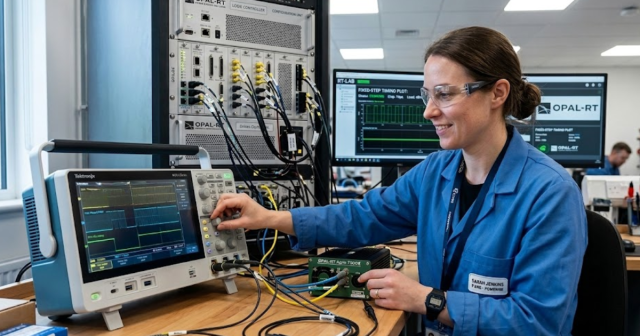
Industry applications, Simulation
03 / 31 / 2026
Managing high-frequency switching in real-time EMT simulation
Precision in testing complex power systems is essential to avoid failures, accelerate innovation, and integrate new technologies safely.

Simulation
03 / 30 / 2026
Understanding timestep requirements for modern power converters
Practical criteria for selecting EMT and real time simulation timesteps for power converters, covering switching resolution, control and PWM timing alignment, multirate approaches, and verification checks.
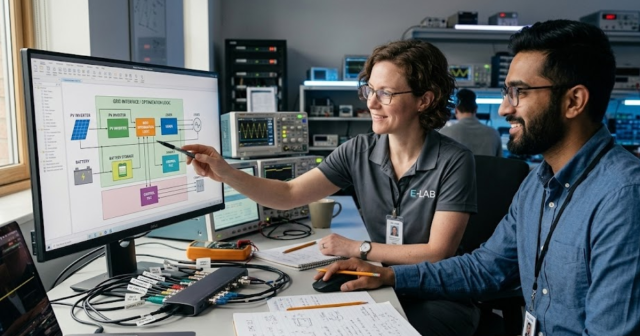
Energy, Industry applications, Simulation
03 / 29 / 2026
Validating data center energy management systems using real-time HIL
This piece explains how AI workload variability affects data centre power stability and how closed-loop HIL testing helps validate EMS control behaviour under site and grid stress.
EXata CPS has been specifically designed for real-time performance to allow studies of cyberattacks on power systems through the Communication Network layer of any size and connecting to any number of equipment for HIL and PHIL simulations. This is a discrete event simulation toolkit that considers all the inherent physics-based properties that will affect how the network (either wired or wireless) behaves.