Building a regression testing pipeline for HIL in electrification teams
Power Systems
01 / 27 / 2026

Key Takeaways
- HIL regression testing will stay reliable only when bench setup and inputs are repeatable and versioned.
- Test automation will work when every test controls initial state, stimulus, and a numeric pass or fail rule.
- CI gates will stay fast when scarce bench time is protected for small stable suites, while longer runs stay scheduled and time-boxed.
Automated HIL regression testing will keep your electrification program moving. Electric cars made up almost 20% of global car sales in 2023. More variants and faster software drops push HIL labs into triage. A repeatable regression pipeline turns each change into a check you can trust.
HIL automation works only when the bench acts like a build system, not an experiment. Versioned inputs, deterministic timing, and pass or fail rules beat “it looked fine on the scope.” Evidence must survive handoffs across shifts and sites. Each run must link back to firmware, model, calibration, and wiring state.
What HIL regression testing must achieve for electrified powertrains
HIL regression testing must prove control behaviour stays safe after every change. It must catch timing slips, saturation, and protection logic errors early. Each run must hold I/O mapping, plant model, and solver step constant. Results must end in a pass or fail you can rerun without debate.
A traction inverter update can pass unit tests and still fail on HIL. A new current-loop gain set can look stable on a desktop model, then trip overcurrent on a regen torque step. Fault logic can regress, such as a latch that clears early and masks a DC link sag. HIL regression exposes these because timing, interfaces, and limits meet in one run.
Strong suites focus on invariants that must not move. Safety and protection checks come first, then acceptance-level performance checks. Ten stable tests will beat fifty fragile ones. Each gate must be numeric and traceable.
“HIL automation works only when the bench acts like a build system, not an experiment.”
Why manual HIL testing breaks at electrification scale
Manual HIL runs fail once variant count and merge cadence outpace bench time. Setup steps create drift in wiring, calibrations, and load scripts. Results turn into screenshots and judgement calls instead of evidence. The team spends more time preparing tests than learning from them.
A common scene is two engineers running the “same” inverter test on two benches and getting different waveforms. One bench uses a different sensor scaling file, and the other has a stale load profile. Both runs pass, yet nobody can explain the gap or reproduce it. Uncertainty grows as branches land and benches rotate through maintenance.
Late surprises hurt because schedules are tight and hardware is booked. Software flaws still cost the U.S. economy $59.5 billion each year. A missed regression in a torque-control path can trigger bench retest, then vehicle retest, then another release candidate. Automation will stop wasting lab hours on drift and reruns.
Core components of an automated HIL regression pipeline
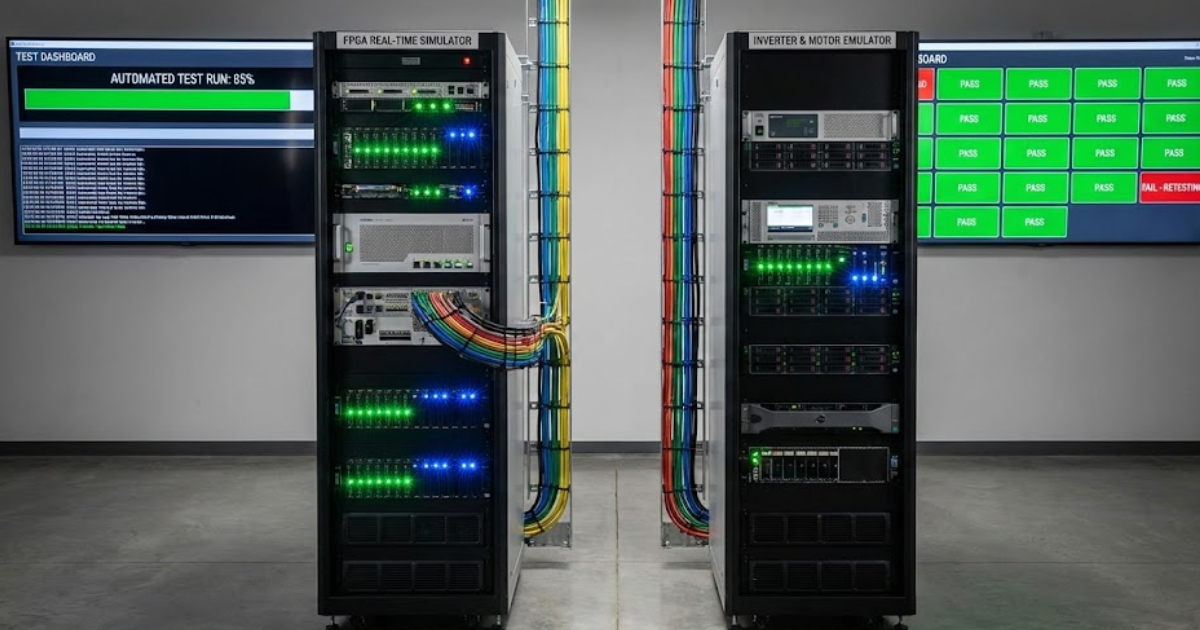
A HIL regression pipeline needs a test runner, a repeatable bench profile, and a results service. It must pull the correct model, firmware, and calibration versions for every run. It must reserve the bench, provision targets, execute scripts, and collect signals automatically. It must publish results that link back to the exact inputs.
One practical run starts from a job request and ends with a signed result. A motor drive case can load a 12-phase permanent magnet synchronous machine plant on FPGA, inject a phase-open fault, then run torque ramps to check ride-through. Teams running OPAL-RT benches can split plant and power stages across CPU and FPGA to keep step timing stable. The job captures run metadata so a rerun on a second bench stays comparable.
| Pipeline checkpoint | What good looks like |
| Versioned bench profile | I/O map, solver step, scaling stay fixed. |
| Provisioning and flashing | Firmware and calibrations come from tagged builds. |
| Deterministic execution | Stimulus and faults trigger on timestamps. |
| Signals and metadata capture | Logs include raw signals plus replay context. |
| Pass or fail judgement | Numeric checks run the same way on every bench. |
| Rerun control | Retries happen only for bench faults with recorded cause. |
Pipelines fail when the bench sits outside software hygiene. Bench configuration needs version control and review. Bench time is scarce, so runtime limits and strict timeouts matter. Small and reliable will scale better than large and fragile.
How to structure test cases for repeatable HIL automation
Automatable HIL tests start from a named requirement and end with a numeric check. Each test must control initial conditions, stimulus, and stop criteria so reruns match. Tests should run fast and isolate one feature at a time. Treat tests as code, with reviews and version history.
A charge controller test can set battery temperature to -10°C, apply a step in current request, and check that current settles within limits. A motor control test can command a speed ramp, then verify torque ripple stays under a threshold after field weakening engages. A protection test can force a sensor open circuit, then confirm the fallback path triggers within a set time. These stay stable because stimulus and checks are explicit.
- Lock every test to a bench profile ID and inputs.
- Reset states and fault flags before stimulus.
- Trigger faults and steps on timestamps.
- Use tolerances and filtering so noise does not trip a fail.
- Log only signals needed to explain a fail.
Good structuring means resisting “one test that checks everything.” Multi-purpose tests hide root cause and waste rerun time. A short test that fails for one reason will get fixed faster. Clear naming and tagging matter, because nobody keeps running tests they cannot interpret.
“Ten stable tests will beat fifty fragile ones.”
Data management and pass fail criteria that engineers trust
Trust comes from data you can trace, replay, and compare across runs. Every run should store raw signals, derived metrics, and the inputs that produced them. Pass or fail rules must stay consistent across benches and releases. When a test fails, the report must show what changed, not just that it failed.
A regen braking check might log DC link voltage, phase currents, temperature estimate, and fault flags, then compute peak value and settling time. Run context should capture solver step, I/O map hash, calibration checksum, and the fault schedule. That package lets you replay a fail, compare it to the last pass, and explain the delta. Without that context, teams rerun until the red light goes away.
Criteria earn trust when they match physics and measurement limits. A rule like “must trip within 5 ms” will mislead if your measurement chain adds 2 ms, so checks must match what you can measure. Baselines need care, because a trace that shifts with temperature will create false alarms. Keep strict checks for safety paths and trend checks for performance.
Integrating HIL regression into CI workflows without slowing teams
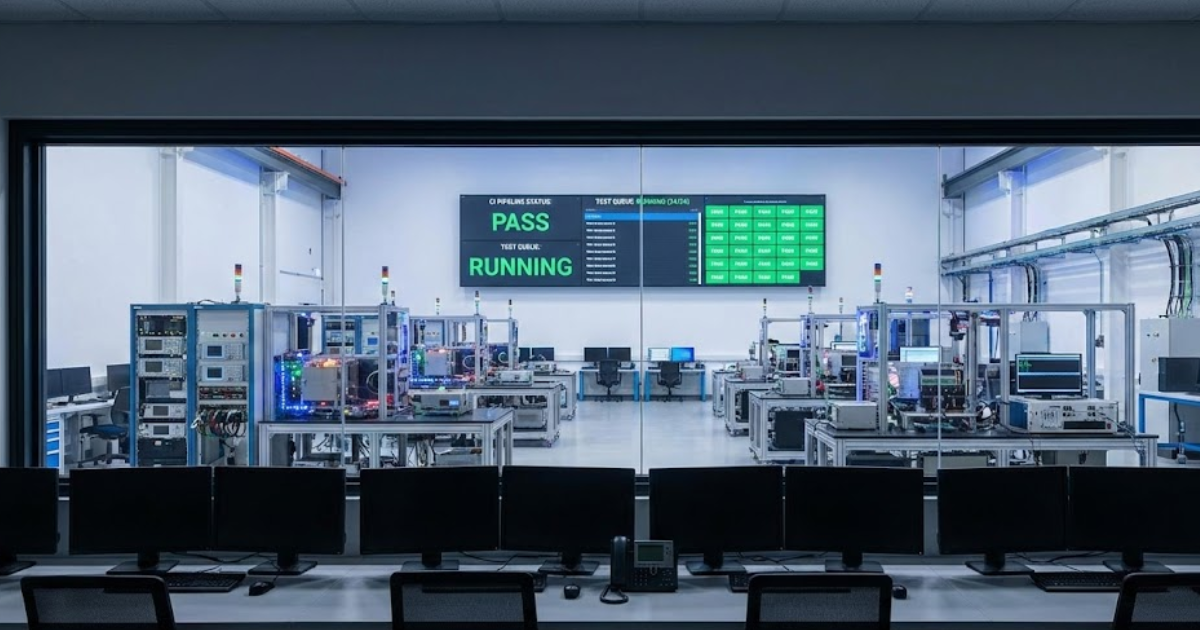
CI integration works when HIL is treated as a scarce, shared resource. Your build system should trigger a small smoke set on every merge and a larger suite on a schedule. Runs must be queued, time-boxed, and cancelled when inputs change. Results should gate merges only when the tests are stable.
A practical pattern is a 10 to 20 minute suite after each merge. Nightly runs cover longer thermal and fault campaigns that take an hour. Bench reservation matters, so the queue needs priorities and a clear access rule. When a bench goes down, the pipeline should mark the run as blocked and move on.
Integration also means choosing what will block and what will inform. Blocking gates should stay small and stable, or developers will avoid them. Longer suites matter, but they work best as feedback that tightens criteria after flakiness is fixed. A clean workflow makes HIL part of cadence instead of a last-minute scramble.
Common failure modes in HIL automation and how to avoid them
Most HIL automation fails for boring reasons: unstable tests, unmanaged bench drift, and unclear ownership. Flaky results teach teams to ignore red builds entirely. Hidden manual steps creep back when tooling feels awkward. Fixing those issues takes rules, not heroics.
Noise can sink trust fast. One team checks a single-sample peak current and gets a fail once a week from an ADC glitch, so engineers rerun until it passes. Another team updates bench firmware without recording it, then wonders why timing margins shrink and protection tests start failing. Both are avoidable once flakiness and drift are treated as defects with owners and fixes.
Discipline keeps HIL regression useful over months, not days. Bench changes need change control, and test changes need review and rationale. Fail triage needs a clear path: rerun only for bench faults, file bugs for product issues, and quarantine flaky tests. OPAL-RT can provide deterministic real-time execution, but results stay trusted only when your process is as strict as your hardware.
Real-time solutions across every sector
Explore how OPAL-RT is transforming the world’s most advanced sectors.
02 / 28 / 2026
12 phase PMSM validation checklist for mission critical drives
A practical 12 phase PMSM validation checklist covering acceptance criteria, 12 tests, multiphase HIL fault injection, pass fail evidence, test sequencing from SIL to dyno, and common setup errors.
Power Electronics
02 / 27 / 2026
Cloud Simulation for Power Electronics Development
Covers how cloud simulation supports power electronics modeling, faster run cycles, control validation, and the cost and security tradeoffs when selecting a cloud stack.
Simulation
02 / 26 / 2026
CPU versus FPGA simulation for high speed motor drive testing
Compares CPU and FPGA real-time simulation for high speed motor drive HIL testing, focusing on timing limits, solver step size, switching fidelity, I/O latency, and acceptance criteria.
EXata CPS has been specifically designed for real-time performance to allow studies of cyberattacks on power systems through the Communication Network layer of any size and connecting to any number of equipment for HIL and PHIL simulations. This is a discrete event simulation toolkit that considers all the inherent physics-based properties that will affect how the network (either wired or wireless) behaves.