Energy simulation guide for renewable grids and microgrids
Simulation, Microgrid, Energy
01 / 15 / 2026
Key Takeaways
- Energy simulation works best when each study finds a limit with pass criteria you can defend.
- Microgrid simulation needs equal focus on controls, protection, and transition events, not only energy balance.
- Strong results come from scoping first, then matching fidelity and time resolution to risk.
Energy simulation will tell you what will break before commissioning. Renewable power capacity increased by 473 GW in 2023. More inverter-based generation means more control interactions and tighter limits. Simulation turns those interactions into limits you can operate within.
Energy simulation for renewable grids uses models to predict system behaviour. Microgrid simulation adds islanding, resynchronization, and protection changes to the mix. We start small, answer one question, then add detail. That discipline keeps results explainable and keeps lab time focused.
Energy simulation defines technical limits for renewable grids and microgrids
Energy simulation defines the operating limits of your networked power system. You will check voltage, frequency, thermal loading, and protection actions. Renewable energy simulation aims for a safe envelope, not perfect forecasts. Microgrid simulation adds stable islanded operation and safe grid reconnection.
A rural feeder with heavy solar export often sees midday overvoltage. A power-flow study will show where regulators and capacitors run out. A follow-up dynamic run will show if controls fight and oscillate. You can then set an export limit and a settings package.
Single base cases hide the events that actually cause trips. Switching states, light-load days, and faults will expose different limits. We treat each study as a limit-finding exercise with clear pass criteria. That output becomes an operating rule, not an argument.
“Scope errors create clean plots and costly surprises during commissioning.”

Simulation scope starts with grid boundaries and controllable assets
Scope decides what is modelled and what is treated as input. Set the boundary at a breaker or point of common coupling. List every controllable asset inside it and its hard limits. Everything outside becomes an equivalent that still matches fault strength.
Campus microgrid studies often start at the utility tie breaker. The upstream grid becomes a voltage source with an impedance. The model includes switch states used during planned and unplanned transfers. That scope keeps focus on what operators can actually change.
- Document the boundary on a one-line that matches field wiring.
- Include impedances for lines, cables, voltage step units, and grounding paths.
- Represent each inverter, generator, and battery with control limits.
- Model protection devices and settings when trips change outcomes.
- Match the upstream equivalent to measured voltage and fault level.
Scope errors create clean plots and costly surprises during commissioning. Leaving out a delta-wye connection at the voltage step unit can hide grounding and relay issues. Ignoring feeder reconfiguration can miss overvoltage after a tie closes. If a component can switch, trip, or saturate, it belongs.
Model fidelity choices shape accuracy, runtime, and test confidence
Model fidelity sets which physics you will see and what you miss. Steady-state models run fast and answer voltage and loading questions. Electromagnetic transient models capture inverter controls, faults, and harmonics. Choose higher detail only when it changes the design choice.
Aggregating fifty identical rooftop inverters works for a voltage study. Protection coordination needs device-level current limits and relay timing. Harmonic checks need filters and switching effects, not averaged models. That difference decides if you run hundreds of cases or one.
More detail will not fix missing or guessed parameters. A simplified inverter that acts like a machine will mask oscillations. A detailed model with bad settings will still fail in the lab. Parameter checks and sensitivity runs will earn more confidence than detail.
| What you’re trying to decide | Time span and step size that fits | Model detail that must be present | Simplification that still keeps the answer |
| Feeder voltage compliance under high solar export | Minutes to hours with 1 to 15 minute steps | Line impedances, regulators, and inverter reactive limits | Group similar rooftop units per feeder section |
| Voltage step unit heating under peak and shoulder load | Hours to seasons with 15 to 60 minute steps | Loss model, tap positions, and temperature assumptions | Use averaged inverter behaviour and keep power limits |
| Frequency recovery after islanding or generator loss | Seconds with 1 to 10 millisecond steps | Droop control, reserve limits, and load damping | Ignore switching ripple and keep control loops |
| Protection clearing for feeder and bus faults | Cycles to seconds with 50 to 200 microsecond steps | Relay logic and inverter current limiting | Reduce distant network detail and keep near-fault impedances |
| Harmonic distortion at a sensitive load bus | Milliseconds with 5 to 50 microsecond steps | Filters and harmonic sources tied to inverter controls | Replace remote feeders with an equivalent impedance |
| Controller timing effects on stability margins | Milliseconds with 1 to 5 millisecond steps | Sampling, delays, and saturation limits | Use an averaged plant model and keep I/O timing |
Time resolution separates planning studies from control validation
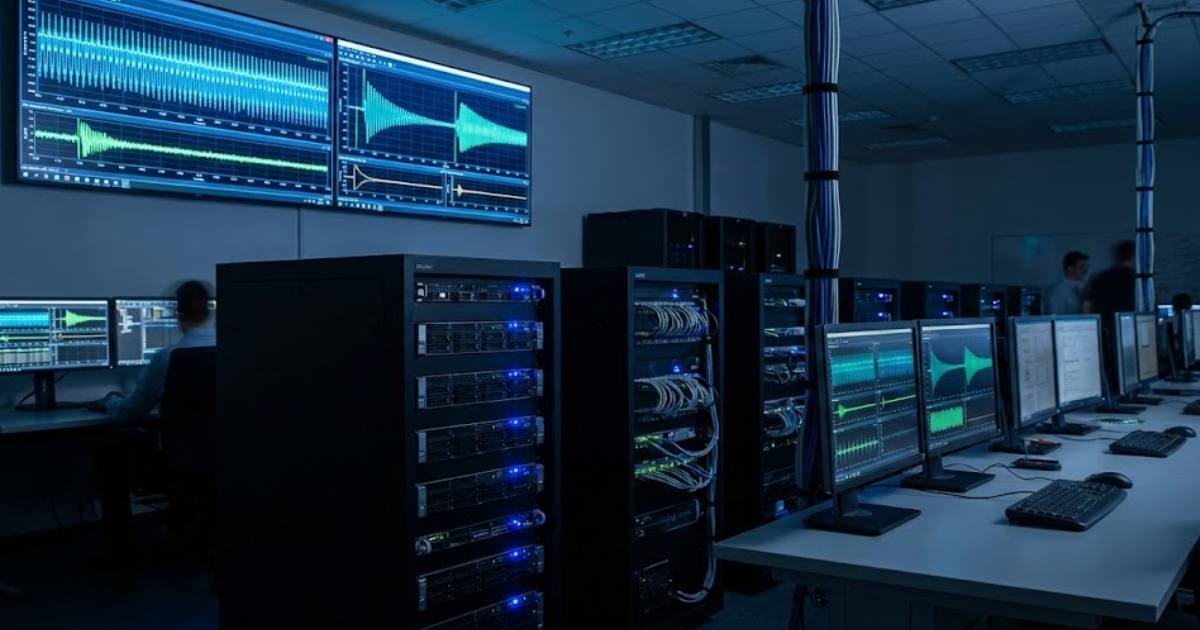
Time resolution must match the behaviour you need to validate. Coarse steps suit energy balance and thermal loading across long time spans. Fine steps capture control loops, protection actions, and inverter current limits. Wrong resolution gives false comfort because the failure mode stays hidden.
Dispatch runs that span a week can use 15-minute steps without losing value. A transition-to-island run needs millisecond steps to catch frequency dip. Sensor filtering and communications delay must be modelled as actual time. Those milliseconds decide if controllers settle or trigger a protection trip.
Capital stakes are high, so rework needs to stay rare. Grid investment needs to nearly double to over USD 600 billion per year by 2030. A common workflow uses coarse screening, then fine validation on the same model. Teams run real-time, closed-loop tests on platforms such as OPAL-RT when timing matters.
Microgrid simulation exposes stability and protection coordination limits
Microgrids fail on stability and protection long before they run out of energy. Islanded operation needs one source to set frequency and voltage. Inverter fault current is limited, so classic overcurrent assumptions break. Microgrid simulation checks transitions, faults, and recovery, not just steady output.
Tie breaker opening events will show how a grid-tied microgrid behaves. The battery inverter hits its current limit and voltage collapses quickly. An upstream relay then sees too little current and misses the fault. Directional or differential elements, plus tuned settings, will clear faults reliably.
Control and protection interact in surprising ways during the first test week. Governor tuning that behaves well on grid will hunt when islanded. Two sources regulating the same bus will fight and create oscillation. Simulation lets you test those interactions early and lock settings with evidence.

Renewable variability requires scenario-based simulation coverage
Renewable variability forces scenario coverage instead of one neat base case. Solar and wind swings stress voltage control, reserves, and storage limits. Rare combinations, such as high output plus a feeder outage, set limits. Scenario design will prove your system holds up across the conditions you expect.
Fast cloud ramps can drop solar output within minutes. Storage will respond first, but state of charge will constrain it. A diesel unit can cover the gap, but warm-up time matters. Simulation will tune the handoff so frequency stays within your limit.
Scenario sets work best when they are built around failure modes. Voltage and thermal checks need feeder switching cases, not only weather. Stability checks need timed events, such as islanding, trips, and load steps. Thirty purposeful scenarios tied to risks will beat hundreds of random runs.
“We trust disciplined execution over flashy plots every time.”
Simulation results guide architecture tradeoffs and risk reduction
Simulation results matter only when they force sharp tradeoffs and specific actions. The key question stays simple: what breaks first under stress. Good outputs include limits, settings, and operating rules you can apply. That clarity will reduce redesign and make commissioning calmer.
Frequency failures after a load step will show where your microgrid needs support. A larger battery improves fast response, while tuned generation provides headroom. Staged load shedding protects critical buses when supply falls short. Simulation quantifies each option using the same disturbance set.
We trust disciplined execution over flashy plots every time. Model governance, parameter checks, and acceptance criteria keep results tied to field behaviour. OPAL-RT fits when you need real-time, closed-loop validation of controls and protection timing. Teams that keep assumptions traceable will make faster calls and avoid repeat mistakes.
Real-time solutions across every sector
Explore how OPAL-RT is transforming the world’s most advanced sectors.
Industry applications, Simulation
03 / 31 / 2026
Managing high-frequency switching in real-time EMT simulation
Precision in testing complex power systems is essential to avoid failures, accelerate innovation, and integrate new technologies safely.

Simulation
03 / 30 / 2026
Understanding timestep requirements for modern power converters
Practical criteria for selecting EMT and real time simulation timesteps for power converters, covering switching resolution, control and PWM timing alignment, multirate approaches, and verification checks.
Energy, Industry applications, Simulation
03 / 29 / 2026
Validating data center energy management systems using real-time HIL
This piece explains how AI workload variability affects data centre power stability and how closed-loop HIL testing helps validate EMS control behaviour under site and grid stress.
EXata CPS has been specifically designed for real-time performance to allow studies of cyberattacks on power systems through the Communication Network layer of any size and connecting to any number of equipment for HIL and PHIL simulations. This is a discrete event simulation toolkit that considers all the inherent physics-based properties that will affect how the network (either wired or wireless) behaves.