Key Takeaways
- Deterministic timing is the credibility layer in HIL because it keeps closed-loop delay bounded and repeatable across runs and workloads.
- FPGA execution improves HIL latency and jitter control through fixed hardware timing paths and tick-aligned I/O, so controllers see consistent cause-and-effect timing.
- Stable results come from explicit timing budgets, careful CPU versus FPGA partitioning, and timestamp-based validation that checks worst-case behaviour end to end.
Deterministic timing is what makes a hardware-in-the-loop result believable.
When timing slips, you can still get plots and pass or fail flags, but you won’t know if you tested your controller or just tested your test setup. Hard timing errors often hide as “noise” until you ship code to a target that behaves differently under load. One public estimate put the annual cost of inadequate software testing infrastructure at $59.5 billion, which is a reminder that test credibility has real financial weight, not just technical pride.
FPGA-based real-time simulation is popular because it replaces best-effort timing with fixed, repeatable execution and I/O. The useful stance is simple. If you can’t explain and measure latency and jitter end to end, closed-loop simulation accuracy becomes an assumption. If you can, HIL turns into a reliable way to find corner cases early and with confidence.
“When those two align, the simulator behaves like a stable piece of lab equipment.”
Deterministic timing sets the trust level in HIL tests
Deterministic timing means every simulation step and I/O update happens on schedule, with bounded and repeatable delay. Your controller will react to the same timing profile every run, not a different one each time the CPU gets busy. That repeatability is the trust layer in HIL. Without it, results look precise while the timing behaviour stays unknown.
You can treat determinism as a contract that covers three things. The solver step must complete before a hard deadline, I/O sampling must align to the step boundary, and the time from “controller output” to “plant response” must stay consistent. When any of those slip, the loop still closes, but you’re no longer validating the timing assumptions inside your control design. That’s the point where a test becomes hard to defend to a safety or validation team.
Deterministic real-time simulation also reduces the need to “tune around” the lab. A controller tuned against jitter will often look stable, but that stability can be a lab artefact. Tight determinism pushes you to tune against the plant physics and the intended sampling rate. Over time, that discipline improves reuse, because the same model and controller behave the same way as you expand test coverage.
Jitter and latency errors reduce closed-loop simulation accuracy
Latency is the fixed delay between cause and effect, while jitter is the variation of that delay from one cycle to the next. Closed-loop simulation accuracy drops fastest when jitter is present, because the loop delay is no longer predictable. The controller effectively sees a time-varying plant. That time variance shows up as extra phase lag and noisy feedback, even with perfect math.
Teams often focus on average latency and miss the worst-case tails. A stable mean delay can still hide occasional long delays that push a loop over its stability margin. Jitter also breaks repeatability, so regressions are harder to reproduce and harder to blame on a model change. When a test failure depends on CPU load, bus contention, or background services, it’s a timing failure first and a control failure second.
Latency is still important because it defines the loop’s usable bandwidth. If the closed-loop delay is too large for the sampling rate, you’ll be forced to soften gains, add filtering, or accept slower response. Those “fixes” can mask plant issues and can also hide sensitivity to sensor noise. A clear timing budget keeps you honest, since every microsecond has a place and a reason.
FPGA execution cuts real-time simulation latency and I/O delay

FPGAs reduce latency and jitter because logic executes as fixed hardware paths, not time-sliced software tasks. Once compiled, an FPGA design runs the same sequence every clock cycle with predictable pipeline delays. That determinism applies to both computation and I/O handling. As a result, FPGA latency in HIL becomes a budget you can design to, not a variable you hope stays small.
A concrete case makes the point. An inverter controller that updates PWM at 20 kHz has a 50 microsecond control period, and even a few microseconds of I/O delay variation can move current ripple and torque response in ways your model won’t predict. Putting the fast switching functions, PWM capture, and protection logic on an FPGA keeps the I/O edge timing repeatable, so the loop sees the same delay every cycle. That single change often does more for closed-loop simulation accuracy than adding model detail.
FPGAs also let you treat I/O as synchronous data, not as asynchronous interrupts. ADC sampling, digital captures, and encoder decoding can all be aligned to a shared clock and a shared tick. That alignment reduces the hidden “stagger” between channels that otherwise shows up as phantom phase shifts. The tradeoff is design effort, since FPGA partitioning rewards early planning and clear timing targets.
Partitioning models across FPGA and CPU to hit deadlines
Partitioning is the practice of placing each model task on the compute resource that can meet its deadline with stable timing. The CPU handles numerically heavy or variable-step style work that still fits a fixed-step schedule. The FPGA handles the fast, repetitive, timing-sensitive parts where jitter will hurt the loop most. Done well, you get determinism without forcing the entire plant model into hardware.
A practical partition usually starts with the I/O boundary and works inward. Anything tied to switching events, edge timing, or protection interlocks belongs near the I/O, because late updates change behaviour, not just accuracy. Slower dynamics, supervisory logic, and logging fit better on the CPU, where flexibility is higher. Platforms that combine CPU solvers and FPGA I/O, such as OPAL-RT systems, make this split workable as long as you treat the interface as part of the timing budget.
The main failure mode is treating the CPU to FPGA boundary like a free mailbox. Every crossing adds buffering, handshaking, and clock-domain handling, which can add delay and variation if it’s not scheduled. Rate transitions also need care, since a fast FPGA task feeding a slower CPU task will alias if you don’t define sampling and hold behaviour. Good partitioning is less about raw speed and more about keeping every loop delay explicit and repeatable.
I/O synchronisation and scheduling choices that keep timing repeatable
Repeatable timing depends on synchronising I/O to the simulation tick and scheduling every update as a predictable sequence. Synchronous sampling means each channel is captured at a known instant, not “when the driver gets around to it.” Deterministic output means updates are applied at a defined edge, not smeared across a variable window. When those two align, the simulator behaves like a stable piece of lab equipment.
Three choices matter most. First, align ADC and digital capture to a shared clock and a defined trigger so channels stay coherent. Second, keep buffering explicit and bounded so “helpful” queues don’t add hidden delay. Third, treat asynchronous buses as timed interfaces, with clear assumptions about when values are valid relative to the tick. These details sound small, but they decide if your loop delay is constant or a moving target.
“If you can’t explain and measure latency and jitter end to end, closed-loop simulation accuracy becomes an assumption.”
| Timing checkpoint you can audit | What repeatable operation looks like in practice |
| ADC sampling instant | A single trigger defines when all channels are captured. |
| Output update edge | DAC and digital outputs change on a fixed tick boundary. |
| Clock-domain crossings | Each crossing has a known, constant pipeline delay. |
| Buffer depth and queueing | Queues are bounded so backlog cannot grow under load. |
| Time alignment across mixed I/O | Every signal has a defined timestamp relative to the solver step. |
Setting and validating latency budgets with timestamp based measurements
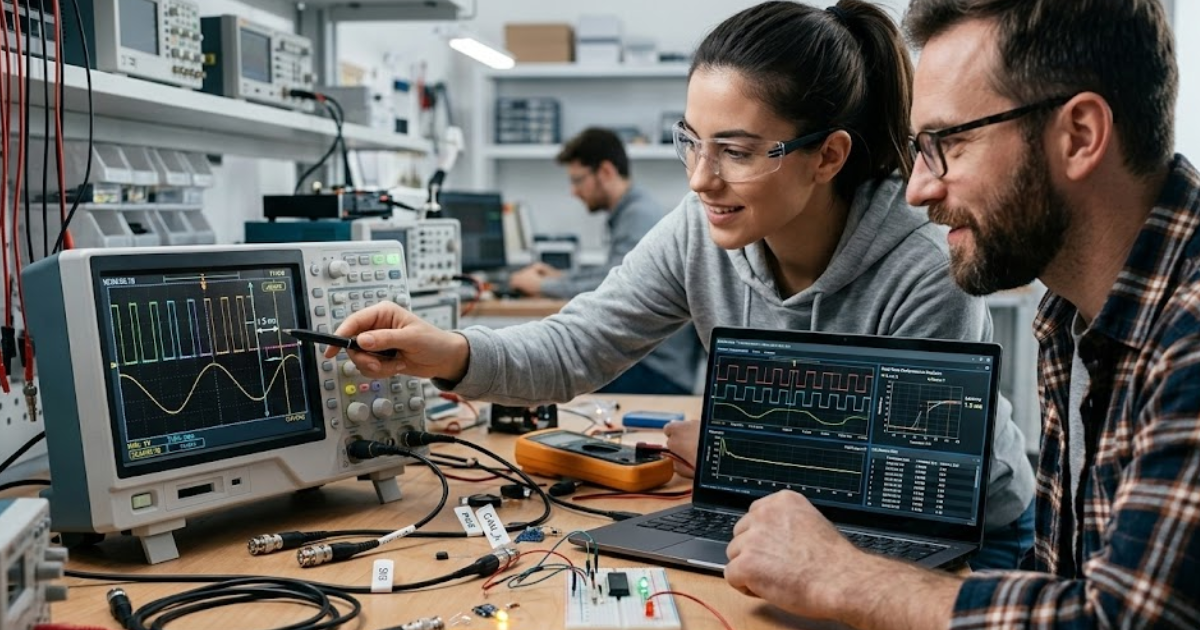
A latency budget is a written limit for each delay component in the closed loop, from I/O conversion to compute to output update. Timestamp-based validation checks that the budget holds under realistic load, not just in a quiet lab moment. The goal is proof of bounds, not a best-case number. Once you can measure it, you can manage it.
Timestamps need enough resolution to show small variations, and common timing formats already support that. A standard 64-bit NTP timestamp uses a 32-bit fractional field with a theoretical resolution of about 233 picoseconds. That level of resolution is far beyond typical HIL needs, but it reinforces the principle that measurement tooling can be much finer than the delays you’re budgeting. What matters is placing timestamps at the right boundaries, such as at ADC latch, solver step start, solver step end, and output apply.
A useful validation routine combines instrumentation and stress. Record timestamps while running your normal workload, then repeat while adding logging, communications traffic, and the worst-case model configuration you expect to ship. Compare worst-case and typical values, not just averages, and treat outliers as defects to fix. Teams that do this early avoid the late-stage surprise where “the model is fine” but the timing isn’t.
Common HIL setup mistakes that create non deterministic behaviour
Non-deterministic behaviour in HIL usually comes from a small set of repeatable mistakes, not from mysterious physics. Timing errors show up when parts of the loop run on different clocks, when software scheduling is treated as “good enough,” or when buffering hides delay. Fixing these issues is rarely glamorous, but it is the work that protects credibility. If the timing is disciplined, your results will stand up in reviews and in audits.
- Letting I/O run free instead of tick aligned
- Ignoring worst-case jitter and trusting average latency
- Allowing unbounded queues in data paths
- Mixing clock domains without defined pipeline delays
- Measuring latency at one point instead of end to end
The practical judgement is straightforward. You should treat deterministic timing as a test requirement, the same way you treat sensor scaling or safety interlocks as requirements, because timing defines the loop you’re validating. OPAL-RT projects that succeed long term tend to institutionalize this as a habit, with written budgets and repeatable measurements, not as a one-time tuning exercise. That habit keeps closed-loop simulation accuracy tied to engineering intent instead of tied to a lab’s momentary conditions.
Real-time solutions across every sector
Explore how OPAL-RT is transforming the world’s most advanced sectors.
Industry applications, Simulation
03 / 31 / 2026
Managing high-frequency switching in real-time EMT simulation
Precision in testing complex power systems is essential to avoid failures, accelerate innovation, and integrate new technologies safely.
Simulation
03 / 30 / 2026
Understanding timestep requirements for modern power converters
Practical criteria for selecting EMT and real time simulation timesteps for power converters, covering switching resolution, control and PWM timing alignment, multirate approaches, and verification checks.
Energy, Industry applications, Simulation
03 / 29 / 2026
Validating data center energy management systems using real-time HIL
This piece explains how AI workload variability affects data centre power stability and how closed-loop HIL testing helps validate EMS control behaviour under site and grid stress.
EXata CPS has been specifically designed for real-time performance to allow studies of cyberattacks on power systems through the Communication Network layer of any size and connecting to any number of equipment for HIL and PHIL simulations. This is a discrete event simulation toolkit that considers all the inherent physics-based properties that will affect how the network (either wired or wireless) behaves.