Hardware‑in‑the‑loop testing for data center power systems
Power Systems, Simulation
10 / 02 / 2025

Key takeaways
- Conventional testing misses high consequence edge cases that cause outages.
- Data center HIL testing brings real controllers into a safe, real time simulation to expose and fix faults early.
- The core of the setup is a precise simulator, flexible I O, and your production controllers with automation for repeatable cases.
- Teams launch faster with fewer delays and gain confidence that transfer, protection, and ride through behave as intended.
- The same workflow that proves resilience also tunes efficiency and reduces on site rework.
OPAL-RT’s view is clear: every critical control and protection mechanism must be proven via real-time hardware-in-the-loop (HIL) simulation before deployment. It is the only reliable way to eliminate uncertainties and guarantee continuous power continuity in such complex facilities. Anything less leaves too much to chance in an industry where absolute uptime is required.
No modern data center can afford an unexpected power outage, yet conventional testing still leaves dangerous gaps that put uptime at risk.
Conventional testing leaves blind spots in data center power reliability

Modern data centers are staggering in scale and complexity. Ten years ago, a 30 MW facility was considered large, whereas today 200 MW hyperscale data centers are common. These massive power demands come with intricate on-site generation, uninterruptible power supply (UPS) systems, and automatic transfer controls. Yet traditional testing methods like isolated component checks or limited full-scale trials during commissioning cannot realistically cover every failure mode in such multi-layered power architectures. Engineers are often constrained to testing only a handful of scenarios that won’t disrupt operations, leaving many potential issues unexamined. The limitations of conventional testing leave several potential failure scenarios unaddressed. As a result, many plausible but dangerous events remain untested in practice. Some key examples include:
- Grid disturbances: Severe voltage sags, frequency deviations, or phase imbalances from the utility that trigger emergency power transfers.
- Simultaneous failures: Overlapping breakdowns across redundant systems (for example, a generator startup failure coinciding with a UPS battery depletion) that are hard to replicate in routine tests.
- Transient interactions: Complex behavior between backup generators, UPS units, and switchgear during sudden load changes or transfers, which might reveal control instabilities.
- Edge-case control bugs: Hidden software logic errors in controllers or protective relays that only surface under extreme or irregular conditions.
- Integrated energy system glitches: Unseen chain reactions from integrating on-site generators or energy storage (like battery systems) with the grid, especially under peak load or islanding conditions.
In short, conventional approaches leave engineers essentially hoping that these edge cases never occur in production. Power-related failures remain the most common cause of severe data center outages. The stakes are enormous: more than half of data center operators report that their last major outage cost over $100,000, and 16% suffered losses above $1 million. Any blind spot in testing can translate into a catastrophic and costly downtime event.
Hardware-in-the-loop simulation exposes data center power vulnerabilities safely in the lab

Hardware-in-the-loop simulation lets teams actively find vulnerabilities in a controlled setting instead of waiting for them to emerge in the field. This technique connects real data center control hardware (such as a generator controller, a UPS control unit, or a protection relay) to a high-fidelity real-time simulation of the facility’s power network. The real controller “believes” it is interfacing with a live electrical system, when in reality it interacts with a mathematical model running on a real-time simulator. This setup makes it possible to simulate everything from utility grid blackouts to abrupt equipment faults without any risk to actual infrastructure.
HIL testing can recreate dangerous power disturbances and failure scenarios in the laboratory, giving engineers the chance to observe and fix weaknesses before they ever cause an outage. For instance, a team can simulate a sudden short-circuit on the main switchboard or an unexpected oscillation in grid frequency and watch how the control devices respond. If a backup generator’s control system is slow to react or a UPS’s algorithm mismanages a transient, those issues become evident in the simulation. Engineers can then adjust settings or refine control logic long before the real data center faces that situation. Researchers have shown that HIL techniques allow them to mirror field conditions and evaluate complex scenarios with zero risk to operations.
By subjecting controllers and power devices to extreme but plausible conditions, HIL testing reveals design flaws and reliability gaps early in the development process. Teams iteratively refine their systems, tweaking parameters, updating firmware, and improving failover sequences until the power architecture handles every stress test as intended. This not only prevents unforeseen downtime, but also builds confidence that the data center will perform reliably even in worst-case scenarios.
Real controllers and real-time models form the core of a data center HIL setup

At the heart of a data center HIL testbed is a real-time digital simulator capable of emulating the facility’s electrical behaviour with high precision. This simulator runs detailed models of the power infrastructure, including the utility feed, switchgear, busbars, UPS units, backup generators, distribution down to server racks, and any on-site renewable or storage sources. Crucially, the simulator computes these models in real time (often with sub-millisecond time steps) so it can exchange signals with physical hardware in a closed loop without lag.
Equally important are the control and protection devices under test. These include generator control units, UPS controllers, battery management systems, and the programmable logic controllers (PLCs) that manage power transfers. Each device connects to the simulator through specialized input/output (I/O) interfaces. For example, the simulator can feed a controller with simulated sensor signals (such as bus voltages or breaker status) and accept the controller’s outputs (trip commands, breaker operations, generator starts) back into the model. High-speed I/O cards and communication links (like Ethernet or IEC 61850) ensure this data exchange is instantaneous and faithful, so the virtual model and real hardware operate as one integrated system.
For certain tests, power hardware-in-the-loop (PHIL) can incorporate actual power equipment via amplifiers. In both cases (purely digital simulation or involving physical power devices), the key elements remain the same: a real-time simulation engine, real controllers in the loop, and a suite of monitoring and automation tools. With this setup, engineers essentially create a virtual data center with real control hardware in the loop, gaining visibility into how every component will behave once deployed.
HIL testing ensures resilient, efficient data center power operations from day one
Comprehensive HIL testing translates directly into a smoother, more reliable data center launch. By catching and correcting issues in the design phase, project teams avoid the costly last-minute surprises that often plague complex power deployments. In fact, four out of five data center managers believe their most recent serious outage could have been prevented with better upfront practices and configuration. Rigorous HIL validation is exactly the kind of proactive measure that turns those “what if” scenarios into non-issues. When every emergency condition has been rehearsed and every control response verified in simulation, you can flip the switch on opening day with far greater confidence.
Guaranteeing reliability through exhaustive testing
HIL’s greatest payoff is the assurance of resilience. Engineers leave no stone unturned, simulating everything from grid spikes and utility outages to multi-fault chain reactions in the simulator. This exhaustive approach means that when a real incident occurs (be it a utility transformer failure or a sudden power bus fault), the data center’s systems react as intended to keep critical loads online. Such thorough preparation yields a near-immunity to unplanned downtime, a crucial advantage given the high cost of outages and the industry expectation of “five nines” availability.
Identifying design flaws early to avoid delays
Incorporating HIL early in the project timeline accelerates deployment and reduces costly revisions. Design flaws that could cause delays in commissioning – such as miscoordinated protection settings or an inverter control instability – emerge in simulation when changes are far easier and cheaper to make. Instead of discovering a critical coordination problem during on-site startup tests (then scrambling for a fix while schedules slip), the team resolves it months earlier in the lab. By the time the data center is built, its power control systems have essentially been pre-commissioned via HIL, ensuring a faster, trouble-free rollout.
HIL’s greatest payoff is the assurance of resilience.
Optimizing performance and efficiency from the start
Engineers can also use the real-time simulation to fine-tune the data center’s power operations for peak efficiency. They might adjust generator dispatch schemes or refine UPS control parameters in the model to find optimal settings. This approach often uncovers improvements that reduce energy use or wear-and-tear while preserving reliability. As a result, the facility isn’t just able to withstand faults; it’s also calibrated to run smoothly and cost-effectively under typical loads from day one.
OPAL-RT empowers proactive HIL validation for critical power systems
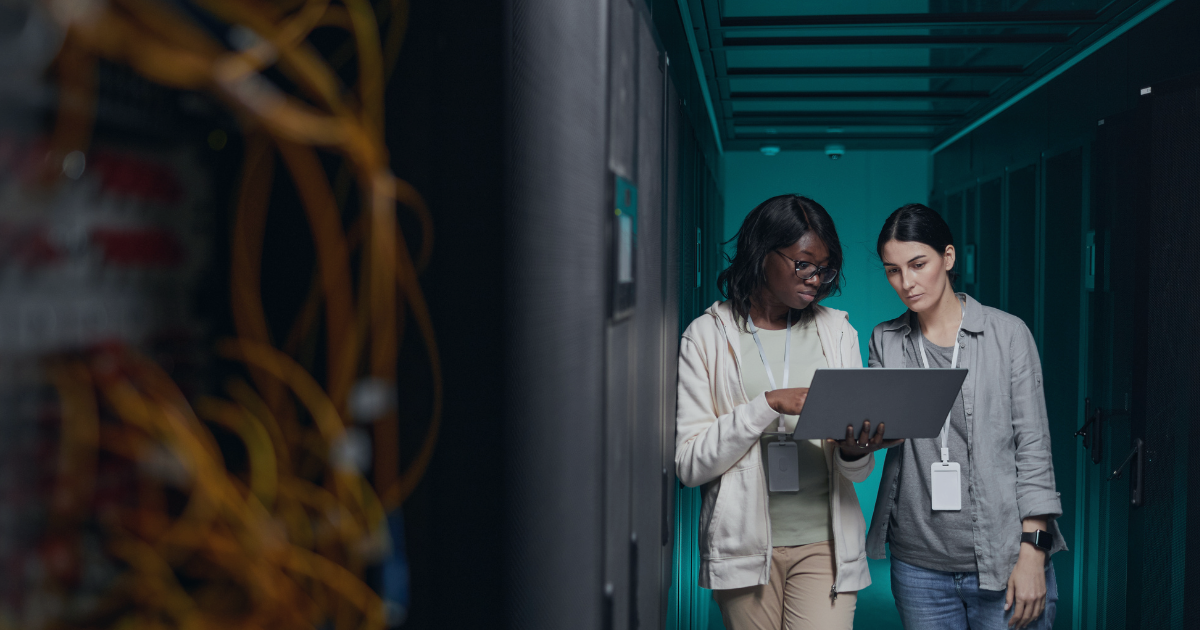
Building on the imperative of thorough pre-deployment testing, we deliver the advanced real-time simulation technology that makes exhaustive HIL validation possible. Our high-performance digital simulators and flexible I/O interfaces replicate complex data center power systems with absolute fidelity. Engineers can plug in their actual controllers and subject them to a limitless range of virtual scenarios, effectively removing guesswork from system integration. By embracing this proactive approach, data center teams eliminate uncertainties and ensure their power infrastructure is ready for any contingency before it goes live.
OPAL-RT’s solutions have been trusted by organizations globally to safeguard critical power and energy systems. From electric utilities and microgrid developers to aerospace and automotive innovators, leading engineers rely on these real-time HIL tools to validate designs against the most demanding requirements. With an open, scalable simulation ecosystem that supports industry-standard modeling tools and hardware integration, our technology allows power system experts to test and perfect every aspect of their design. The outcome is a data center power foundation that is thoroughly vetted and robust from day one, reflecting OPAL-RT’s commitment to powering confidence for organizations that cannot afford downtime.
Common questions
Engineering teams exploring HIL testing often raise a few recurring questions. Clarifying these points helps demystify the approach and its role in modern data center operations.
What is hardware-in-the-loop testing for data center power systems?
Hardware-in-the-loop testing is an advanced method of verifying data center power system performance by connecting actual control hardware to a simulated power network. In practice, a real controller or device (for example, a UPS control module or a generator’s controller) is interfaced with a real-time computer model of the data center’s electrical infrastructure. The controller operates as if it were in the real facility, receiving lifelike electrical measurements and sending commands into the simulation. This allows engineers to test how the controller and the entire power system behave under various conditions, from normal operations to extreme fault scenarios, without risking any real equipment.
How does HIL testing improve data center reliability?
HIL testing improves reliability by exposing and correcting potential failures before they can cause an outage. It lets engineers safely simulate emergency situations such as utility power loss, abrupt load surges, or critical equipment malfunctions—scenarios that traditional testing cannot fully replicate. By verifying that backup generators kick in on time, UPS units seamlessly carry critical loads, and protection relays trip appropriately for every fault condition, HIL removes much of the uncertainty in how the system will perform under stress. The result is a power infrastructure with far fewer surprise failures.
Which equipment is needed for data center HIL testing?
A typical data center HIL setup requires a few key components. First, there is a real-time simulator, which is a powerful computing platform that runs detailed electrical models in real time. Second, the actual hardware devices to be tested are needed, such as controllers for generators, UPS units, or switchgear protection relays. Third, specialized I/O interface hardware links the simulator to these devices by converting simulated signals into physical voltages, currents, or data streams and vice versa. For instance, the simulator might send a voltage signal to a UPS controller and receive the controller’s circuit breaker trip signal through a digital input. In some cases, power amplifiers are also used if physical power hardware (like a portion of a UPS or inverter) is included in the loop.
What is data center simulation?
Data center simulation uses software models to replicate a facility’s power systems in order to study and improve them. It involves creating a virtual twin of the electrical network that covers the utility source, backup generators, UPS units, distribution panels, and loads. Engineers run these simulations to see how the power system handles different scenarios without impacting the real facility. For example, they can model extreme peak loads or equipment failures virtually to observe the effects. By testing the data center in a digital domain first, teams can identify potential issues, validate design choices, and fine-tune control settings with zero risk. This practice ensures that when the data center goes live, its power system will perform as intended.
Adopting hardware-in-the-loop testing is a proactive strategy to ensure power systems achieve uncompromising reliability. By preemptively validating every response to adversity in a virtual setting, data center teams effectively safeguard their power infrastructure against unforeseen failures. In an era when even a brief outage can have enormous consequences, HIL testing provides a critical safety net.
Real-time solutions across every sector
Explore how OPAL-RT is transforming the world’s most advanced sectors.
Industry applications, Simulation, Energy
03 / 29 / 2026
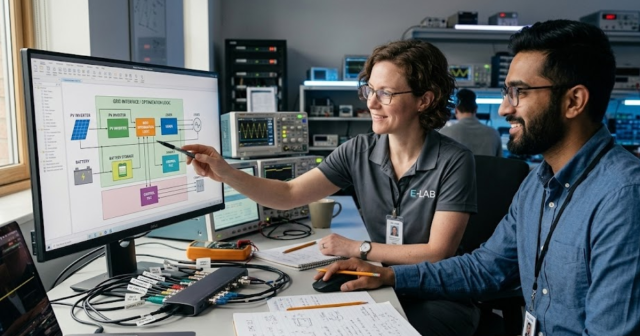
Validating data center energy management systems using real-time HIL
This piece explains how AI workload variability affects data centre power stability and how closed-loop HIL testing helps validate EMS control behaviour under site and grid stress.
Industry applications
03 / 28 / 2026
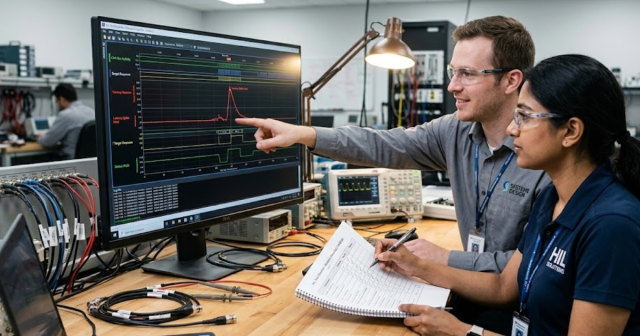
Control algorithm validation using real-time HIL
A practical look at how real-time HIL testing validates embedded control algorithms through closed-loop simulation, fault reproduction, digital plant models, and disciplined integration.
Simulation
03 / 27 / 2026
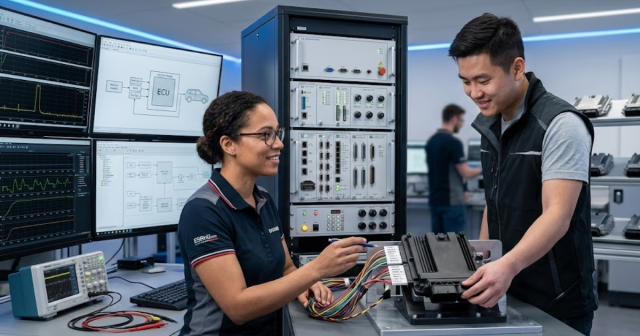
Real-time simulation for validating autonomous and ADAS systems
Explains why autonomous and ADAS validation relies on deterministic real-time simulation and hardware-in-the-loop, what scenarios matter, how to assess simulator stacks, and where simulation programs commonly fail.
EXata CPS has been specifically designed for real-time performance to allow studies of cyberattacks on power systems through the Communication Network layer of any size and connecting to any number of equipment for HIL and PHIL simulations. This is a discrete event simulation toolkit that considers all the inherent physics-based properties that will affect how the network (either wired or wireless) behaves.