Why Rapid Control Prototyping Speeds Sustainable Innovation
Industry applications
02 / 01 / 2026

Key Takeaways
- Rapid control prototyping speeds innovation when closed-loop proof happens early on representative hardware with repeatable regression tests.
- Sustainable engineering improves when efficiency and safety margins are measured sooner, reducing prototype rebuilds, scrap, and high-risk fault trials.
- MIL, SIL, and HIL choices should follow the biggest uncertainty, and trustworthy results depend on deterministic timing and a plant model tuned to the behaviours that matter.
Rapid control prototyping will shorten control development cycles while cutting test waste.
Control software decides how efficiently machines use energy, how safely they handle faults, and how quickly teams can tune performance without breaking hardware. Energy-related CO2 emissions reached 37.4 billion tonnes in 2023, so small efficiency losses at scale add up to large impacts. Rapid control prototyping matters because it moves control verification earlier, when design changes are still cheap and safe. That shift turns sustainability goals into testable engineering targets instead of late-stage guesses.
The key idea is simple and strict. Put the controller on the kind of processor you plan to ship, close the loop with a plant model that runs in real time, and iterate until timing, stability, and safety margins hold under stress. You will spend less time debating what the controller “should” do and more time proving what it does. Sustainable engineering improves when teams treat validation as a workflow, not a final gate.
Rapid control prototyping tests control code on target hardware
“Rapid control prototyping runs your control algorithm on representative hardware while it interacts with a simulated plant in real time.”
You keep the same sampling, I/O behaviour, and timing limits the deployed controller will face. The plant model reacts immediately to controller outputs, so you see closed-loop behaviour instead of isolated signals. The result is an early, repeatable proof of control performance under realistic constraints.
This approach sits between desktop simulation and a full physical prototype. Desktop work is still useful for exploring concepts, but it often hides timing issues, quantization, and I/O latency that show up on embedded targets. Rapid control prototyping forces you to confront those limits early, while requirements and controller structure are still flexible. You also gain a practical handoff point between control engineers and test teams because the controller runs as executable code, not as a diagram or a document.
Done well, rapid control prototyping becomes a discipline of tight feedback loops. You define measurable acceptance criteria such as overshoot, settling time, fault response, and CPU headroom. You then run the same tests each time you adjust gains, filters, or scheduling. That consistency is what makes speed meaningful, since faster iteration without repeatable checks just creates churn.
Why rapid control prototyping speeds innovation across complex systems
Rapid control prototyping speeds innovation because it reduces the time between a control change and a trustworthy system-level result. Complex systems fail at integration points such as timing alignment, sensor scaling, and actuator limits. Rapid control prototyping exposes those failures while you still have freedom to adjust architecture, not just tuning. You spend fewer cycles waiting for hardware builds and more cycles learning from closed-loop behaviour.
Iteration speed also rises because testing becomes automated and comparable. A good setup lets you run the same scenarios after each change, so progress is visible and regressions are obvious. That matters for teams coordinating controls, power electronics, and safety, since arguments about “what changed” waste time. Software defects cost the US economy an estimated $59.5 billion per year, and control defects are expensive in the same way because late discovery forces redesign and requalification.
Speed comes with a tradeoff you should accept upfront. Earlier testing will surface more issues sooner, which can feel like slower progress at first. Teams that benefit treat those early failures as schedule protection, because each one avoids a later hardware incident or a missed compliance test. Once the test suite stabilizes, the workflow shifts from firefighting to deliberate iteration.
Sustainable engineering benefits from earlier efficiency and safety validation
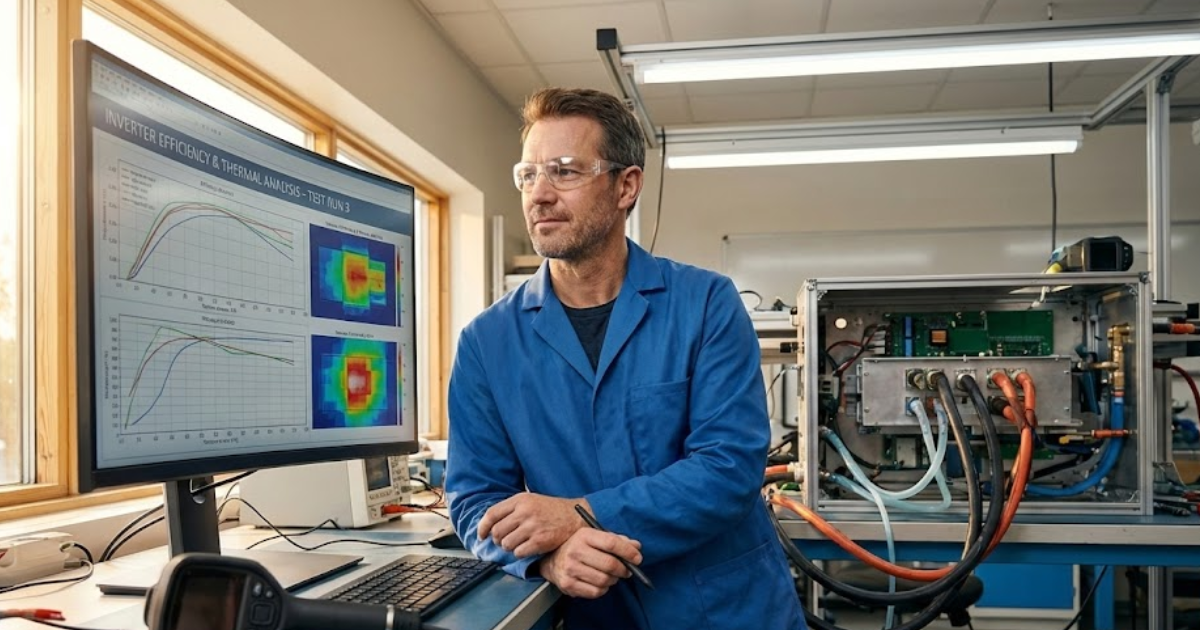
Sustainable engineering improves when efficiency and safety are validated early under controlled, repeatable conditions. Rapid control prototyping lets you measure energy losses and thermal stress while you can still change the control strategy, sensing approach, and protection logic. You also reduce waste by limiting the number of physical prototypes needed for tuning and fault trials. The most practical sustainability gains come from fewer rebuilds and fewer destructive tests.
A concrete case looks like this. A team developing a grid-tied inverter controller can run the controller on target hardware while a real-time plant model represents the grid, filter, and DC source, including voltage sags and frequency drift. The team can verify current-loop stability, anti-islanding behaviour, and ride-through logic without pushing a power stage into unsafe fault currents. Loss maps and thermal limits can then be tied to control choices such as switching strategy and current ripple targets.
That earlier proof changes how sustainability targets get treated inside your program. Instead of stating “high efficiency” as an aspiration, you can attach it to measurable test points, repeat them after every change, and stop changes that add loss or risk. Safety benefits follow the same logic, since controlled fault injection is safer in simulation than in high-power hardware. The end result is less scrap, fewer last-minute design pivots, and more confidence that the deployed controller will hit performance targets without hidden energy penalties.
How to pick MIL SIL HIL and power hardware
The main difference between MIL, SIL, and HIL is what runs as a model and what runs as executable code. Model-in-the-loop keeps controller and plant as models, which is best for early logic checks. Software-in-the-loop runs compiled controller code against a model, which is best for software behaviour. Hardware-in-the-loop runs the controller on hardware with a real-time plant, which is best for timing, I/O, and integration proof.
Your choice should follow risk, not habit. Start with MIL to stabilize control structure and state machines without worrying about processor limits. Move to SIL when code generation, numerical precision, and scheduling decisions begin to matter. Move to HIL when timing determinism, I/O behaviour, and fault handling become the main uncertainty, since those are the areas that cause late-stage surprises.
Power hardware selection is where many programs stall, so treat it as a set of explicit checks. Platforms such as OPAL-RT real-time digital simulators are used when you need deterministic time steps, flexible I/O, and a test setup that can grow from basic HIL to more advanced power-focused validation. You also need to decide how close you will get to physical power, since higher power brings more safety work and more limits on how many fault cases you can run each day.
| What you need to learn next | Best fit test stage | What a good result looks like |
| Control logic and operating modes behave correctly across scenarios | MIL | Mode transitions are stable and repeatable without brittle assumptions |
| Generated or hand-written code matches the intended control behavior | SIL | Numerical limits and scheduling do not break stability or protections |
| Processor timing, I/O delays, and quantization effects are acceptable | HIL | Closed-loop response stays within margins at the target sample time |
| Fault handling can be tested safely and repeatedly | HIL with fault injection | Trips, derating, and recovery behave consistently under stress cases |
| Higher-power interaction is required for the final confidence step | Power-focused testing with strict safety controls | Power limits, protection coordination, and measurement accuracy stay stable |
Timing determinism and model fidelity set trustworthy test outcomes
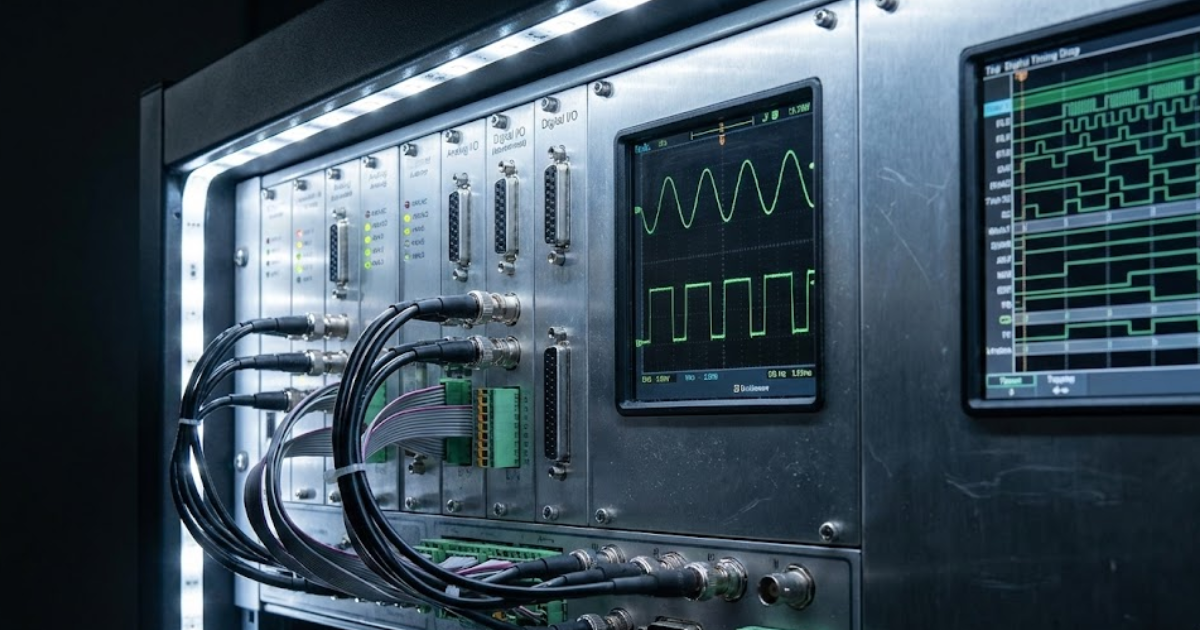
Trustworthy rapid control prototyping depends on two technical constraints you can’t compromise on. Timing determinism means your plant model and I/O execute on a fixed schedule with minimal jitter, so controller timing matches deployment conditions. Model fidelity means the plant captures the behaviours that matter for control stability and protection behaviour. If either constraint is weak, you will tune to artifacts and ship avoidable risk.
Determinism is more than “it runs.” Your sample time, interrupt structure, and I/O update order shape phase margin and transient response. A test setup that drifts or jitters will hide oscillations or create ones that won’t exist in deployment. You should measure end-to-end latency from controller output to plant response and back to sensed input, then lock that behaviour down before trusting tuning results.
Fidelity needs to be focused, not maximal. A plant model should represent the dynamics the controller will fight, such as saturation, dead time, and sensor noise, without becoming so heavy that real-time execution breaks. Teams get better outcomes when they define fidelity targets based on what could cause a wrong engineering call, then validate the model against known behaviours. Once those targets are met, consistency matters more than chasing detail that does not change control choices.
“Sustainable innovation is not a slogan, it is what happens when you refuse to ship control code that was never proven under the same constraints it will face in operation.”
Common pitfalls and practical checks before committing to deployment
Rapid control prototyping fails when teams treat it as a demo instead of a gate with measurable acceptance criteria. The usual issues are mismatched timing, unrealistic plant assumptions, and tests that can’t be repeated after each code change. A good final check is not about optimism, it is about removing uncertainty you can still control. The goal is a deployment path that feels boring because surprises were already exhausted in test.
- Lock the sample time and measure jitter before tuning any gains
- Confirm sensor scaling and units end-to-end across every I/O channel
- Run a fixed regression set after each change and record pass fail
- Inject fault cases that match protection requirements and recovery rules
- Document model limits so results are not applied outside valid bounds
These checks work because they target the failure modes that burn schedule and sustainability at the same time. Bad scaling wastes days of debugging and often leads to unnecessary hardware trials. Weak fault coverage creates late safety findings, which forces requalification and extra builds. Non-repeatable tests create internal debate instead of progress, and debate still consumes power, lab time, and people.
Judgment comes down to discipline. Treat rapid control prototyping as the point where software, timing, and physics must agree before hardware risk rises. When OPAL-RT is used as part of that discipline, the value comes from repeatable real-time behaviour and a test setup that stays stable as requirements get stricter. Sustainable innovation is not a slogan, it is what happens when you refuse to ship control code that was never proven under the same constraints it will face in operation.
Real-time solutions across every sector
Explore how OPAL-RT is transforming the world’s most advanced sectors.
02 / 28 / 2026
12 phase PMSM validation checklist for mission critical drives
A practical 12 phase PMSM validation checklist covering acceptance criteria, 12 tests, multiphase HIL fault injection, pass fail evidence, test sequencing from SIL to dyno, and common setup errors.

Power Electronics
02 / 27 / 2026
Cloud Simulation for Power Electronics Development
Covers how cloud simulation supports power electronics modeling, faster run cycles, control validation, and the cost and security tradeoffs when selecting a cloud stack.
Simulation
02 / 26 / 2026
CPU versus FPGA simulation for high speed motor drive testing
Compares CPU and FPGA real-time simulation for high speed motor drive HIL testing, focusing on timing limits, solver step size, switching fidelity, I/O latency, and acceptance criteria.
EXata CPS has been specifically designed for real-time performance to allow studies of cyberattacks on power systems through the Communication Network layer of any size and connecting to any number of equipment for HIL and PHIL simulations. This is a discrete event simulation toolkit that considers all the inherent physics-based properties that will affect how the network (either wired or wireless) behaves.