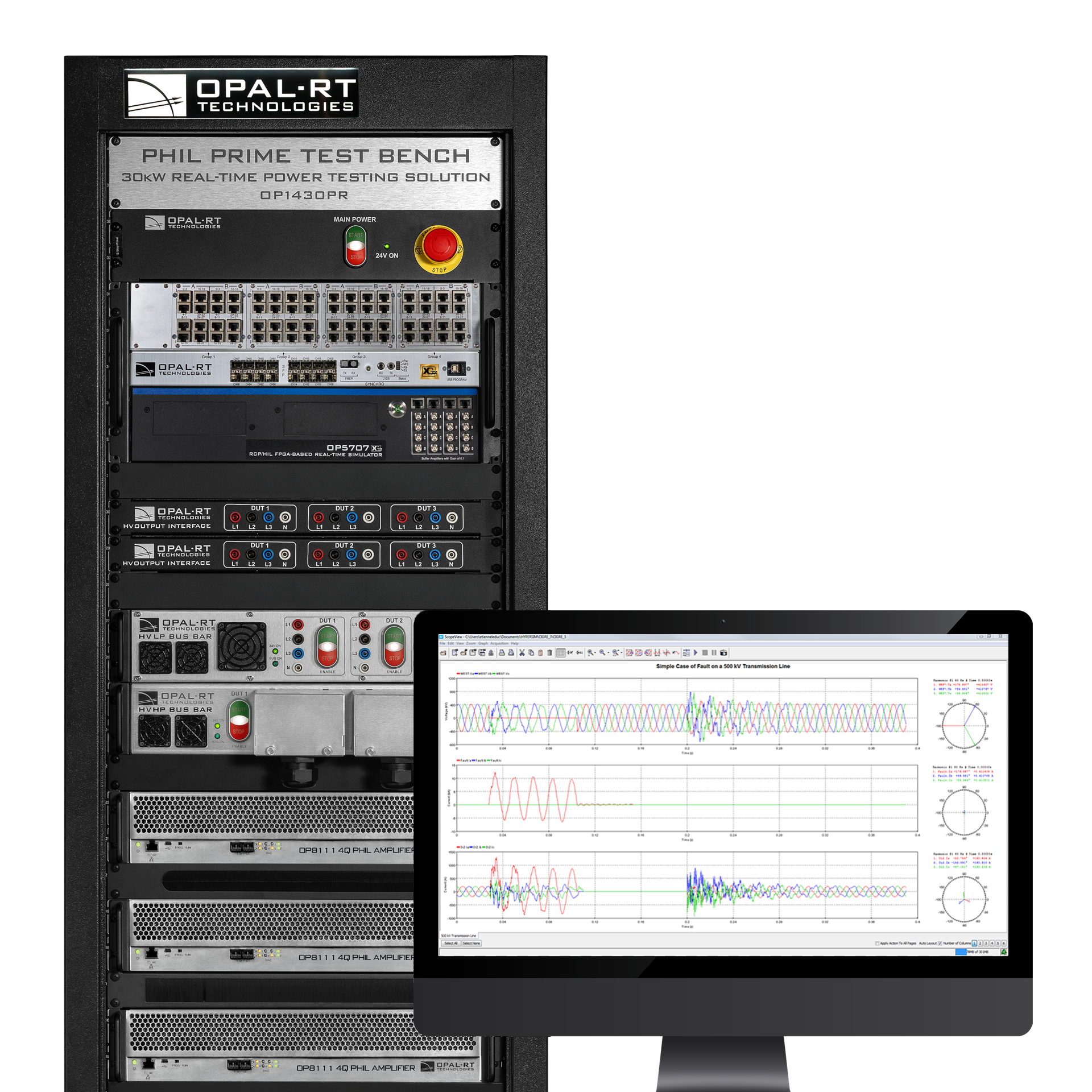
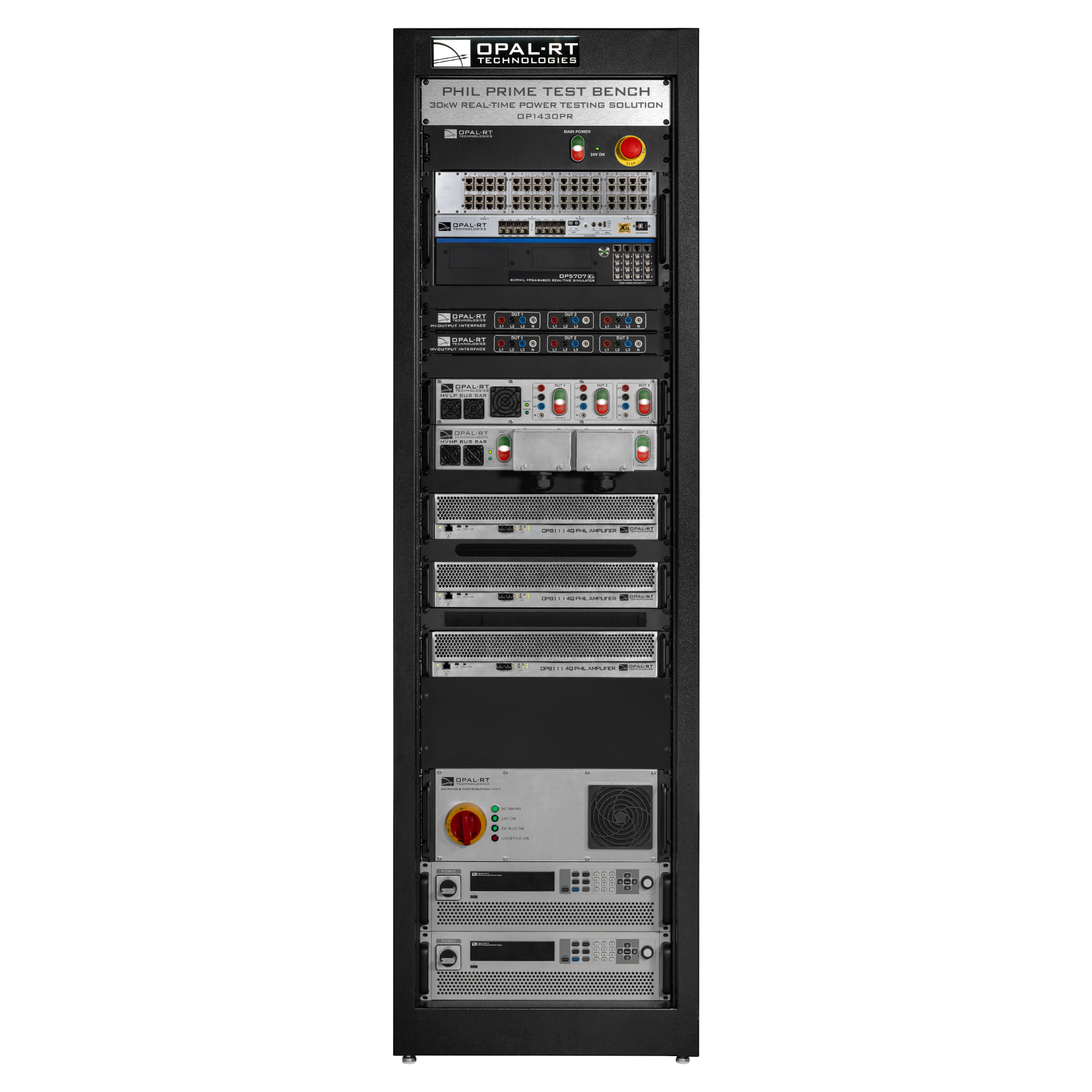
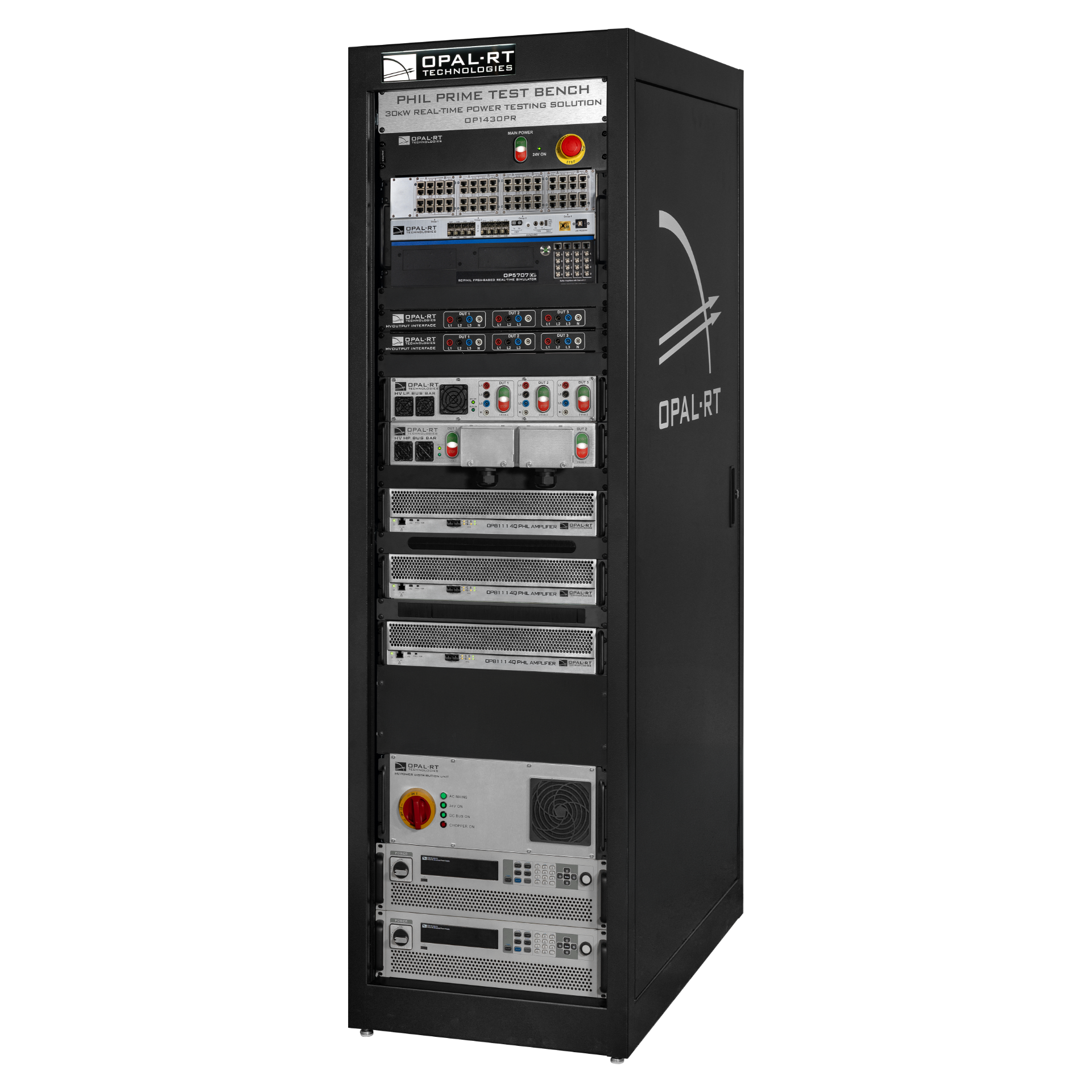
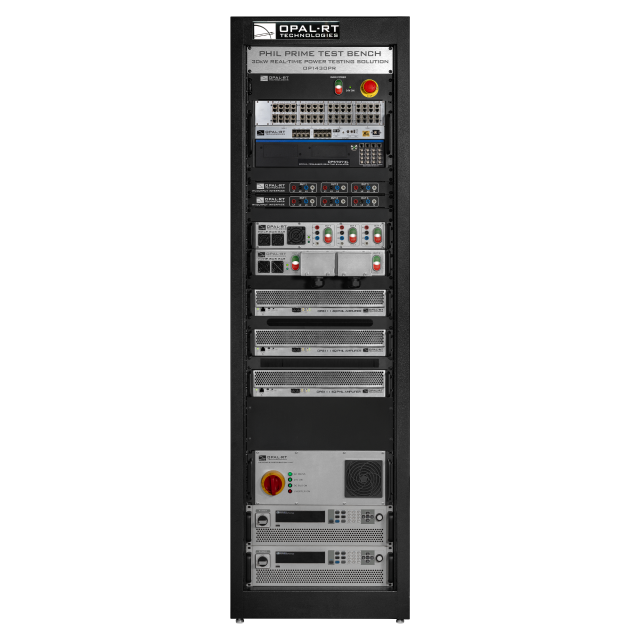
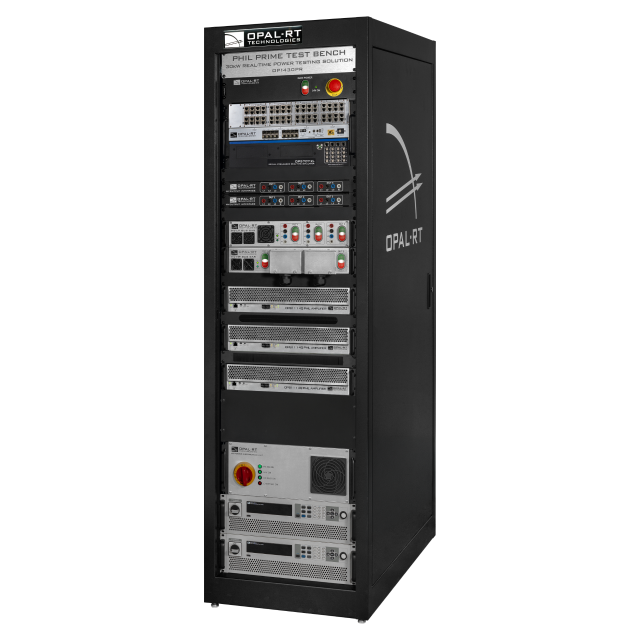
PHIL Prime Test Bench Series
Built for 240 V-per-phase applications, OP1430PR combines real-time simulation, OP8111 power amplification, flexible DUT connectivity, and PHIL integration in one reconfigurable test bench. With scalable 5 kW amplification units, support for AC, DC, and hybrid configurations, and seamless integration with RT-LAB and HYPERSIM, it provides a practical path to high-fidelity PHIL testing for research, development, and validation teams. Backed by more than 25 years of work with industry and leading research laboratories, we built the most complete PHIL test bench.
Features
Redefine. Reconfigure. Reimagine PHIL.

Scalable & Upgradable power

Configurable output

Versatile connectivity

Precision performance

Built for dynamic testing

Integrated PHIL environment
Boost your simulation capabilities with PHIL
Power Hardware-in-the-Loop connects a physical device under test to a real-time simulated electrical environment through a power amplifier. The simulator calculates the virtual system response while the amplifier reproduces the corresponding voltage or current at the DUT, allowing power hardware to interact dynamically with the simulated system.
With OP1430PR, this simulation-to-power environment is integrated into one configurable test bench for power systems, power electronics, and other electrification applications.

Configurations
Configurations and specifications
The OP1430PR Test Bench is offered in 5 standard configurations, based on the number of amplification units. Optional Smart Bus Bars provide shared-bus, multi-DUT, and parallelized power configurations.
Base configurations
| OP1430 PHIL Prime Test Bench Base Configuration | ||
| Configuration Number | Amplification Units (5kW) | Available Rated Power |
| 3Φ, 240/415 V RMS OR
800V DC |
||
| OP1430PR-10 | 1 | 1 x 5 kW |
| OP1430PR-20 | 2 | 2 x 5 kW |
| OP1430PR-30 | 3 | 3 x 5 kW |
| OP1430PR-40 | 4 | 4 x 5 kW |
| OP1430PR-60 | 6 | 6 x 5 kW |
OP1430PR PHIL Prime test bench with Smart Bus Bar
| OP1430 PHIL Prime Test Bench with Smart Bus Bars | ||
| Configuration Number | No. & Type of DUT Connections (3-Ph + N) | Maximum Bus Power (kW) |
| 3Φ, 240/415 V RMS OR
800V DC |
||
| OP1430PR-10-LP | 3 x 25A, Banana | 5 |
| OP1430PR-20-LP | 3 x 25A, Banana | 10 |
| OP1430PR-30-LP /HP/LPHP | 3 x 25A , Banana/
2 x 50A, Screw/ Both |
15 |
| OP1430PR-40-LP /HP/LPHP | 3 x 25A , Banana/
2 x 50A, Screw/ Both |
20 |
| OP1430PR-60-LP /HP/LPHP | 3 x 25A , Banana/
2 x 50A, Screw/ Both |
30 |
Components
All the must-haves for PHIL
The OP1430PR PHIL Prime Test Bench includes carefully designed components for robust performance, smooth integration, and safe operation, giving users a reliable and intuitive experience.
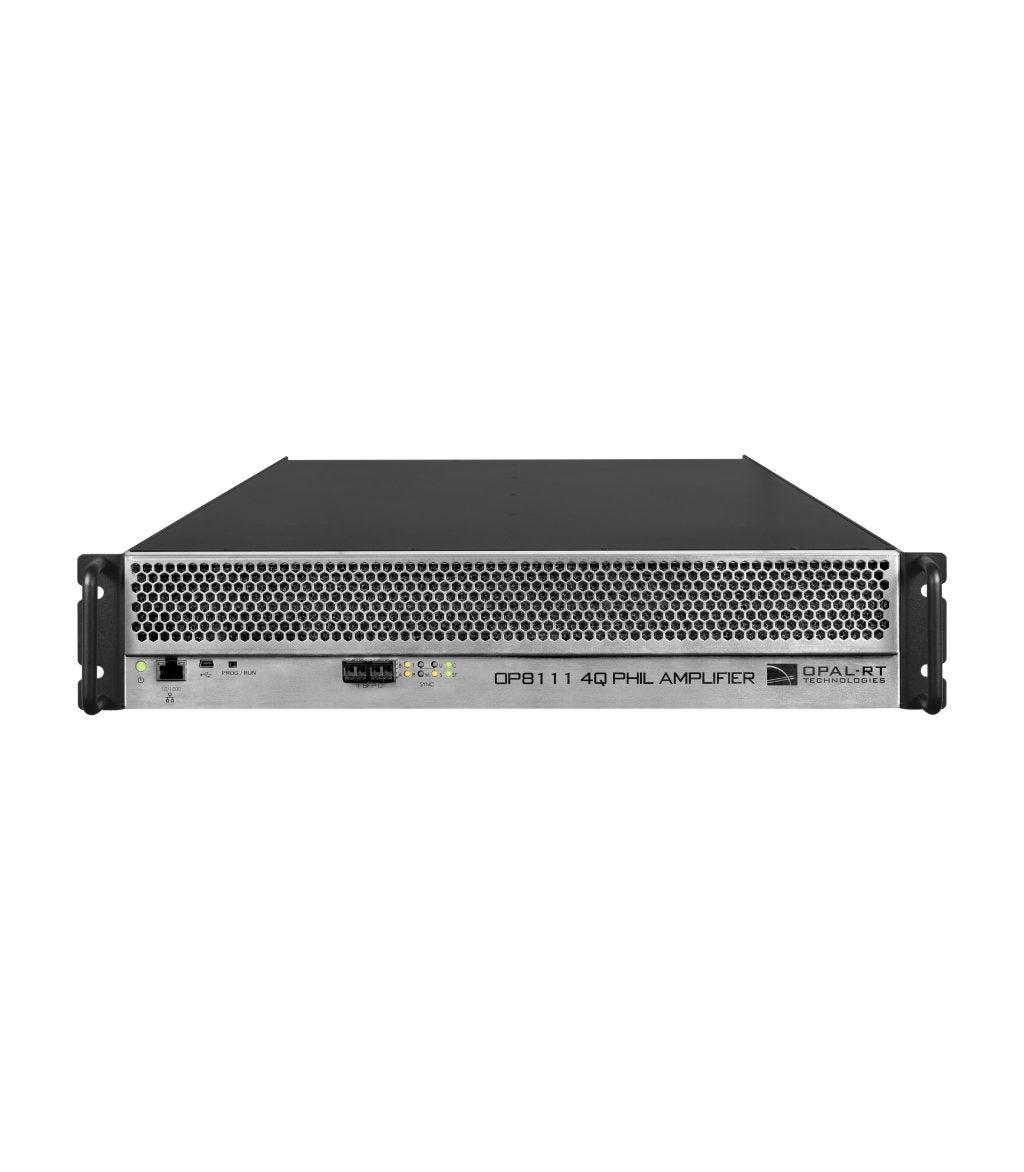
The OP8111 Power Amplifier
The OP8111 is a high-fidelity 4-quadrant power amplifier with 100% non-dissipative regeneration, a large-signal bandwidth of DC to 10 kHz, and low THD (0.5% at 50/60 Hz nominal voltage/current), connected to OPAL-RT simulators through a direct low-latency fiber-optic link. It supports AC (3Φ, 415 VL-L) and 800V DC operation. The OP1430 PHIL Prime Test Bench includes up to 3 OP8111 power amplifiers, each with up to two 5 kW amplification units.
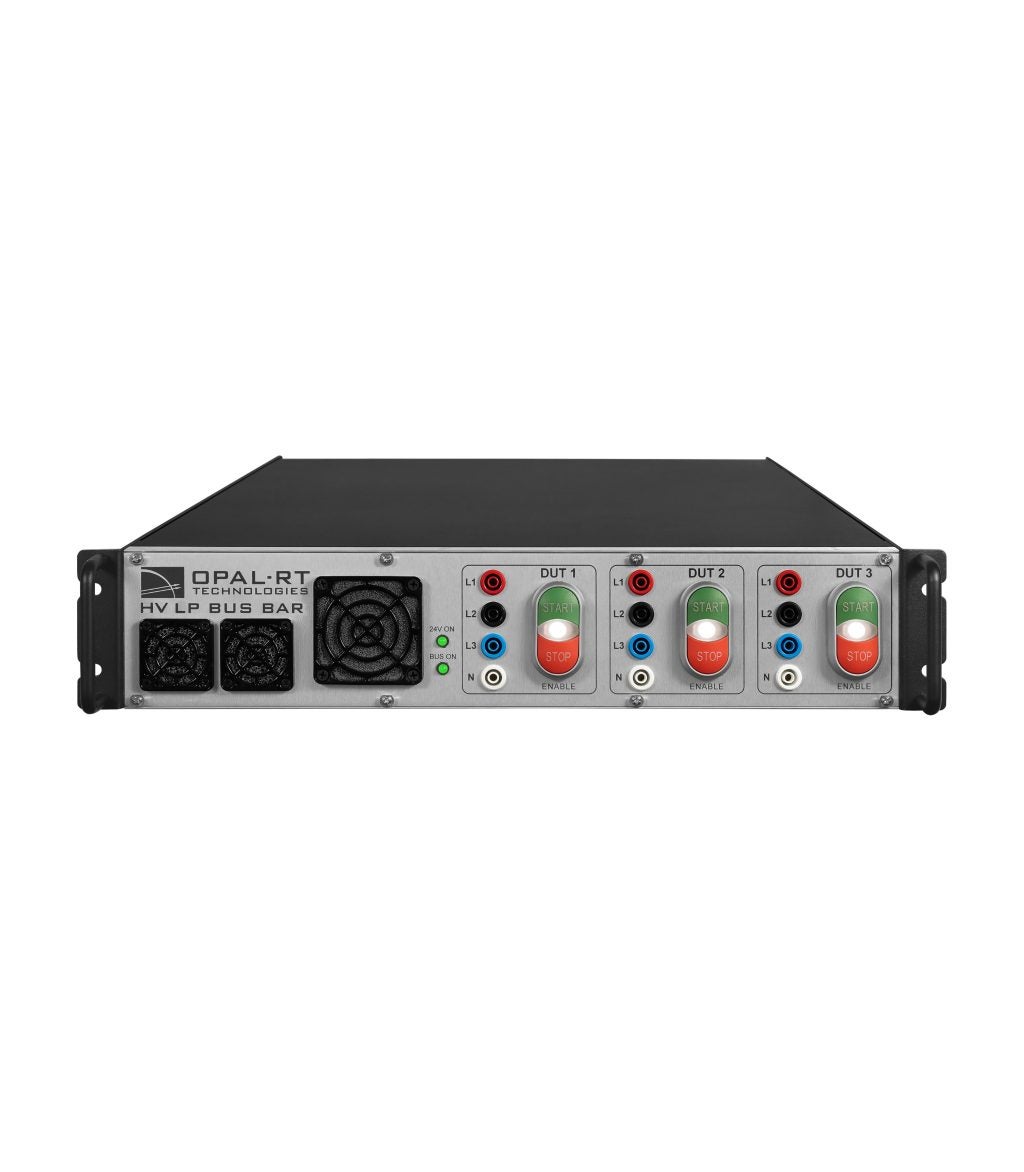
HV LP Bus Bar
- Provides 3 DUT connections at 25 A each.
- Parallel operation from 5 kW to 30 kW.
- Real-time control of DUT connections via DOUTs or Ethernet (Modbus).
- Real-time voltage and current measurements of all connected DUTs.
Includes a validated generic microgrid model with detailed DER models and a preconfigured, PHIL-ready controller for a streamlined setup from day one.
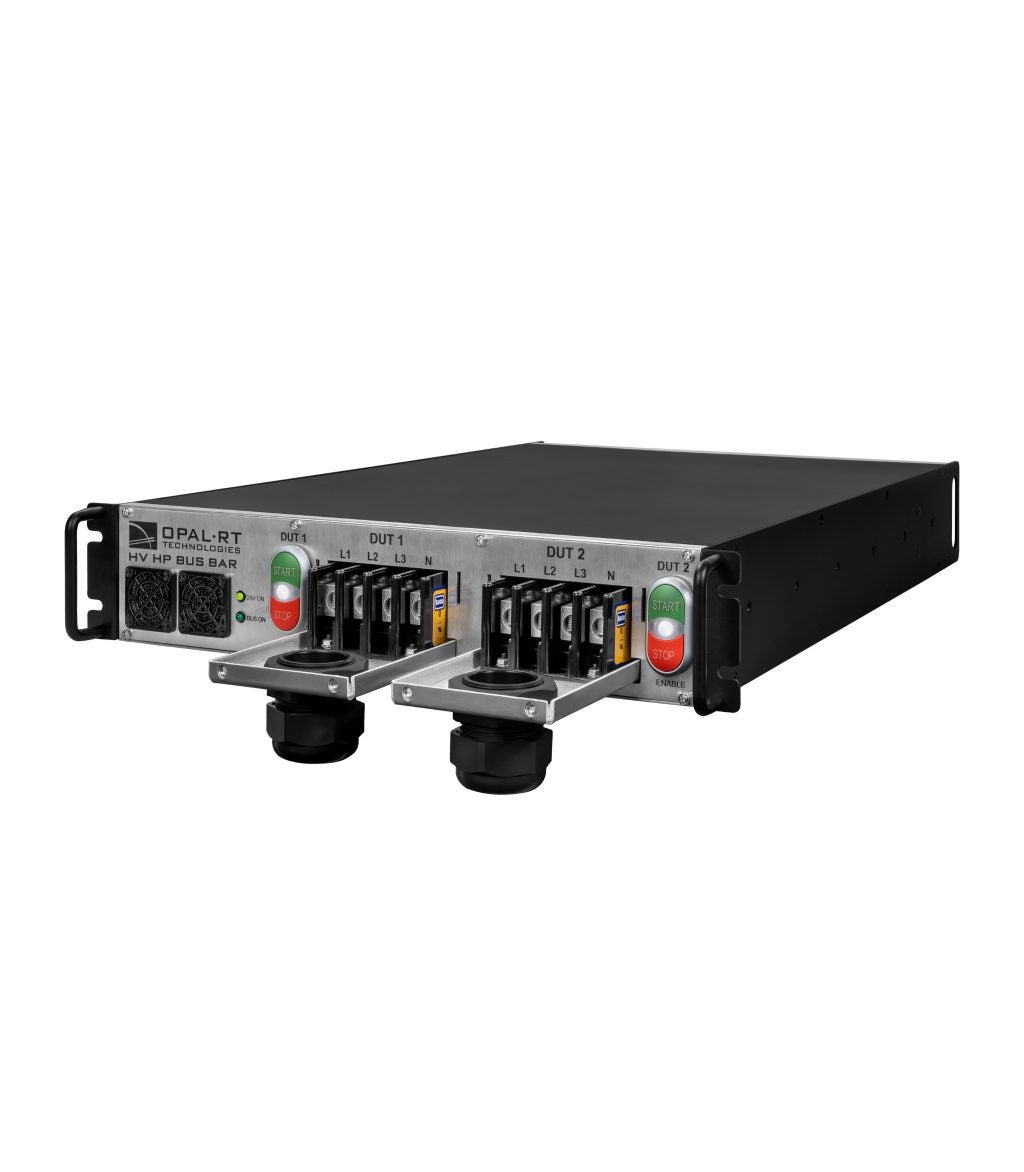
HV HP Bus Bar
- Provides 2 DUT connections at 50 A each.
- Parallel operation from 5 kW to 30 kW.
- Real-time control of DUT connections via DOUTs or Ethernet (Modbus).
- Real-time voltage and current measurements of all connected DUTs.
Includes a validated generic microgrid model with detailed DER models and a preconfigured, PHIL-ready controller for a streamlined setup from day one.
SOFTWARE
Work with our compatible software platforms

Multi-Domain, Simulink®-based HIL
RT-LAB
Fully integrated with MATLAB/Simulink® and best combined with our various toolboxes to bring multi-domain Simscape™ Electrical™ and SimPowerSystems models to real time for fast control development.

EMT Simulation and HIL Testing
HYPERSIM
High-fidelity platform for EMT simulation, SIL and HIL testing, ideal for validating control, protection, grid integration and large-scale stability across all stages of power system development.
Testimonials
Trusted by industry and academia
With the PHIL system, we were able to measure the scale of the inverter needed for impedance measurement. We assessed how noise in power systems could lead to an injection conflict.
Dr. Yue Zhu
Imperial College London

OPAL-RT’s PHIL test bench is invaluable to us. It supports our work on microgrid cybersecurity, grid-tied EVs, V2G, and DER energy management. Its remote controllability allows researchers located here and beyond to access it.
Prof. Kamal Al-Haddad
ÉTS – École de technologie supérieure

PHIL has allowed us to reduce the gap between simulations and real-world performance. We have validated DER models, studied resonance phenomena, and tested advanced grid-forming controls with synthetic inertia, all without relying on a fixed grid.
Dr. Renato Machado Monaro
The Research Centre for Greenhouse Gas Innovation

With the increasing proportion of inverters, OPAL-RT’s PHIL Test Bench really helps TPC verify the characteristics of inverters working in Taiwan power systems and validate the microgrid control algorithm applying to the offshore island microgrids. PHIL enables more in-depth analysis of future changes in power systems.
Taiwan Power Company

With PHIL simulation, we significantly reduced the cost and time associated with prototyping electrical machines, as we didn’t have to rely on a physical machine prototype. This accelerated our development process and allowed for deeper and more flexible lab validation.
Prof. Arun Rahul
Indian Institute of Technology Palakkad

FAQ
Find the answers to your questions
What is the OP1430 PHIL Prime Test Bench designed for?
The OP1430 PHIL Prime Test Bench is built for power hardware-in-the-loop (PHIL) applications, letting engineers test power components and systems in real time under realistic operating conditions with scalable, high-voltage power amplification.
What power configurations are available with the OP1430 PHIL Prime Test Bench?
The OP1430 PHIL Prime Test Bench is offered in standard configurations from 1 × 5 kW to 6 × 5 kW amplification units, providing up to 30 kW of available rated power with 240V RMS AC and 800V DC output. Other configurations are available on request. Contact us to learn more.
How scalable is the OP1430 PHIL Prime Test Bench for different testing needs?
The modular design lets users start with a 5 kW setup and scale to higher power by adding amplification units. This suits both small lab setups and more demanding industrial test benches.
Who should consider using the OP1430 PHIL Prime Test Bench?
The OP1430 PHIL Prime Test Bench suits power electronics and power systems engineers, researchers, and lab managers working on renewable integration, microgrid validation, or advanced high-voltage converter testing who need a reliable, flexible PHIL platform.
How does the OP1430 PHIL Prime Test Bench integrate with OPAL-RT’s simulation ecosystem?
The OP1430 PHIL Prime Test Bench integrates with OPAL-RT’s real-time simulators for end-to-end PHIL testing workflows. Engineers get a capable setup to validate control systems, grid interaction, and power hardware safely and efficiently, and can design and implement complex PHIL systems with ease.
How many physical devices can I connect at once to the OP1430 PHIL Prime Test Bench?
The Smart Bus Bars let you connect multiple physical devices at once, a key advantage of the PHIL Prime bench over other solutions. The LP variant connects up to 3 physical devices at 25 A each; the HP variant connects up to 2 physical devices at 50 A each.
Resources