Data centers
As data centers expand in size and energy consumption, their influence on electrical grids becomes increasingly complex. High concentrations of load can affect power quality, stability, and reliability, especially during transient voltage disturbances and load fluctuations. With our real-time hardware-in-the-loop (HIL) platform, users can simulate large-scale data centers, analyze their behavior under dynamic grid conditions, and safely test control and protection strategies. From design to deployment, our tools help anticipate operational risks and support a more stable, resilient energy ecosystem.

They trust us






Challenges
Powering modern data centers: The new grid challenges
Modern data centers are adopting diverse and evolving electrical infrastructures. But this shift brings major challenges:
- Complex power load behavior: New equipment, power converters, and load profiles create interactions with the grid that are difficult to model and validate.
- New electrical infrastructures: DC based datacenters, solid state transformers, and other modern power converter topologies
- Power quality issues: Rapid, non-linear load changes can trigger voltage dips, frequency deviations, harmonics, and flicker.
- Sub-synchronous interaction (SSI): Low-frequency oscillations can resonate with generator shaft torsional modes which causes fatigue, damage, or failure.
- Smarter energy management needed: Dynamic IT and cooling loads demand adaptive energy management strategies to optimize consumption.
- Complex system coordination: Fault ride-through, protection, and synchronization must work seamlessly across grid, on-site, and backup systems.
Advanced modeling and real-time simulation are essential to test new designs and ensure reliable operation.
Solution
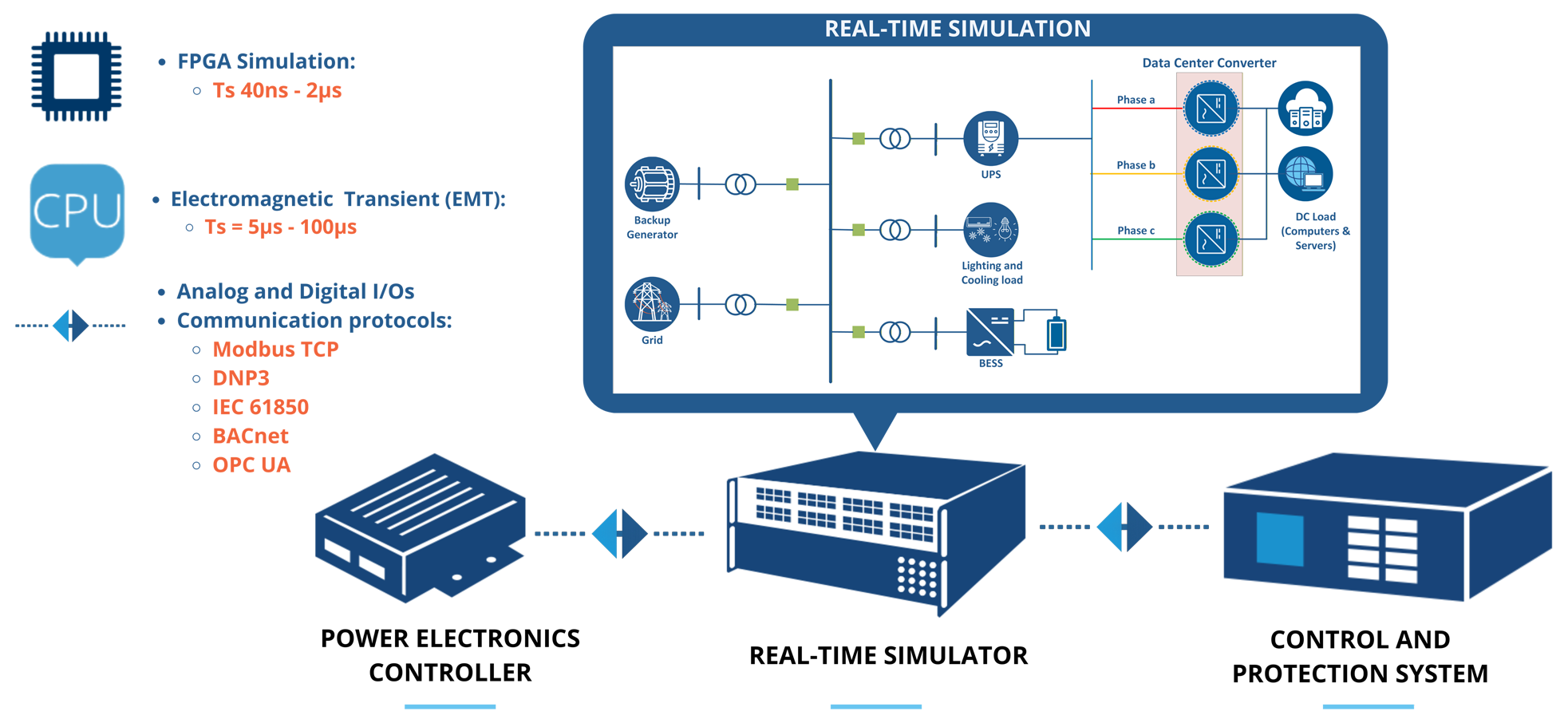
Hardware-in-loop testing for data centers
Validate and optimize data center power and control systems safely.
Success story
Powering next-generation data center reliability with advanced UPS testing
Discover how Schneider Electric accelerated the development of its modular Galaxy PX UPS engineered for small and medium data centers using our solution to achieve faster validation, enhanced reliability, and significantly improved testing efficiency.
With OPAL-RT, we introduced a new HIL-based simulation platform that automates 80% of UPS testing and executes 700+ cases across 10–15 rounds. Compared to the previous 50% coverage and 600+ cases in 3–4 rounds, this boosts automation by ~30% and weekly test volume by over 40%.The platform lets us recreate complex real-world events and extreme fault conditions with accuracy, all without putting our hardware at risk. Remote, continuous testing allows the system to run for a full week without supervision, which has dramatically accelerated our R&D.
Ricky Zhang
Chief Firmware Test Specialist, Secure Power Division, Energy Management Business at Schneider Electric

Why choose OPAL-RT?
A proven track record
With decades of collaboration with industry leaders and top research institutions, OPAL-RT brings proven expertise in real-time power systems and power electronics simulation.
01
Improve grid stability & reliability
02
Broad topology coverage
03
Ultra-fast resolution
04
High-density integration
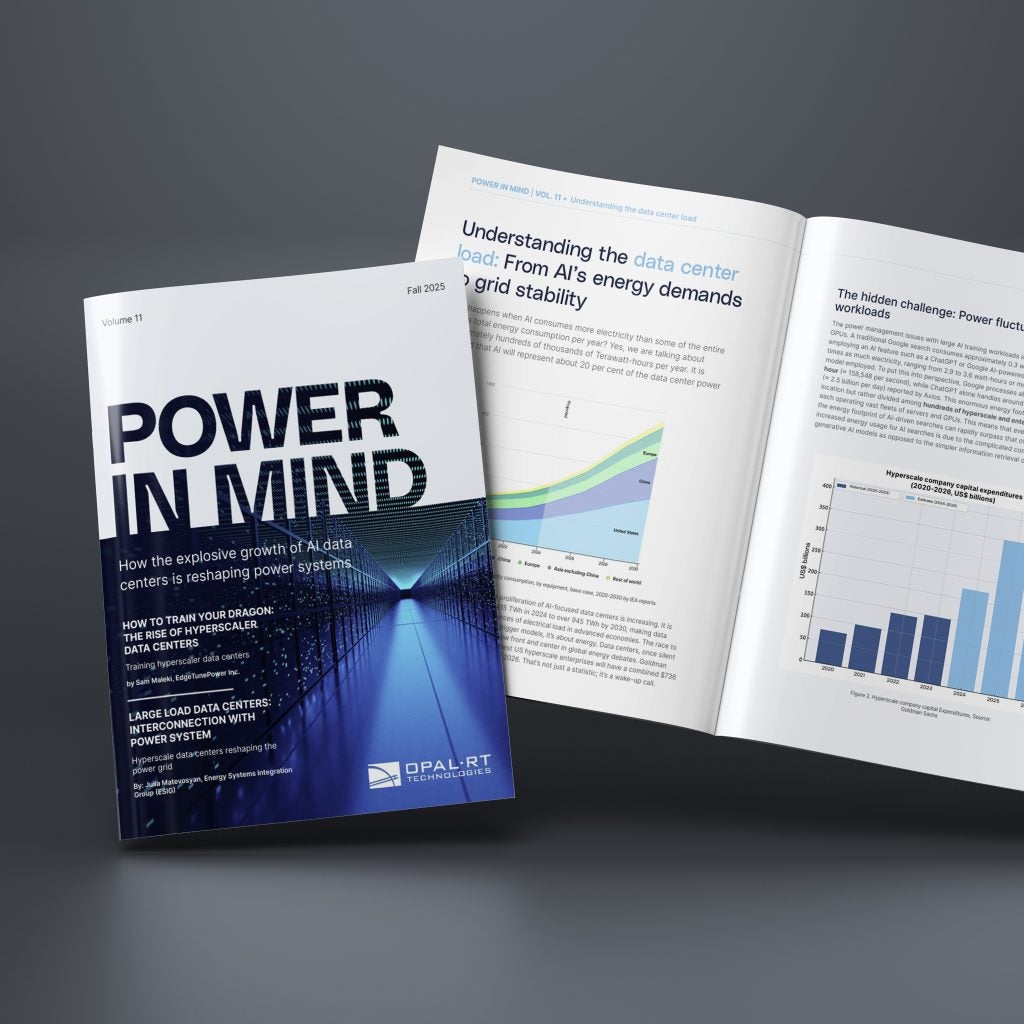
POWER IN MIND — VOLUME 11
How the explosive growth of AI data centers is reshaping power systems
This edition of Power in Mind magazine explores the electrified frontier where AI meets the grid. Volume 11 examines how data centers, the new industrial giants, are reshaping power systems with loads that shift in microseconds, driven by machine learning’s growing demand. From real-time simulation and hardware-in-the-loop (HIL) testing to FPGA-based modeling of modular power converters, our contributors reveal the tools engineers need to manage the turbulence of AI-powered infrastructure. Featuring insights on large-load data centers, the rise of AI-driven testing co-pilots like Voltis, and deep dives into converter dynamics, this issue captures the pulse of a revolution where intelligence and electricity converge.
Products
The essentials for data center testing
Explore our most relevant real-time simulators and platforms for power electronics modeling, control validation, and HIL testing in data center applications.

Multi-Domain, Simulink®-based HIL
RT-LAB
Fully integrated with MATLAB/Simulink® and best combined with our various toolboxes to bring multi-domain Simscape™ Electrical™ and SimPowerSystems models to real time for fast control development.

Ultra-Fast EMT Simulation and HIL Testing
eHS
Advanced FPGA technology for high-fidelity, low-latency, power systems and power electronics simulation, enabling HIL testing across energy, automotive, aerospace, and industrial applications.
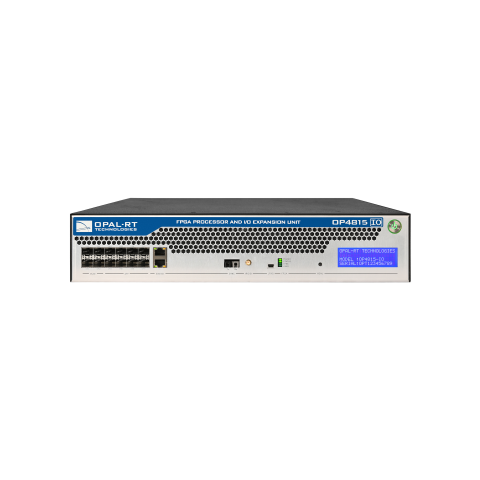
AMD Versal™ Prime VM1402 Adaptative SoC
OP4815-IO
An expansion unit allowing you to upgrade and expand your real-time simulators with a larger top-of-the-line Versal™ Prime compute engine and additional and faster I/Os.
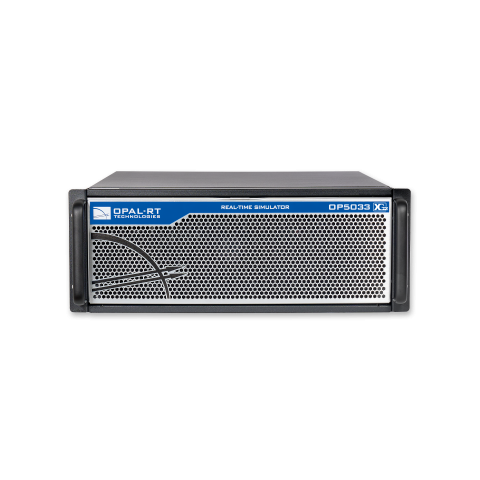
Brute force computing
OP5033XG2
Simulator based on up to 16 cores of the latest Intel® Xeon® CPU and offers up to 6 PCIe slots for optional I/Os. It’s ideal for modular configurations with FPGA and 1/O expansion units.
Demo
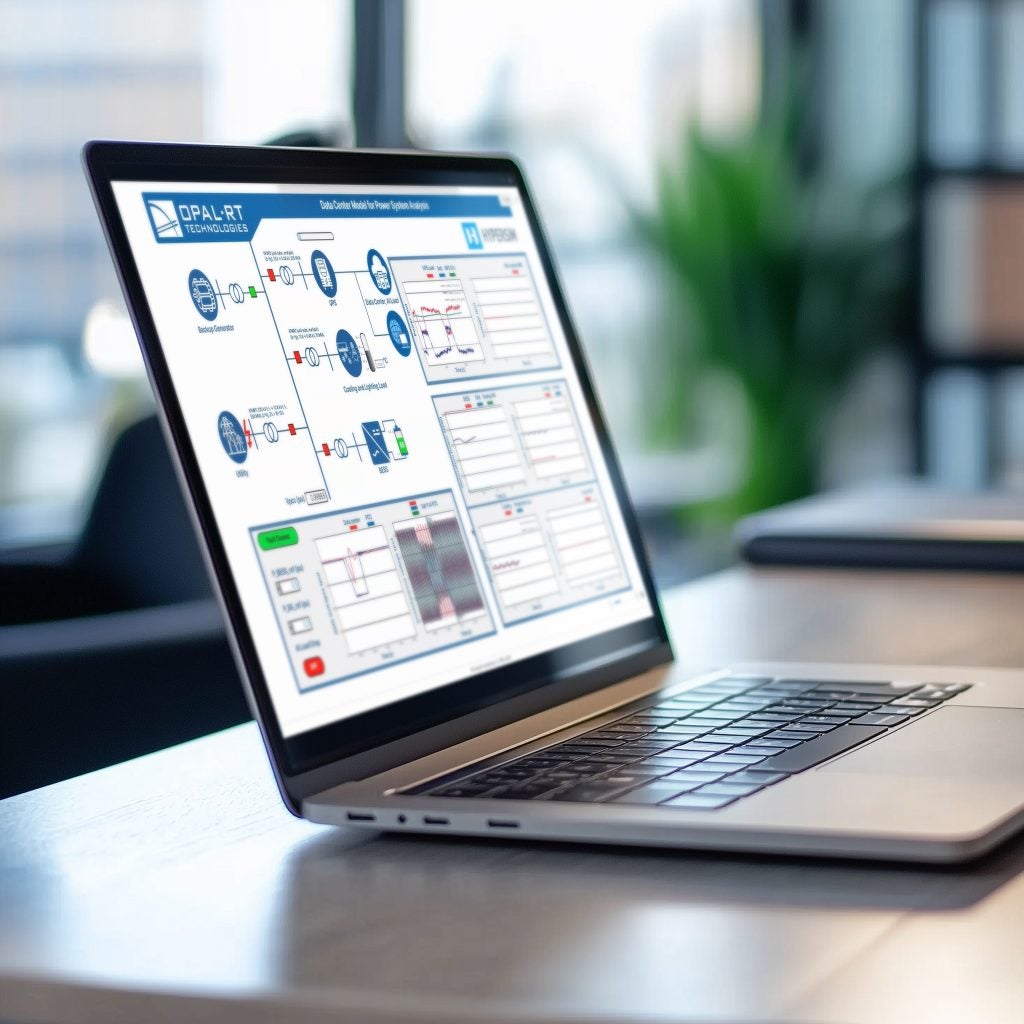
Data center modeling for power system analysis
See how power, thermal, and backup systems react when AI workloads push the limits.
This demo showcases a real-time digital twin of an AI-driven data center, including the grid, UPS, BESS, cooling system, generator, and dynamic AI workloads. We walk through scenarios like UPS mode changes, thermal ramp-up, grid faults, and generator synchronization. With high-fidelity real-time EMT simulation, you can observe how the system responds to fast oscillations, thermal ramps, grid disturbances, and islanding events, exactly as they would occur in the real world.

Let’s get started in real-time
Whether you need more details or have a specific question, our experts are here to help. Contact us today for personalized support.
FAQ
Find the answers to your questions
What aspects of data center systems can be simulated with OPAL-RT platforms?
You can model power converters, UPS systems, on-site generation, grid interconnection dynamics, battery management systems (BMS), and control algorithms all in real time, using detailed EMT simulation modes.
Can OPAL-RT solutions help with renewable-powered data centers?
Yes. Our platforms allow co-simulation of renewable energy sources, microgrids, and hybrid power systems to ensure resilient operation under fluctuating conditions.
What is data center simulation?
Data center simulation uses mathematical models to represent power, cooling, controls, and operations so you can study behaviour before the site goes live. The method supports capacity planning, failure analysis, and energy studies without risking equipment or uptime. Teams test “what if” scenarios, validate settings, and compare options using consistent metrics. The outcome is faster decisions, reduced rework, and higher confidence at each phase.
Why are traditional planning and offline simulation methods often insufficient for data centers?
Conventional studies typically use static or averaged load models that cannot capture fast dynamics, control interactions, or electromagnetic transients. For large, converter-dominated data centers, these effects can drive oscillations, protection mis-coordination, or unexpected behaviour that only becomes visible with high-fidelity, real-time simulation.
How does hardware-in-the-loop testing reduce risk before commissioning a data center?
HIL testing allows real controllers and protection devices to be exercised against a real-time digital model of the data center and grid. This makes it possible to identify control issues, timing problems, and interaction risks early, before equipment is deployed or changes become costly and disruptive.
How can data center developers and EPCs evaluate grid interconnection and stability impacts?
By combining electromagnetic transient (EMT) simulation with real-time testing, teams can study harmonics, voltage and frequency response, fault ride-through behaviour, and large load steps. This approach supports more credible interconnection studies and helps demonstrate grid-compatible operation.
Can OPAL-RT platforms support testing for grid code compliance and utility requirements?
Yes. OPAL-RT solutions are used to validate control and protection behaviour under conditions aligned with utility and grid-code expectations, helping OEMs, integrators, and developers demonstrate compliant and predictable behaviour before connecting large data center loads to the grid.
How can real-time simulation help data center owners plan for AI-driven load growth?
Real-time simulation enables operators to evaluate “what-if” scenarios such as rapid AI workload ramps, cooling surges, or infrastructure upgrades. This helps assess future capacity limits, stability margins, and operational risk without affecting live operations.
EXata CPS has been specifically designed for real-time performance to allow studies of cyberattacks on power systems through the Communication Network layer of any size and connecting to any number of equipment for HIL and PHIL simulations. This is a discrete event simulation toolkit that considers all the inherent physics-based properties that will affect how the network (either wired or wireless) behaves.