8 best practices for validating data center simulation results
Simulation
10 / 08 / 2025

Key takeaways
- Validation is the foundation of credibility for data centre simulation and must connect assumptions, data, and measurable objectives.
- Early planning defines scope, priorities, and reproducibility, ensuring every result ties back to qualified reference data.
- The most reliable simulations combine real facility measurements, clear criteria, and collaborative review to confirm accuracy.
- Automation, documentation, and scheduled rule reviews maintain consistency and reduce rework across engineering teams.
- OPAL-RT platforms accelerate validation through real-time execution, traceable data management, and integrated testing confidence.
Validation makes or breaks trust in your data centre simulations. Engineers stake capacity plans, uptime targets, and energy budgets on those numbers, so confidence cannot be optional. A small modelling shortcut can snowball into poor thermal predictions, stranded capital, or an unexpected outage during a peak load event.
You deserve methods that stand up to scrutiny, not rules of thumb that only work on a good day. Teams that treat validation as a repeatable discipline see fewer surprises, stronger cross‑functional buy‑in, and faster approvals for change. The key is to connect model intent, facility measurements, and acceptance thresholds before anyone interprets results. That structure reduces rework, shortens review cycles, and builds credibility with every run.
A clear validation plan turns models into assets you can rely on.
Why validation matters for data centre simulation credibility

Credibility starts with traceability. Stakeholders need to see where numbers came from, how assumptions were chosen, and which facility measurements anchor the model. When each conclusion points back to a method, a dataset, and a documented rule, questions turn from “can we trust this” to “how do we use this.” That shift saves time, reduces friction, and strengthens collaboration across operations, planning, and finance.
Risks show up when validation is treated as an afterthought. Temperature error can hide hotspots, airflow mismatch can mask recirculation, and electrical simplifications can understate protection trips. Those gaps lead to overprovisioned cooling, mis-sized power paths, and performance throttling under stress. A well‑defined validation practice catches these issues early, long before changes reach the server hall.
How to plan your validation approach before running simulations
Clear planning reduces the guesswork that often surrounds model acceptance. Teams align on what the model must prove, which data will verify it, and how to decide pass or revise. Early agreement avoids disputes about targets, tolerances, and scope that otherwise surface at the worst time. Strong planning also accelerates approvals, since reviewers see consistent evidence across scenarios.
Define scope and risk priorities
Scope sets expectations for what the model will and will not answer. A facility‑level airflow study focuses on rack inlet temperatures, containment performance, and fan control policies, while a power model may target feeder loading, breaker coordination, and transfer sequences. Trying to answer every question with one configuration spreads effort thin and blurs accountability. A crisp boundary helps everyone understand where accuracy must be highest.
Risk priority ties validation depth to potential impact. Thermal throttling, nuisance trips, and service degradation carry different costs, so the validation plan should reflect that ranking. High‑impact behaviours deserve tighter thresholds, more measurement points, and extra scenario coverage. Lower‑impact areas still get checked, but with appropriate effort.
Gather and qualify reference data

Reference data is the anchor for acceptance. Useful sources include sensor logs at rack inlets, containment differential pressure, chilled water supply and return, power meter intervals, and event logs from control systems. Collection without qualification creates a false sense of certainty, so data quality checks must catch missing points, calibration drift, and time skew. Reliable data lets you compare like for like.
Alignment is as important as breadth. Temperature, airflow, and electrical readings should share time bases, synchronized clocks, and clear mapping to model entities such as racks, aisles, or panels. Metadata needs consistent naming, units, and sampling rates to avoid misinterpretation. A small investment in data hygiene prevents large errors later.
Select validation metrics and thresholds
Metrics translate engineering intent into measurable success. Mean absolute error and root mean square error capture overall fit, while percentile error highlights peak conditions that drive risk. For airflow and thermal models, rack inlet temperature error during high‑load windows carries outsized weight. For power studies, feeder current error near protective limits matters most.
Thresholds should be agreed in advance. Stating acceptable error ranges, coverage percentages, and allowed deviations keeps reviews consistent across scenarios. Numeric targets must reflect sensor accuracy, model granularity, and the consequences of a miss. Documenting these values up front prevents goalposts from moving mid‑project.
Set up version control and reproducibility
Reproducibility makes validation auditable. Store models, solver settings, input datasets, and run scripts in version control, and capture a manifest that records software versions and library dependencies. Random seeds, discretization settings, and mesh choices belong in that manifest as well. Anyone should be able to re‑run a case and reach the same outputs.
Naming and retention policies reduce confusion. Adopt conventions for scenario labels, timestamped artefacts, and parameter sets, then keep result packages complete with logs and comparison plots. A lightweight run recipe helps new team members execute approved validations without guesswork. Structured hygiene keeps reviews focused on outcomes, not housekeeping.
Introductory planning creates shared understanding, disciplined execution, and reliable evidence. Teams move faster when reviewers trust the process, not just the people. Scope, data, metrics, and reproducibility form a loop that turns validation into a habit. Confidence grows with each cycle, and model maturity becomes visible to everyone.
8 best practices for validating simulation results effectively
Consistent process separates speculation from evidence. Teams that embrace data center simulation validation improve accuracy, shorten rework, and build trust across disciplines. The ideas here turn validating simulation results into a repeatable skill, not a one‑off activity. Clear language, numeric thresholds, and traceable data create data center simulation best practices you can scale.
1. Establish clear objectives and criteria
Objectives tell you what success looks like. A thermal objective might be “predict 95th percentile rack inlet temperatures within 0.8 degrees Celsius during peak hours,” while an electrical objective could be “estimate feeder currents within 3 percent during transfer.” Objectives framed this way tie back to risk, cost, and performance. Every validation case should map to at least one objective.
Criteria make those objectives testable. Write acceptance thresholds as ranges with rationale, not as vague “good” or “close.” Include conditions, such as load levels, control states, and containment modes, that must be present for the criterion to apply. A criterion without context is hard to evaluate and harder to defend.
2. Compare with facility measurements
Measurements are the referee for model credibility. Match each predicted variable to its instrumented counterpart, then compare during representative steady and transient periods. Align timestamps, synchronize sampling rates, and handle missing data with documented rules. Comparisons should rely on consistent filters to avoid cherry‑picking either quiet or noisy windows.
Spatial mapping matters as much as timing. Tie sensors to the correct racks, tiles, panels, or zones, and avoid assuming symmetry that the facility does not have. Heat recirculation, partial containment, and cable cutouts can create localized effects that the model must represent. Honest mapping prevents false confidence created by convenient averaging.
3. Document and validate assumptions
Assumptions shape results more than most people expect. Typical items include server load distribution, fan curves, cable fill, containment leakage, control deadbands, and setpoints. Each assumption needs a source, a date, and an owner, plus a plan to verify it against measurements or vendor data. A single undocumented guess can undermine weeks of work.
Validation of assumptions reduces surprises later. Test them directly with spot measurements, short experiments, or controlled logs, and record the outcome. If an assumption fails verification, update the model, rerun impacted cases, and keep the change history linked to results. This discipline builds a chain of custody from inputs to conclusions.
4. Perform sensitivity and scenario analyses
Sensitivity reveals what truly drives outcomes. Vary inputs such as load skew, supply temperature, tile open area, or breaker settings within plausible ranges, then quantify how outputs shift. The variables with the largest effect deserve the tightest data and the most careful modelling. Low‑impact inputs still get reasonable values, but they do not need heroic effort.
Scenario coverage prepares the model for practical questions. Test peak hours, maintenance windows, partial outages, seasonal changes, and planned upgrades. Different combinations expose different weaknesses, such as hotspot migration or unexpected protection interactions. Covering the scenarios your stakeholders care about keeps validation relevant to decisions that follow.
Automation and periodic rule reviews keep the method current without adding unnecessary overhead.
5. Review and iterate collaboratively
Strong validation welcomes scrutiny. Invite operations, capacity planning, and reliability peers to review methods, datasets, and results against the agreed criteria. Fresh eyes catch gaps in mapping, units, or time alignment that are easy to miss under schedule pressure. Open conversation turns validation into a shared responsibility, not an isolated task.
Iteration improves both model and data. Feedback often triggers small configuration fixes, better sensor placement, or additional logging that pay off across many studies. Each cycle should be short, focused, and traceable, with clear notes on what changed and why. Stakeholders learn to expect steady progress rather than big, risky leaps.

6. Cross‑model and historical validation
Independent perspectives strengthen confidence. Compare airflow predictions from your current model to those from a different solver or a reduced‑order approach, and reconcile key differences. Electrical studies can be checked with simplified analytical calculations at known operating points. Agreement boosts trust, and disagreement highlights where to look next.
History offers another reference. Recreate known events such as prior maintenance states, high‑load days, or controlled tests, then confirm that the model reproduces the behaviour. Matching the past does not guarantee the future, but it confirms that the model captures important physics and controls. That assurance matters when you forecast under new conditions.
7. Automate and standardize validation
Automation reduces human error and speeds reviews. Script comparisons, generate plots, compute metrics, and export reports from a repeatable pipeline. Standard inputs and outputs create consistency from case to case and across engineers. Reviewers see familiar layouts, aligned metrics, and clear pass‑or‑revise cues.
Standards also simplify training and hand‑offs. A documented template for datasets, manifests, and result packages lets new team members contribute without slowing the group. Consistent structure helps stakeholders find what they need without hunting through custom folders. Time saved on formatting can be spent improving the model.
8. Regularly review validation rules
Rules lose relevance as facilities, loads, and policies change. Error thresholds, metrics, and mapping guidelines should be revisited on a set cadence, such as quarterly or after major upgrades. New sensors, containment changes, or power paths may justify tighter targets or additional checks. Reviews keep the process aligned with current priorities.
Change control helps these reviews land smoothly. Propose updates with examples, test on a small set of cases, and adopt once benefits are clear. Communicate changes, rationale, and effective dates to everyone who touches the model or reads the results. Clear rules reduce debates and make audits straightforward.
Structured practice turns expert judgement into predictable outcomes. Teams avoid rework when objectives, measurements, and assumptions are explicit. Automation and periodic rule reviews keep the method current without adding unnecessary overhead. Data center simulation validation then becomes part of your culture, not a special event.
When and how often you should revalidate your models
Revalidation should track change, not calendar alone. Hardware refreshes, containment adjustments, control policy updates, and new load mixes are clear triggers that warrant a focused check. Seasonal swings can justify targeted thermal reviews when outside conditions shift supply temperatures or capacity margins. Sensor maintenance and calibration updates also provide a natural moment to confirm model agreement.
Time‑based checks still matter. A modest cadence, such as semiannual reviews for high‑impact areas, catches slow drift in data feeds, naming, or behaviour. Spot tests after incidents, maintenance windows, or unusual spikes add confidence that the model remains aligned with facility conditions. The right schedule balances rigour with effort, keeping validation useful and proportional.
How OPAL-RT aids validation and accelerates your trust

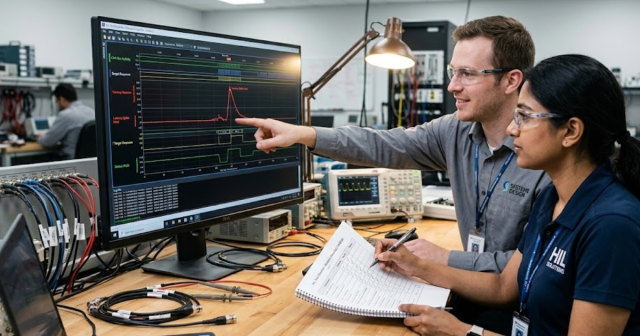
OPAL-RT supports rigorous validation with real‑time execution that mirrors control behaviour under stress. You can close the loop with hardware‑in‑the‑loop (HIL) test benches, observe controller interactions at millisecond scales, and verify protections without risk to production equipment. Open integration with Functional Mock‑up Interface (FMI) and Functional Mock‑up Unit (FMU) standards lets you bring external models into the same workflow. Automated data capture, synchronized scenario execution, and consistent result packaging shorten the path from run to review.
Teams also gain audit‑ready traceability. Versioned projects, deterministic scheduling, and repeatable test recipes make it easy to compare runs across revisions, seasons, or facilities. Built‑in scripting and APIs support standardized metrics, plots, and approval artifacts that slot into your process, not the other way around. These capabilities turn validation from a manual exercise into an engineered system that scales with your ambitions. OPAL-RT earns trust by matching engineering rigour with practical tools you can apply today.
Common questions
Clear answers help teams move from uncertainty to action. The topics here reflect what engineers, test leads, and managers ask most when adopting a consistent validation practice. Each response gives practical steps and guidance you can apply to your own context. Strong fundamentals make every result easier to defend.
How do you validate data center simulation results?
Start with stated objectives and acceptance criteria tied to risk, such as rack inlet temperature error or feeder current error during peak periods. Map each predicted variable to a measured counterpart, align timestamps, and compute metrics like mean absolute error, root mean square error, and percentile error. Run sensitivities to see which inputs matter most, and confirm that assumptions hold using targeted measurements or vendor data. Close with a structured review, clear decisions, and versioned artefacts that other teams can replay.
What are best practices for validating data center simulations?
Write objectives as measurable targets with context, not broad statements. Use qualified datasets with synchronized clocks, clean metadata, and clear mapping to racks, zones, feeders, or panels. Automate comparisons, plots, and reports so every case follows the same steps and yields the same metrics. Schedule periodic rule reviews so thresholds and methods stay aligned with current hardware, loads, and policies.
Why is validation important in data center simulation?
Validation ties predictions to evidence, which turns models into decision support that teams can trust. Without it, errors in assumptions, mapping, or data quality can hide hotspots, understate power risk, or misguide capacity plans. A repeatable validation method lowers rework, shortens approvals, and clarifies accountability across roles. Confidence grows as results consistently match measurements under the conditions that matter.
What is data center simulation validation?
Data center simulation validation is the structured process of comparing model outputs to qualified measurements, against predefined criteria and scenarios. The process covers objectives, datasets, assumptions, metrics, and reviews, all managed with version control and clear traceability. Strong validation also includes sensitivity checks, cross‑model comparisons, and routine rule updates to stay relevant. Teams use the outcomes to accept a model, refine it, or limit its use to specific questions.
How often should you revalidate a data centre simulation model?
Revalidation timing follows change triggers such as hardware refresh, containment adjustments, control updates, or shifts in load mix. Seasonal checks can be helpful for thermal models, since supply temperatures and capacity margins vary through the year. A semiannual rhythm works for many facilities, with faster checks after incidents or major maintenance. The goal is to catch drift early while keeping effort proportional to risk.
Clarity, evidence, and repeatability define strong validation. Teams that invest in these habits find that reviews become faster, decisions become easier, and outcomes become more reliable. Models keep pace with facility changes, and stakeholders see proof that numbers reflect how systems behave. That combination builds a durable foundation for choices with technical and financial impact.
Real-time solutions across every sector
Explore how OPAL-RT is transforming the world’s most advanced sectors.

Industry applications, Simulation, Energy
03 / 29 / 2026
Validating data center energy management systems using real-time HIL
This piece explains how AI workload variability affects data centre power stability and how closed-loop HIL testing helps validate EMS control behaviour under site and grid stress.
Industry applications
03 / 28 / 2026
Control algorithm validation using real-time HIL
A practical look at how real-time HIL testing validates embedded control algorithms through closed-loop simulation, fault reproduction, digital plant models, and disciplined integration.

Simulation
03 / 27 / 2026
Real-time simulation for validating autonomous and ADAS systems
Explains why autonomous and ADAS validation relies on deterministic real-time simulation and hardware-in-the-loop, what scenarios matter, how to assess simulator stacks, and where simulation programs commonly fail.
EXata CPS has been specifically designed for real-time performance to allow studies of cyberattacks on power systems through the Communication Network layer of any size and connecting to any number of equipment for HIL and PHIL simulations. This is a discrete event simulation toolkit that considers all the inherent physics-based properties that will affect how the network (either wired or wireless) behaves.