Why simulation is vital for renewable microgrid design and cybersecurity
Simulation, Microgrid
01 / 27 / 2026
Key Takeaways
- Treat renewable microgrid simulation as a sign-off gate for integration, not a late fix step.
- Closed-loop tests link cyber events to voltage, frequency, and protection behaviour you can verify.
- Match model fidelity and real-time timing to the failure modes you must rule out.
Simulation is the practical path to a renewable microgrid that stays stable and secure under stress. It tests control logic, protection settings, and operating limits early. Global annual renewable capacity additions reached nearly 510 GW in 2023. More inverter-based generation tightens margins.
Microgrids rely on communications and automated dispatch. A cyber event that flips a setpoint or delays a sensor update will upset the power system. IT-only security testing won’t show voltage collapse or nuisance trips. Closed-loop simulation treats design and cybersecurity as one job with measurable pass criteria.
Simulation sets the foundation for reliable microgrid design
Renewable microgrid simulation lets you verify stability across grid-connected, islanded, and transition states. It shows how voltage, frequency, and power sharing respond to disturbances. Those results become criteria you can repeat in the lab and on site. Reliability starts when you can reproduce behaviour when you need it.
Picture a community centre microgrid with solar, batteries, and a backup generator. A planned islanding test will expose how quickly the battery must pick up load while the generator synchronizes. Simulation will show if an inverter hits a current limit and drags voltage down. You adjust droop settings and ramp rates before equipment sees that stress.
This foundation also sharpens your commissioning plan. You’ll know which measurements matter, such as frequency dip, recovery time, and breaker timing. You can define what “safe fallback” looks like when controls misbehave. A maintained model gives you a baseline you can trust when the design changes.
“Microgrids fail on transitions, not on steady operating points.”

Renewable microgrids need system level testing beyond components
Component tests miss interactions that break microgrids once devices share a feeder. Inverters share voltage control, fault current is limited, and power quality problems stack up. Dispatch logic touches every asset, so a small rule creates a swing. System-level simulation checks couplings early and avoids rework.
A battery inverter can look stable on a bench, then oscillate once a solar inverter shares its droop curve. Those swings trigger trips missed in factory tests. Dispatch logic can charge at the wrong moment, pushing a generator into poor operation. Simulation surfaces integration faults while changes are affordable.
Scope stays manageable when everyone agrees on proof. Protection, controls, and operations need the same outcomes. Clear pass criteria stop arguments. The table lists the minimum proof to insist on.
| Proof you need | Simulation output required |
| Islanding stays stable in first seconds | Voltage and frequency settle without trips |
| Islanded faults clear without losing service | Protection isolates the faulted section |
| Dispatch stays inside power and energy limits | Commands stay inside current and energy limits |
| Parallel inverters share load without conflict | Sharing converges with no oscillation |
| Black start reaches steady operation without resets | Sequencing works with ramps and delays |
Control and power interactions must be validated under transient conditions
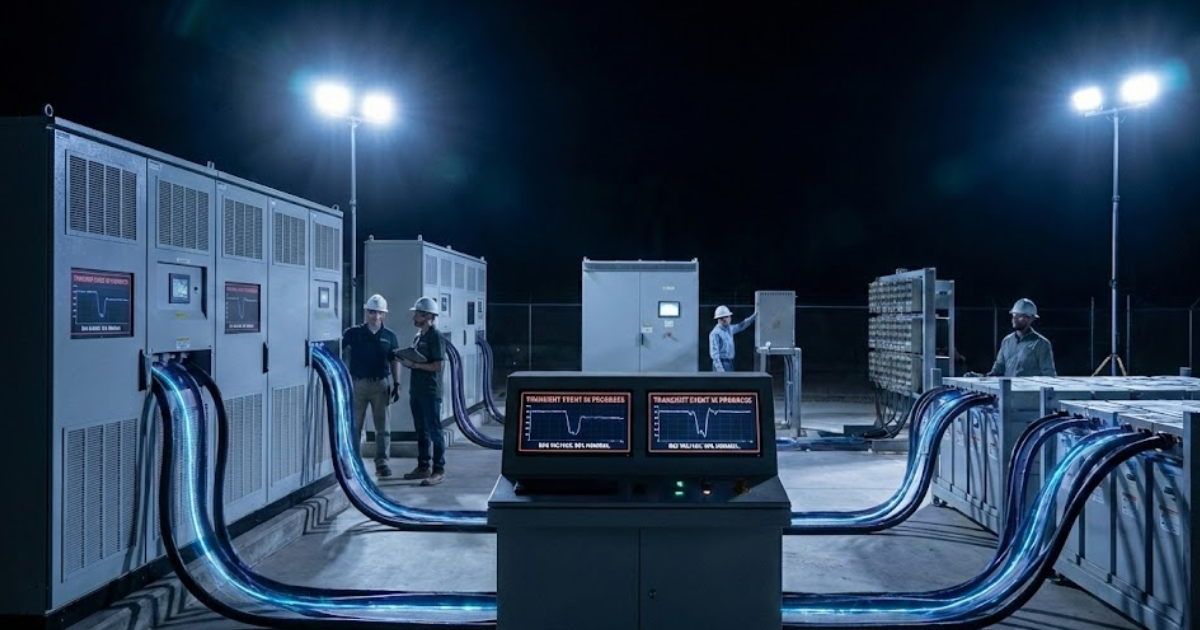
Microgrids fail on transitions, not on steady operating points. Transients stress current limits, control loops, and protection timing all at once. Renewable sources add fast power swings that mechanical units never had to match. Simulation lets you test those moments before they happen on site.
A motor start during islanded operation is a classic trouble spot. Inrush current pulls voltage down, the inverter hits its limit, and the frequency controller reacts to a sudden power gap. The same system can look fine until cloud cover cuts solar output while the battery is already near its discharge floor. Transient simulation shows if your controls recover cleanly or spiral into repeated trips.
These tests also guide the level of model detail you need. Slower studies will catch energy management and sharing issues, while fast controller stability sometimes needs electromagnetic transient modelling. You pick the simplest model that still reproduces the failure you care about. Clean transient behaviour is proof your control design stays coherent under stress.
Cyber attack scenarios require closed-loop energy simulation testing
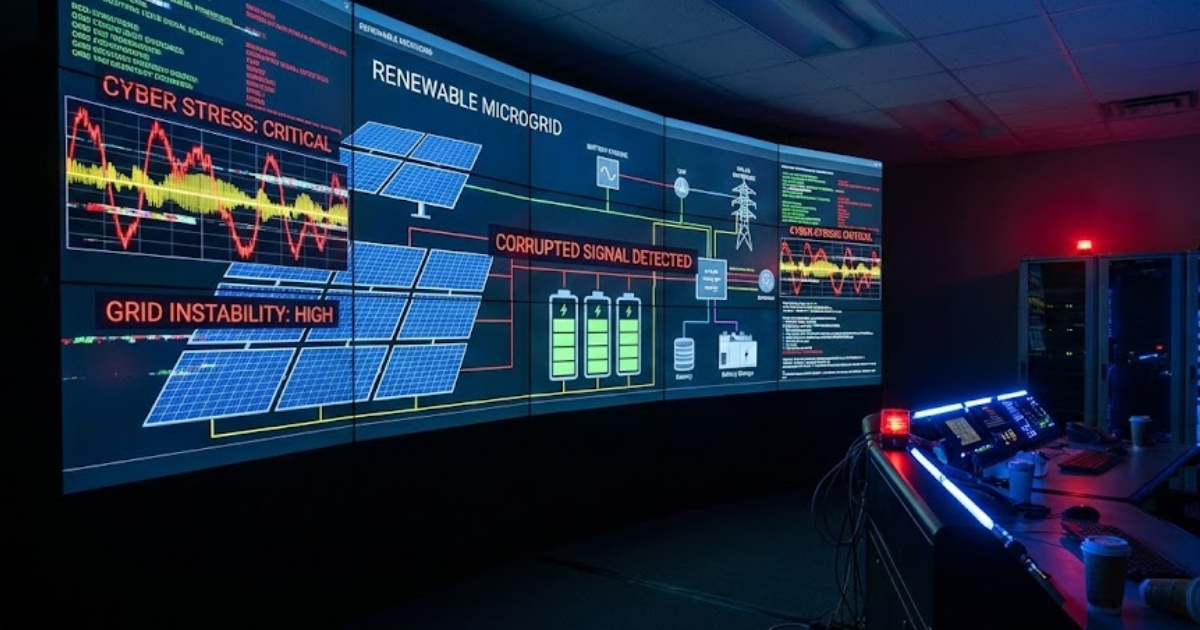
Energy simulation cybersecurity works when cyber inputs and electrical outputs stay in the same loop. A bad command matters only if you see the physical consequence at the inverter terminals. Closed-loop tests show how detection, fail-safe logic, and operator actions affect stability. That makes cybersecurity testable.
About 50% of the reported cyber security incidents in NERC’s CIP-008-6 public summaries were attributed to malware as the attack vector. Malware often changes what the controller reads or receives. Test it by injecting a false battery state-of-charge value and watching dispatch push the asset past its safe limit. Verify interlocks force a stable fallback mode.
Closed-loop testing also surfaces tradeoffs security teams miss. Filtering can block malicious commands, but it can also delay legitimate control action during faults. Alarm thresholds must balance noise against missed detection. Simulation gives operators rehearsal time without risking live equipment.
Simulation exposes protection gaps before field deployment risks escalate
Protection in renewable microgrids is hard because fault current is limited and control-dependent. Many inverters clamp current, so classic overcurrent settings stop working in islanded mode. Simulation lets you evaluate selectivity, sensitivity, and clearing time across operating states. It stops “works grid-tied” from turning into “fails when islanded.”
A feeder fault during islanded operation shows the gap quickly. The inverter current limit keeps fault current low, so a downstream element won’t pick it up fast, or at all. Simulation reveals miscoordination when an upstream breaker opens instead, taking the full microgrid dark. You then redesign settings and schemes around what the microgrid will actually produce.
Protection results should shape the site test plan, not just the settings file. You can stage isolation tests, validate setting changes, and confirm the controller reacts correctly when a section drops. Documentation is simpler because evidence links settings to expected behaviour. That traceability keeps field risk under control.
Model fidelity and real-time constraints shape trustworthy results
A simulation result is only as good as the assumptions behind it. Fidelity means modelling what matters for your question, then checking it against measurements. Real-time constraints matter with hardware controllers, since timing and latency affect stability. Trustworthy results match both physics and timing.
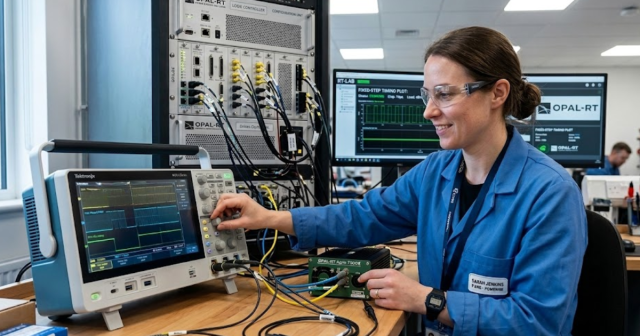
An inverter model that behaves like an ideal voltage source will hide the current limit that defines fault and transient response. A battery model that ignores thermal limits will make dispatch look easy until the hardware clamps power. Hardware-in-the-loop testing closes the gap, since the controller runs real firmware while the plant runs in a real-time simulator. OPAL-RT is one way labs run that loop with realistic timing.
Fidelity also has a cost, so tradeoffs must be explicit. High-detail switching models are heavy to run, while simplified models still answer protection and energy management questions. The goal is not maximum detail; it is the minimum detail that still reproduces your key failure modes. Treat fidelity as a design choice and your results stay defensible.
Common microgrid failures traced to skipped simulation steps
Most microgrid headaches trace back to missing tests, not bad intentions. Teams skip integrated scenarios, then discover controller conflicts, nuisance trips, and unstable voltage under the first abnormal event. Each subsystem looked fine alone, so the failure feels unfair. Simulation makes the couplings visible while you still have room to fix them.
A site test that goes wrong often starts with an untested transition. Grid loss happens, the microgrid islands, and the controller commands the battery to pick up load while the generator is still ramping. Voltage drops, protective devices trip, and the blame lands on the last device touched. A similar failure follows a short communications dropout that leaves stale setpoints active long enough to push assets past limits.
Skipped steps also erode trust inside the team. Protection engineers, controls engineers, and cybersecurity specialists end up debating logs after the fact instead of agreeing on pass criteria up front. Treat every control or settings change like a software update, then rerun the same scenario set. Repeatable tests build reliability faster than post-mortems.
“Simulation makes the couplings visible while you still have room to fix them.”
How to prioritize simulation scope for design and security goals
Simulation scope should follow risk, not curiosity. Start with scenarios that can cause instability, unsafe operation, or long commissioning delays, then add detail only where it changes the outcome. Include cyber-triggered control faults beside electrical disturbances, since the controller loop reacts to both the same way. Confidence comes from a small set of tests you can repeat.
- Define operating modes and limits
- Validate islanding, reconnection, and black start under load swings
- Prove protection selectivity in islanded mode with current limits
- Inject bad commands and measurements and confirm safe fallback
- Lock pass criteria and rerun tests after every control change
Treat those items as gates, not extras. A remote setpoint error that forces over-discharge deserves the same seriousness as a feeder fault. Teams that use OPAL-RT run controller hardware against these disturbances to keep risk off the live system. Sign-off is simple: if you can’t control worst-case behaviour in simulation, you’re not ready to commission.
Real-time solutions across every sector
Explore how OPAL-RT is transforming the world’s most advanced sectors.
Industry applications, Simulation
03 / 31 / 2026
Managing high-frequency switching in real-time EMT simulation
Precision in testing complex power systems is essential to avoid failures, accelerate innovation, and integrate new technologies safely.

Simulation
03 / 30 / 2026
Understanding timestep requirements for modern power converters
Practical criteria for selecting EMT and real time simulation timesteps for power converters, covering switching resolution, control and PWM timing alignment, multirate approaches, and verification checks.
Energy, Industry applications, Simulation
03 / 29 / 2026
Validating data center energy management systems using real-time HIL
This piece explains how AI workload variability affects data centre power stability and how closed-loop HIL testing helps validate EMS control behaviour under site and grid stress.
EXata CPS has been specifically designed for real-time performance to allow studies of cyberattacks on power systems through the Communication Network layer of any size and connecting to any number of equipment for HIL and PHIL simulations. This is a discrete event simulation toolkit that considers all the inherent physics-based properties that will affect how the network (either wired or wireless) behaves.