
Key Takeaways
- Data centre protection that isolates the site on voltage dips keeps servers safe but can drop large blocks of load off the grid at once.
- Stability studies need load models that capture UPS controls, trip logic, ramp rates, phase balance and reconnection behaviour.
- Real-time simulation with actual controllers in the loop lets teams tune ride-through settings and prove them before connection.
Data centre power system stability has to be engineered and proven before a disturbance arrives, because large data centre loads now shape grid stability as much as the grid shapes them.
The scale of that load has changed the problem. US data centres used 4.4% of US electricity in 2023 and could reach 6.7% to 12% by 2028, which turns a single campus into a load the size of a small city sitting on one or two transmission points. When that load reacts to a voltage dip by dropping off the grid, both the facility and the utility feel it.
Conventional tests can’t reproduce every grid disturbance, transfer timing or controller interaction, so hidden weak points stay hidden until a real event finds them. Stability comes from modelling those behaviours accurately and testing the actual controls against them.
How grid stability affects data centre power systems
Grid stability affects data centre power systems because every voltage sag, frequency swing or fault on the utility side reaches the facility’s protection, UPS and transfer equipment within milliseconds. A less stable grid means more transfers to backup power, more stress on batteries and generators and more chances for a sequence to fail.
Data centres rarely get protected status on the utility network, since operators know they have backup generation. Several pressures are making disturbances more frequent across many regions.
- Inverter-based solar and wind replacing synchronous generators and their inertia
- Older transmission equipment carrying flows it wasn’t designed for
- Heat waves, storms and wildfires hitting generation and lines at the same time
- Thin reserve margins as large new loads connect faster than new generation
- Line auto-reclosing that turns one fault into a string of voltage dips
Each of those pressures shows up at the site as a power quality event. You should assume your facility will see more sags and frequency deviations, even in years without a full outage.
Why data centre power systems trip during grid faults
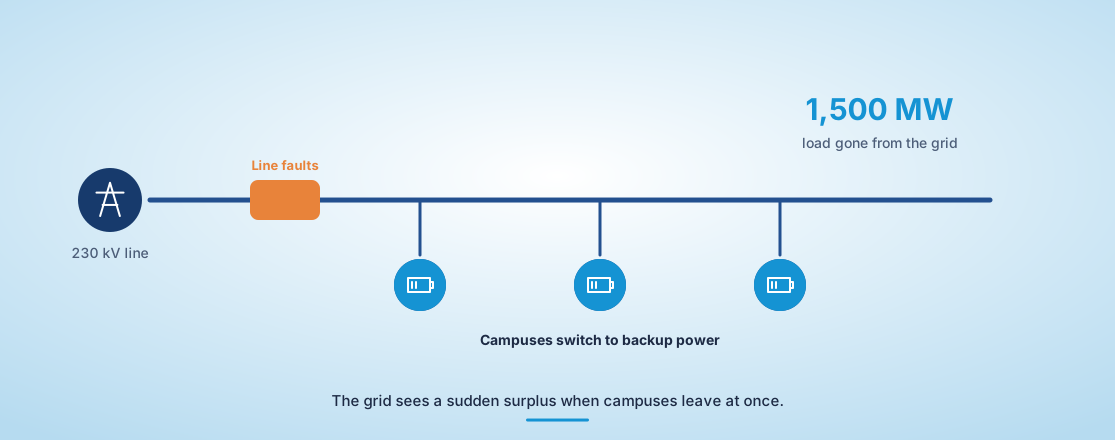
Data centre power systems trip during grid faults because their protection is set to isolate the facility the moment voltage or frequency leaves a narrow band. The UPS carries the load, generators start and the site transfers to backup, and some schemes stay there until someone reconnects them manually.
That behaviour protects servers and creates a grid problem at the same time. A string of faults on a 230 kV line in Virginia in July 2024 led to about 1,500 MW of load reduction, all of it data centre load moving to backup power. Much of it stayed off the grid for hours, because the protection logic counted repeated voltage dips and then held each facility on backup.
Losing that much load at once pushes frequency and voltage up on the remaining system, so grid operators have to react quickly to a disturbance the original fault never caused. Over-sensitive trip settings that keep one site safe can aggravate the event for everyone else, which is why utilities now ask large loads to show their ride-through behaviour before they connect.
“Over-sensitive trip settings that keep one site safe can aggravate the event for everyone else, which is why utilities now ask large loads to show their ride-through behaviour before they connect.”
How large data centre loads affect grid stability
Large data centre loads affect grid stability through the speed and size of their response. Fast-acting UPS inverters, server power supplies and cooling drives all regulate their own input, so a campus behaves like a coordinated control system that can drop, ramp or oscillate far faster than a conventional industrial load.
When a sudden sag hits, every UPS in the facility tries to correct it at once, and their control loops can overshoot or interact. AI training clusters add another layer, since thousands of processors can step power up and down in synchrony as jobs start, checkpoint and finish. Phase imbalance across single-phase rack loads adds negative-sequence current that heats transformers and stresses upstream protection.
Backup transitions carry their own risk. A generator that isn’t in sync, a brief overlap between sources or a slow transfer switch can cause a dip just as the facility is trying to settle, and periodic generator runs rarely cover those edge cases.
How to model a data centre load for stability studies
You model a data centre load for stability studies by representing its power electronics and protection logic in detail. An accurate model captures how the UPS and power supplies respond to voltage, the ramp rates of IT load and the logic that decides when the site leaves the grid.
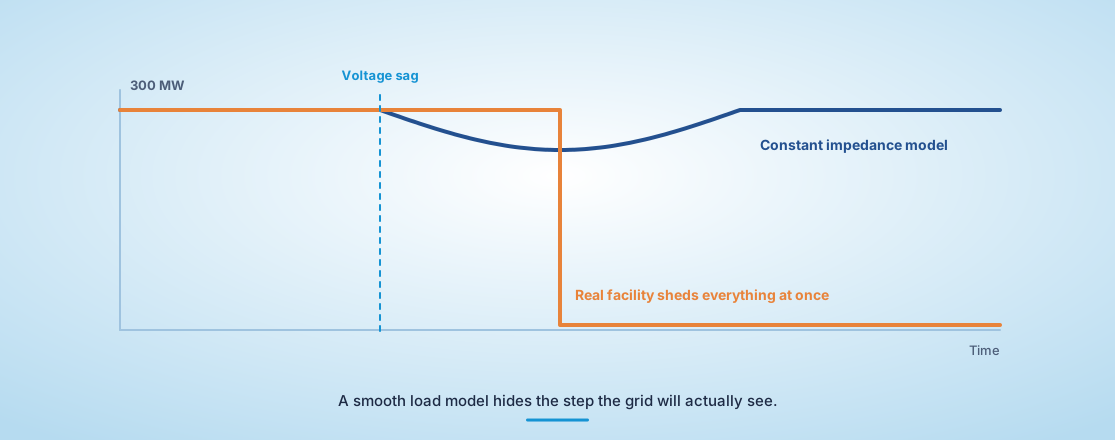
Traditional composite load models assume motors and resistive load that recover smoothly after a fault. A data centre does the opposite, holding constant power through the UPS and then disappearing entirely once a trip threshold is crossed. Studies that miss that step change will understate the risk to the grid and to the site. Picture a 300 MW campus modelled as constant impedance. The study shows load easing gently during a sag, while the real facility holds full draw for several cycles and then sheds everything at once, leaving the utility with a sudden surplus it never planned for.
The model elements that matter most are summarized below.
| Model element | What the study needs it to capture |
| UPS rectifier and inverter controls | How fast input current changes during a sag and how the units interact in parallel. |
| Ride-through and trip logic | The voltage, frequency and event-count thresholds that send the site to backup power. |
| IT load ramp profile | How quickly large compute jobs raise or cut consumption across the campus. |
| Phase balance across rack loads | Unequal single-phase loading that adds heating and negative-sequence current upstream. |
| Reconnection behaviour | When and how fast the facility returns load to the grid after a disturbance. |
Vendor data sheets rarely give these parameters at the detail a stability study needs. That’s why field measurements and controller-in-the-loop tests are the most reliable way to tune the model.
“A data centre does the opposite, holding constant power through the UPS and then disappearing entirely once a trip threshold is crossed.”
Why grid stability simulation is the safest testbed
Grid stability simulation is the safest testbed because it recreates worst-case grid events against a high-fidelity model of the site and the network, with no physical equipment at risk. Engineers see exactly how the UPS, switchgear and controls respond, then fix settings before an event does it for them.
Real-time simulation adds the actual control hardware to that picture. A UPS controller or transfer switch relay can sit in the loop while the model applies deep multi-cycle sags, repeated reclosing faults or a generator that fails to start alongside a battery fault. Engineering teams use OPAL-RT simulators to run those cases hundreds of times and document which settings ride through, giving utilities and operators the same evidence when a new interconnection or a new block of load goes live. The same setup lets you tune the trip logic itself. Engineers can test a three-dip counting scheme against a reclosing sequence, widen a threshold, rerun the event and confirm the site rides through without exposing the IT load. That loop takes an afternoon on a simulator and would be impossible on a live facility.
Stable data centre power is engineered and proven
Data centre power stability comes from evidence gathered before an event, because backup systems only behave as well as their settings have been tested. Teams that model their load honestly and test their controls against hard grid events find weaknesses while there’s still time to fix them calmly.
That discipline builds over time. Every study, retuned setting and documented ride-through result makes the next expansion easier to approve and the next disturbance easier to absorb. We see the most reliable operators treat stability testing as routine engineering, and with OPAL-RT real-time simulation they walk into each interconnection review with proof instead of assumptions.
Real-time solutions across every sector
Explore how OPAL-RT is transforming the world’s most advanced sectors.
Power Systems
11 / 13 / 2026
Grid forming inverters, how they work and how to test them
A technical explainer on how grid forming inverters and their control loops work, and how to test grid forming control through faults, islanding and weak grids.
Automotive
11 / 08 / 2026
Active vs passive cell balancing and how to validate balancing logic before pack build
A comparison of active and passive cell balancing in battery packs and a practical guide to validating balancing logic on HIL before pack build.
Power Systems
11 / 03 / 2026
Medium voltage and grid interactive UPS systems for data centers
An engineering guide to medium voltage and grid interactive UPS systems for data centres, covering static transfer switches, modular designs and pre-commissioning validation.