5 Ways Controller Hardware in the Loop and Model-Based Engineering are Reducing Risk
Simulation
08 / 05 / 2026
Key Takeaways
- Controller hardware in the loop reduces risk fastest when you focus on closed-loop failures that usually appear late in development.
- Model based engineering adds value when requirements, tests, and controller revisions stay linked and repeatable.
- The best C-HIL starting point is a narrow, high-impact control function with measurable pass criteria and stable rerun conditions.
Controller hardware in the loop reduces risk by exposing control faults while fixes are still cheap.
That shift matters because the most expensive control problems rarely start on a bench. They start much earlier, when timing assumptions, plant behaviour, and interface details still live inside models and early software builds. Controller hardware in the loop, often shortened to C-HIL, puts the actual controller in a closed loop with a simulated plant so you can test responses before motors, converters, vehicles, or grid assets are ready. When you pair that setup with model-based engineering, you move the riskiest checks left on the V-model and stop late surprises from becoming schedule slips.
Controller hardware in the loop tests controllers before hardware exists

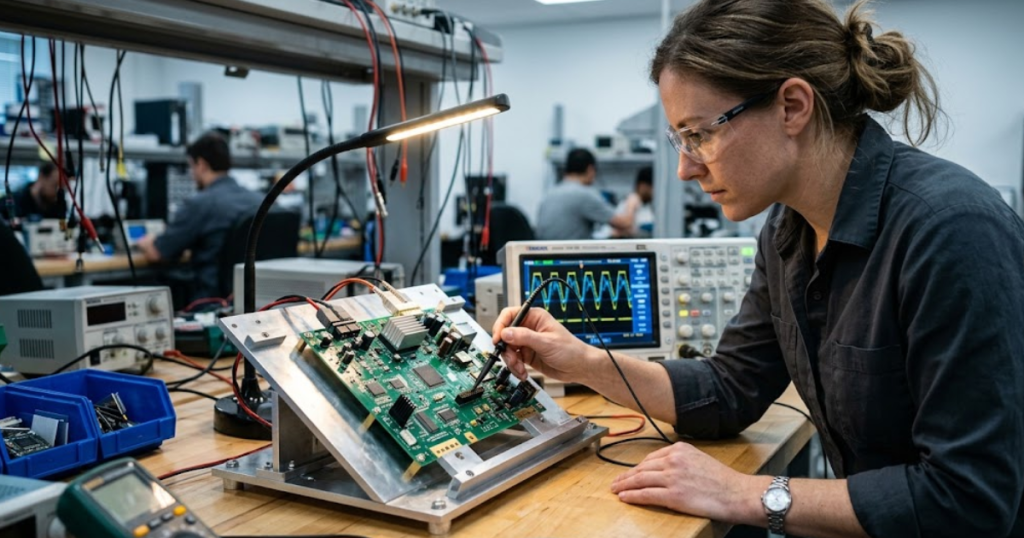
Controller hardware in the loop connects a physical controller to a simulated plant and runs that loop under realistic timing. C-HIL reduces risk because the controller sees credible inputs and its outputs affect a live simulation. You get behaviour evidence early. You fix faults before prototype hardware locks in cost and delay.
An inverter controller is a clear example. You can connect the production control board to a simulated motor and DC bus, then watch torque commands, current limits, and fault states under acceleration, regen, and low-voltage events. The same pattern works for a protection relay, flight control computer, or battery management unit. Each case gives you earlier proof of control behaviour, which is what makes controller hardware in the loop valuable inside model-based engineering workflows.
“C-HIL reduces risk because the controller sees credible inputs and its outputs affect a live simulation.”
5 Ways C-HIL within model-based engineering cuts risk
C-HIL cuts risk most effectively when you use it to target the failure types that usually appear late and cost the most to diagnose. Those failure types fall into six practical groups. Each one maps to a common control problem. Each one becomes cheaper to fix when you catch it before bench integration.
1. Virtual plant models expose unstable control logic before prototypes
Virtual plant models let you test the actual controller against dynamic behaviour long before a prototype exists. That matters because unstable gains, poor scheduling, and weak mode logic usually stay hidden in code review. A traction inverter controller, for instance, can look correct in a desktop simulation but start oscillating when the simulated motor inertia, bus ripple, and sensor delay are applied in closed loop. You’ll see overshoot, integrator windup, or limit cycling while the fix is still a parameter update or state machine change. That early view also forces better model discipline, since plant assumptions must be explicit enough to support a test you trust.
2. Fault injection reveals unsafe responses under rare operating conditions
Fault injection shows how the controller behaves when inputs stop making sense or plant conditions move outside nominal limits. Those tests reduce risk because rare faults are hard to reproduce safely on physical hardware, yet they often expose the weakest recovery logic. A battery controller facing a stuck temperature sensor, an undervoltage event, or a dropped communication frame will reveal if it derates cleanly, latches the right code, and recovers in the intended sequence. You’re not just checking that a fault is detected. You’re checking that the response stays bounded, traceable, and safe for the rest of the system after the first fault appears.
3. Timing tests catch latency jitter before bench integration
Timing faults are control faults, and C-HIL makes them visible while the system is still easy to inspect. Closed-loop execution exposes missed deadlines, variable task latency, and I/O skew that won’t show up in a static model review. A motor control unit might compute the right duty cycle, yet a delayed PWM update or a noisy timestamp can still push current regulation outside tolerance. Teams using OPAL-RT often run these tests with deterministic plant execution so controller timing can be measured under repeatable load. That matters because you’re separating software logic issues from execution timing issues before they blend into a confusing bench failure.
“Timing faults are control faults, and C-HIL makes them visible while the system is still easy to inspect.”
4. Model based engineering keeps requirements traceable through each revision
Model based engineering reduces risk when every control requirement stays linked to the model element, test case, and observed result. That traceability matters once revisions begin to stack up and nobody remembers which assumption changed first. A speed-limiter requirement, for instance, should remain tied to the state logic, the threshold values, and the C-HIL test that proves the limiter engages within the allowed time. When the threshold shifts after a safety review, you can rerun the linked test and verify the effect immediately. You’re not guessing which spreadsheet, script, or software branch still reflects the current control intent.
5. Regression testing flags software drift after every controller update
Regression testing cuts risk because control software rarely breaks in obvious places. Small edits to filters, anti-windup logic, calibration tables, or startup sequencing can shift behaviour far from the code block that was changed. A current-limit update on an electric drive, for example, can alter fault recovery time or torque response during a sag event even if the new code passes a bench smoke test. C-HIL gives you repeatable closed-loop scenarios that can run after every build, so software drift gets caught as a measurable delta instead of an expensive surprise. That discipline also helps teams compare revisions using the same plant conditions and pass criteria.
| Risk check | What you should take from it |
| 1. Virtual plant models expose unstable control logic before prototypes | Closed-loop plant simulation reveals unstable gains and weak mode logic while fixes still sit in software. |
| 2. Fault injection reveals unsafe responses under rare operating conditions | Injected faults show if detection, derating, and recovery stay controlled when unusual failures occur. |
| 3. Timing tests catch latency jitter before bench integration | Deterministic execution separates timing defects from logic defects before the bench muddies the diagnosis. |
| 4. Model based engineering keeps requirements traceable through each revision | Linked requirements and tests make control changes easier to verify after thresholds or logic are updated. |
| 5. Regression testing flags software drift after every controller update | Repeatable scenarios catch behaviour drift after small software edits that would otherwise slip past bench checks. |
Where to start C-HIL for the highest risk
Start with the controller function that carries the biggest safety, performance, or schedule consequence if it fails. You don’t need a perfect plant model first. You need a credible closed loop around the function most likely to create late rework. That’s the fastest path to useful risk reduction.
A good starting point is the narrowest setup that can reproduce a failure you can’t afford to miss, such as current control on an inverter, fault recovery on a relay, or torque arbitration in a vehicle controller. Teams that work with OPAL-RT often get better results when they treat C-HIL as part of model based engineering discipline instead of a late lab task. The payoff comes from choosing sharp pass criteria, keeping tests repeatable, and expanding scope only after the first loop is stable.
- Pick one control loop with clear project impact.
- Set measurable pass and fail thresholds early.
- Model only the plant dynamics that affect that loop.
- Automate reruns after every software revision.
- Promote proven tests to later lab stages unchanged.
Microgrid
09 / 19 / 2026
Hybrid AC-DC microgrid emulation with power hardware-in-the-loop
An examination of how hybrid AC-DC microgrid stability is set at the interlinking converter and why power hardware in the loop is required to test that boundary at full power.

Power Electronics
09 / 17 / 2026
BLDC motor control fundamentals with simulation examples
A technical primer on six step BLDC commutation, Hall sensor and sensorless back EMF position sensing, torque ripple at each switching instant, and the simulation exercises a teaching lab can run.
Power Systems
09 / 16 / 2026
How to build a protection relay testing workflow utility engineers trust
A practical look at how utility engineers build protection relay testing workflows, from secondary injection through closed loop validation against a real time power system model.