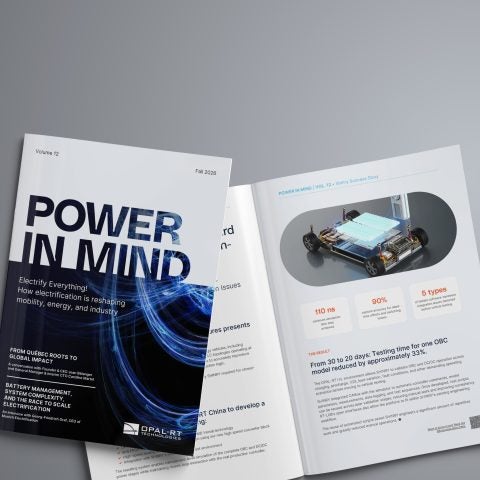
A conversation about OPAL-RT’s next chapter with Founder & CEO Jean Bélanger and General Manager & Interim CTO Caroline Martel.
The next energy transition is already underway.
It is visible in electric vehicles, renewable energy systems, data centers, industrial equipment, aircraft and ships. Technologies that once evolved independently are becoming part of a single, increasingly interconnected electrical ecosystem. As electrification accelerates, engineers face a familiar challenge: how do you innovate faster while managing greater complexity?
For nearly three decades, OPAL-RT TECHNOLOGIES has been helping answer that question.
Founded in Québec in 1997 by Jean Bélanger and Lise Laforce, the company was built on a simple belief: engineers would always demand more computing power, and simulation would play an increasingly important role in accelerating innovation. Looking back at OPAL-RT’s beginnings, Bélanger remembers betting on parallel processing long before it became mainstream.
“The idea was that engineers would always ask for more power, and parallel processing was the only way,” he recalls. “Few people believed that at the time, but we started with that.”
Nearly thirty years later, that conviction feels remarkably relevant.
As electrification brings together previously separate industries and technologies, the need to design, validate and test increasingly sophisticated systems continues to grow. For OPAL-RT, the challenges facing customers today have become larger and more complex, but the company’s mission remains fundamentally the same: help innovators move faster.
QUÉBEC ROOTS, GLOBAL AMBITION
Long before OPAL-RT became an international company, it was an ambitious idea emerging from Québec’s engineering community.
Bélanger spent more than 25 years at HydroQuébec before founding OPAL-RT, bringing expertise in power systems and large-scale infrastructure projects. In the early days, the company was less focused on markets than on solving difficult technical problems.
The idea was that engineers would always ask for more power, and parallel processing was the only way.
Jean Bélanger
“We had a solution, but we were trying to find people with problems,” Bélanger says with a smile.
Those customers often shared a common frustration: their simulations were simply too slow.
By making those simulations run in real time, OPAL-RT helped engineers accelerate development, test more scenarios, and gain confidence in increasingly complex systems.
Over time, the company expanded beyond its initial focus. What began with a handful of engineers evolved into a broad portfolio supporting customers across mobility, energy, aerospace, research and industrial markets. Today, OPAL-RT serves organizations around the world while remaining firmly connected to the values that shaped its beginnings: technical excellence, innovation and long-term thinking.
For Caroline Martel, who joined the company this year as General Manager and Interim CTO, those foundations are one of OPAL-RT’s greatest strengths.
“The beauty of it is that we have several possibilities ahead of us because the foundation is solid,” she says. “It opens the door to perhaps diversifying a little more than we do today while ensuring long-term sustainability.”
WHY ELECTRIFICATION CHANGES EVERYTHING
Electrification is often associated with electric vehicles, but the reality is far broader.
According to Bélanger, one of the most important trends is the convergence taking place across industries. Technologies originally developed for transportation are increasingly being applied to larger energy systems. Vehicles are becoming energy storage assets. Data-center loads are becoming active participants in energy infrastructure.
“The car will be used as an energy storage system,” he says. “There is a convergence in electrification.”
For engineers, that convergence creates both opportunity and complexity. Modern systems rely on advanced power electronics, sophisticated controls and increasingly interconnected networks. As those systems become faster and more capable, the simulation technologies used to develop them must evolve as well.
That challenge is one OPAL-RT knows well.
“Electrification and mobility force us to innovate and develop faster systems,” Bélanger explains.
For Martel, the company’s future contribution will depend as much on collaboration as technology.
“Collaboration with our partners and customers has a predominant role because it is their needs that we want to address,” she says. “If we want to position ourselves as a partner that accelerates innovation, we always have to be listening. We even have to be ahead.” Trust, she believes, remains fundamental. “If they succeed, we succeed.”
If we want to position ourselves as a partner that accelerates innovation, we always have to be listening. We even have to be ahead.
Caroline Martel
THE NEXT CHAPTER
OPAL-RT prepares for its next phase of growth, both leaders share a long-term perspective.
For Bélanger, success means ensuring that the company continues to thrive decades into the future. organization with deep expertise, strong values and significant untapped potential.
“Our objective is to make sure the company will last,” he says. “We look at companies like Siemens, ABB and Hitachi and say it should be here for the next hundred years.”
For Martel, the challenge is building on what already makes OPAL-RT unique.
“The most important thing is to preserve the essence of OPAL,” she says. “The values are important. Sustainability is important. We want to remain relevant, contribute to advancing technology and continue being accelerators.”
That vision is ultimately what attracted her to the company.
Beyond the technology, she saw an organization with deep expertise, strong values and significant untapped potential.
“What excites me the most is the potential,” she says. “I would like to unlock that full potential, and I think we can do it. We have everything we need to do it.”
Nearly thirty years after its founding, OPAL-RT finds itself at the intersection of two transformations: its own evolution and the electrification of industries around the world.
The technologies may change. The systems may become more complex. The pace of innovation may continue to accelerate.
But the mission remains remarkably familiar: help engineers solve difficult problems, move innovation forward, and transform imagination into reality.
Our objective is to make sure the company will last.
Jean Bélanger
To learn more, visit our Leadership page.

President and CTO
Jean Bélanger
As an electrical engineer, Jean co-founded OPAL-RT in 1997 and built it with the vision of bringing high-end real-time simulation tools to all engineers and scientists. Today, under his direction and technological leadership, OPAL-RT has become a world-renowned developer of state-of-the-art real-time simulators capable of simulating all types of mechanical and electrical systems. Prior to founding OPAL-RT, Jean led a successful career at Hydro-Québec in the domain of power system design and simulation, and is a fellow of the Canadian Academy of Engineering.

General Manager
Caroline Martel
Caroline Martel brings extensive international management experience in technology driven organizations, where she has led multidisciplinary teams, overseen complex operations, and supported ambitious growth trajectories. Prior to joining OPAL-RT, Caroline held executive leadership roles at Solotech and CAE, with responsibilities spanning operational performance, governance, organizational transformation, and the development of new offerings in rapidly evolving markets. She is recognized for a leadership style grounded in collaboration, operational rigor, and strategic execution. Deeply committed to OPAL-RT’s culture of expertise and innovation, she is focused on advancing the organization in alignment with its mission and values, leveraging the strength of collective effort.