7 Key criteria for evaluating real-time simulation software for EV charging interoperability
Simulation, Power Systems
04 / 07 / 2026

Key Takeaways
- Interoperability testing works best when protocol timing, electrical response, and back office behaviour are tested as one system.
- The strongest evaluation criteria map directly to the failure modes that already slow your lab, especially timing drift, rare faults, and weak traceability.
- Software selection gets easier when you judge each option on repeatable regression, clear diagnostics, and fit with existing EV charging software workflows.
Choose simulation software that tests the charger, vehicle, and back office as one timed system.
That standard rules out a lot of EV charging software that only replays messages or checks a narrow script. Interoperability failures usually appear when timing slips, power stages react slowly, or EV charging management software handles state changes out of order. A charger can pass a protocol trace and still fail when a vehicle asks for a new current limit during a noisy grid event. You need software that exposes those combined faults before hardware reaches the field.
That matters because EV charging station management software now has to coordinate more stations, more firmware versions, and more session data than earlier test benches had to cover. If your simulator can’t connect message timing to electrical behaviour and back office logic, your team will spend weeks chasing faults that should’ve been caught in one repeatable test run. Good selection starts with criteria that map to the failure modes you already see in the lab. That keeps your shortlist practical.
“Start with the failures that cost your team the most time, then choose the software that reproduces those failures with the least manual setup.”
Interoperability testing needs more than protocol message playback
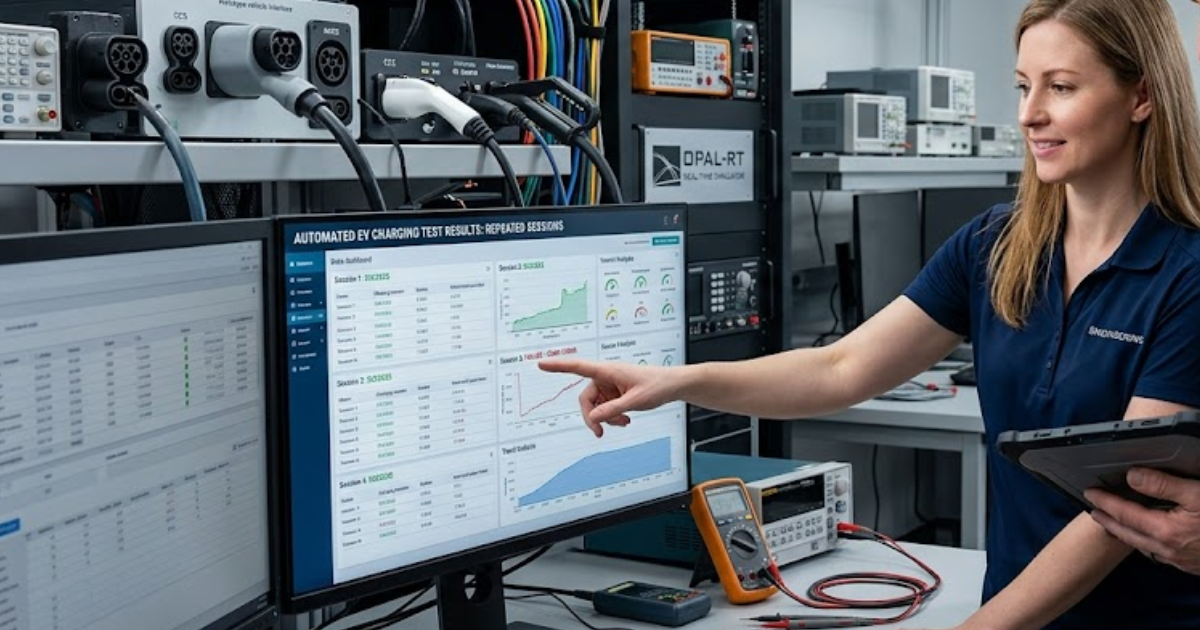
Good interoperability testing software reproduces the full charging session, not only the message exchange. You need time-aligned power models, controller I/O, fault conditions, and links to EV charging back office software so a pass result means the station, vehicle, and session records stay consistent under load.
A DC charger provides a clear example. The handshake can look correct while the current ramp lags, contactor timing shifts, and the vehicle reacts with a stop request. Message logs alone won’t explain that failure. A simulator has to connect communication events to electrical response in the same run.
The same rule applies to central systems. An authorization request can succeed while EV charging management software closes the session late or posts the wrong status to the operator portal. That issue sits between charger logic and back office timing. Your test software has to cover both or you’ll miss the fault that users actually see.
The 7 criteria to assess EV charging simulators
The best criteria follow the path of a charging session from standards support to toolchain fit. You’re checking whether the simulator can reproduce protocol exchange, physical response, fault conditions, repeatable automation, and data visibility across EV charger software and EV charging back office software.
1. Protocol coverage must match the standards you test
Protocol coverage matters when your lab has to test the exact stack your products use, not a simplified subset. A useful simulator will support the message sets, state machines, and security steps required for your current work across AC and DC charging. A mixed fleet is a good example, because one programme can need station control, plug and charge messaging, and charger state handling in the same campaign. If the software handles one protocol well but forces crude stubs for the rest, your pass result won’t say much. You should also check how easily the tool switches profiles, versions, and session roles, because interoperability faults often appear at those boundaries.
2. Timing accuracy must hold under closed-loop load
Timing accuracy tells you if the simulator stays trustworthy when control loops, protocol traffic, and plant models run at the same time. Latency that looks fine in a quiet demo can slip once current control, measurement I/O, and charging messages all compete for execution time. Picture a vehicle that requests a lower current during a thermal event while the charger updates contactor state and publishes a status change upstream. If latency rises when several subsystems run at once, your results won’t survive contact with actual hardware. You should look for deterministic execution, stable step times, and proof that the platform keeps those limits during long test sequences.
“If latency rises when several subsystems run at once, your results won’t survive contact with actual hardware.”
3. Power stage models must reflect converter behaviour
Power stage models matter because charging faults often come from electrical response rather than message syntax. A simulator should reproduce converter limits, pre-charge behaviour, DC link dynamics, and measurement delays closely enough that the controller reacts as it would on a bench. Consider a high-power charger that passes communication tests but trips when the requested voltage rises near the pack limit. That failure can come from model simplification rather than charger logic, which means your test software has hidden the actual issue. You should check model fidelity against the switching detail and transient response your team needs, then match that to the speed required for hardware-in-the-loop work.
4. Fault injection must reach rare interoperability failures
Fault injection is useful only when it can reproduce the awkward cases your lab rarely catches twice.
will let you insert packet delay, signal dropouts, invalid sequencing, sensor drift, and grid-side disturbances without rebuilding the full test each time. A session that fails after a brief cable disconnect or a delayed authorization reply is a common example, because that defect can disappear during manual retest. You should check how precisely the tool schedules the fault and how well it combines protocol errors with electrical events. If the platform only supports generic faults, it won’t help much with the failures that keep returning from field logs.
5. Test automation must support repeatable regression suites
Automation matters because interoperability testing loses value when every rerun depends on lab memory and manual timing. Your software should schedule scenarios, reset states, compare outputs, and store results in a way that fits release cycles for charger firmware and central systems. A nightly regression run is a practical benchmark, since it shows whether the simulator can execute dozens of sessions after a code change without an engineer standing next to it. Teams using OPAL-RT for scripted execution often focus on how easily the platform links model states, protocol triggers, and hardware I/O in one sequence. If your tool can’t do that, defect tracking will stay slow and uneven.
6. Data traces must pinpoint message sequence errors
Data tracing should make root cause obvious, not flood you with separate logs that never line up. The simulator needs synchronized timestamps across protocol messages, analogue values, digital I/O, and controller states so you can see what happened first and what followed. One useful case is a failed session stop where the charger reports a clean shutdown, the vehicle still requests current, and the meter value posts late. That fault only becomes clear when every event shares one time base. You should judge the software on how quickly a new engineer can isolate the sequence error from captured traces, because trace quality often decides how long a bug stays open.
7. Toolchain fit must extend into back office systems
Toolchain fit decides if the simulator helps your broader validation flow or sits beside it as a one-off lab tool. You need clean links to test frameworks, model repositories, reporting systems, and the EV charging back office software used to authorize sessions, start billing records, and close transactions. A good example is roaming support, where the station behaves correctly at the connector but the session record fails when handed to the central platform. That defect crosses charger logic and business logic, so isolated simulation won’t catch it. You should check import and export options, API access, and how easily the software plugs into the systems your team already uses.
| What to check | What it tells you in practice |
|---|---|
| 1. Protocol coverage must match the standards you test | The simulator should mirror your active charging standards closely enough that a passing session means something outside the lab. |
| 2. Timing accuracy must hold under closed-loop load | Stable timing under full execution load shows that controller response and protocol timing will stay credible during hardware tests. |
| 3. Power stage models must reflect converter behaviour | Electrical fidelity tells you if the software can expose control faults tied to voltage, current, and transient response. |
| 4. Fault injection must reach rare interoperability failures | Precise fault control shows that the tool can reproduce awkward failures instead of only easy, scripted errors. |
| 5. Test automation must support repeatable regression suites | Strong automation reduces manual retest work and keeps charger and central-system releases under a consistent test routine. |
| 6. Data traces must pinpoint message sequence errors | Aligned traces shorten debugging time because electrical events and protocol events share the same time base. |
| 7. Toolchain fit must extend into back office systems | Good integration shows that simulation results can follow the same workflow as your models, reports, and session platforms. |
Choose software around your highest risk test cases
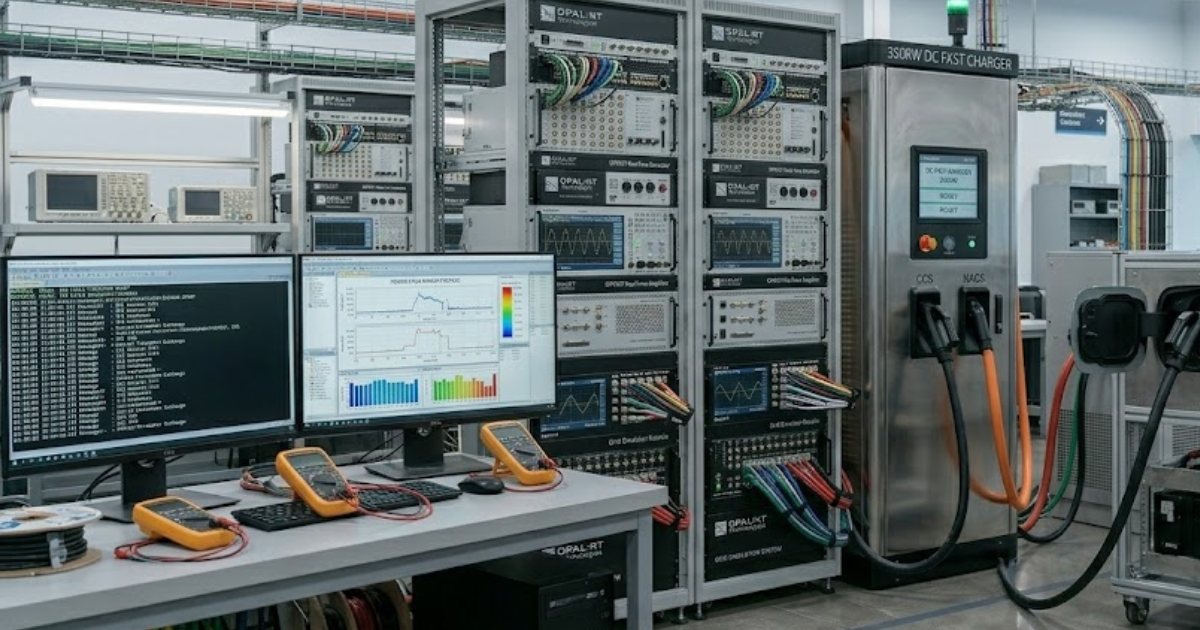
Start with the failures that cost your team the most time, then choose the software that reproduces those failures with the least manual setup. That approach keeps evaluation grounded in timing, electrical response, and back office fit instead of glossy feature lists that don’t help your current validation work.
A practical shortlist comes from a few hard checks. Run one scenario where communication passes but power control slips. Run another where the session closes badly in EV charging station management software. Add a third that forces regression after a firmware update. If the simulator handles those cases cleanly, you’re much closer to a sound choice.
- Match the tool to the standards already on your test matrix.
- Check timing stability during full closed-loop execution.
- Confirm model fidelity against the charger faults you actually see.
- Require automated reruns after firmware and back office changes.
- Review trace output before you judge any interface or dashboard.
Teams usually regret the software that looks easy in a demo and turns opaque during debugging. OPAL-RT fits this stage of evaluation when a lab needs to connect timing, plant models, controller I/O, and automation in one repeatable workflow. That kind of fit matters more than polished screens, because your results will only be as useful as the defects your team can reproduce, isolate, and fix.
Real-time solutions across every sector
Explore how OPAL-RT is transforming the world’s most advanced sectors.

Automotive
10 / 21 / 2026
Megawatt charging system validation for heavy duty trucks
A practical look at how the megawatt charging system works, how it differs from CCS and how charger controls are tested before a truck site is energized.

Automotive
10 / 19 / 2026
Dynamometer testing and motor emulation compared for e-drive programs
A comparison of dynamometer testing and motor emulation for e-drive programs, covering what each method proves, what it costs and how teams sequence both.

Power Electronics
10 / 17 / 2026
How wide bandgap devices push converter power density
Wide bandgap devices raise converter power density through faster switching and smaller passives, and this guide traces that chain from device physics to thermal limits to validation.