Why global labs are standardizing on 240V for power hardware validation
Power Electronics | Power Systems
04 / 30 / 2026

Key Takeaways
- 240 V gives labs a consistent validation baseline for hardware that will ship into many high-line markets.
- Regional differences still matter, so the best practice is a 240 V baseline followed by market-specific checks for voltage and frequency.
- Adding a 240 V outlet only works when the circuit, protection, and panel capacity match the actual test load.
Global validation labs standardize on 240 V because it matches more target markets, reveals power-stage issues earlier, and makes cross-site results easier to trust.
Public electricity supplied at consumer terminals in the United Kingdom is 230 V with a permitted range of 216.2 V to 253.0 V, which is a useful reference point for the many export markets that centre on high-line mains. Labs that validate chargers, inverters, motor drives, and power supplies against that range catch more relevant faults before hardware leaves the bench. You’re also less likely to spend time re-running tests for each destination market. That makes 240 V a practical validation baseline, even when some products will still ship into 120 V regions.
“240 V gives global labs a practical default because it lines up with the supply range used across many export markets and with the power levels common in chargers, converters, and drives.”
240 V sets a common baseline across global validation labs
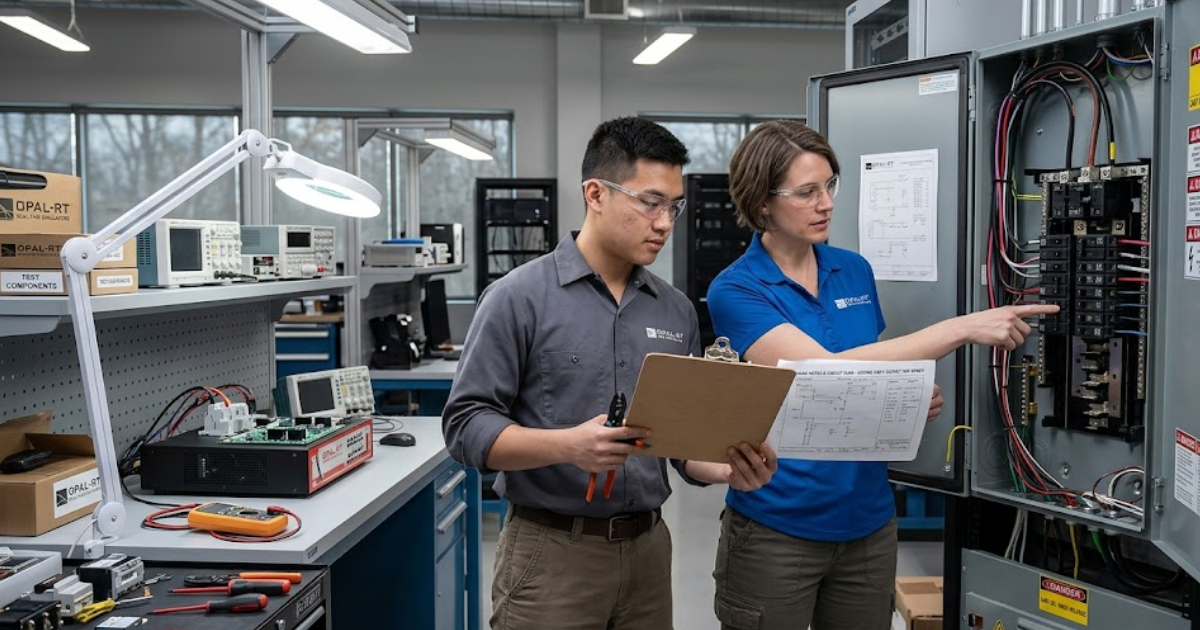
240 V gives global labs a practical default because it lines up with the supply range used across many export markets and with the power levels common in chargers, converters, and drives. That baseline reduces special-case setups. It also makes results easier to compare across sites. You get a cleaner starting point for validation.
A team validating a 3.3 kW onboard charger shows why this matters. At 120 V, that charger sits in a high-current corner of its operating range, while 240 V reflects the line condition it will face in much of Europe, Asia, and Australia. The same pattern shows up with motor drives, UPS units, and grid-edge converters. Labs that begin at 240 V usually see fewer test stand workarounds, fewer cable changes, and fewer arguments about which site used the more representative mains setup.
Regional mains differences still shape what labs must verify
240 V is a useful baseline, but it isn’t the whole validation plan. Regional differences in nominal voltage, line frequency, grounding, plug type, and tolerance bands still affect what you must test. A unit that passes at one site can still fail elsewhere. You need the baseline and the local variants.
Japan is a good example because its mains system sits at 100 V and uses both 50 Hz and 60 Hz depending on region. North American products often see 120/240 V split-phase service, while many other markets centre on 220 V to 240 V single-phase service. If your product includes PFC, hold-up, or line-frequency sensing, those differences aren’t cosmetic. They shape start-up, thermal load, relay timing, and protection thresholds.
| Target market pattern | What the lab must confirm before signoff |
| High-line regions centred near 230 V at 50 Hz | The hardware must start cleanly and hold regulation across the expected tolerance band. |
| North American split-phase service with 120 V and 240 V options | The setup must reflect which loads run from branch circuits and which use dedicated high-power feeds. |
| Markets with lower nominal mains such as 100 V or 120 V | The test must check current rise, conductor heating, and weak-line performance under load. |
| Regions with 50 Hz mains | Input filtering, timing assumptions, and zero-cross detection need direct verification. |
| Sites with unstable facility power | The lab must separate product faults from source impedance, sag, and grounding problems. |
240 V exposes power stage behaviour that 120 V can miss
240 V reveals operating conditions that 120 V often hides in power hardware. Semiconductor switching, bus charging, harmonic content, and thermal spread all shift when the same power is delivered at a higher line voltage. Those shifts affect pass and fail outcomes. You can’t assume low-line testing covers them.
A front-end PFC stage makes the difference easy to see. At 240 V, the converter can enter a different duty-cycle range, charge the DC bus faster, and show a distinct current waveform during start-up. That affects component heating and control stability, especially near protection limits. A bench supply or AC source set only to 120 V will miss that operating region, which leaves a gap right where production hardware often spends much of its service life.
120 V remains useful for controls not full power tests
120 V still has a clear role in validation when the focus is controls, firmware, sequencing, or communications rather than full-power conversion. It keeps setups simpler and safer for early integration work. It also helps labs stage testing in a sensible order. You don’t need 240 V for every bench task.
A control board tied to contactors, sensors, and a low-power auxiliary supply can be exercised well at 120 V. You can check relay logic, fault latching, ADC scaling, CAN timing, and shutdown sequencing before exposing the main power stage to higher stress. That saves wear on expensive hardware and reduces setup time during debugging. Once the controls are stable, moving to 240 V becomes a focused validation step instead of a messy hunt for basic integration faults.
Higher voltage cuts current stress inside lab power setups
Higher voltage reduces current for the same power, and that matters across the whole lab setup. Cables run cooler, breakers have more headroom, and source impedance has less effect on the device under test. The gain isn’t abstract. It shows up in cleaner measurements and fewer nuisance trips.
A 3 kW load draws roughly 25 A at 120 V and about half that at 240 V. That difference affects conductor size, connector temperature rise, clamp meter accuracy, and the voltage drop between your panel and the bench. If you run power-hardware-in-the-loop on OPAL-RT, the simulator fidelity won’t rescue a weak AC source or an undersized feeder. Labs that validate at higher line voltage usually spend less time chasing issues that actually belong to the facility wiring.
Adding a 240 V outlet starts with load planning
If you plan to install a 240 V outlet for validation gear, start with the actual electrical load and duty cycle. The right circuit rating depends on continuous current, plug type, breaker coordination, and upstream panel capacity. A receptacle choice on its own tells you very little. Load planning has to come first.
Before adding a 240 V outlet, check these points:
- The circuit amperage matches the sustained test load.
- The receptacle pattern matches the equipment plug and grounding scheme.
- The panel has space and capacity for a dedicated branch circuit.
- The wiring route supports the conductor size and protection required.
- The bench layout keeps disconnect access clear during testing.
A lab feeding a programmable AC source, an isolation stage, and a 7 kW inverter bench needs a very different branch circuit from a small control test station. Level 2 electric vehicle charging uses 240 V service in homes, which is a clear sign that higher-power validation quickly exceeds ordinary receptacles. If you skip the load plan, you’ll install a 240 V outlet that looks correct yet still limits the tests you can run safely.
The cost to install a 240 V outlet varies
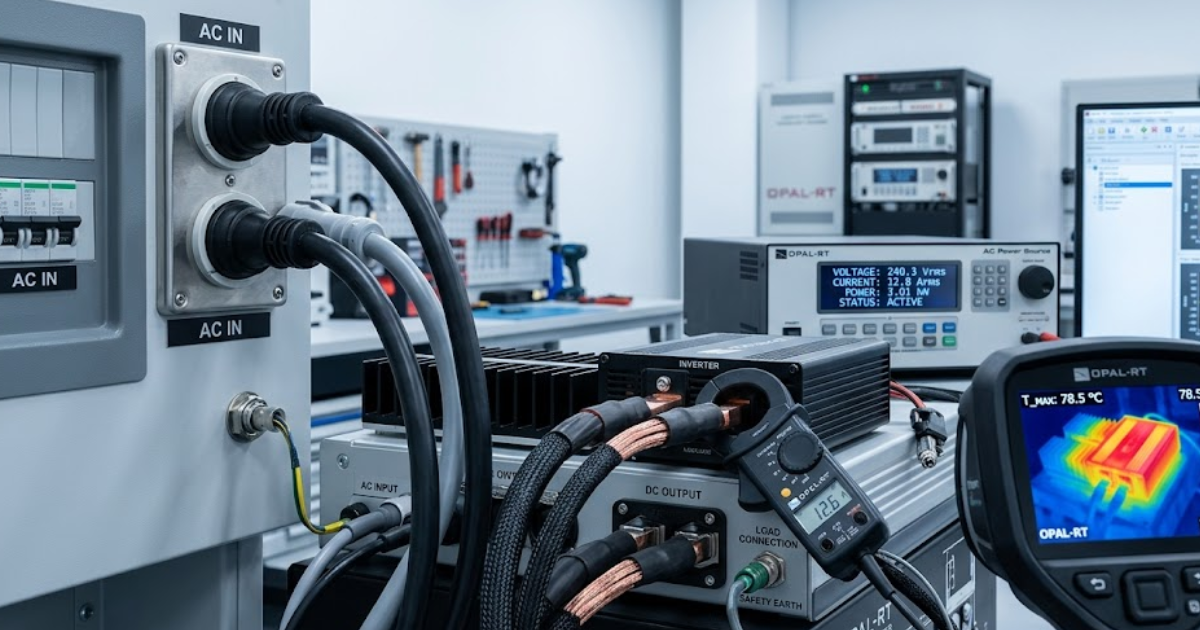
The cost to install a 240 V outlet depends more on panel access and circuit complexity than on the receptacle itself. Distance from the panel, conductor size, wall construction, permit rules, and breaker upgrades will set the price. That’s why two similar labs can get very different quotes. The labour is rarely the same job twice.
A short run to an open panel with spare capacity is the cheap case. Costs rise when you need a subpanel, a larger feeder, conduit, surface raceway, or an isolated location for noisy power equipment. Some labs also need a lockable disconnect, surge protection, or a receptacle style that matches imported hardware. If you’re budgeting for 240 V outlets, treat the electrical path, protection hardware, and inspection requirements as part of the validation budget rather than as an afterthought.
“Teams that treat supply voltage as part of the test system, instead of a facility afterthought, build results you can trust when hardware leaves the bench.”
Mismatched supply assumptions distort validation results before field deployment
Supply assumptions shape validation quality more than many teams expect. A product tested on the wrong mains profile can look stable in the lab and then misbehave once it sees the voltage, current, and frequency conditions it was actually built for. That gap is preventable. It comes from treating facility power as part of the test method.
A disciplined lab treats the 240 V outlet, the feeder, the protection scheme, and the AC source settings as validation variables with the same status as sensors and firmware builds. OPAL-RT fits into that work when the simulation stack is strong enough that mains assumptions become the next source of error. Teams that treat supply voltage as part of the test system, instead of a facility afterthought, build results you can trust when hardware leaves the bench. That judgment holds up long after a single test campaign ends.
Real-time solutions across every sector
Explore how OPAL-RT is transforming the world’s most advanced sectors.

Power Electronics
08 / 24 / 2026
Real-time simulation of matrix converters
This guide explains what a matrix converter is, why commutation makes it hard to model, and how a real-time AC-AC converter model is validated.

Automotive
08 / 24 / 2026
What powertrain means in automotive and how engineers test it
A clear explanation of what a powertrain is in automotive, how its parts and controls work, how it differs from the drivetrain, and how engineers test it.

Power Electronics
08 / 23 / 2026
How to simulate power electronics on FPGA for nanosecond timesteps
FPGA power electronics simulation preserves switch-level timing, supports mixed FPGA and CPU model partitioning, and helps you choose an FPGA board for accurate converter testing.