9 simulation approaches supporting advanced batteries and hydrogen storage
Simulation
12 / 10 / 2025

Key Takeaways
- Simulation has become a central tool for energy storage innovation, giving engineers a concrete way to test advanced batteries, hydrogen storage concepts, and control strategies before hardware is built.
- Physics based, hybrid electrical thermal, and multiscale models help teams connect cell level behaviour with system and grid level performance, which supports better design decisions and more credible business cases.
- Real time grid modeling and power hardware testing provide a safe space to validate grid services, controller behaviour, and protection schemes so storage assets support grid modernization objectives with fewer surprises.
- Digital twin approaches, supported by AI assisted analysis, turn simulation into a continuous asset that tracks long term storage health, informs maintenance plans, and refines operating policies over time.
- OPAL-RT gives engineering teams a practical way to apply these methods through real time simulation platforms, hardware in the loop testbeds, and open toolchains that match the pace and complexity of modern storage programs.
Engineers building next generation energy storage systems know that guesses are expensive and validated insight is priceless. Battery packs, hydrogen tanks, and hybrid plants sit at the centre of clean power strategies across regions. You face tough questions about cost, risk, and performance long before a single cell or valve reaches the lab. Simulation offers a concrete way to test storage concepts early, adjust designs with confidence, and avoid surprises during deployment.
As control loops, communication links, and market rules grow more complex, traditional spreadsheets and offline studies start to feel thin. You need models that connect electrochemistry with grid behaviour, and platforms that connect those models with actual controllers. Real-time simulation, power hardware testing, and AI assisted analysis give you a way to try edge cases without putting assets at risk. The focus is shifting from proving that storage works in isolation to proving that it works as part of a reliable and flexible energy system.
Understanding current progress shaping energy storage innovation
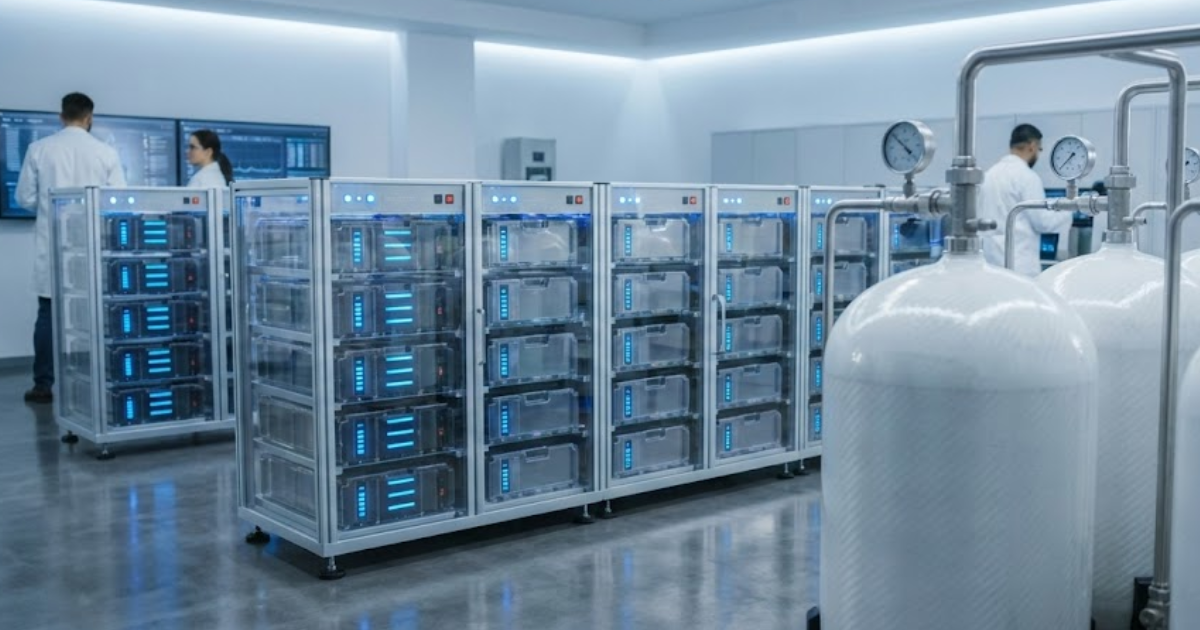
Costs for lithium based batteries have fallen over the past decade, and new chemistries continue to appear in pilot projects. At the same time, utilities are integrating more variable renewables, so storage needs to provide fast balancing, longer duration capacity, and stability support. Energy storage innovation is no longer only about higher energy density, because operators also need safe operation, easier recycling, and predictable lifetime. Hydrogen storage is gaining attention for multi day or seasonal balancing, especially where large scale tanks or underground caverns can be developed. These shifts create strong motivation for more advanced simulation that captures interactions between storage devices, power electronics, and the wider grid.
Simulation now sits closer to project decisions than ever, guiding chemistry choices, pack layouts, and siting of storage assets. Teams want to know how a new cell recipe or hydrogen configuration behaves under extreme temperatures, grid faults, and unusual usage patterns before hardware is manufactured. Clean energy technology strategies increasingly rely on model based checks to filter ideas, align stakeholders, and build credible business cases. As models improve in fidelity and run faster, they unlock more scenarios, more sensitivity studies, and more confidence in storage decisions. The result is a tighter link between simulation outcomes and project risk, which puts new expectations on the tools and methods you choose.
9 simulation approaches supporting advanced batteries and hydrogen storage
Different stages of an energy storage program benefit from different types of simulation, from early paper studies through to pre-commissioning tests. Some models answer detailed questions about ion transport inside a cell, while others focus on how converters and storage units behave on a large grid. A clear structure for these methods helps teams share assumptions, reuse models, and maintain traceability from concept studies to field validation. Thinking in terms of distinct approaches helps you pick the right mix of tools, focus effort, and justify simulation choices to leadership.
1. Physics based battery modeling for early architecture evaluation
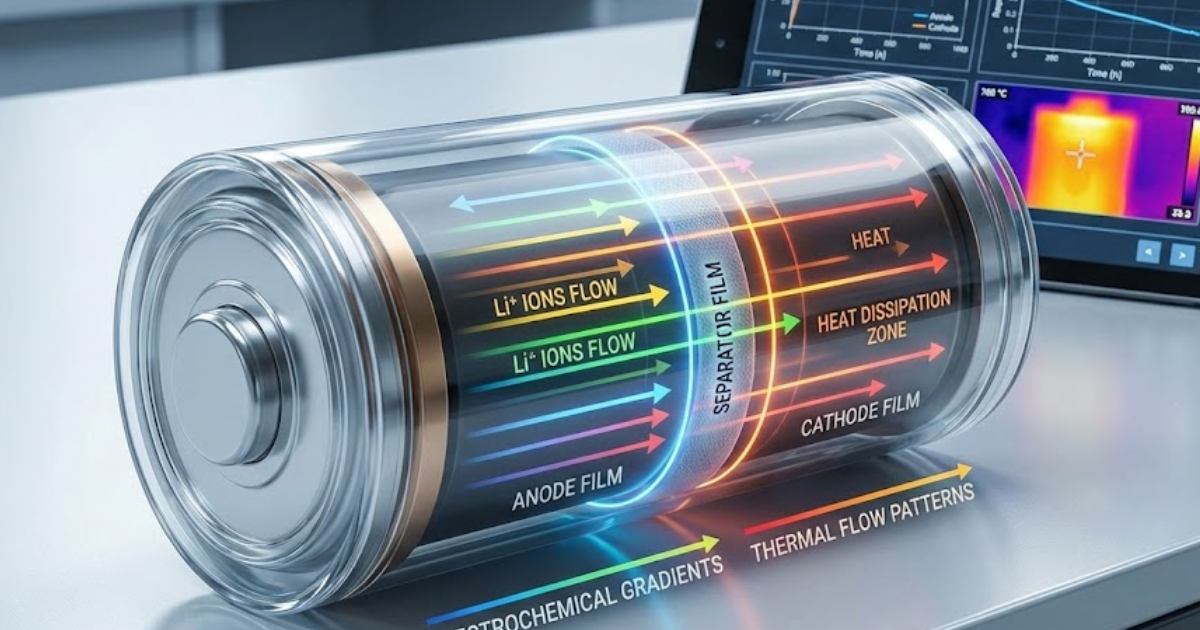
Physics based battery modelling uses equations for charge transport, electrochemical reactions, and thermal behaviour instead of simple curve fits. These models describe how concentration, potential, and temperature change inside the electrodes and electrolyte during charging and discharging. You can evaluate cell formats, electrode thicknesses, and coolant layouts before investing in prototypes, because the model exposes internal limits like lithium plating or local hot spots. This level of detail makes early architecture evaluation more grounded, especially when you need to compare different chemistries or vendors using fair assumptions.
For program planning, physics based models help you identify which operating windows keep degradation slow while still meeting power and energy targets. You can link the cell model to a pack model, include contact resistances and busbars, and then attach a controller that runs realistic charge and discharge strategies. Sensitivity studies on ambient conditions, load profiles, and cooling system faults reveal where design margins are thin and where extra cost brings limited benefit. Teams gain a shared reference that ties lab data, field data, and control concepts back to underlying physics, which supports clearer engineering decisions.
2. Hybrid electrical thermal simulation improving storage system stability
Hybrid electrical thermal simulation combines electrical circuit models with detailed thermal networks so that voltage, current, and temperature influence each other consistently. This approach captures how converter switching, contact resistances, and coolant flow affect cell temperatures, which then feed back into internal resistance and available power. Without this coupling, you might size components correctly on paper but still face unexpected derating, stress, or protection trips during operation. Hybrid models let you evaluate stability of storage units under worst case ambient conditions, tight converter limits, and aggressive cycling patterns.
Engineers often start with reduced order thermal models for packs and cabinets, then refine areas with high gradients using more detailed meshes as needed. When you link these models to control software, you can check how algorithms respond to uneven heating, blocked cooling channels, or fan faults. The same hybrid framework supports decisions about sensor placement, fault thresholds, and redundancy, which directly affects safety cases and certification. Over time, measured temperature data can be used to calibrate and tune the model, improving alignment between simulation and field behaviour.
3. High fidelity hydrogen storage simulation shaping clean energy planning
High fidelity hydrogen storage simulation focuses on thermodynamics, fluid flow, and materials interactions in tanks, pipelines, and storage caverns. Pressurization, cooling, and filling strategies have strong effects on stress, fatigue, and usable capacity, so they need more than simple steady state assumptions. Detailed models consider compression stages, heat exchange, and transient mass flow, which helps designers avoid issues like unexpected temperature spikes or stratification. For projects planning hydrogen storage beside renewables, accurate simulations become important for scheduling compression, matching supply and load, and protecting equipment.
These models also support safety studies, including leak scenarios, vent sizing, and emergency depressurization sequences. When combined with grid models, hydrogen storage simulations show how conversion between electricity and hydrogen can support long duration balancing. Planners can compare configurations that pair electrolysers, storage tanks, and fuel cells with different sizing rules, operating strategies, and pricing assumptions. This helps decide where hydrogen storage fits best as part of a portfolio of clean energy technology options, instead of treating it as an isolated project.
4. Electrochemical modeling supporting new active material development
Electrochemical modelling gives researchers a way to explore new active materials, binders, and electrolytes before committing to extensive synthesis campaigns. Changes in diffusion coefficients, reaction kinetics, or transport properties can be translated into performance predictions at cell level with controlled assumptions. Researchers can test how a material behaves under high rate charging, low temperature operation, or partial state of charge cycling without building dozens of experimental cells. This helps narrow down promising combinations for lab testing, which saves time and budget in early stages of material selection.
Electrochemical models also help connect material behaviour with degradation paths such as solid electrolyte interphase growth, gas generation, or structural changes. When these effects are captured in simulation, teams gain insight into how manufacturing tolerances or impurity levels could shorten lifetime. The same models can be simplified into faster formats for integration into pack, system, or grid studies, preserving the most important sensitivities. This chain from detailed to reduced order models improves consistency across research teams and supports traceable design choices from material to system scale.
“Engineers building next generation energy storage systems know that guesses are expensive and validated insight is priceless.”
5. Multiscale simulation linking cell behaviour with system level performance
Multiscale simulation connects detailed cell or module models to higher level models of packs, power electronics, and grids. This structure lets you keep fine detail where it matters, such as inside limiting cells, while using simplified models elsewhere to keep simulations efficient. For example, you might model a few modules with full electrothermal detail and represent the rest with equivalent circuits that match dynamic response. This balance gives enough accuracy to study state of charge imbalances, ageing differences, and control interactions without making runtimes impractical.
Multiscale approaches are especially useful when storage participates in services like frequency control, voltage support, or congestion relief. Control engineers can check how fleet level commands translate into stress on specific cells, contactors, and fuses. Planning teams can test how different operating policies affect degradation distributions across packs, which matters for warranty and maintenance strategies. The result is a more complete picture of performance that connects what happens inside cells with how the storage asset behaves in larger power systems.
6. Power hardware testing improving control validation for storage units
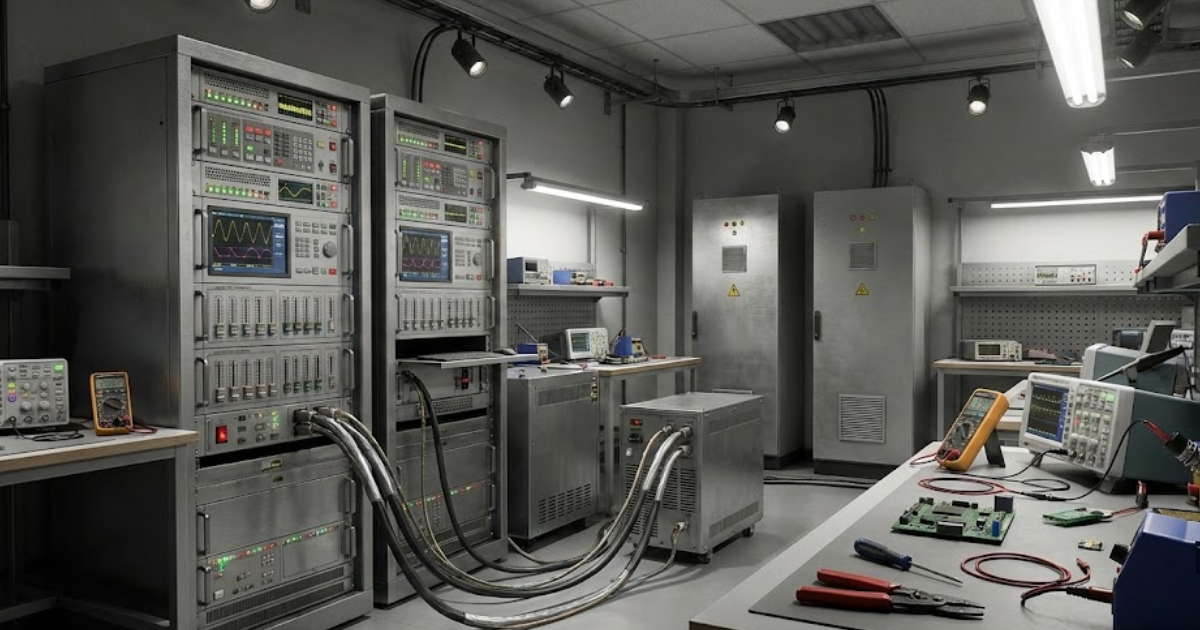
Power hardware testing connects actual converters, controllers, or protection devices to a simulated grid, storage unit, or plant in real time. Engineers can stress control code with faults, transients, and extreme operating conditions that would be risky or costly to reproduce with live assets. This type of test reveals issues like unexpected trip sequences, timing problems, or interactions between multiple control loops. Hardware tests complement software simulation, because they capture sensor behaviour, communication delays, and non idealities that are hard to model accurately.
For energy storage, power hardware setups support validation of converter controls, battery management systems, and hydrogen plant controllers before site commissioning. Teams can model grids, renewables, and storage devices on a real-time simulator, then connect physical control cabinets to that virtual system. This approach uncovers integration issues between protection relays, controllers, and supervisory systems early enough to adjust code or hardware layouts. The same testbed often serves multiple projects, which spreads cost and builds a shared library of proven test cases.
7. Real time grid modeling assessing storage integration performance
Real time grid modelling runs network, generation, and load models fast enough to exchange signals with actual control hardware at small time steps. This allows storage controllers to see realistic voltages, currents, and frequency behaviour while they execute their normal software. Engineers can reproduce fault events, weak grids, and complex interactions between inverter based resources and traditional equipment without putting infrastructure at risk. These studies support questions about grid codes, protection schemes, and acceptable operating regions for storage assets under different connection points.
Real time grid models can include detailed networks at distribution or transmission level, as well as aggregated representations of neighbouring areas. Storage units can then be tested for voltage control, islanding behaviour, and support during system restoration after outages. Grid operators and project developers use these tests to verify that storage does not create new instabilities when providing services like fast frequency response. The same platform can later validate firmware updates or new control modes before deployment, keeping behaviour consistent over the asset lifetime.
8. Digital twin simulation supporting long term storage health insights
Digital twin simulation keeps a model of a storage asset running in parallel with measurements from the actual equipment. The model tracks estimated state of charge, state of health, and expected degradation under the same duty cycle that the asset experiences. When simulated behaviour starts to drift from measured data, engineers can investigate causes like calibration issues, unexpected usage, or emerging faults. These insights support targeted maintenance, improved operating policies, and more precise projections of remaining useful life.
For battery systems, digital twins might combine electrochemical ageing models with data driven corrections based on field measurements. Hydrogen storage twins can monitor cycles, temperatures, and pressures, then estimate how close components are to fatigue or inspection limits. Long term simulations also inform future procurement, since they reveal how design decisions affect performance over many years. When linked with asset management tools, this approach helps storage portfolios maintain availability and meet contractual commitments with fewer surprises.
9. AI assisted simulation improving development speed for storage programs
AI assisted simulation uses machine learning models to complement physical models, speeding up tasks like parameter estimation, meta modelling, or scenario screening. Surrogate models can approximate detailed simulations with much lower computational cost, which makes large design of experiments studies more practical. Pattern detection in simulation results can reveal non intuitive relationships between design variables and performance metrics. These tools help prioritise which configurations deserve full high fidelity simulation or hardware testing, saving time in crowded project schedules.
AI methods also support automated test generation for hardware in the loop, proposing sequences that excite important modes or corner cases. When combined with digital twins, they can flag unusual trends and suggest targeted simulation runs to investigate possible causes. Careful validation remains essential, so teams still rely on physics based models and expert review to keep AI guided work grounded. The best outcomes come when AI assisted tools are treated as helpers that accelerate engineering judgement, not as replacements for domain knowledge.
“Combining detailed physics, multiscale structures, and hardware testing gives storage projects a firmer technical foundation.”
Summary of simulation approaches
| Approach | Primary focus | Key engineering benefit | Typical applications |
| Physics based battery modelling | Detailed cell behaviour based on physical laws | Early architecture comparison grounded in electrochemistry and thermal behaviour | Selecting chemistries, cell formats, and pack layouts |
| Hybrid electrical thermal simulation | Coupled electrical and thermal response of storage systems | Better sizing of components and cooling for stable operation | Pack design, cabinet design, and converter integration |
| High fidelity hydrogen storage simulation | Thermodynamics and flows in storage tanks and related equipment | More accurate capacity, safety, and lifetime assessments | Hydrogen tank farms, pipelines, and power to gas projects |
| Electrochemical modelling for materials | Linking material properties to cell performance and ageing | Faster screening of new active materials and electrolytes | R&D on electrodes, electrolytes, and additives |
| Multiscale simulation | Connecting detailed models with system and grid models | Consistent view from cell to grid level behaviour | Service definition, warranty studies, and fleet studies |
| Power hardware testing | Real time interaction between hardware and simulated systems | Early detection of control and protection issues | Converter testing, BMS validation, and plant controllers |
| Real time grid modelling | High speed grid and plant simulation for control tests | Confidence that storage meets grid codes and stability needs | Grid studies, connection assessments, and compliance tests |
| Digital twin simulation | Continuous model linked with field measurements | Better insight into degradation, faults, and remaining life | Operations support, maintenance planning, and warranty follow up |
| AI assisted simulation | Machine learning models supporting physics based models | Faster studies and richer analysis of design spaces | Design of experiments, anomaly detection, and test optimisation |
Combining detailed physics, multiscale structures, and hardware testing gives storage projects a firmer technical foundation. When each simulation approach has a clear purpose, teams spend less time debating tools and more time comparing credible design options. Strong links between cell level models, system behaviour, and grid performance also make it easier to align researchers, product engineers, and grid specialists. As requirements for advanced batteries and hydrogen storage grow, this mix of simulation methods helps projects move from concept to confident operation with fewer surprises.
How engineering teams apply these methods for grid modernization
Grid modernization efforts rely on storage to support stability, host more renewables, and provide services that traditional generators once supplied. Engineering teams must show how new storage assets affect power quality, protection schemes, and operating margins before projects proceed. Simulation and testing allow those teams to answer questions with clear evidence instead of rough rules of thumb or over conservative assumptions. The way these methods are applied in practice depends on project phase, available hardware, and how close a design is to deployment.
- Early concept screening for storage roles: Teams use simplified grid and storage models to compare options such as peak shaving, frequency support, and congestion management at candidate sites. These studies filter configurations that are technically weak before detailed design begins, which saves engineering effort later.
- Integrated design of converters and storage assets: Hybrid electrical thermal models and physics based batteries help match converter limits, protection settings, and cooling capacity with realistic operating profiles. This alignment reduces the risk of unexpected derating, nuisance trips, or thermal issues once equipment is installed.
- Validation of grid services and compliance: Real time grid modelling linked to power hardware testing allows teams to test grid code behaviour, fault ride through, and protection coordination with actual controllers. Evidence from these tests supports discussion with regulators and system operators about new services or connection configurations.
- Planning for resilience and restoration: Multiscale simulations examine how storage contributes during outages, islanded operation, and restoration sequences after major faults. These studies highlight required control modes, communications, and sequencing rules so that storage supports recovery rather than introducing instability.
- Operational optimization and asset management: Digital twins and AI assisted analysis help operators adjust dispatch strategies, cycling profiles, and maintenance plans as conditions change over the asset life. Insights from these models guide decisions on firmware updates, spare parts, and replacement timing, which protects both performance and revenue.
- Portfolio level planning across multiple sites: Simulation workflows scale from single projects to fleets of storage assets connected at different voltage levels and locations. Consistent models across the portfolio give planners confidence when comparing investment options, sequencing upgrades, and coordinating storage with other clean energy technology.
Uses like these show that simulation is not just a report deliverable, but a continuous companion across storage project life cycles. From feasibility through to operations, the same core models can be refined, shared, and reused in ways that limit duplicated work. Grid modernization gains speed when planners, equipment vendors, and operators work from shared models instead of isolated spreadsheets or opaque black boxes. A structured simulation strategy also helps justify investments in labs and tools, since stakeholders can see how those resources support specific decisions and project outcomes.
How OPAL-RT supports advanced simulation for energy storage programs
OPAL-RT works with engineering teams that need real-time simulation, power hardware testing, and flexible models for energy storage innovation. The company provides modular simulators and software that connect detailed storage models with actual controllers, protection devices, and power hardware. Engineers can run physics based battery models, hydrogen storage representations, and grid networks at time steps suitable for closed loop control tests. This setup lets you validate converter controls, battery management strategies, and plant coordination under high stress conditions before equipment is shipped or commissioned.
Teams often start with desktop model development, then move to real-time execution with hardware in the loop and finally to extended digital twin studies, all on the same OPAL-RT infrastructure. Open interfaces allow models from different tools and languages to interact, which helps protect earlier investments in storage modelling and controls. Support engineers and application specialists help adapt platforms to specific test benches, grid codes, and storage technologies so that projects benefit from proven practice rather than one off experiments. Clients gain a technical partner they can trust for long term simulation, validation, and grid modernization studies that carry real weight with internal and external reviewers.
Common Questions
How do I choose the best power system simulation software for my project?
Choosing the right tool depends on the type of studies you need, such as electromagnetic transient analysis, steady-state planning, or hardware-in-the-loop validation. You should compare solver methods, model libraries, and integration paths with your existing workflow. Real-time capability and hardware connections are key if your project requires closed-loop testing. OPAL-RT helps you match the right simulation approach with practical lab integration so you can move faster with less risk.
What’s the difference between offline and real-time power system simulators?
Offline simulators run detailed studies without time constraints, which makes them well suited for design and sensitivity analysis. Real-time simulators, on the other hand, execute models within strict time steps to stay synchronized with hardware and controllers. Both approaches often work best when paired, with offline studies guiding scenarios later tested in real time. OPAL-RT bridges this gap by supporting both offline modeling and real-time execution, giving you continuity across design and testing stages.
Why should I use hardware-in-the-loop for power system projects?
Hardware-in-the-loop (HIL) allows you to test controllers, relays, and converters against simulated grids before using live hardware. This approach improves safety, reduces test time, and exposes issues earlier when they are less costly to fix. With accurate models and tight timing, you can validate protections, controls, and fault cases with confidence. OPAL-RT offers purpose-built HIL platforms that give engineers a reliable way to test without putting equipment or schedules at risk.
Can power system modeling and simulation improve collaboration between my teams?
Yes, consistent simulation models serve as a shared reference across design, testing, and planning teams. When everyone works from the same data sets, it reduces duplication, errors, and misalignment between studies. Shared libraries and automation also make it easier to reproduce cases and track changes over time. OPAL-RT supports open standards and scripting so you can integrate across groups while keeping models transparent and traceable.
How can I future-proof my investment in simulation tools?
The most effective way is to choose platforms that are open, scalable, and adaptable to new standards. You want flexibility to run larger networks, add new device models, or connect emerging hardware without starting over. Cloud-ready and AI-compatible solutions also ensure you can extend capabilities as projects grow. OPAL-RT designs its platforms to scale with your requirements so you can be confident your simulation setup will remain relevant.
Real-time solutions across every sector
Explore how OPAL-RT is transforming the world’s most advanced sectors.

Power Electronics
12 / 16 / 2025
7 Top power electronics simulation tools for engineers
Power electronics engineers use targeted simulation tools to improve modelling fidelity, de-risk controller validation, and link offline studies with real-time and hardware-in-the-loop testing.
Simulation
12 / 12 / 2025
8 reasons engineers rely on hardware in the loop systems for power electronics
Hardware in the loop testing for power electronics helps your team validate controllers earlier, study demanding grid and fault conditions safely, and build a reliable path from models to high-confidence hardware results.
Simulation
12 / 08 / 2025
Accelerating renewable integration projects with HIL and SIL simulation
Real-time HIL and SIL simulation turn renewable integration projects into faster, safer efforts by validating control strategies and grid interactions in the lab before deployment.
EXata CPS has been specifically designed for real-time performance to allow studies of cyberattacks on power systems through the Communication Network layer of any size and connecting to any number of equipment for HIL and PHIL simulations. This is a discrete event simulation toolkit that considers all the inherent physics-based properties that will affect how the network (either wired or wireless) behaves.