
Thank you
Your message is on its way.
In the meantime, explore how real-time simulation supports engineers solving complex testing and validation challenges across energy, aerospace, automotive, and more.

Need technical support?
To efficiently address your needs, please open a support case through our portal. This directly connects you with our technical support team. Our portal also provides access to our knowledge base for quick self-service solutions.
Our Testing Approaches
Integrated testing for smarter engineering

Hardware-in-the-loop
HIL simulation is the gold standard for developing and validating the most advanced control, protection, and monitoring systems.

Power hardware-in-the-loop
PHIL simulation builds on HIL by introducing real power exchanges between simulated and physical systems.

Rapid control prototyping
RCP enables faster control development by integrating models, typically based on MATLAB/Simulink™, directly into a real-time simulator.

Software-in-the-loop
SIL testing allows engineers to integrate compiled production code directly into a real-time simulation environment.

Simulation acceleration
Our simulation acceleration technology uses the full capacity of multi-core architectures to significantly reduce simulation time, especially for computationally intensive tasks like EMT simulations.

Digital twins for advanced simulation
By creating virtual replicas of physical systems, organizations can gain deeper insights, troubleshoot issues before they arise, and explore innovative solutions to complex challenges.
Blog
Discover our latest articles
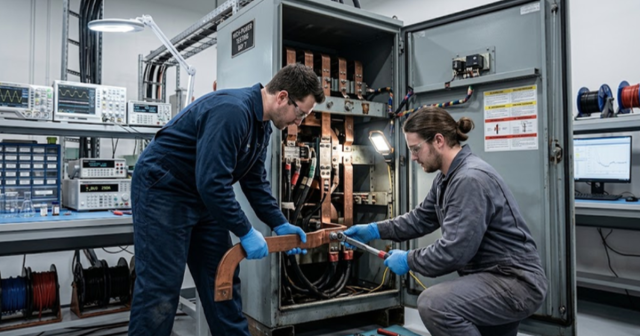
Microgrid
09 / 19 / 2026
Hybrid AC-DC microgrid emulation with power hardware-in-the-loop
An examination of how hybrid AC-DC microgrid stability is set at the interlinking converter and why power hardware in the loop is required to test that boundary at full power.

Power Electronics
09 / 17 / 2026
BLDC motor control fundamentals with simulation examples
A technical primer on six step BLDC commutation, Hall sensor and sensorless back EMF position sensing, torque ripple at each switching instant, and the simulation exercises a teaching lab can run.
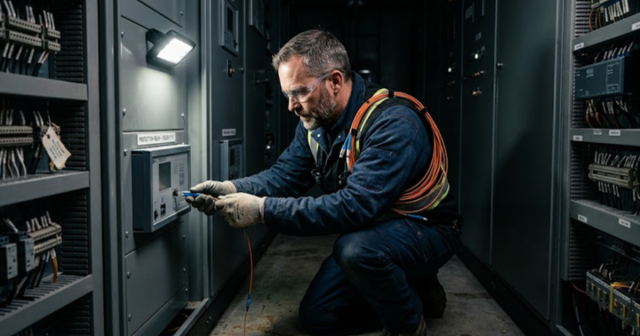
Power Systems
09 / 16 / 2026
How to build a protection relay testing workflow utility engineers trust
A practical look at how utility engineers build protection relay testing workflows, from secondary injection through closed loop validation against a real time power system model.