Key Takeaways
- DNP3 was built for slow, unreliable utility links, and its event reporting gives operators an accurate sequence of events after a fault.
- Growing numbers of distributed energy resources push DNP3 links toward event storms, stale setpoints and overloaded polls.
- Testing DNP3 against a real-time grid model shows how the whole control system behaves during a disturbance, which protocol testers alone can’t.
DNP3 remains one of the main protocols carrying utility SCADA traffic, and the only reliable way to know how a DNP3 control scheme behaves is to test it against a grid model that reacts in real time.
The number of devices that need DNP3 links is growing quickly at the edge of the grid. U.S. small-scale solar generation reached 92,979 GWh in 2025, up from 18,812 GWh in 2016, and much of that capacity now has to be monitored and dispatched by utilities through the same SCADA systems that once watched only substations and feeders.
That shift puts a protocol designed in the 1990s at the centre of modern distribution control. DNP3 handles it well when its configuration matches the grid it serves, and poorly when nobody has tested how polling, events and control commands behave during a real disturbance.
What the DNP3 protocol does in utility SCADA
DNP3, the Distributed Network Protocol, carries measurements, status changes and control commands between a SCADA master and field devices such as RTUs, relays and inverters. It was built for unreliable, low-bandwidth utility links, so it timestamps events at the source and lets devices report changes without being asked.
Those design choices explain why it’s still everywhere in North American electric, water and gas networks. A recloser on a rural feeder can report a trip with millisecond timestamps over a slow radio link, and the operator still sees the sequence of events in the order it happened.
How DNP3 masters exchange data with field outstations
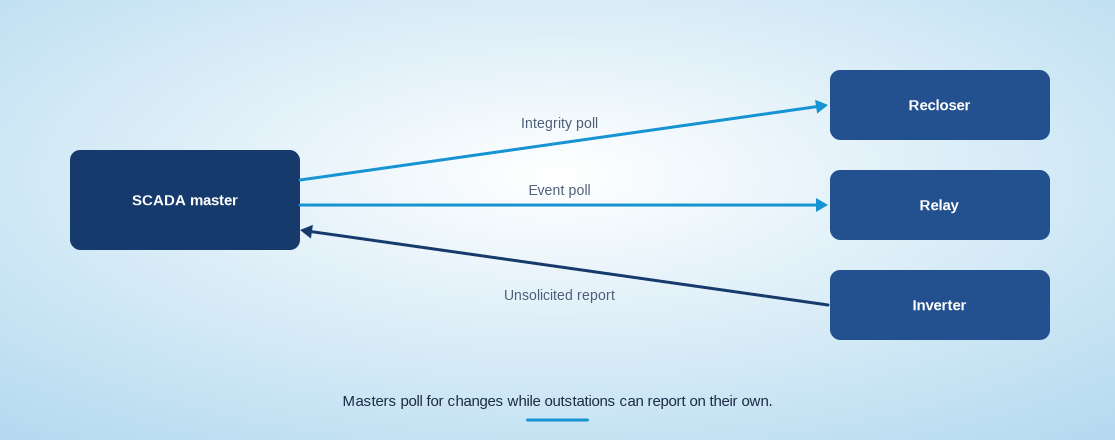
A DNP3 master polls outstations for data and sends control commands, while outstations answer polls and can send unsolicited reports when something changes. Data is organized into object groups and variations, such as binary inputs, analog inputs and counters, each with defined formats and classes.
Polling usually runs in two layers. Integrity polls request every point periodically to confirm the database is correct, and event polls request only what changed since the last request. Event data is sorted into classes 1, 2 and 3, so a master can ask for urgent changes often and less important ones occasionally.
Controls follow a select-before-operate sequence for critical outputs. The master selects a point, the outstation confirms, and only then does the operate command execute, which protects breakers from a corrupted or misrouted message.
Every one of those mechanisms has timeouts, retries and buffer limits. They work well on a quiet day and get tested hard when a storm drives hundreds of events through a link at once. A retry setting that looks harmless can stretch a control response from one second to ten when the link is congested.
“Testing authentication in isolation proves the cryptography.”
Why event reporting is the feature that defines DNP3
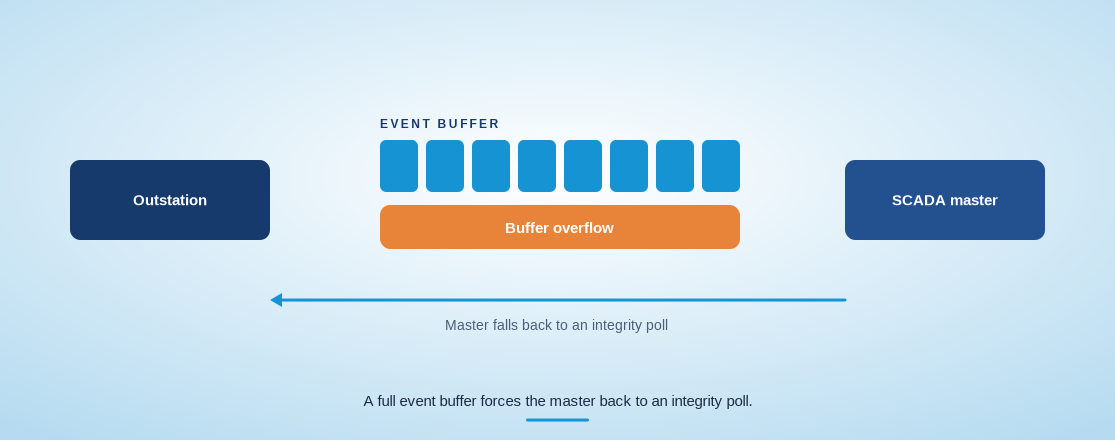
Event reporting defines DNP3 because it lets outstations buffer changes with timestamps and deliver them reliably, even after a communication outage. Operators get an accurate sequence of events, which is essential for understanding faults and for post-event analysis.
The weak point is buffer sizing. If an outstation’s event buffer overflows during a burst, it drops events and sets a flag, and the master has to fall back to an integrity poll. During a fault that trips several devices, that fallback can delay the picture the operator needs most. Buffer sizes are set in each device’s configuration, often by different teams at different times, so a feeder can carry a mix of outstations that behave very differently under the same burst. Finding the smallest buffer before a storm does is a configuration review that only a realistic event load can drive.
Where DNP3 Secure Authentication fits into utility operations
DNP3 Secure Authentication adds challenge and response checks to critical messages, so an outstation can confirm a control command came from an authorized master. It’s defined in IEEE 1815 and adds latency and key management work that has to be tested alongside normal operation.
Key changes are the scenario most often skipped. If a key update fails or arrives late, an outstation can reject legitimate controls during exactly the event when operators need them, and that failure only shows up when the timing is exercised deliberately.
Testing authentication in isolation proves the cryptography. Testing it during a simulated fault proves the operator can still open a breaker on time.
What breaks when DNP3 meets distributed energy resources
DNP3 strains when it meets large numbers of distributed energy resources because each inverter adds points, events and control requests to links that were sized for a few substations. IEEE 1547 names DNP3 as one of the interfaces for distributed resources, so utilities can’t avoid the scaling question.
Wind and solar generated a record 17% of U.S. electricity in 2025, and a growing share of that output sits behind distribution feeders. Failures tend to appear in a few predictable places.
- Event storms when many inverters ride through the same voltage sag
- Stale setpoints when a curtailment command reaches some devices late
- Integrity polls that overload slow radio or cellular links
- Mismatched point maps after a firmware update on one inverter model
- Time synchronization drift that scrambles the sequence of events
“A retry setting that looks harmless can stretch a control response from one second to ten when the link is congested.”
How to test DNP3 communication against a live grid model
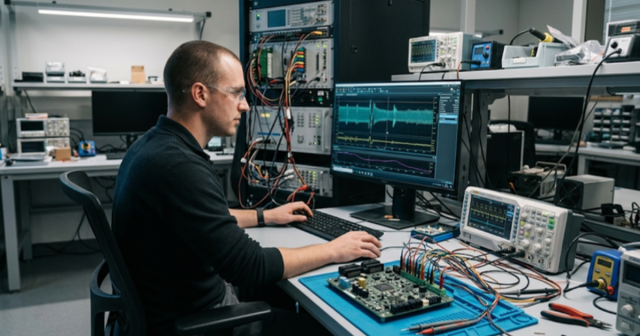
You test DNP3 communication against a live grid model by connecting the real SCADA master, RTUs and protection devices to a real-time simulation of the network. The simulator drives realistic voltages and currents into the devices and also acts as additional DNP3 outstations, so the whole control system sees one consistent grid.
Protocol testers can verify message formats on a bench, but they can’t show how the system behaves when the grid itself is moving. A real-time model can apply a fault, trip relays, generate hundreds of events and watch how quickly the master’s view catches up. Utilities and integrators using OPAL-RT simulators often run those scenarios as part of factory acceptance, before a control centre upgrade goes live.
The table summarizes what each test setup can confirm.
| Test setup | What it confirms | What it leaves open |
| Protocol conformance tester | Message formats, object support and sequence handling match IEEE 1815 | System behaviour during a real disturbance with many devices |
| Point-to-point bench test | A single master and outstation exchange data and controls correctly | Scaling effects such as event storms and link congestion |
| Simulated outstation farm | The master can handle hundreds of outstations and their traffic | Physical grid response to the controls being issued |
| Real-time grid model in the loop | Controls, events and measurements stay consistent with grid physics | Final field link quality, which still has to be measured on site |
| Field commissioning | Installed links and devices work on the actual network | Severe fault scenarios that operators won’t stage on live feeders |
What reliable DNP3 behaviour means for grid operators
Reliable DNP3 behaviour means operators see an accurate, timely picture of the grid and their commands arrive when they’re needed, including during the worst minutes of a storm. That outcome depends on configuration, buffer sizing and timing that only system-level testing can confirm.
We’ve watched utilities find event storm and point map issues in a lab that would have surfaced months later as unexplained gaps in their outage records. With OPAL-RT real-time simulation driving the grid, the DNP3 network they commission is the one they’ve already proven under stress.
Automotive
11 / 26 / 2026
EV charger testing guide covering equipment, standards and HIL workflows
A guide to EV charger testing that covers EVSE test equipment, conformance testing for charging protocols and HIL workflows that tie them into one campaign.

Simulation
11 / 22 / 2026
The V-model in systems engineering and where MIL, SIL and HIL sit on it
A guide to the V-model in systems engineering, its stages and where MIL, SIL and HIL testing sit on it, including how ASPICE and Agile-V build on the V.
Automotive
11 / 20 / 2026
Motor controller and inverter testing with controller HIL
A practical guide to inverter testing and motor controller testing with controller HIL, from first commissioning steps to fault injection and power testing.
 See how real-time simulation and hardware-in-the-loop (HIL) testing help aerospace engineers validate complex systems earlier in development.