6 Ways engineering teams compare real-time simulators for battery and charging development
Power Systems
04 / 14 / 2026

Key Takeaways
- Teams compare a battery simulator against the specific test loop first because charger testing, pack emulation, and HIL validation stress different limits.
- The strongest shortlist usually comes from six checks: response speed, model fidelity, bidirectional power, software reuse, timing, and scaling path.
- A good platform keeps value across validation stages, so you won’t need to rebuild models, scripts, and lab setup when test scope expands.
Engineering teams get better battery and charging validation when they compare simulators against the exact tests they need to run.
A battery simulator can look strong on a spec sheet and still fall short on a charger bench, a BMS rig, or a hardware-in-the-loop setup. You’ll narrow the field much faster when you map battery simulation fidelity, response speed, power exchange, and software fit to the work already sitting on your bench.
Teams compare real-time battery simulators against test scope first

Teams start with test scope because a battery simulator only matters if it fits the loop you need to close. Charger validation, pack control checks, and HIL testing stress different limits. The right platform depends on timing, model detail, and power handling. Scope keeps your shortlist honest.
A lab validating a 6.6 kW onboard charger won’t compare tools the same way as a group testing pack fault logic or contactor sequencing. One team needs clean current transients and stable voltage response. Another needs rich battery simulation software with fault injection and I/O timing that stays consistent. Put the test objective first, and weak options drop out quickly.
- High-power charger transient checks
- BMS fault logic validation
- Pack emulation with bidirectional flow
- Controller HIL timing verification
- Model reuse across lab stages
You’ll also avoid buying a battery simulator power supply that solves the wrong problem. A wide voltage range won’t help much if your pack model is too simple. Rich software won’t help much if the power stage cannot sink current cleanly. Start with the test, then match the simulator.
“Closed-loop response tells you how well the simulator behaves when the charger pushes current, changes mode, or hits a protection edge.”
6 ways engineering teams compare real-time battery simulators
Engineering teams usually compare real-time battery simulators across six practical checks that shape test quality and lab efficiency. Those checks cover response speed, battery model fidelity, power capability, software fit, timing, and scale. Each one answers a different risk in charging development. Miss one, and your results won’t travel well from bench to validation.
1. Closed-loop response sets the limit for charger testing
Closed-loop response tells you how well the simulator behaves when the charger pushes current, changes mode, or hits a protection edge. If voltage and current updates lag, the charger will react to stale conditions. That creates false stability, false trips, or tuning work that doesn’t hold up later. Fast response is the first gate for charger development.
A team testing constant-current to constant-voltage handoff will see this immediately. The charger expects the simulated pack voltage to move as current rises and taper as the charge state shifts. Slow updates can make the control loop hunt or mask overshoot. That means you aren’t testing the charger anymore. You’re testing the delay in the simulator.
This is why teams ask for step response, loop delay, and behaviour during abrupt current reversals. A battery simulator that feels stable during steady operation can still fail when the control loop gets aggressive. If your charger work includes edge cases, response speed will set the ceiling on useful results.
2. Battery model fidelity determines which failures you can test
Battery model fidelity decides how much trust you can place in abnormal test results. A simple source can imitate nominal voltage, but it won’t capture the electrical behaviour that triggers charger faults or BMS actions. A stronger battery simulation model will reproduce state of charge, internal resistance shifts, and fault conditions with enough detail to matter. Fidelity defines the failures you can see.
Consider a charger that must reduce current as pack resistance rises with temperature or ageing. If the model holds resistance flat, the charger looks better than it is. A pack fault study has the same problem. Without believable cell imbalance or voltage sag, protection logic gets a clean test that never happens on hardware.
Teams don’t always need electrochemical depth, but they do need the right level of battery simulation for the test stage. Early control tuning can use a simpler model. Fault coverage, corner cases, and handoff to formal validation need much richer behaviour. The simulator should let you move up that ladder without rebuilding everything.
3. Bidirectional power capability defines usable emulator range
Bidirectional power capability tells you if the simulator can both source and sink power across the operating range that matters. Many charging tests need more than a programmable output. Regenerative events, reverse current moments, and fast load shifts require controlled energy flow in both directions. That is where a basic supply stops being a usable battery emulator.
A battery simulator power supply used for bidirectional DC testing has to stay stable when the unit under test pushes energy back. This can happen during charger shutdown, fault recovery, or transitions tied to precharge logic. If the simulator cannot absorb that energy cleanly, you’ll add clamps, dump loads, or workarounds that distort the test.
Teams also compare voltage and current derating across the full operating window, not just at one headline point. A platform that covers pack voltage but loses sink capacity at higher current will limit useful scenarios. Usable range matters more than peak numbers, because charging systems spend most of their life in transitions.
4. Toolchain fit affects battery simulation software reuse
Toolchain fit decides how much battery simulation software you can reuse across modelling, HIL, and regression testing. If the simulator forces model rewrites, separate scripting, or manual I/O mapping, test cycles slow down and errors accumulate. Teams compare platforms on how cleanly they carry existing models into execution. Reuse saves more time than a long feature list.
A control group might already have charger logic, pack models, and automated test scripts in common tools. When the real-time target accepts those models with minimal rework, engineers keep the same reference behaviour from desktop studies through bench testing. OPAL-RT often shows up in this conversation because teams want one execution path from model development to closed-loop validation rather than a disconnected battery simulator software stack.
This comparison reaches beyond convenience. Reuse preserves traceability when a failed test has to be explained six weeks later. It also reduces the quiet tax of maintaining parallel models that drift apart. A platform that fits your toolchain will cut retesting and make results easier to trust.
5. Signal timing sets confidence in HIL control validation
Signal timing sets the trust level for HIL validation because controllers react to edge timing, not just average values. Battery voltage, current feedback, digital I/O, and bus communication must arrive in the right order and within tight limits. If timing slips, fault logic and control transitions stop reflecting the actual system. Good timing turns a battery simulator into a credible HIL plant.
A pack controller test makes this visible. The controller sees a current spike, opens a contactor, and expects voltage decay and status signals to follow in a precise sequence. Jitter on analogue channels or late digital responses can trigger a safe outcome for the wrong reason. The test passes, but the logic was never challenged correctly.
Teams compare deterministic timing, synchronization options, and the way the simulator handles mixed I/O loads. Charging development often joins power hardware with communications and supervisory logic. When timing is solid across those layers, you can trust protection timing, mode shifts, and interlock behaviour.
6. Scaling path determines long-term value across test programs
Scaling path shows how well the simulator will support the next phase after today’s bench work is done. A tool that fits one charger test stand but stalls at pack-level HIL or multi-device validation creates avoidable replacement cost. Teams compare how easily models, power stages, and I/O capacity grow with the program. Scale matters because development never stays at one bench for long.
“The right battery simulator is the one that matches your current validation stage without blocking the next one.”
A group might begin with a single charger and a reduced-order pack model, then move to multiple charge ports, fault injection, and supervisory controls. If the same battery simulation software can expand across those steps, validation remains consistent. If expansion means a new platform, the team repeats integration work and requalifies tests that already consumed months.
Long-term value comes from a clean upgrade path, stable model portability, and enough headroom for larger scenarios. Teams that compare scaling early usually spend less time rebuilding labs later. The best fit is the one that still works when your test matrix gets harder.
| Comparison point | What teams learn from it |
| 1. Closed-loop response sets the limit for charger testing | Fast and stable response shows if the simulator can support charger tuning without hiding oscillations or false trips. |
| 2. Battery model fidelity determines which failures you can test | Model depth shows how well the simulator can expose charger and BMS issues tied to pack behaviour under stress. |
| 3. Bidirectional power capability defines usable emulator range | Source and sink performance shows if the platform can handle realistic energy flow across the tests you care about. |
| 4. Toolchain fit affects battery simulation software reuse | Clean model and script reuse reduces rework and keeps validation results easier to trace and repeat. |
| 5. Signal timing sets confidence in HIL control validation | Deterministic timing shows if fault logic and control responses reflect actual system sequencing instead of lab delay. |
| 6. Scaling path determines long-term value across test programs | Expansion options show if one platform can support early bench tests and larger validation scope without a reset. |
Choosing a battery simulator for your validation stage
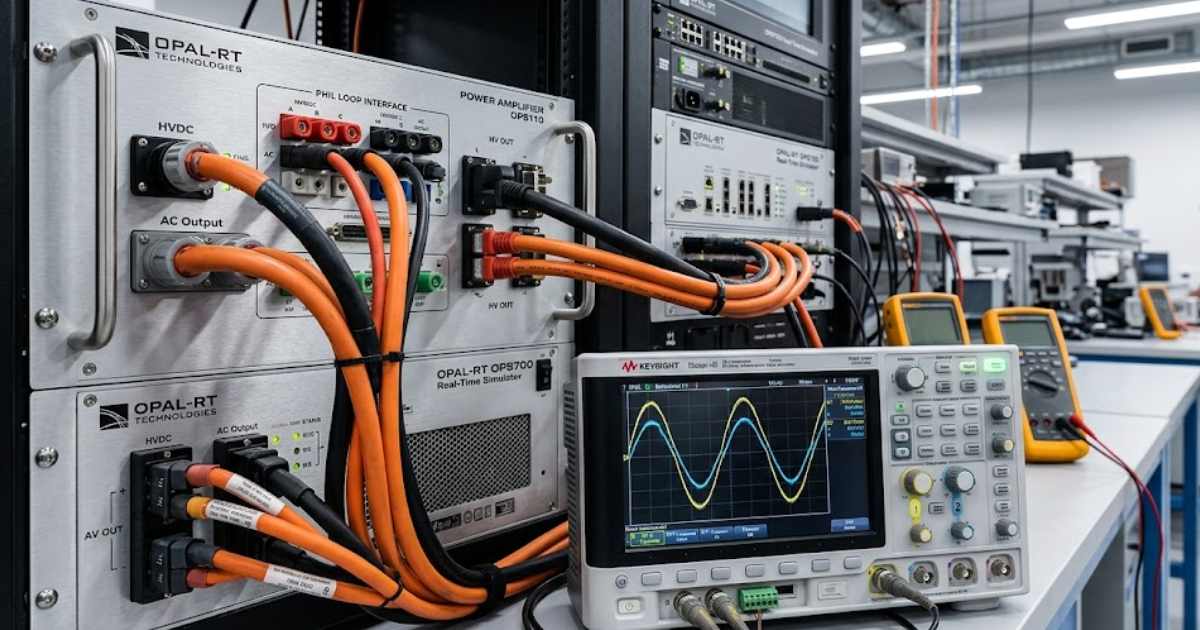
The right battery simulator is the one that matches your current validation stage without blocking the next one. Early charger tuning needs clean response and enough model detail to shape control behaviour. Formal validation needs stronger fault coverage, timing, and repeatability. A good choice reflects the tests you must trust today.
You’ll get better results if you rank requirements in order: closed-loop response for charger work, model fidelity for fault coverage, power capability for energy exchange, software fit for reuse, timing for HIL confidence, and scale for lab growth. That order keeps you focused on test quality instead of headline specifications. Teams that skip this discipline often end up with a capable box that still creates manual work, retesting, and uncertain results.
That is also why experienced groups look at platforms such as OPAL-RT through the lens of execution. The question isn’t which system has the longest brochure. The better question is which one will let your models, power hardware, and control loops stay aligned as validation gets harder. When that fit is right, your battery simulation work keeps its value from the first charger bench to the last acceptance test.
Real-time solutions across every sector
Explore how OPAL-RT is transforming the world’s most advanced sectors.

Automotive
10 / 21 / 2026
Megawatt charging system validation for heavy duty trucks
A practical look at how the megawatt charging system works, how it differs from CCS and how charger controls are tested before a truck site is energized.

Automotive
10 / 19 / 2026
Dynamometer testing and motor emulation compared for e-drive programs
A comparison of dynamometer testing and motor emulation for e-drive programs, covering what each method proves, what it costs and how teams sequence both.

Power Electronics
10 / 17 / 2026
How wide bandgap devices push converter power density
Wide bandgap devices raise converter power density through faster switching and smaller passives, and this guide traces that chain from device physics to thermal limits to validation.