When EMT simulation is required for data center power studies
Industry applications, Power Systems, Simulation
03 / 08 / 2026

Key Takeaways
- Data centre studies should start with phasor simulation, then move to EMT only when fast converter behaviour decides the result.
- The right method depends on the failure mechanism under review, especially during faults, control interaction, harmonic risk, and source transfer events.
- Closed-loop validation matters because controller timing, protection logic, and I/O behaviour often decide field performance after the study phase ends.
EMT simulation is required for data centre power studies when converter behaviour, control interaction, and sub-cycle disturbances decide the answer. Data centres consumed about 176 TWh in the United States in 2023, equal to roughly 4.4% of total US electricity use, which shows how large these electrical loads have become in grid studies. Once a facility reaches that scale with many inverter-based devices, phasor methods stop giving you enough detail for the most important study questions.
You still should not assume EMT belongs in every case. Most planning work starts with phasor simulation because it is faster, simpler, and good enough for slower phenomena. The line between the two methods becomes clear when you ask a practical question: do you need average system trends, or do you need to see what the converters and controls are actually doing in time steps short enough to capture switching-related effects?
Data center power systems now behave like converter-dominated electrical loads
Large data centres now look less like passive industrial loads and more like converter-dense electrical systems. Rectifiers, DC links, battery systems, static switches, UPS blocks, and grid-supporting controls shape the electrical response you will see during faults, energization, and control transitions.
A modern white space fed through double-conversion UPS equipment does not present the grid with a simple motor or resistive profile. The upstream system sees coordinated power electronics, control loops, and protection logic. A utility interconnection study for a 200 MW campus, for instance, will often need to account for the way front-end converters recover after a voltage dip, how they limit current, and how they interact with capacitor banks or nearby inverter-based resources.
That shift matters because the study method has to match the device physics that dominate the event. The attached brochure points to that same trend, noting converter modelling for datacentre applications, broad topology coverage, support for up to 64 converters in a single FPGA, and 40 ns timestep capability, which reflects the level of resolution these systems can require in test work .
Phasor simulation methods used in most data center power studies
“Phasor studies should be treated as a filter.”
Phasor simulation remains the right starting point for most data centre power studies. It represents voltages and currents as fundamental-frequency quantities, so you can study slower electromechanical and RMS behaviour without solving the fast waveform detail.
That approach works well for long-duration voltage recovery, steady-state power flow, short-circuit screening, protection coordination at a broad level, and many interconnection checks. A team assessing feeder loading, transformer sizing, reactive support needs, or generator dispatch during a utility outage will often get useful answers from phasor tools first. You can test dozens of contingencies quickly and narrow the set of cases that deserve deeper work.
The limit shows up when the study question depends on what happens inside a cycle, not across many cycles. Phasor models average away switching, harmonics, converter blocking, control saturation, and detailed fault current waveforms. That is why phasor studies should be treated as a filter. They tell you where the risk sits, but they do not always tell you what the converters will do when the system is stressed.
Electrical behaviours that phasor models cannot accurately represent
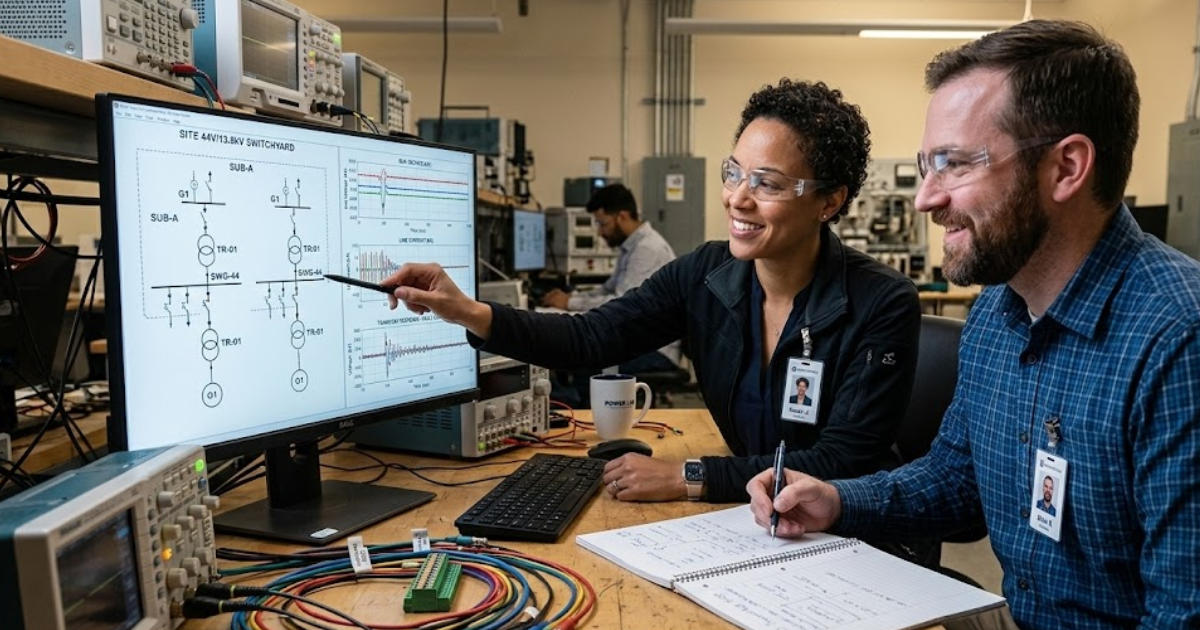
Phasor models cannot accurately represent electrical behaviour that depends on waveform shape, fast control action, or converter state changes. Once the event hinges on those details, the averaged representation hides the mechanism you need to evaluate.
A voltage sag that lasts a few cycles is a good example. A phasor model can show the dip magnitude and recovery trend, yet it will not show commutation failure risk, DC-link excursions, control mode transitions, or harmonic bursts during recovery. The same issue appears during energization of a large UPS block, transfer between utility and backup sources, or interaction between active front ends and weak grid conditions.
You care about those missing details because they often sit directly upstream of nuisance trips, unstable recovery, or mis-set protection. Engineers sometimes see a phasor result that looks calm, then find in lab work that a converter current limiter, PLL, or firing logic behaves very differently under the same event. EMT closes that gap because it keeps the waveform information and the control timing that explain why the event unfolded the way it did.
Power electronics interactions that require EMT simulation resolution
Power electronics interactions require EMT resolution when two or more fast control systems affect each other through the network. That usually means the main engineering risk sits in converter-to-converter coupling, not in slow system averages.
A common case is a data centre connected near solar inverters, battery energy storage, or an HVDC-fed industrial area. The data centre UPS front ends, utility-side STATCOMs, and nearby inverter plants can all respond to the same disturbance through their own PLLs, current controllers, and voltage controls. Another case appears inside the facility when multiple UPS modules, static transfer switches, and battery converters share a bus with very low short-circuit strength.
The main difference between phasor and EMT simulation is that phasor tools smooth these interactions into averaged responses, while EMT tools preserve the timing and waveform detail that show instability, oscillation, or control hunting. You need that resolution when converter controls are the source of the problem, not just participants in it.
| Study question | Method that usually fits | Why the distinction matters |
| You need feeder loading and voltage trends across many contingencies. | Phasor simulation usually fits because averaged quantities answer the planning question clearly. | Fast waveform detail adds little value when the outcome depends on steady operating limits. |
| You need to see converter current limiting during a short voltage sag. | EMT simulation usually fits because the answer depends on sub-cycle control response. | Averaged models can hide the exact behaviour that causes trips or unstable recovery. |
| You need a first pass on backup generation and transformer sizing. | Phasor simulation usually fits because slower RMS behaviour sets the main constraints. | Study speed matters when you are screening many operating cases. |
| You need harmonic, resonance, or switching transient insight. | EMT simulation usually fits because waveform shape is part of the problem statement. | The wrong method can miss the mechanism that causes overheating or nuisance protection action. |
| You need to validate controller I/O and closed-loop response with hardware. | EMT simulation usually fits because real interfaces and fast controls require time-domain fidelity. | Practical test work depends on signals that match the physical system closely enough to trust the result. |
Grid disturbances that force engineers to shift from phasor to EMT studies
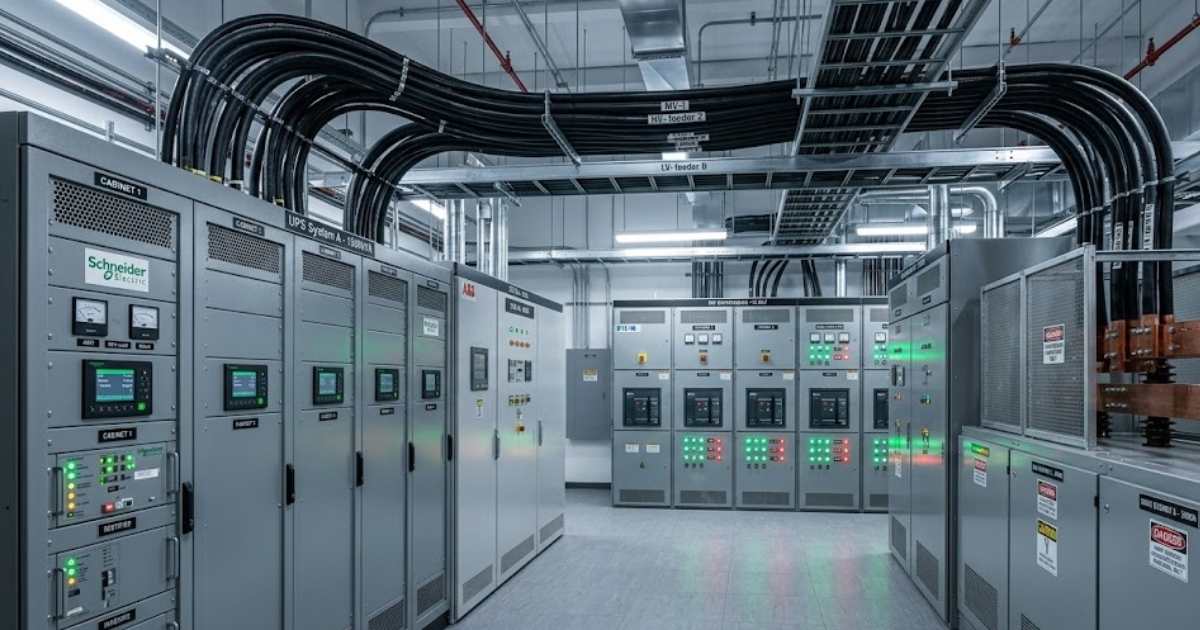
Certain grid disturbances force a shift to EMT because the event unfolds too quickly or too nonlinearly for phasor methods. Fault ride-through, breaker restrikes, capacitor switching, islanding transitions, and weak-grid voltage recovery all belong in that group.
A utility fault near the point of interconnection illustrates the issue well. The planner may first use phasor simulation to identify the severe buses and likely recovery window. Once the result shows a tight voltage margin or an unusual converter response, EMT becomes the next step because you need to inspect waveform distortion, current clipping, controller transitions, and exact relay input conditions. Global data centre electricity use is projected to reach about 945 TWh by 2030, nearly double the 2024 level, which means these grid-facing events will affect more large sites and more interconnection work.
You should also move to EMT when the utility or system operator asks for evidence beyond RMS recovery. That request often appears when the data centre is large relative to local short-circuit strength or when nearby inverter resources already make the area electrically sensitive.
Practical criteria engineers use to select EMT simulation methods
Engineers should select EMT when the study objective depends on fast electrical detail, control sequencing, or waveform accuracy. The method choice should come from the failure mechanism you need to confirm, not from habit or software preference.
A clean screening process helps. Start with the event, the device, and the acceptance criterion. A short-circuit ratio concern near the point of interconnection points toward EMT if converter stability is under review. A harmonic compliance concern points toward EMT if filter performance and resonance matter. A basic transformer loading check stays in phasor territory because fast waveform detail will not change the answer.
You can use five practical tests to make the call:
- The event unfolds within a few cycles or less.
- Converter controls determine the pass or fail result.
- Harmonics, resonance, or switching transients matter.
- Protection inputs depend on exact waveform shape.
- Hardware validation is part of the study scope.
That framework keeps effort under control. EMT models take more time to build and verify, so you want a clear reason for using them. Clear selection criteria also help technical leads explain the added modelling cost to project teams.
How engineers build EMT models for large data center electrical systems
Large data centre EMT models work best when they are built in layers, with detail placed only where the answer needs it. The goal is not to model every converter switch in the facility. The goal is to represent the parts that shape the event you are studying.
A practical build often starts with a reduced network around the point of interconnection, main transformers, medium-voltage distribution, UPS systems, battery interfaces, and the most influential controls. Aggregate models can represent repeated load blocks away from the disturbed area. Detailed models stay on the buses where waveform accuracy matters, such as the interconnection node, a weak internal bus, or a transfer path between sources.
Model discipline is important here. You need validated control parameters, believable source strength, realistic protection timing, and sensible aggregation rules. OPAL-RT often fits this execution stage because large converter counts, FPGA-based solving, and tight timesteps help engineers keep the right detail in the right place for closed-loop studies rather than building an oversized model that becomes hard to verify .
Hardware in the loop testing extends EMT studies into controller validation
“You get better engineering judgment when the method matches the physics, and EMT earns its place only when it answers a question phasor tools cannot settle with confidence.”
Hardware-in-the-loop testing turns EMT work from a study into a validation step. Once you connect the actual controller, relay, or protection device to the simulated power system, you stop asking only what the model predicts and start checking what your hardware will really do.
A data centre UPS controller under a bus fault is a useful case. A pure software EMT model can show the expected voltage and current response, but it will not expose a timing issue on a digital input, a poorly tuned filter in the controller firmware, or a relay setting that trips one cycle too early. Closed-loop testing will show those gaps because the physical device sees realistic waveforms and sends real outputs back into the simulation.
That is where disciplined execution matters most. OPAL-RT belongs naturally in this final step because the same work often needs fast EMT execution, high I/O density, and converter-focused modelling in one platform rather than separate study and lab setups .
Real-time solutions across every sector
Explore how OPAL-RT is transforming the world’s most advanced sectors.

Automotive
10 / 21 / 2026
Megawatt charging system validation for heavy duty trucks
A practical look at how the megawatt charging system works, how it differs from CCS and how charger controls are tested before a truck site is energized.

Automotive
10 / 19 / 2026
Dynamometer testing and motor emulation compared for e-drive programs
A comparison of dynamometer testing and motor emulation for e-drive programs, covering what each method proves, what it costs and how teams sequence both.

Power Electronics
10 / 17 / 2026
How wide bandgap devices push converter power density
Wide bandgap devices raise converter power density through faster switching and smaller passives, and this guide traces that chain from device physics to thermal limits to validation.