7 Ways to advance grid resilience through digital twin simulation
Microgrid, Digital Twin, Simulation
12 / 25 / 2025

Key Takeaways
- Treat the digital twin as a change gate for operational risk.
- Focus first on control interfaces and protection timing tests.
- Keep scenarios repeatable with replay, logs, and regular drills.
Digital twin simulation will help you test grid resilience before the field pays the price. Cyber actions become visible as physical effects. You see trips, voltage shifts, and oscillations. Fixes become repeatable instead of anecdotal.
A digital twin for power systems links asset behavior to controls and data. Digital grid simulation adds communication timing and bad data effects. Used well, it becomes a change gate. Teams share one testable picture of risk.
How digital twins support cybersecurity and resilience in power systems
A cybersecurity-focused digital twin mirrors the power system and the signals that operate it. It will show how spoofed commands and erroneous measurements can lead to relay actions and power quality issues. That is digital twin cybersecurity in practice. The goal is repeatable tests that link cyber cause to grid consequence.
A practical twin needs a few pieces so results map to field behavior:
- Trust zones and boundaries
- Control and protection signals
- Timing and delay models
- Fault and restore events
- Logs for replay and audit
A substation can receive a remote trip command over a message bus. The twin can inject that command and quantify overload shifts on adjacent feeders. A delayed breaker status update can be replayed to see how automation misreads state. Keep detail tight on the interfaces you approve or defend next.
7 ways digital twin simulation advances grid resilience
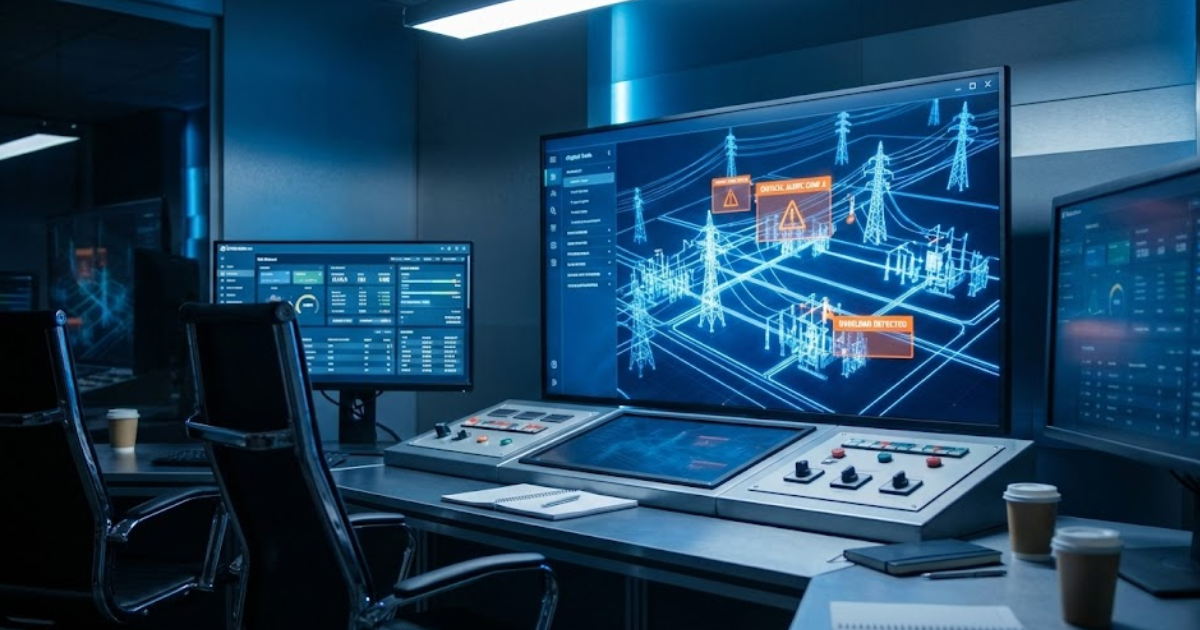
Seven workflows cover high-impact uses. Each produces an output you can act on. We start with control links and protection timing because failures arrive fast. Repeat runs after each change to keep results comparable.
1. Cyber attack testing exposes weak control paths before deployment
Attack testing in a twin will reveal which control paths fail safely and which fail dangerously. A spoofed open command sent to a breaker while feeder loading is near a relay threshold can trigger an unnecessary trip. A false voltage value pushed into a regulator loop can drive tap actions outside limits. The output should be a short fix list tied to overload, undervoltage, or loss of supply. Re-run the same attack set after every settings or firmware change so risk stays down.
2. Continuous state awareness improves detection of abnormal grid behavior
State awareness improves when the twin provides an expected trajectory for the current operating point. A rolling simulation fed with telemetry will flag mismatches that break power balance, not just a threshold. A small bias on a feeder current tag can look normal, yet the twin will show the mismatch against adjacent feeder flows. Status changes get context when the twin checks them against switching plans and timing rules. Keep the model synced with topology and settings or alerts will lose trust.
3. Closed loop testing validates protection logic under attack conditions
Closed loop testing runs protection and control code against the twin in real time, so timing faults show up before deployment. A delayed breaker status update during a fault can cause a scheme to trip late, trip falsely, or fail to trip. Add jitter or replayed packets on the control channel and watch logic under multiple loading conditions. Real-time simulators such as OPAL-RT keep timing close to what the field sees. Record exact code and settings so each run stays auditable.
“Attack testing in a twin will reveal which control paths fail safely and which fail dangerously.”
4. Scenario replay clarifies cascading failure paths across grid assets
Scenario replay turns a messy event into a run you can repeat with one variable changed. A timeline with a feeder trip, recloser cycles, and distributed resource ride-through can be rebuilt to show which device action caused the voltage to enter a protection band. The same replay can swap in higher load to test thermal headroom. A single delayed status message can explain why automation took a wrong branch. Good replay needs clean time stamps and complete signal capture.
5. Model based analysis improves incident response timing and accuracy
Model-based response runs let you test the next action while the incident is still live. A suspected compromise of a substation gateway can be modeled by blocking control commands while leaving local protection active. The twin will quantify loading shifts and voltage change on neighboring feeders before you commit. Another run can freeze setpoint updates to stop malicious oscillations and confirm stability. Pre-build these plays so analysts aren’t inventing steps under pressure.
6. Secure design validation reduces risk from system upgrades
Upgrades introduce risk because firmware, settings, and data paths often change together. A security control that adds authentication can introduce latency, and the twin will reveal whether that delay breaks a timing-dependent protection scheme. Data feed changes, such as new scaling or renamed tags, can silently break alarms and control logic, and simulation will catch them before rollout. Pair the upgrade test with a rollback run so the exit path works. Lock acceptance to measurable trip times and voltage limits.
7. Operator training improves coordinated response during cyber events
Training with a twin builds muscle memory for cyber events that initially look like routine noise. A drill can mix a false frequency measurement that triggers load shedding logic with an unrelated feeder fault so operators practice separating causes. Another drill injects conflicting breaker status signals and forces a check against an independent measurement before switching. These sessions expose gaps in handoffs between security analysts and the control room. Track time spent stabilizing voltage and the number of unnecessary actions, then rerun the same scenarios each quarter.
| 1. Cyber attack testing exposes weak control paths before deployment | A focused attack set will reveal the worst interfaces fast. |
| 2. Continuous state awareness improves detection of abnormal grid behavior | Expected-state checks will cut false alarms and catch slow attacks. |
| 3. Closed loop testing validates protection logic under attack conditions | Real-time closed-loop runs will prove timing under hostile signals. |
| 4. Scenario replay clarifies cascading failure paths across grid assets | Replay will pinpoint the step that caused the cascade. |
| 5. Model based analysis improves incident response timing and accuracy | Quick what-next runs will compare response options using grid impact. |
| 6. Secure design validation reduces risk from system upgrades | Upgrade tests will surface hidden latency and data mapping issues. |
| 7. Operator training improves coordinated response during cyber events | Practice runs will improve coordination when indicators conflict. |
Applying digital twin results to grid planning and operations
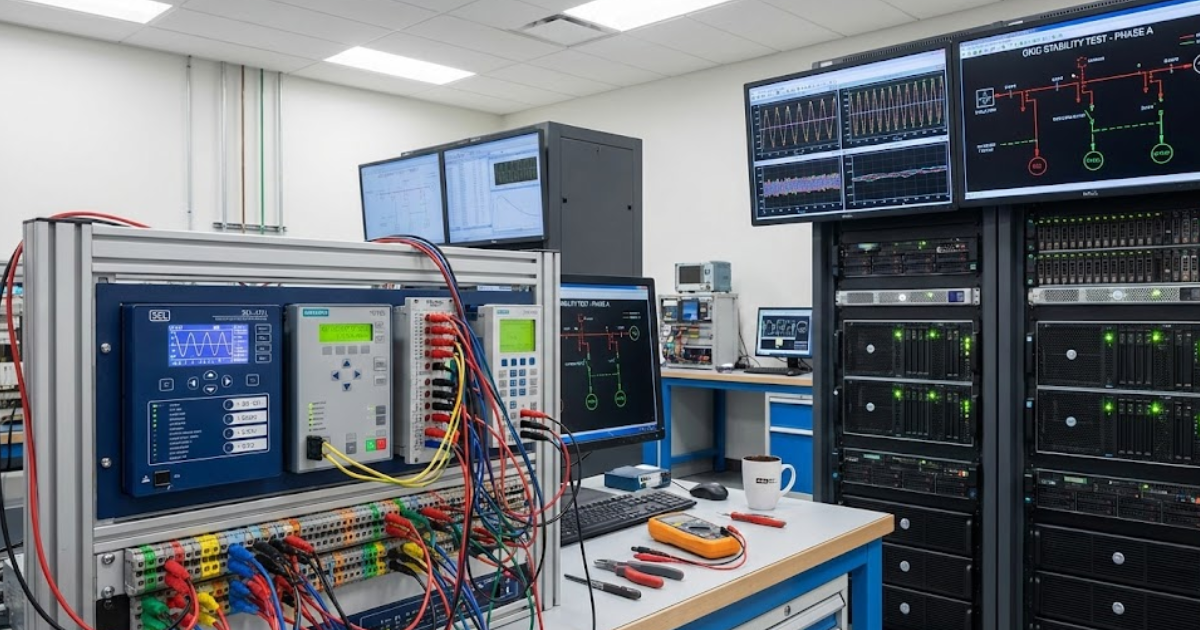
Digital twin results only matter when they alter approvals and runbooks. Turn scenarios into test gates for settings, firmware, and control logic changes. Keep a short must-run library tied to known failure modes. Evidence should outweigh intuition during change windows.
“Evidence should outweigh intuition during change windows.”
A relay setting update shouldn’t ship until replay matches expected trip timing under bad data tests. Runbooks improve when isolation options have already been simulated under current loading limits. OPAL-RT can sit here as the real-time execution layer so timing stays honest. Teams that do this well treat simulation as routine engineering hygiene.
Real-time solutions across every sector
Explore how OPAL-RT is transforming the world’s most advanced sectors.
Automotive
10 / 21 / 2026
Megawatt charging system validation for heavy duty trucks
A practical look at how the megawatt charging system works, how it differs from CCS and how charger controls are tested before a truck site is energized.
Automotive
10 / 19 / 2026
Dynamometer testing and motor emulation compared for e-drive programs
A comparison of dynamometer testing and motor emulation for e-drive programs, covering what each method proves, what it costs and how teams sequence both.

Power Electronics
10 / 17 / 2026
How wide bandgap devices push converter power density
Wide bandgap devices raise converter power density through faster switching and smaller passives, and this guide traces that chain from device physics to thermal limits to validation.