How real-time simulation prevents AI data center power failures
Simulation
05 / 11 / 2026

Key Takeaways
- AI data centre power failures usually start in timing interactions between loads, controls, and protection rather than in simple capacity shortfalls.
- Time-domain validation gives you evidence on feeder response, protection selectivity, UPS behaviour, and backup sequencing before procurement and commissioning lock in risk.
- Expansion work needs fresh validation because each added hall or backup asset can alter fault response and restart overlap across the full electrical system.
Preventing power failures in AI data centres requires real-time electrical validation before buildout, especially as global data centre electricity use rises from about 460 TWh in 2022 toward more than 1,000 TWh in 2026.
Static studies still matter, but they won’t catch the millisecond swings that appear when large GPU clusters ramp, idle, checkpoint, and recover after faults. Those swings affect breakers, transfer logic, UPS controls, battery limits, and generator recovery in ways nameplate planning misses. You need a model that runs against time, not a spreadsheet frozen at peak load. That is the difference between a power system that looks adequate on paper and one that stays stable under stress.
“You need time-domain models that capture burst shape, pulse width, and recovery interval.”
Preventing power failures starts with closed-loop electrical validation
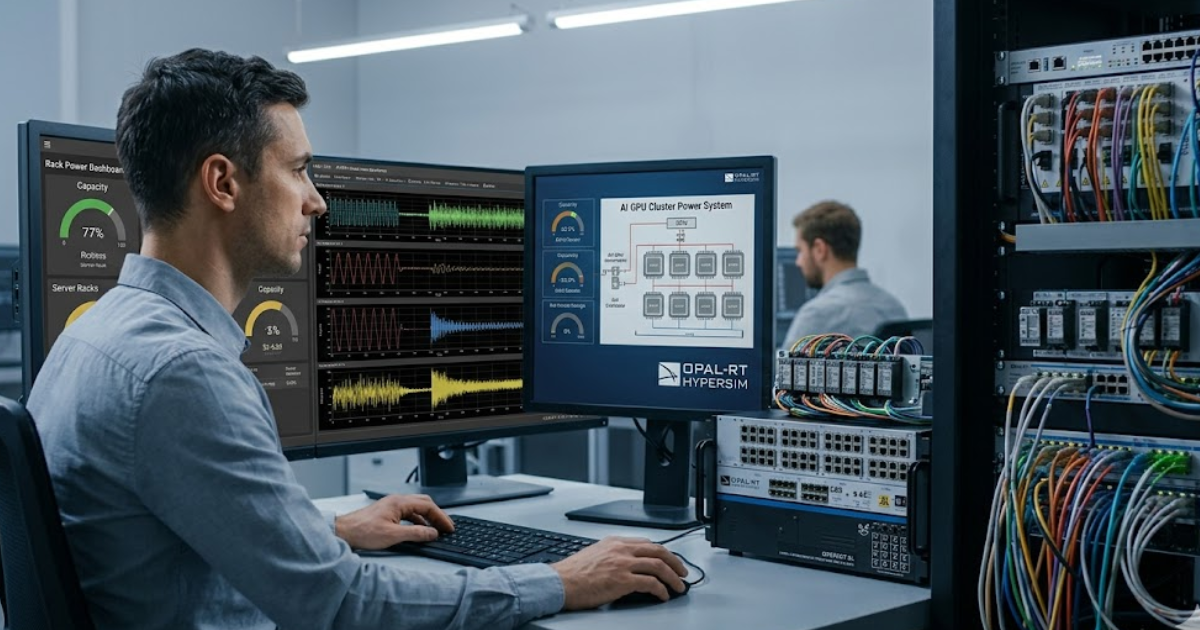
Closed-loop electrical validation prevents power failures because it tests the power chain, control logic, and protection response as one connected system. You see how equipment interacts during faults, transfers, and steep load steps before construction crews wire the site, which is when corrections are still manageable.
A useful example is a new hall built for 60 kW racks with busways, UPS modules, and standby generators sized from peak load sheets. The design looks sound until a simulated utility sag forces a transfer while hundreds of accelerators restart their fans and voltage regulators at once. Current overshoot trips a downstream breaker that should have stayed closed. That single miss shows the problem was never just capacity.
Closed-loop testing matters because every device acts on local measurements and timers. A breaker curve, a UPS firmware delay, and a generator governor response can combine into a failure path no single vendor model will show on its own. You’re validating interactions, selective protection, and recovery order with the same timing the installed system will face. That approach turns power planning into electrical proof rather than assumption.
AI GPU clusters create load behaviour that static models miss
AI GPU clusters produce steep, short-duration load swings that static studies smooth away. A generative AI query can use about 10 times the electricity of a conventional search, and clustered training jobs stack those shifts across racks, feeders, and cooling support equipment.
Consider a training cluster where hundreds of accelerators hit a new batch at the same instant. Rack power rises sharply, power supply units correct, and cooling fans respond a moment later. Upstream equipment sees a layered surge rather than a flat step. Static peak numbers can’t show which protection settings will nuisance trip during that sequence.
That matters during design because AI loads are synchronized by software schedules, checkpoint recovery, and orchestration policies. Two halls with the same average megawatt rating can behave very differently if one contains tightly aligned compute jobs. You need time-domain models that capture burst shape, pulse width, and recovery interval. Without that detail, spare capacity on paper can hide weak margins during operation.
Power infrastructure planning must start with transient behaviour
Power infrastructure planning should start with transient behaviour because switchgear, UPS modules, batteries, and generators are sized and coordinated around short events, not only steady load. If your first design pass ignores ramp rate, fault current, and recovery timing, later fixes will spread into every layer of the electrical room.
A common case appears when a team sizes generators from average loading plus reserve. The units look sufficient until a black start sequence is tested against a staged return of cooling, pumps, and compute rows. Frequency dips long enough to force another transfer, which deepens the disturbance instead of clearing it. Planning begins with the hardest seconds. The calmest hour tells you far less.
Transient-first planning also changes where you spend engineering time. Feeders with modest average loading can still be the first points to fail if they sit behind slow protection or share support loads with a dense GPU block. The checkpoint below shows what steady-state studies answer and what time-based validation adds before procurement locks settings and equipment ratings.
| Planning question | What a static study tells you | What a real-time simulation tells you |
|---|---|---|
| Feeder loading during AI compute ramps | A static study shows expected loading at selected steady operating points. | A real-time simulation shows how the feeder behaves during short surges and recovery. |
| UPS autonomy during a transfer event | A static study estimates battery duration at a fixed load level. | A real-time simulation shows battery stress during transfers and staggered restarts. |
| Generator adequacy after utility loss | A static study compares generator rating with planned megawatt load. | A real-time simulation shows frequency and voltage dip during motor and IT pickup. |
| Protection coordination at faulted sections | A static study checks time-current curves at selected fault levels. | A real-time simulation shows which device trips first during stressed operating states. |
| Expansion impact after a new hall is added | A static study updates total loading after topology changes. | A real-time simulation shows how old and new sections interact during the same disturbance. |
Real-time simulation tests controls under millisecond load swings
Real-time simulation tests control systems under millisecond load swings by running the power model and control hardware on the same clock. That setup lets engineers inject utility sags, feeder faults, and restart pulses while protection relays, UPS controllers, and supervisory logic react as they will in service.
Picture a lab setup with relay I/O, breaker status, and generator controls connected to a real-time simulator. Engineers can force a bus fault, clear it, and then replay a staged server restart with precise timing. They’ll see if a relay trips too broadly or if transfer logic waits long enough for voltage to settle. That is hard to prove with offline files and vendor datasheets alone.
Teams using OPAL-RT for this kind of validation can tune timers, droop settings, and protection coordination before site commissioning starts. You’re not guessing how firmware from several suppliers will interact under stress because the closed loop exposes those links. The main value is speed with evidence. You find bad assumptions in the lab, where edits take hours, instead of on the floor, where delays can stretch for weeks.
Electrical validation should confirm protection selectivity under stress
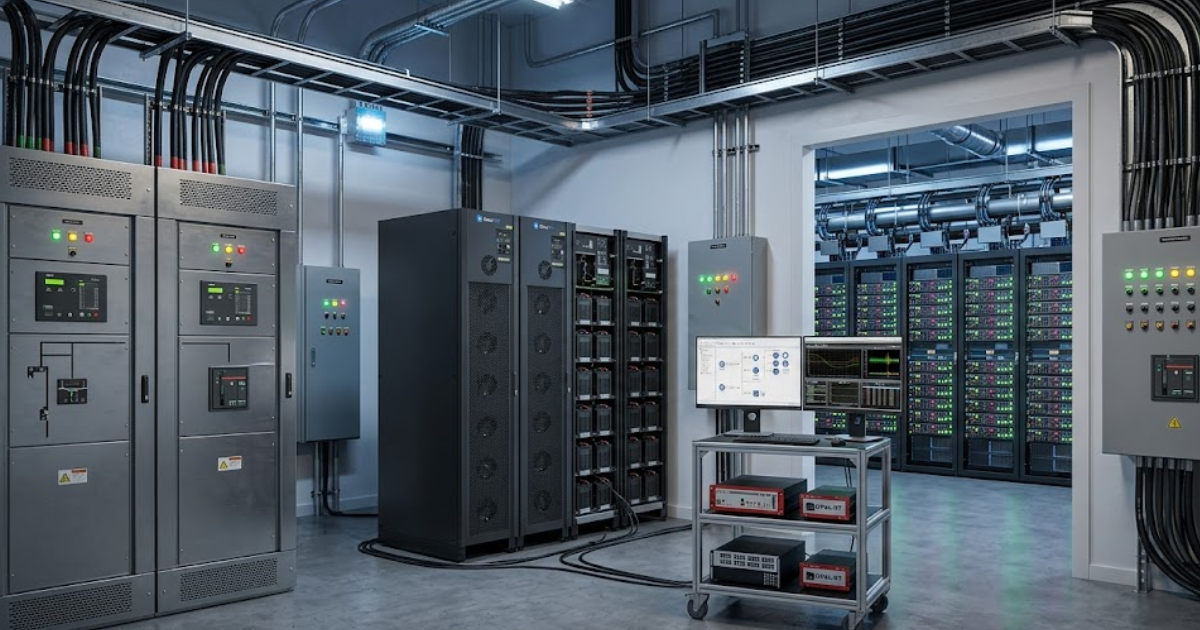
Electrical validation should confirm protection selectivity under stress because AI facilities fail when the wrong device trips first. Protection studies must show that faults stay contained to the smallest possible zone during load surges, voltage dips, and transfer events, or a local issue will spread across upstream distribution.
A realistic scenario is a feeder fault near one GPU row during heavy compute activity. If the downstream breaker opens within its curve and the upstream device stays closed, the outage remains local and recovery is orderly. If both trip, you lose a much larger section and restart currents multiply the disturbance. Selectivity has to hold during stressed operating states, not only under nominal current.
You should confirm five checks before protection settings are frozen. Each one connects directly to containment and restart stability. Skipping any of them leaves a blind spot that won’t show up in a simple coordination plot. These checks keep protection studies tied to operating behaviour.
- Each major fault clears at the closest protective device.
- Upstream breakers stay closed during downstream faults and restart surges.
- Relay settings still coordinate after UPS and generator states shift fault current.
- Transfer logic does not overlap with breaker clearing windows.
- Restart groups limit inrush so protection margins remain intact.
Power management depends on sequence timing across backup paths
Data centre power management depends on sequence timing across backup paths because backup capacity only works when devices hand off in the right order. Utility loss, UPS discharge, battery protection, generator start, breaker transfer, and staged IT recovery must line up within tight windows or stable equipment will still drop load.
Think about a brief utility outage followed by generator pickup. Batteries carry the load, generators reach speed, and transfer switches prepare to close. Trouble starts when cooling returns late while compute rows come back early. Rack inlet temperature rises, server fans surge, and the electrical path sees a second spike during an already fragile recovery.
Sequence timing is where data centre power management shifts from equipment selection to operating discipline. You’ll want restart groups, load shedding rules, and supervisory thresholds tested against one another rather than reviewed as isolated settings. A few hundred milliseconds can separate a clean ride-through from a broad trip. Real-time validation gives you that timing truth before operators have to live with it.
“A few hundred milliseconds can separate a clean ride-through from a broad trip.”
Static studies leave blind spots during phased expansion
Static studies leave blind spots during phased expansion because each new hall, battery block, or generator adds fresh interactions to a system that already works near tight timing margins. Expansion plans need revalidation of transient behaviour, protection selectivity, and recovery order each time electrical topology changes.
A site that opened with one AI hall can run cleanly for months, then show instability after a second hall is added on the same medium-voltage bus. Nothing looks overloaded in the one-line diagram. The problem appears when both halls recover from a short utility event and their restart profiles overlap. That is why expansion reviews must replay operating sequences, not just refresh load totals.
This is where disciplined engineering matters more than optimistic capacity buffers. Static studies still belong in the process, but they won’t settle the questions that trigger outages in dense AI compute sites. OPAL-RT fits this closing step when teams need to prove how controls, protection, and power equipment behave as one system. You end up with fewer surprises, tighter commissioning, and a power design you can trust under stress.
Real-time solutions across every sector
Explore how OPAL-RT is transforming the world’s most advanced sectors.
Automotive
10 / 21 / 2026
Megawatt charging system validation for heavy duty trucks
A practical look at how the megawatt charging system works, how it differs from CCS and how charger controls are tested before a truck site is energized.
Automotive
10 / 19 / 2026
Dynamometer testing and motor emulation compared for e-drive programs
A comparison of dynamometer testing and motor emulation for e-drive programs, covering what each method proves, what it costs and how teams sequence both.

Power Electronics
10 / 17 / 2026
How wide bandgap devices push converter power density
Wide bandgap devices raise converter power density through faster switching and smaller passives, and this guide traces that chain from device physics to thermal limits to validation.