How real-time simulators enable hardware-in-the-loop testing for automotive battery systems
Automotive, Power Systems
04 / 23 / 2026

Key Takeaways
- Closed-loop simulation matters because battery control hardware has to react to believable pack behaviour at the same pace it will see in service.
- Battery testers and load testers are useful screening tools, but they do not prove fault handling, timing, or protection logic across the full battery system.
- Strong battery validation follows a staged sequence that starts with simple checks, moves through HIL, and reserves pack benches for confirmation work.
Real-time simulators make automotive battery hardware-in-the-loop testing useful because they let you test control hardware against pack behaviour, faults, and thermal limits before a full pack reaches the bench.
Electric car sales reached nearly 14 million in 2023, equal to 18% of all cars sold, which means battery teams face more pack variants and less room for late test failures. A basic automotive battery tester still matters, and an automotive battery load tester still answers useful bench questions. Those tools check charge state, voltage sag, and simple load response. Closed-loop battery system validation needs more than that, because the controller has to react to a battery that behaves like the full pack it will finally manage.
“The best automotive battery load tester still answers only part of the validation problem.”
Real-time simulators close the loop around battery hardware

Real-time simulators support hardware-in-the-loop testing by acting like the battery pack in closed loop with the battery hardware. They solve the pack model at controller speed. They send back voltages and currents through real I/O. The battery management hardware then reacts to a believable pack response.
A useful setup connects the battery management unit to simulated cell voltages, pack current, contactor feedback, and insulation signals. When the hardware requests contactor closure, the simulator updates pack state and returns the expected electrical response on the next time step. That gives you a live test of measurement paths, control logic, and protection thresholds. Offline simulation cannot do that, because the controller is not feeling the timing and signal limits of actual hardware.
You will see the value when a controller asks for charge current at low state of charge and the simulated pack accepts it, then pushes back as voltage rises and temperature climbs. That sequence looks ordinary, yet it tells you if balancing starts too early, if current limits are clipped, or if fault latches clear at the wrong time. Bench packs are expensive and risky places to find those problems. Closed-loop simulation moves that discovery step to a safer and faster part of the test flow.
Battery pack physics must run faster than controller timing
Battery pack physics must execute within the controller’s timing budget or the test result will be misleading. The simulator has to update before the controller makes its next choice. If the model runs late, current spikes and voltage dips arrive after the fact. The controller then looks calmer or worse than it really is.
A current control loop that samples every 100 microseconds will expose this immediately. If your battery model updates every millisecond, the controller will miss short transients that shape protection logic and estimator performance. That matters during pre-charge, regenerative braking, and fast charger handoff, where voltage and current can shift quickly. A slow model will still plot smooth traces, but those traces will not represent the hardware interaction you’re trying to prove.
You usually solve this with model partitioning. Fast electrical states stay in a short time step, while slower thermal or ageing states run at a longer interval. Cell detail also needs restraint, because a full electrochemical model for every cell will break timing long before the controller hits its edge cases. Good HIL battery work is less about squeezing in every state variable and more about keeping the states that alter controller action within the time budget the hardware can actually use.
A battery load tester cannot replace battery system HIL
An automotive battery load tester checks how a battery responds to a controlled electrical load, while battery system HIL checks how control hardware responds to a simulated pack in closed loop. Both are useful. They answer different questions. Treating them as substitutes will leave important faults untested.
A standard automotive battery tester will tell you if a 12 V unit has weak cranking support, high internal resistance, or poor charge acceptance. An automotive battery load tester adds a repeatable current draw and helps you compare response under load. Those checks are helpful for service work and incoming inspection. They do not tell you how a battery management unit will react to a false temperature reading, a welded contactor, or a pack model that reaches a charge limit mid-cycle.
| Each test method answers a different battery question | The result tells you what the next bench step should be |
| A handheld automotive battery tester checks voltage, conductance, and simple health indicators on a single battery. | You will know if the unit is obviously weak, but you will not know how system controls react under faults. |
| An automotive battery load tester applies a known load and shows how far voltage drops during that event. | You will learn load response and recovery, which helps screen batteries before deeper validation begins. |
| A pack cycler runs charge and discharge profiles across longer test windows with high power capability. | You will measure energy throughput and endurance, yet controller timing issues can still remain hidden. |
| Battery system HIL links the controller hardware to a pack model that reacts through real I/O. | You will see if software, sensing, and protections behave correctly before a physical pack is placed at risk. |
| Full pack bench testing uses physical cells, sensors, and contactors under controlled lab conditions. | You will confirm final behaviour, but that stage is far too costly for finding basic logic or interface faults. |
The best automotive battery load tester still answers only part of the validation problem. You should use it for what it does well, which is quick battery screening under repeatable load. HIL starts where the load tester stops. It tells you how the hardware and control logic behave when the battery becomes a system rather than a stand-alone unit.
Fault injection reveals BMS behaviour before pack testing starts
Fault injection lets you test failure handling without waiting for the failure to happen on a physical pack. The simulator can force sensor errors, isolation drops, overcurrent events, and contactor faults on cue. That makes safety logic testable. It also makes fault timing repeatable across runs.
A practical case is a stuck contactor signal during shutdown. The controller believes the pack is opening, but pack voltage stays present on the load side. That single condition checks fault detection, retry logic, warning codes, and service mode handling in one sequence. A physical pack can produce the same issue, but setting it up cleanly takes more time and adds more risk.
Fault work also exposes gaps that normal charge and discharge tests will never hit. Sensor bias is a good example, because a 2 degree temperature offset or a small current offset can shift state-of-charge estimation enough to trigger bad power limits. If you catch that in HIL, the fix is usually a calibration or filtering change. If you catch it after pack build, the fix turns into lab rework, schedule slip, and a harder root-cause search.
Thermal states shape battery responses under dynamic load
Thermal state changes battery behaviour even when the control logic stays the same. Internal resistance rises in the cold. Charge acceptance falls near the limit. Available power shifts as the pack heats under repeated load. HIL needs thermal effects if you want believable current limits and protection actions.
A cold-soak charging test makes this obvious. The controller will accept moderate current at room temperature, then sharply restrict current when the same pack model starts near freezing. That response affects charger handshakes, regenerative braking limits, and power derating seen by the rest of the vehicle. If the simulator ignores temperature, the battery management unit will appear stable during a condition that should trigger clear limit behaviour.
Temperature also matters to the customer-facing result. At 20°F, electric vehicles in one large AAA test showed an average driving-range reduction of 41% when cabin heat was used. That statistic describes range, yet the test implication is broader. Your controller has to manage current, charging, and protection correctly across the thermal states that produce those visible performance shifts. A battery model without thermal response will hide that requirement.
Latency limits decide how much battery detail you can keep
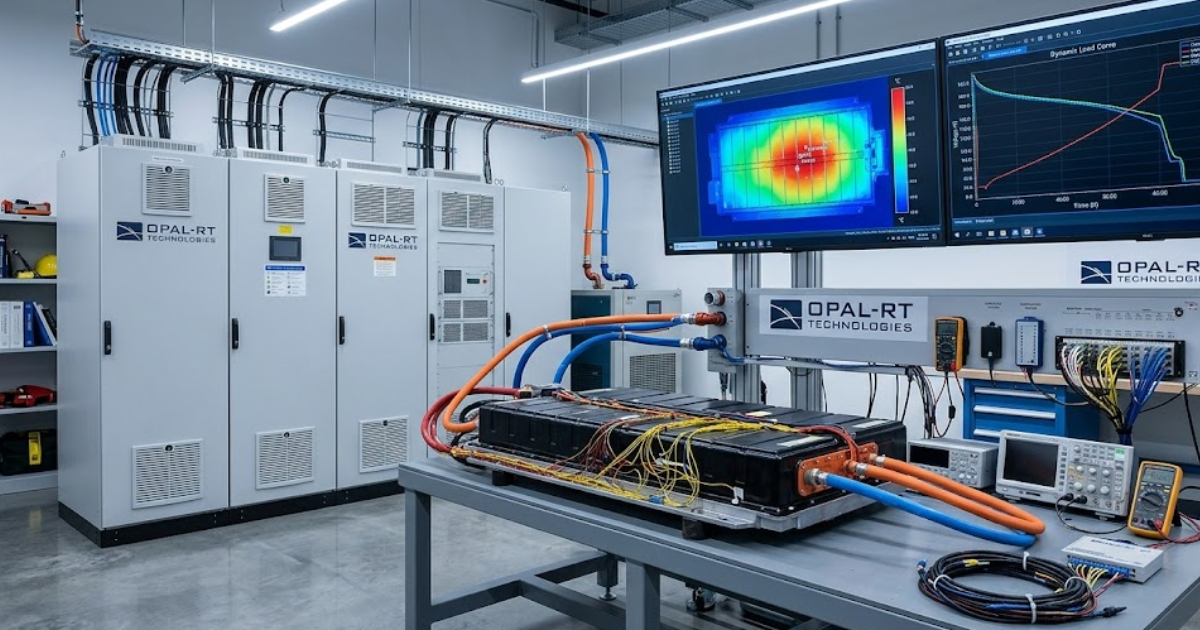
Latency sets the ceiling for model detail in HIL battery testing. Every extra state, communication path, and I/O conversion takes time. If the total delay grows past the controller’s tolerance, fidelity on paper turns into poor fidelity in practice. Stable timing matters more than model size alone.
That tradeoff appears when engineers try to represent every cell, balancing path, and electrochemical effect in one loop. The result often looks impressive in a model review and then misses deadlines during execution. A reduced-order battery model with accurate terminal behaviour will produce better controller evidence than a detailed model that slips its step time. You want the controller to see the right electrical consequences at the right instant.
Teams working on platforms such as OPAL-RT often split fast electrical states from slower supervisory states so the signal path stays deterministic. That approach keeps current, voltage, and protection loops tight while thermal estimators and diagnostic logic run on a slower schedule. You will still have to choose what to simplify. Good choices focus on the parts of battery behaviour that alter controller action, because that is what the HIL bench exists to test.
“The payoff is straightforward: you catch timing errors, protection gaps, and thermal limit mistakes before they reach costly pack tests.”
How to test automotive battery systems with staged validation
How to test automotive battery systems comes down to test order. Start with simple battery checks, move into closed-loop control validation, and finish with full pack confirmation. An automotive battery tester and a battery load tester automotive teams use for screening still matter. They just belong at the start of the sequence, not the end of the argument.
- Check basic voltage, internal resistance, and charge state on incoming batteries.
- Use an automotive battery load tester to screen repeatable load response and recovery.
- Run HIL with the battery management hardware against simulated pack states and faults.
- Confirm thermal limits, charge control, and protection timing on pack benches.
- Validate final integration only after earlier stages stop exposing basic control issues.
That sequence saves time because each stage asks a tighter question than the last one. A weak battery should fail early on a simple test stand. A timing bug in contactor logic should fail in HIL. Pack hardware should be reserved for the faults and limits that still need physical confirmation after the controller has already proved it can respond correctly.
That is why teams using OPAL-RT treat the simulator as part of a disciplined validation flow rather than a stand-alone lab showpiece. The payoff is straightforward: you catch timing errors, protection gaps, and thermal limit mistakes before they reach costly pack tests. If you are judging tools, keep the question specific. The best automotive battery load tester will screen batteries well, but only staged validation will prove the full battery system behaves correctly.
Real-time solutions across every sector
Explore how OPAL-RT is transforming the world’s most advanced sectors.

Automotive
10 / 21 / 2026
Megawatt charging system validation for heavy duty trucks
A practical look at how the megawatt charging system works, how it differs from CCS and how charger controls are tested before a truck site is energized.

Automotive
10 / 19 / 2026
Dynamometer testing and motor emulation compared for e-drive programs
A comparison of dynamometer testing and motor emulation for e-drive programs, covering what each method proves, what it costs and how teams sequence both.

Power Electronics
10 / 17 / 2026
How wide bandgap devices push converter power density
Wide bandgap devices raise converter power density through faster switching and smaller passives, and this guide traces that chain from device physics to thermal limits to validation.